
AI Is Reshaping Indian Tech Careers Abroad—and the Global Talent Map
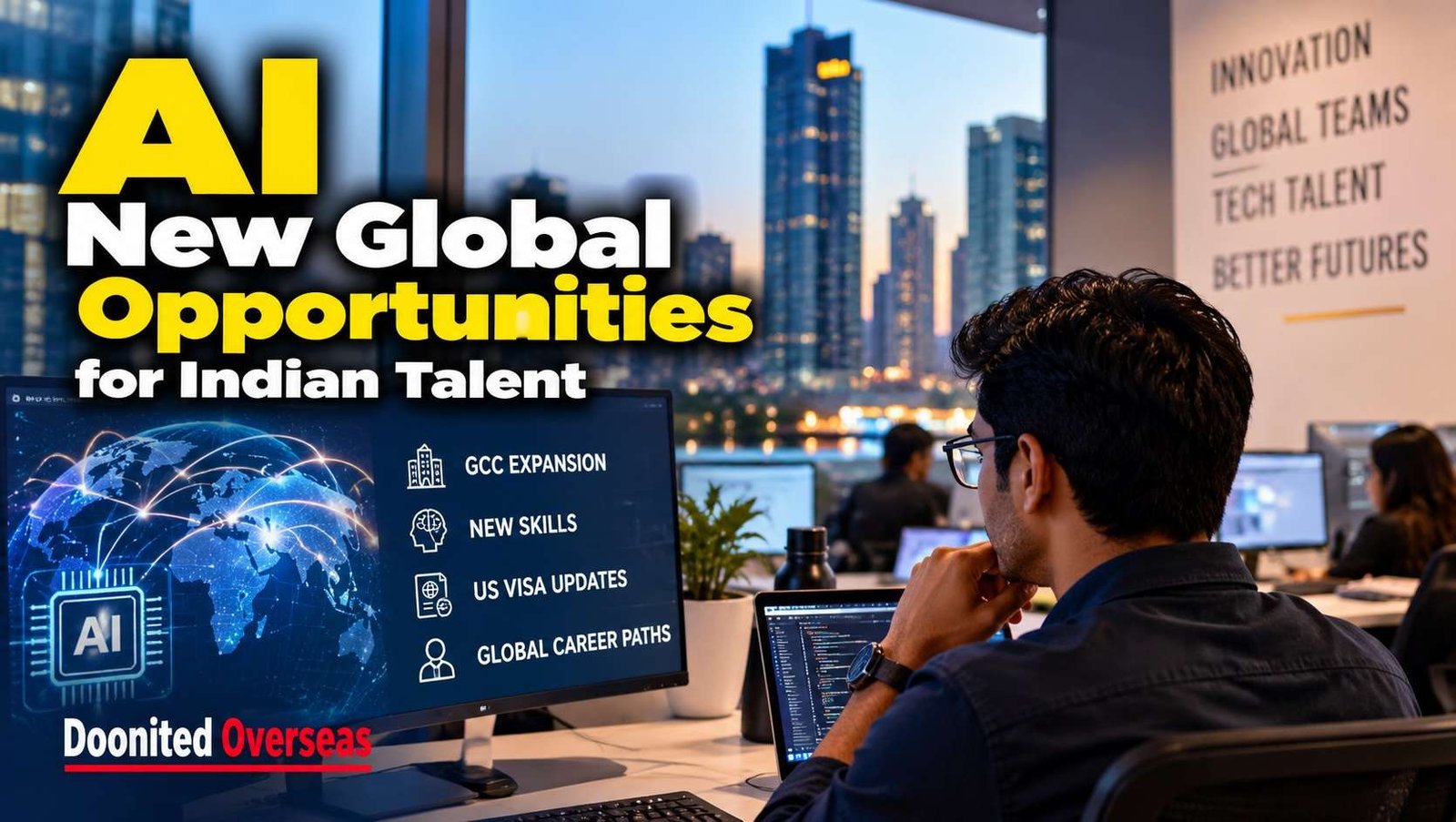
Artificial intelligence is changing what global employers expect from Indian technology professionals. As companies move from routine software delivery towards AI engineering, product ownership and enterprise transformation, India’s Global Capability Centres are gaining strategic importance. For Indians already overseas, the shift brings new opportunities—but also uncertainty around skills, job security and immigration status.
The AI opportunity comes with a workplace warning
The timing of this transition is significant. A new Korn Ferry study suggests that Indian employees are embracing workplace AI faster than their global counterparts, but the gains are arriving alongside heavier workloads.
Korn Ferry’s Workforce 2026 India findings, released on September 30, report that 86% of surveyed employees in India are positive about AI’s effect on how they work, compared with 65% globally. Some 76% say they are adequately trained to use AI, against 52% globally. Meanwhile, 81% say AI improves efficiency, but 78% report significantly higher workloads over the past two years.
These figures complicate the idea that AI adoption automatically makes working life easier. Employees may complete tasks faster, but organisations can respond by assigning more tasks, expanding responsibilities or expecting staff to take on work previously divided among several roles.
For overseas Indian professionals, this matters because the skills that make them valuable are changing. Technical expertise remains important, but employers increasingly need people who can connect AI systems to business objectives, assess risks, manage data, work across functions and take responsibility for outcomes.
The career advantage may belong not simply to those who use AI, but to those who understand where it can be trusted, where human judgement remains essential and how to redesign work around it.
India’s GCCs are becoming more than offshore support centres
India’s Global Capability Centres (GCCs) are central to this shift. These centres, established by multinational companies to perform and increasingly lead business functions, have evolved beyond traditional back-office and IT support.
The 2026 Nasscom–Zinnov landscape report estimates that India hosts 2,117 GCCs, employing around 2.36 million professionals and generating US$98.4 billion in revenue in FY2026. Their responsibilities increasingly include product engineering, analytics, AI, research and development, and global business operations.
Recent developments illustrate the continuing expansion. On September 30, DoorDash announced plans to create 3,000 jobs over two years through a new global technology hub in Hyderabad, starting with 500 hires. The company said the centre would primarily support customer service and general administrative functions. The announcement is a reminder that the GCC model is not changing uniformly: some centres are taking on advanced technology mandates, while others continue to perform operational work at scale.
The strategic question is whether India-based teams will increasingly own products, architecture, budgets and decisions—or remain responsible for delivering work specified elsewhere.
A Dell Technologies–Zinnov report released in September argues that GCCs will need stronger AI infrastructure, governance, workforce redesign and business accountability to become “agentic” transformation engines. It also reports that many AI initiatives remain at pilot stage, highlighting the gap between experimenting with AI and deploying it successfully across an enterprise.
For Indian professionals abroad, the growth of GCCs creates an alternative career geography. A move to India may offer access to global projects without requiring a permanent overseas posting. But it is not necessarily a simple transfer: compensation structures, tax residence, family circumstances, seniority and the actual authority attached to a role all matter.
Immigration uncertainty adds another layer
For some Indian workers in the United States, the AI transition intersects with the risks of employer-sponsored immigration.
Under existing US rules, certain nonimmigrant workers—including H-1B employees—may receive a discretionary grace period of up to 60 days, or until the end of their authorised validity period if that comes sooner, after employment ends. It is not an automatic guarantee, and the grace period does not itself authorise employment. Eligible workers may have options such as a timely employer petition or a change of status, depending on their circumstances.
There is, however, a significant current development that requires careful distinction between a proposal and a rule already in force. On September 11, 2026, the US Department of Homeland Security published a proposed rule to eliminate the discretionary 60-day grace period for certain nonimmigrant workers. A proposal is not the same as a final rule. Workers should check the rule’s current status and obtain qualified immigration advice before making decisions based on it.
That distinction is critical. Treating a proposed change as already implemented could cause unnecessary panic; ignoring it could leave workers unprepared if the rules change.
For professionals facing redundancy, the immediate priority is to understand their own immigration status, authorised stay, petition validity and available options. The right response depends on individual facts—not a general headline about visa policy.
The return-to-India decision is becoming more complex
India’s expanding GCC ecosystem may make returning home a more viable option for some overseas professionals, particularly those with experience in AI engineering, cybersecurity, data architecture, product leadership and enterprise transformation.
But “reverse talent flow” should not be mistaken for a universal exodus. A professional returning to India may be pursuing a promotion, family priorities, entrepreneurship or a role with greater ownership. Another may prefer to remain abroad because of career opportunities, compensation, children’s education or a partner’s employment.
The decision also depends on the substance of the job. A senior title does not necessarily mean global decision-making authority, and an India-based role may still be constrained by headquarters’ control over budgets, data or product strategy.
For employers, the opportunity is to build genuinely global teams in which India-based leaders have responsibility for outcomes. For workers, the task is to assess the role beyond its title: What will they own? Who makes the final decisions? What skills will they develop? How portable will that experience be across countries and employers?
What Indian tech professionals should do now
The changing market calls for a practical response rather than an assumption that AI will either eliminate jobs or create unlimited new ones.
Build demonstrable AI capability. Learn to apply AI tools in a real business or engineering workflow, not merely list them on a résumé.
Strengthen fundamentals. Data quality, software architecture, cybersecurity, systems thinking and domain knowledge remain essential to reliable AI deployment.
Develop business judgement. Employers need professionals who can explain trade-offs, manage risk and connect technical choices to measurable outcomes.
Evaluate GCC roles carefully. Ask about product ownership, decision rights, global exposure, promotion pathways and the centre’s actual mandate.
Plan for immigration contingencies. Keep copies of immigration documents, understand the conditions of your status and consult a qualified professional promptly if employment ends or regulations change.
Treat reskilling as ongoing. A single certification cannot substitute for experience, applied projects and the ability to learn as tools and job requirements evolve.
The next chapter of Indian tech talent
AI is changing both the location and the nature of technology work. India’s GCCs are increasingly positioned to lead complex functions, while global employers are seeking specialised skills and greater business accountability. At the same time, workplace survey findings show that productivity gains can coexist with rising pressure on employees.
For overseas Indians, the future is not simply a choice between staying abroad and returning to India. It is a question of where their skills can create meaningful value, under what employment and immigration conditions, and with what prospects for growth.
The strongest career strategy is to combine technical adaptability with sound judgement—and to evaluate opportunities on their actual responsibilities, not just the promise of AI or the prestige of a location.


World Beyond the News
Birds Can Navigate Using Earth’s Magnetic Field
Several bird species can sense Earth’s magnetic field, helping them navigate during long-distance migration.
Fermentation Is a Global Food Tradition
People across continents have used fermentation for centuries to preserve food and create distinctive flavours.
Modern Batteries Store Energy Chemically
Rechargeable batteries repeatedly move ions between electrodes, allowing electrical energy to be stored and released.
Why Songs Become Global Hits
Streaming platforms, short-form video, playlists and international collaborations can rapidly carry music across borders.