
Sitaram Raul’s ‘Shifting Sand’: The 90-Second Moment That Put India’s Desert Scorpion on the World Stage
An Indian photographer has won international recognition for capturing a scorpion digging into the dunes of Rajasthan. Behind the striking image lies a story about animal behaviour, patient observation and why the smallest creatures can reveal some of nature’s most remarkable survival strategies.
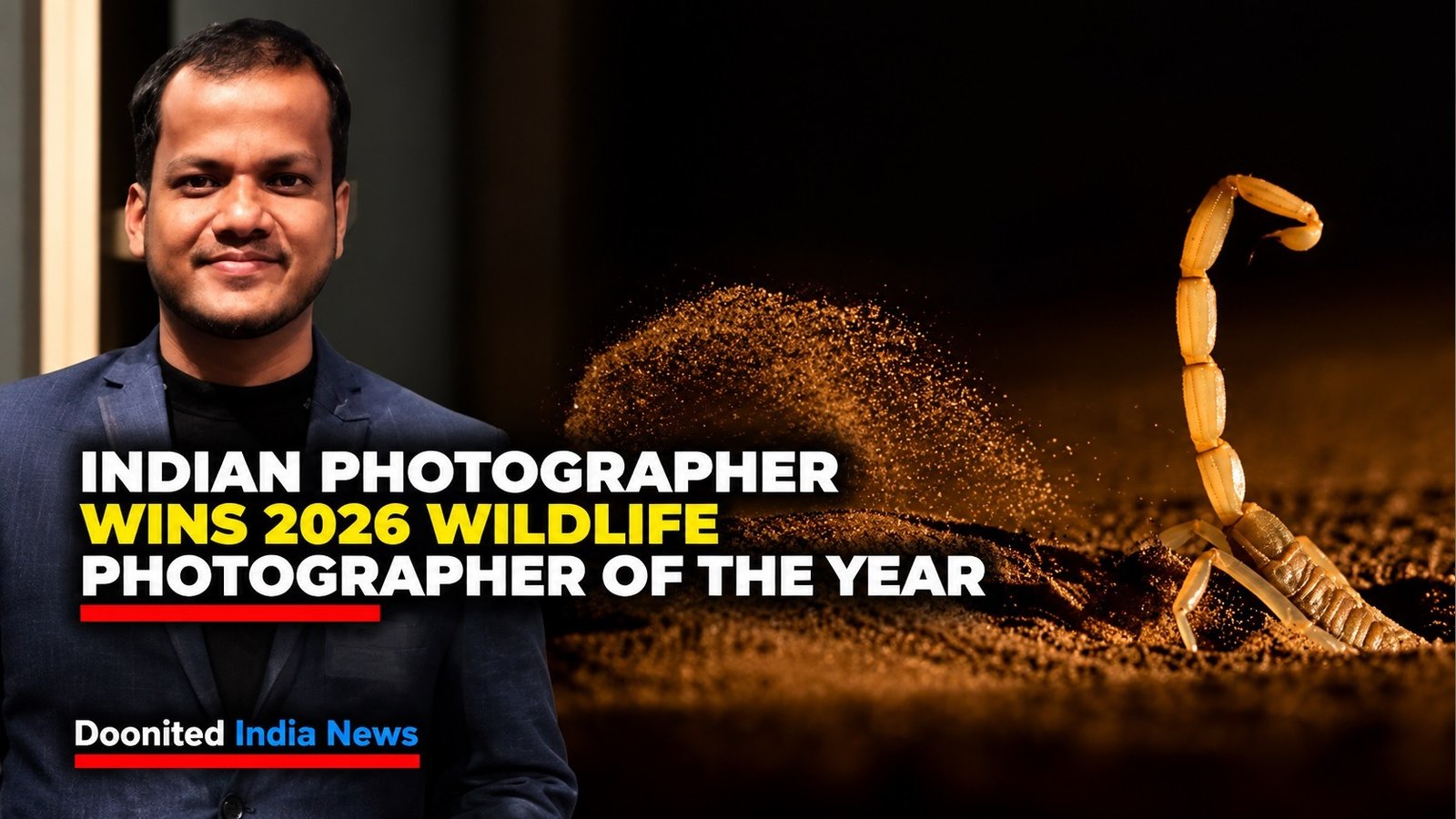
At first glance, the photograph appears to capture an explosion in the desert. Sand particles hang in the air, a pale scorpion is partly buried, and its curved tail rises above the disturbed ground. The scene is dramatic, but its real significance lies in what the animal is doing: trying to find shelter before the desert’s daytime heat becomes dangerous.
The photograph, titled Shifting Sand, has earned Indian photographer and fine artist Sitaram Raul the category award for Behaviour: Invertebrates at the 2026 Wildlife Photographer of the Year competition, organised by London’s Natural History Museum. The image was made in Rajasthan’s Thar Desert, near Sam village, close to Jaisalmer.
The recognition places an often-overlooked desert animal before an international audience. It also demonstrates how wildlife photography can do more than produce an attractive image: it can record a brief biological event that most people would never notice, let alone understand.
A night spent looking at the stars
Raul’s encounter began with a different photographic ambition. According to published accounts of his trip, he had travelled to Rajasthan to photograph the night sky. While exploring the dunes after dark, he came across scorpions searching for prey.
As sunrise approached, their behaviour changed. The scorpions began burrowing into the sand, apparently seeking refuge from the intense heat to come. Raul shifted his attention from the stars to the activity unfolding close to the ground.
That decision mattered. A scorpion moving across a dune might be easy to miss; a scorpion digging creates a fleeting scene of movement, texture and changing light. To photograph it well, Raul needed to understand not simply where the animal was, but what it was likely to do next.
Media reports describe several days of observation and repeated attempts before he secured the decisive frame. The opportunity to photograph the scorpion in the act of digging was brief—reported to have lasted around 90 seconds. The exact duration comes from secondary reporting rather than a published scientific measurement, but it captures the central challenge: the photographer had to be ready before the behaviour ended.
What makes the photograph work?
The Natural History Museum lists the equipment Raul used: a Nikon D750 camera, a 105mm macro lens and a Godox flash. The recorded exposure was 1/250 second at f/14, ISO 125.
Those details offer a glimpse into the technical decisions behind the image. A macro lens allows a photographer to work closely with a small subject, revealing details that can disappear at ordinary viewing distances. The fast shutter speed helps freeze movement; the aperture affects depth of field, helping determine how much of the subject and surrounding scene appears sharp. Flash can provide controlled illumination when the available light is limited or changing.
But equipment alone does not explain the result. The photograph depends on timing: the suspended grains of sand make the scorpion’s digging visible as an action rather than merely a pose. The animal is not arranged for the camera. The photographer has caught a moment in its own routine.
That distinction is important in wildlife photography. A technically accomplished image can still tell little about an animal. Here, the composition directs attention towards behaviour—the effort of digging and the relationship between the creature and its environment.
The engineering hidden in the sand
The Natural History Museum notes that the Buthacus scorpion featured in the image uses its pincers to dig into large piles of sand. It also has stiff, elongated bristles known as “sand combs”, which help prevent it from sinking into the dunes.
These are practical adaptations to a difficult habitat. Loose sand shifts underfoot, while temperatures near the desert surface can become extreme. An animal living in such conditions must navigate both the physical instability of its surroundings and the need to avoid excessive heat.
The museum states that only one species of Buthacus is currently known from India. That is a useful reminder that even familiar landscape labels such as “desert wildlife” can conceal highly specialised animals. However, the competition’s public description does not establish a precise species identification for Raul’s individual subject, so the photograph should not be used to claim more taxonomic certainty than the available evidence supports.
Nor does one photograph, by itself, establish the full ecology of the species. It records a particular behaviour at a particular place and time. Scientific research is needed to answer wider questions about population size, distribution, seasonal patterns and the effects of environmental change.
The image’s value is that it gives viewers a reason to ask those questions.
From the Western Ghats to Rajasthan’s dunes
Raul is a photographer and fine artist whose practice includes wildlife and macro photography. The Natural History Museum describes his approach as unconventional, with an emphasis on experimenting with light, composition and perspective to encourage viewers to see nature differently.
His award-winning desert image also reflects the value of looking beyond one familiar habitat. Published reporting says he had spent about 14 years working in wildlife and macro photography, with previous experience in the Western Ghats. Rajasthan’s dunes offered a different setting and a different set of visual and behavioural challenges.
In 2025, Raul’s photograph Nature Reclaims its Space, featuring fruit bats emerging from a historic monument in Maharashtra, received a Highly Commended distinction in the competition’s Urban Wildlife category, according to Mint. The contrast between the two subjects is striking: one image draws attention to wildlife sharing space with built heritage; the other reveals the survival activity of a small animal in a desert landscape.
Together, the work suggests that wildlife photography need not rely on spectacular predators or rare encounters with large mammals. It can find compelling stories in the animals that remain outside the public imagination.
A global award—and a question about what we notice
The 2026 Wildlife Photographer of the Year competition received 65,403 entries from 121 countries and territories, according to the Natural History Museum. Raul’s category win emerged from that international field. The winning photographs are being exhibited at the museum in London, with the 2026 exhibition scheduled to run from 16 October 2026 to 11 July 2027.
The award brings recognition, but the broader lesson is not simply that an Indian photographer has succeeded overseas. It is that a moment of close observation in Rajasthan can communicate across borders without needing elaborate explanation. A scorpion digging in the sand is both a specific encounter in the Thar Desert and an example of a much wider natural principle: survival often depends on behaviours that are small, specialised and easy to overlook.
There is also a useful caution. A beautiful wildlife photograph can spark curiosity, but it should not substitute for conservation evidence. The image does not, on its own, tell us whether this scorpion population is secure, whether its habitat is changing or whether human activity is putting it under pressure. Those questions require field studies and reliable ecological data.
Yet attention is often where learning begins. By making a tiny creature’s movement visible, Raul’s photograph asks viewers to look again at a landscape they might otherwise regard as empty.
The desert is not empty. It is active, adaptive and full of life that follows a different timetable from our own. Sometimes, the story of that life unfolds in less than two minutes—and a photographer’s patience allows the rest of the world to see it.
Originally published on Doonited India: Read the original article

World Beyond the News
Bees Communicate Where Food Is
Honeybees use movement patterns known as waggle dances to communicate information about food locations.
Street Food Reflects Local History
Many famous street foods developed from migration, trade, local ingredients and the everyday needs of working communities.
A Day on Venus Is Extremely Long
Venus rotates so slowly that one rotation relative to distant stars takes longer than its trip around the Sun.
Human Achievement Continues to Push Limits
Athletes, engineers, scientists and explorers regularly establish new benchmarks in speed, endurance, scale and precision.