
Maharashtra Today: Power Shift, Voter Verification and the Race to Build a Faster State
By Pradeep Banerjee, Editor | Doonited News
Maharashtra | August 19, 2026
Maharashtra’s political and administrative landscape is undergoing a significant shift this week.
A new set of Rules of Business has strengthened the authority of Chief Minister Devendra Fadnavis over decisions taken by individual ministers. At the same time, a 15-month political deadlock over the guardian ministers of Nashik and Raigad has finally ended, the Special Intensive Revision of electoral rolls is approaching a crucial stage, and the Chief Minister has returned from Delhi with a renewed push for major infrastructure projects.
Away from the political corridors, Maharashtra’s higher-education system is also expanding its technical and management capacity for the new academic year.
Taken together, these developments point towards one central question: Is Maharashtra entering a phase of stronger centralised decision-making combined with faster administrative execution?

1. Chief Minister Gets Greater Power Over Cabinet Decisions
The most consequential political development is the notification of the Maharashtra Government Rules of Business, 2026.
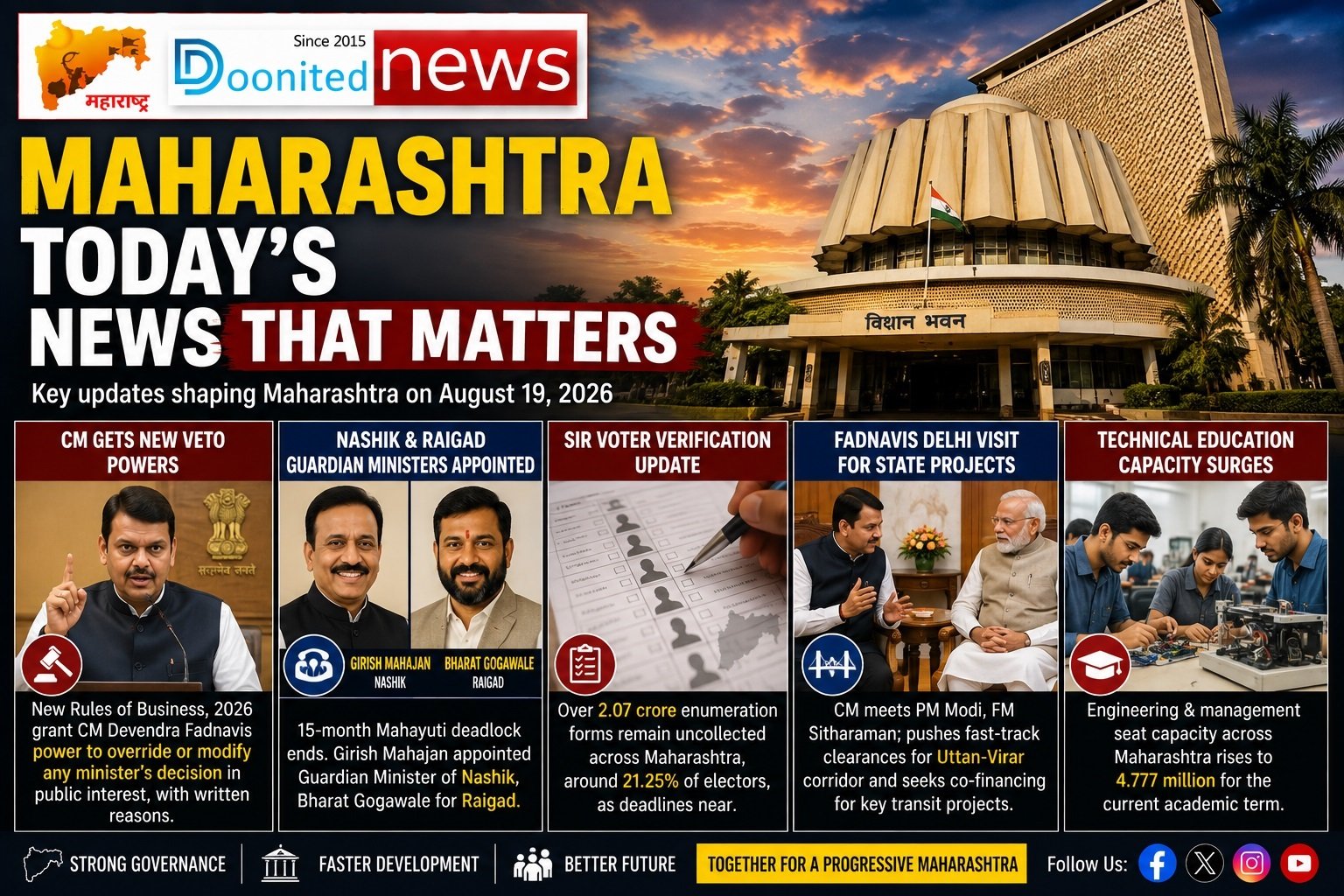
Under the amended rules, Chief Minister Devendra Fadnavis can override or modify a decision taken by an individual cabinet minister when he considers it necessary in the public interest, provided the reasons are recorded in writing. The change follows a legal and administrative debate over the extent of a Chief Minister’s authority in relation to individual ministerial decisions.
This is more than a procedural change.
In a coalition government, individual ministers traditionally exercise considerable authority over their departments. The new framework potentially gives the Chief Minister a stronger mechanism to coordinate decisions across departments and intervene when policies conflict or when a matter has wider implications for the state.
The argument in favour is straightforward: one government should ultimately speak with one voice.
But stronger authority also brings greater responsibility.
If the Chief Minister has more power to alter ministerial decisions, citizens will naturally expect greater transparency about why major decisions are changed.
The new rules therefore create both greater authority and greater accountability.
The political significance
For the Mahayuti government, the change could reduce the possibility of competing policy directions emerging from different departments.
For opposition parties, however, the question will inevitably be whether the new arrangement concentrates too much authority in the Chief Minister’s office.
The real test will be practical: does the change produce faster governance without weakening institutional checks?
2. Nashik and Raigad Finally Escape the Guardian Minister Deadlock
A political dispute that continued for roughly 15 months has finally been resolved.
BJP leader Girish Mahajan has been appointed Guardian Minister of Nashik, while Shiv Sena leader Bharat Gogawale has been given responsibility for Raigad. The appointments ended a prolonged disagreement within the Mahayuti alliance.
The importance of these appointments extends well beyond political symbolism.
Nashik faces one of the state’s biggest administrative challenges in the coming years because preparations for the Simhastha Kumbh will require enormous coordination involving roads, sanitation, water, policing, accommodation and public transport.
Raigad, meanwhile, remains strategically important because of its industrial, coastal, tourism and infrastructure significance.
The political deadlock may have ended, but the real work begins now.
Guardian ministers will ultimately be judged by what changes in their districts—not by the titles attached to their names.
3. SIR Voter Verification: A Massive Administrative Exercise
Another major story unfolding quietly across Maharashtra is the Special Intensive Revision (SIR) of electoral rolls.
The exercise is designed to verify voter records and ensure that electoral rolls contain eligible voters while identifying records requiring correction or further verification.
The figure supplied for this report—more than 2.07 crore uncollected enumeration forms, representing around 21.25% of electors—requires careful qualification. I could not independently verify that exact Maharashtra-wide figure from an accessible official source today, so it should not be treated as a final confirmed statewide number without reference to the latest Chief Electoral Officer data.
What is certain is that the SIR exercise is a large-scale administrative operation, with Booth Level Officers and election officials engaged in verification and digitisation.
The Maharashtra government and election authorities have published official information and schedules relating to the 2026 SIR process.
Why SIR matters
An electoral roll is not simply a government database.
It determines who can exercise the most fundamental democratic right—the right to vote.
Therefore, the process must achieve two objectives simultaneously:
Remove genuinely invalid or duplicate records.
Protect every eligible citizen from wrongful exclusion.
The second responsibility is particularly important.
Citizens whose forms have not been collected or whose records require clarification should not assume that the problem will automatically disappear. Voters should verify their status through official election channels.
4. Fadnavis in Delhi: Maharashtra Pushes Major Infrastructure Projects
Infrastructure has emerged as another important part of the state’s current political agenda.
Chief Minister Devendra Fadnavis met Prime Minister Narendra Modi in New Delhi and discussed major Maharashtra projects, seeking central assistance and faster clearances for initiatives involving transport, urban development and economic expansion.
Among the projects requiring central coordination is the proposed Uttan-Virar corridor, alongside other transportation and infrastructure proposals.
This Delhi engagement is significant because Maharashtra’s largest infrastructure projects often require cooperation between state and central governments.
Mumbai’s transport requirements alone are enormous. The wider metropolitan region is expanding rapidly, while road congestion, suburban mobility, metro connectivity and housing demand continue to place pressure on existing infrastructure.
The state’s challenge is therefore not simply to announce projects.
It must ensure that:
land acquisition is resolved,
environmental and statutory clearances are secured,
funding is available,
construction remains on schedule,
and most importantly,
citizens actually receive the promised infrastructure.
5. Technical Education Expands as Maharashtra Looks Toward a Skilled Workforce
The fifth development concerns education and employment.
Maharashtra’s technical education system is moving into the 2026–27 admission cycle, with engineering, technology and management programmes going through the state’s Centralised Admission Process.
The official State CET Cell confirms that admissions are being conducted for engineering and technology courses as well as postgraduate technical programmes.
The engineering seat matrix itself has expanded: reporting on the 2026 CAP process puts the available B.E./B.Tech capacity at 216,552 seats, up from 202,886 the previous year.
One correction is important here: the 4.777 million figure in the information supplied for this article appears inconsistent with the available official and sector-specific figures. I therefore have not presented 4.777 million as an established number.
What matters more than the headline number is what happens after admission.
More seats are useful only if Maharashtra can provide:
- Quality faculty
- Modern laboratories
- Industry-linked curriculum
- Practical training
- Internship opportunities
- Strong placement systems
- Emerging technology education
The state needs engineers and managers who can contribute to manufacturing, technology, infrastructure, artificial intelligence, renewable energy and the expanding services economy.
Capacity is the first step. Employability is the real destination.

An Editor’s View
Maharashtra has always been India’s economic heavyweight. But size creates its own administrative challenge.
A state of more than 12 crore people cannot be governed through isolated decisions.
Mumbai needs transport.
Nashik needs preparation for the Kumbh.
Raigad needs coordinated industrial and coastal development.
Nagpur and Vidarbha need continued infrastructure and employment investment.
Young people need education that leads to actual careers.
And voters need an electoral system they can trust.
The new Rules of Business may give the Chief Minister greater authority. But authority alone cannot solve these challenges.
The real measure of strong government is not how much power sits at the top. It is how efficiently that power translates into results on the ground.
Maharashtra now has an opportunity to turn political consolidation into administrative execution.
The people of the state will be watching.