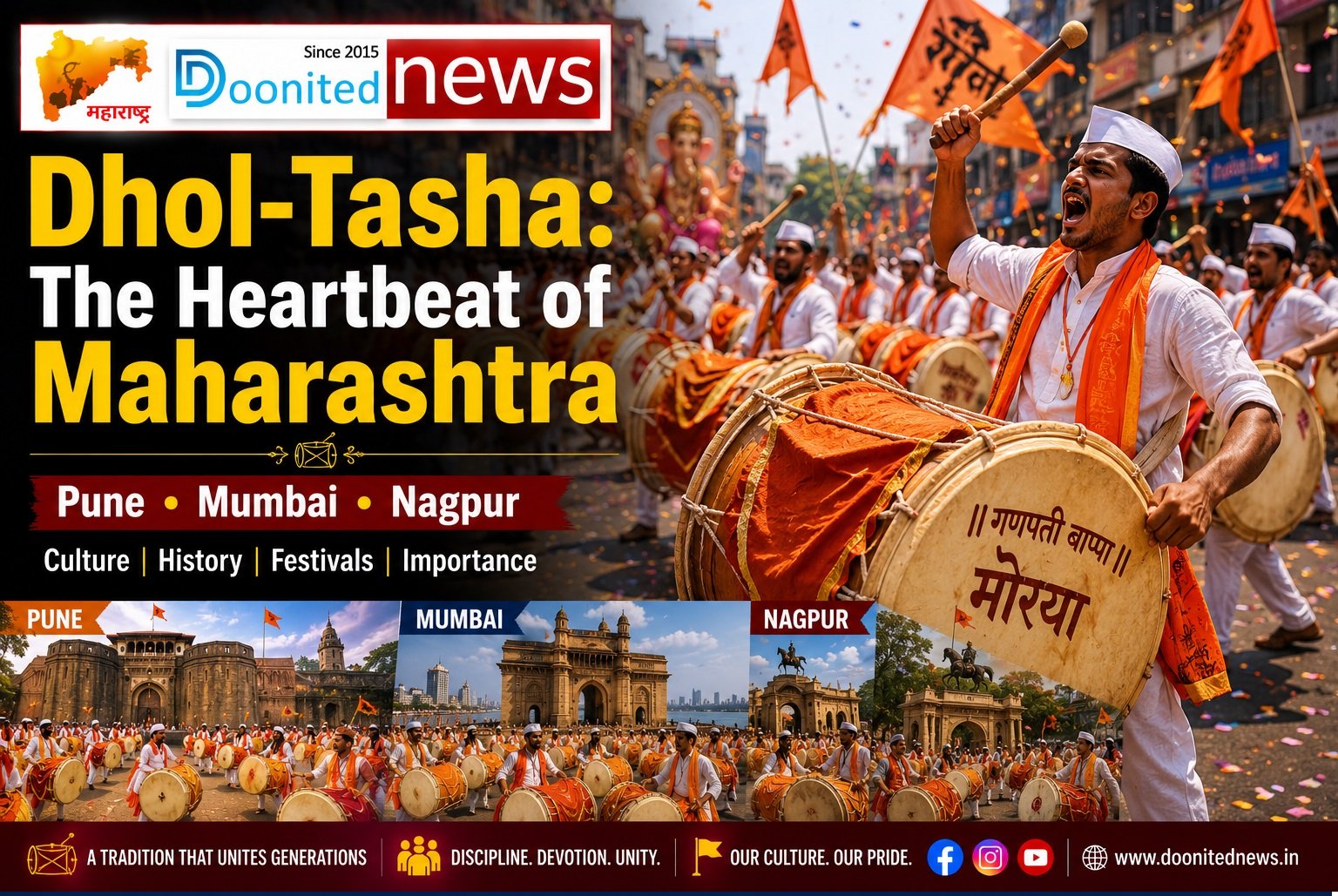

Dhol-Tasha: The Heartbeat of Maharashtra, From Pune’s Ganeshotsav to Mumbai and Nagpur
By Pradeep Banerjee, Editor | Doonited News
There are some sounds that announce a festival.
And then there is the dhol-tasha.
In Maharashtra, the first powerful beat of a dhol can change the atmosphere of an entire street. Conversations stop. Children run toward the sound. Flags rise. Crowds begin to move. And when dozens—or hundreds—of drummers strike together, the rhythm becomes something larger than music.
It becomes identity.
From the traditional lanes of Pune to the crowded streets of Mumbai, and from the historic Ganesh celebrations of Nagpur to Shiv Jayanti and other public festivals, dhol-tasha has become one of the most recognisable sounds of Maharashtra.
But today’s spectacular pathaks have a history that is more complicated than simply being a part of Ganeshotsav.
The instruments are old. The modern dhol-tasha pathak movement, with its disciplined formations, rehearsals and youth participation, is considerably more recent.
And that distinction tells an important story about how Maharashtra’s cultural traditions evolve.

What Exactly Is Dhol-Tasha?
The dhol is a large double-headed drum capable of producing a deep, powerful beat.
The tasha is a smaller, high-pitched percussion instrument that provides sharper rhythmic accents.
Together, they create the characteristic sound associated with Maharashtra’s processions.
But a modern pathak is more than a group of people carrying drums.
Members practise specific rhythms, movements and formations. The performance depends upon coordination, discipline and stamina.
That is why watching a large pathak perform can feel almost choreographed.
Every drummer has a place.
Every beat has a pattern.
Every movement contributes to the collective sound.
A Tradition Older Than Today’s Ganesh Processions
The roots of dhol and tasha in Maharashtra go back much further than the modern Ganeshotsav pathak.
Historical and cultural accounts describe the instruments being used in village fairs, religious processions and other community gatherings. The dhol has also been described as both a mangal vadya—an instrument of celebration—and a ran vadya, associated with martial settings.
There are also traditions connecting drums with Maharashtra’s military history.
Some historians have associated dhol-tasha with the atmosphere of the Maratha military tradition, where percussion could be used to communicate, motivate and energise troops. However, claims about exactly how the instruments were used during particular battles should be treated carefully because detailed historical documentation is limited.
What is clear is that percussion had a place in Maharashtra’s public and ceremonial life long before today’s organised pathaks.
The sound was already there.
What changed later was the way young people were organised around it.
Pune: The City That Gave Modern Dhol-Tasha Its Identity
If there is one city most strongly associated with the modern dhol-tasha pathak tradition, it is Pune.
And the story takes an interesting turn in the 1960s.
In 1965, educationist Dr Vinayak Vishwanath “Appasaheb” Pendse, associated with Jnana Prabodhini, developed a structured dhol-tasha pathak involving students.
According to historical accounts, the initiative was partly intended to develop discipline and leadership among young people. The pathak incorporated dhol, tasha, lezim and other elements into organised formations.
There was also a remarkable incident behind the tradition’s development.
During a period when police restrictions affected the playing of musical instruments during a Ganesh procession, Pendse is reported to have challenged the prohibition by playing the tasha on Pune’s Laxmi Road. The episode became part of the history of the modern movement.
From those beginnings, school-based groups emerged.
Eventually, the movement expanded beyond schools.
By the late 1990s and early 2000s, dhol-tasha became increasingly popular among ordinary citizens and young adults, turning pathaks into a mass cultural movement.
That is the Pune contribution to this story.
Pune did not invent the dhol. It helped reinvent how Maharashtra’s young people experienced it.
Why Pune’s Ganeshotsav Cannot Be Imagined Without Dhol-Tasha
Every year, as Ganesh Chaturthi approaches, Pune changes.
Rehearsals begin weeks in advance.
Youngsters gather after work.
Students practise.
Professionals put aside their daily routines.
Women and men train together.
The drums become heavier as the intensity increases.
The result is visible during Ganesh processions, particularly on major routes such as Laxmi Road.
A 2022 Indian Express report cited the Dhol Tasha Mahasangh Maharashtra as estimating more than 120 pathaks and around 22,000–25,000 performers in Pune at that time.
Those numbers may have changed since then, but they demonstrate the extraordinary scale the tradition had already achieved.

It Is Not Just Noise. It Is Discipline.
This is perhaps the biggest misconception about dhol-tasha.
From outside, a large procession can appear chaotic.
Inside a pathak, however, the opposite is often true.
Players must maintain rhythm.
They must remain in formation.
They must respond to changes in the composition.
They must coordinate their movements with dozens or hundreds of other people.
And they must do it while carrying heavy instruments.
That discipline is one reason the tradition has become attractive to young people.
Women Changed the Picture
One of the most visible changes in the modern dhol-tasha movement has been the growing participation of women.
Mumbai and Pune have seen women increasingly take prominent roles as drummers and performers.
Photographs of women leading dhol-tasha groups during Ganeshotsav have become almost as recognisable as the traditional male-dominated procession of earlier decades. Mumbai reporting has specifically documented women participating enthusiastically in pathaks and helping redefine the visual identity of the tradition.
This is not merely a change in appearance.
It changes the social meaning of the tradition.
The dhol is no longer being presented as an instrument belonging to one gender, age group or profession.
A student can play it.
A homemaker can play it.
An IT professional can play it.
A chartered accountant can play it.
A senior executive can play it.
And that inclusiveness has helped the tradition grow.
Mumbai: Pune’s Rhythm Finds a New Home
Mumbai has its own relationship with dhol-tasha.
The city’s Ganeshotsav culture is enormous, and processions through Lalbaug, Girgaon, Dadar and other neighbourhoods have increasingly featured organised dhol-tasha groups.
For years, Mumbai relied significantly on pathaks from Pune and other parts of Maharashtra.
But the city gradually developed its own groups.
A 2017 Times of India report noted that Mumbai had seen rapid growth in local dhol-tasha groups, with young people rediscovering the tradition and practising despite challenges such as limited rehearsal spaces and noise restrictions.
Today, the sound has become unmistakably Mumbai.
The setting may be different.
Pune has its traditional peths and old Ganesh routes.
Mumbai has its dense neighbourhoods, massive mandals and iconic immersion routes.
But the emotion is remarkably similar.
Ganpati Bappa arrives—and the drums announce his arrival.
Mumbai’s Weekend Drummers
There is another fascinating dimension to Mumbai’s dhol-tasha culture.
People who spend their weekdays in offices are increasingly becoming weekend performers.
A recent Times of India report described around 50 Mumbaikars, including people from professional backgrounds such as senior corporate roles, participating in a Ganpati Aagaman ceremony in Fort.
This says something important about urban Maharashtra.
Modern professional life has not necessarily erased traditional culture.
In some cases, it has created a new way of participating in it.
A person may spend Monday to Friday in an office tower and Sunday evening carrying a dhol through the streets.
That is not a contradiction.
It is contemporary Maharashtrian culture.
Nagpur: A Different City, The Same Beat
Travel east from Mumbai and Pune, and the dhol-tasha tradition does not disappear.
It reaches Nagpur.
The city has developed its own pathaks, particularly around Ganeshotsav and other cultural celebrations.
A Times of India report on Nagpur documented young performers rehearsing extensively before Ganesh festival processions, with dhol-tasha and other traditional percussion filling neighbourhoods in preparation for the celebrations.
More recently, Nagpur has seen the tradition attract people from remarkably diverse backgrounds.
One local pathak reported in 2025 had members including chartered accountants, homemakers, IT professionals, an Air Force officer, a school principal and children. The group had grown to around 180 members.
That is perhaps the strongest evidence that dhol-tasha is no longer simply a performance associated with professional musicians.
It is a community activity.
Nagpur’s Ganesh Tradition Adds Its Own History
Nagpur’s connection with Ganeshotsav is itself historic.
The city has several old Ganpati traditions, including the Bhonsle family’s centuries-old celebration. The Bhonsle Palace Ganesh tradition dates to 1728, while other historic public Ganesh mandals emerged during the early 20th century.
During modern Ganesh processions, dhol-tasha has become part of this larger cultural landscape.
In 2025, Nagpur’s Ganesh immersion processions once again featured traditional dhol-tasha performances as devotees accompanied their idols toward immersion points.
The important point is that Nagpur is not simply copying Pune.
It is incorporating the tradition into its own historical Ganesh culture.

Dhol-Tasha Beyond Ganeshotsav
Ganeshotsav may be the biggest stage, but the drums do not belong exclusively to Ganpati.
Across Maharashtra, dhol-tasha can be seen or heard during different cultural and public celebrations.
Shiv Jayanti
Nagpur groups have specifically practised dhol-tasha performances for Shiv Jayanti, showing the instrument’s continued association with public historical and cultural commemorations.
Gudi Padwa
Maharashtra’s New Year celebrations increasingly feature processions involving traditional music, lezim, powada and dhol-tasha.
In Nagpur, recent Gudi Padwa celebrations have included cultural processions featuring these traditional forms.
Ganeshotsav
This remains the biggest platform.
From Ganpati Aagaman to Visarjan, dhol-tasha has become one of the defining sounds of the festival.
Cultural Processions
Pathaks are also invited to heritage events, community celebrations and cultural programmes.
The instrument has therefore moved from a traditional setting into a broader cultural-performance space.
The Meaning Behind the Beat
Why has dhol-tasha survived?
Because it offers something modern entertainment often cannot.
Participation.
You do not merely watch a dhol-tasha pathak.
You become part of it.
The rehearsals create friendships.
The performance creates teamwork.
The uniform creates identity.
The rhythm creates collective energy.
And the festival creates a shared purpose.
That is why the tradition can attract people from completely different professions and generations.
The Pathak Is Also a Social Institution
Modern pathaks increasingly do more than perform.
Some organise blood donation drives.
Some participate in social-service activities.
Some work with young people.
Some organise cultural education.
The Indian Express reported on the Sangharsh Dhol Tasha Pathak, founded in 2013, whose founder described the group as a means of guiding young people away from bad habits and toward devotion and community participation.
This is perhaps where the legacy of Appasaheb Pendse’s original idea becomes visible again.
The drum was never only about the drum.
It was about discipline, leadership and community.
The Challenge: Tradition Versus Commercialisation
But success brings its own problems.
As dhol-tasha becomes increasingly popular, pathaks face questions about:
- Noise restrictions
- Rehearsal spaces
- Performer safety
- Fair payment
- Commercialisation
- Maintaining traditional rhythms
- Excessive amplification
The balance is delicate.
If the sound is restricted too severely, a living tradition may lose the public space it needs to survive.
If volume becomes the only measure of impact, the musical discipline behind the tradition can be lost.
The future therefore lies somewhere between the two.
Preserve the rhythm. Respect the neighbourhood. Maintain the tradition.
Three Cities, Three Personalities
Pune — The Traditional Heart
Pune gave the modern pathak movement its organised structure and turned dhol-tasha into a powerful expression of Ganeshotsav.
Mumbai — The Urban Explosion
Mumbai transformed the tradition into a mass spectacle involving enormous public celebrations and increasingly diverse groups of performers.
Nagpur — The Cultural Expansion
Nagpur has absorbed dhol-tasha into its own historic Ganesh culture and is seeing participation grow across professions and generations.
Different cities.
Different rhythms.
One cultural language.
Why Dhol-Tasha Matters to Maharashtra
A culture survives not because it is written in a book, but because people continue to practise it.
That is what makes dhol-tasha special.
A child learning the tasha today may not know the history of the instrument.
A software engineer carrying a dhol after work may never have studied Maharashtrian folk traditions.
A woman leading a pathak in Mumbai may simply have joined because she loves the rhythm.
Yet each of them is contributing to the survival of the tradition.
That is how culture actually works.
It is passed from one generation to another—not perfectly, but continuously.
The Beat That Keeps Maharashtra Together
Stand on Pune’s Laxmi Road during Ganeshotsav and the dhol seems to shake the buildings.
Stand in Mumbai during Ganpati Visarjan and the rhythm competes with the roar of one of India’s largest cities.
Stand in Nagpur during a major procession and the same beat travels through streets carrying a different history.
But beneath all three is the same emotion.
Pride.
Pride in Maharashtra.
Pride in tradition.
Pride in community.
And perhaps most importantly, the feeling that for a few hours, thousands of different people can move to the same rhythm.
The dhol-tasha is therefore much more than a festival instrument.
It is Maharashtra’s heartbeat made audible.
And as long as young hands continue to lift the sticks, practise the rhythms and march together behind the saffron flags, that heartbeat will continue.