
Maharashtra Today: What Matters Beyond the Headlines
By Pradeep Banerjee, Editor | Doonited News
Maharashtra | August 18, 2026
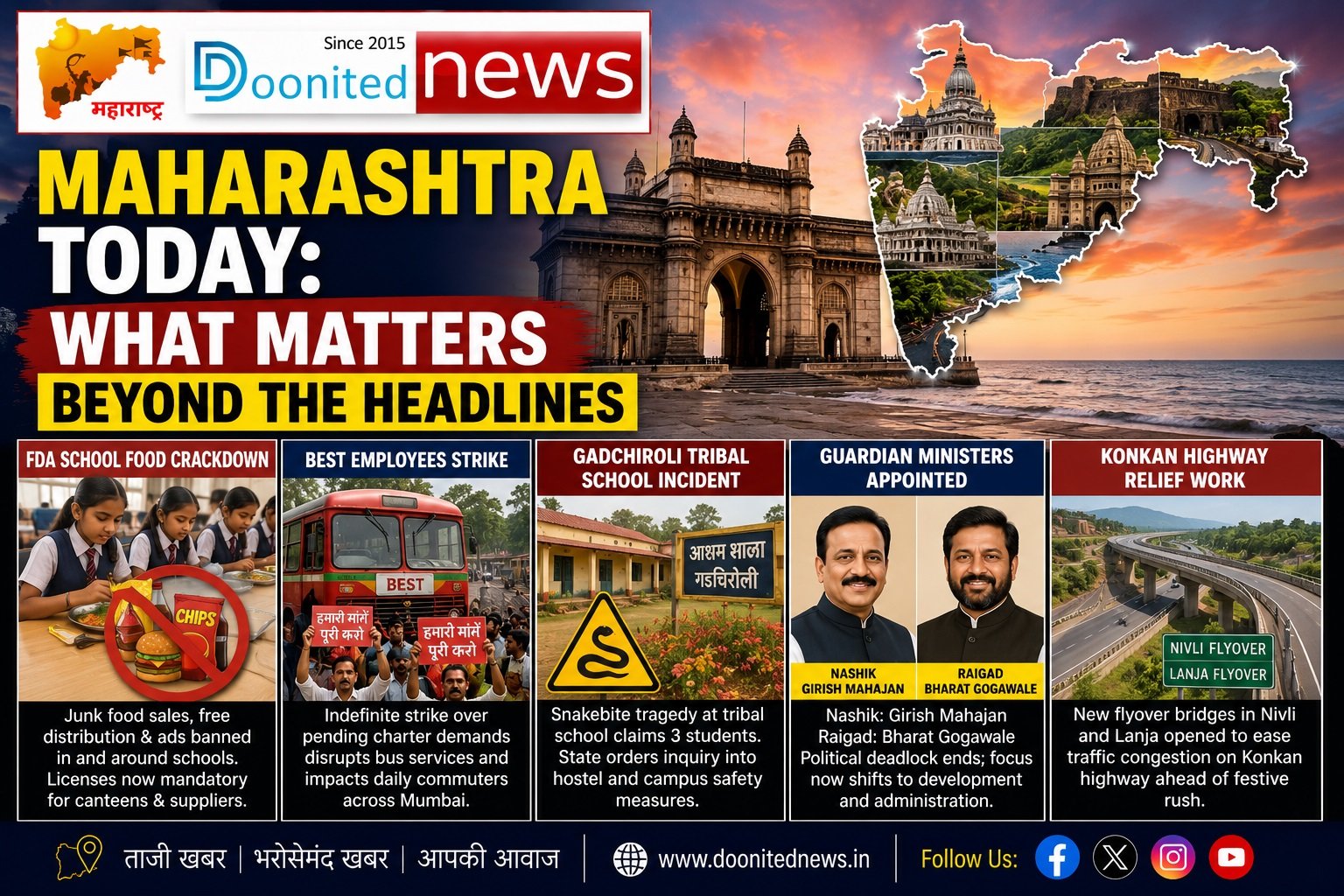
A state as large and diverse as Maharashtra rarely wakes up to a single defining story. On one side, the government is tightening rules around what children eat at school. In Mumbai, the future of the BEST transport undertaking remains tied to unresolved labour and financial questions. In Gadchiroli, reports of a tragedy involving students have again brought rural institutional safety into focus. In Nashik and Raigad, a long-running political disagreement over guardian ministers has finally been settled.
And along the Konkan highway, commuters are still waiting for infrastructure promises to translate into real relief.
For readers in Nagpur and Vidarbha, these may seem like stories happening elsewhere. But together they reveal something important about Maharashtra: public health, public transport, child safety, political administration and infrastructure are not separate issues. They directly shape everyday life.
FDA’s School Food Crackdown: A Necessary Test of Enforcement
The Maharashtra Food and Drug Administration has begun taking stricter action against the sale and promotion of unhealthy food around schools.
Reports from the Sakal Media Group say the FDA is targeting junk and high-fat, high-sugar and high-salt food around educational institutions, with restrictions on sale, advertising and free distribution. The move is being presented primarily as a student-health measure.
The principle behind the action is difficult to argue against.
A school should be an environment where children learn not only mathematics and science but also healthy habits. If food businesses surrounding schools aggressively market products with poor nutritional value, parents are effectively fighting a commercial system designed to influence children.
But a government order is only the beginning.
The FDA must now ensure that enforcement is consistent. School canteens, food suppliers and vendors should understand exactly what is permitted, and licensed operators should be treated differently from businesses operating outside the law.
The real measure of this policy will not be the number of notices issued. It will be whether the food environment around Maharashtra’s schools actually becomes healthier.
BEST: The Bigger Question Is the Future of Mumbai’s Lifeline
The BEST issue requires particularly careful reporting because the information circulating about a fresh indefinite strike is not consistent with the latest verifiable reports.
BEST workers did stage a major indefinite strike in June 2026, disrupting Mumbai’s bus services. That strike was eventually called off after the state government agreed to several measures, including interim wage increases and payment of pending gratuity.
In August, however, the situation was again tense.
The BEST Workers Union had warned of fresh agitation over unresolved issues including wage agreements, fleet ownership, BEST land and the treatment of contractual employees. A mass meeting was scheduled for August 17.
What is beyond dispute is the underlying problem.
BEST is not simply another employer. It is part of Mumbai’s public infrastructure. Millions depend on its buses, while the undertaking faces difficult questions about finances, its dependence on wet-lease buses, employee conditions and the future use of its valuable land.
The government and unions therefore need more than another temporary settlement.
Mumbai needs a financially sustainable BEST—and workers need a settlement they can trust.
Gadchiroli: Student Safety Cannot Be an Afterthought
The third issue is perhaps the most sensitive.
The information supplied for this article refers to three students dying after a snakebite incident at a tribal school in Gadchiroli, followed by a state inquiry into hostel and campus safety.
The concern itself, however, is not theoretical.
Gadchiroli has previously seen suspected snakebite deaths involving students living in residential hostels, with reports raising questions about poor hostel conditions and emergency medical access.
This is where Maharashtra needs to look beyond individual incidents.
A child living in a residential school should have:
- Safe and properly maintained accommodation
- Adequate lighting and sanitation
- Effective pest and snake-control measures
- Immediate access to medical assistance
- Trained staff capable of responding to emergencies
- Clear emergency evacuation and hospital protocols
For tribal children, residential schools are often essential to accessing education.
The more remote the institution, the stronger the safety system should be—not weaker.
If the current Gadchiroli incident is confirmed, the inquiry should establish not only what happened but whether preventive measures were in place and whether emergency procedures worked.
That is the difference between an inquiry that produces paperwork and one that prevents another tragedy.
Nashik and Raigad Finally Get Guardian Ministers
After a prolonged political disagreement within the ruling alliance, the Maharashtra government has finally settled the guardian-minister appointments for two strategically important districts.
Girish Mahajan has been appointed Guardian Minister of Nashik, while Bharat Gogawale has been appointed Guardian Minister of Raigad, according to the Indian Express report published August 17.
The appointments matter because both districts have major administrative and development responsibilities.
Nashik is preparing for the enormous organisational challenge associated with the upcoming Simhastha Kumbh, while Raigad remains a crucial economic, historical and coastal district.
For ordinary citizens, however, the political settlement will matter only if it produces administrative results.
A guardian minister should not simply appear during ceremonies or political events. The position should help coordinate district-level development, resolve departmental bottlenecks and ensure that major projects receive attention from the state government.
Political stability becomes meaningful only when it improves governance.
Konkan Highway: Relief Must Be Measured on the Road
The Mumbai-Goa highway has been one of Maharashtra’s most persistent infrastructure stories.
For years, travellers through the Konkan have dealt with bottlenecks, diversions and unfinished stretches. The four-laning project has progressed, but several important flyovers have also faced delays.
A government document had earlier recorded delays affecting flyovers at Lanja and Pali, while the Nivli section formed part of the Aravali-Talekante stretch of NH-66.
A May 2026 report said the Nivli flyover was around 90% complete and the Lanja flyover around 85% complete at that time, with authorities targeting completion by June. The same report cautioned that parts of several structures remained unfinished.
This is why the latest claim that new flyovers at Nivli and Lanja have opened should be treated carefully unless confirmed by the highway authority.
For Konkan travellers, the question is simple: Is the structure actually open, and does it reduce travel time?
A bridge is not successful because it is inaugurated. It is successful when a family travelling from Mumbai to Ratnagiri no longer spends hours trapped in the same traffic bottleneck.
The Maharashtra Story Behind These Headlines
Look closely at these five developments and a larger picture emerges.
The school food crackdown asks whether the state can protect children from unhealthy commercial influences.
The BEST dispute asks whether a public transport institution can remain financially viable while protecting workers and commuters.
The Gadchiroli case asks whether children in remote residential schools receive the same standard of safety expected elsewhere.
The guardian minister appointments ask whether political settlements can translate into effective district administration.
And the Konkan highway project asks perhaps the most familiar question in Indian infrastructure: when will promised development actually be felt by ordinary people?
For Nagpur and Vidarbha readers, these questions are particularly relevant because the region faces many of the same challenges—public infrastructure, rural access, education, health, transport and administrative accountability.
An Editor’s View
Maharashtra does not lack announcements.
It needs execution.
A school food rule must reach the vendor outside the school gate.
A BEST settlement must reach the worker and the passenger.
A safety inquiry must reach the hostel where another child could be at risk.
A guardian minister must reach the district with solutions, not merely a designation.
And a highway flyover must carry traffic before it can be called relief.
That is how public policy should ultimately be judged: not by the announcement, but by the difference it makes in people’s lives.
For Maharashtra’s citizens, that is the news that matters.