
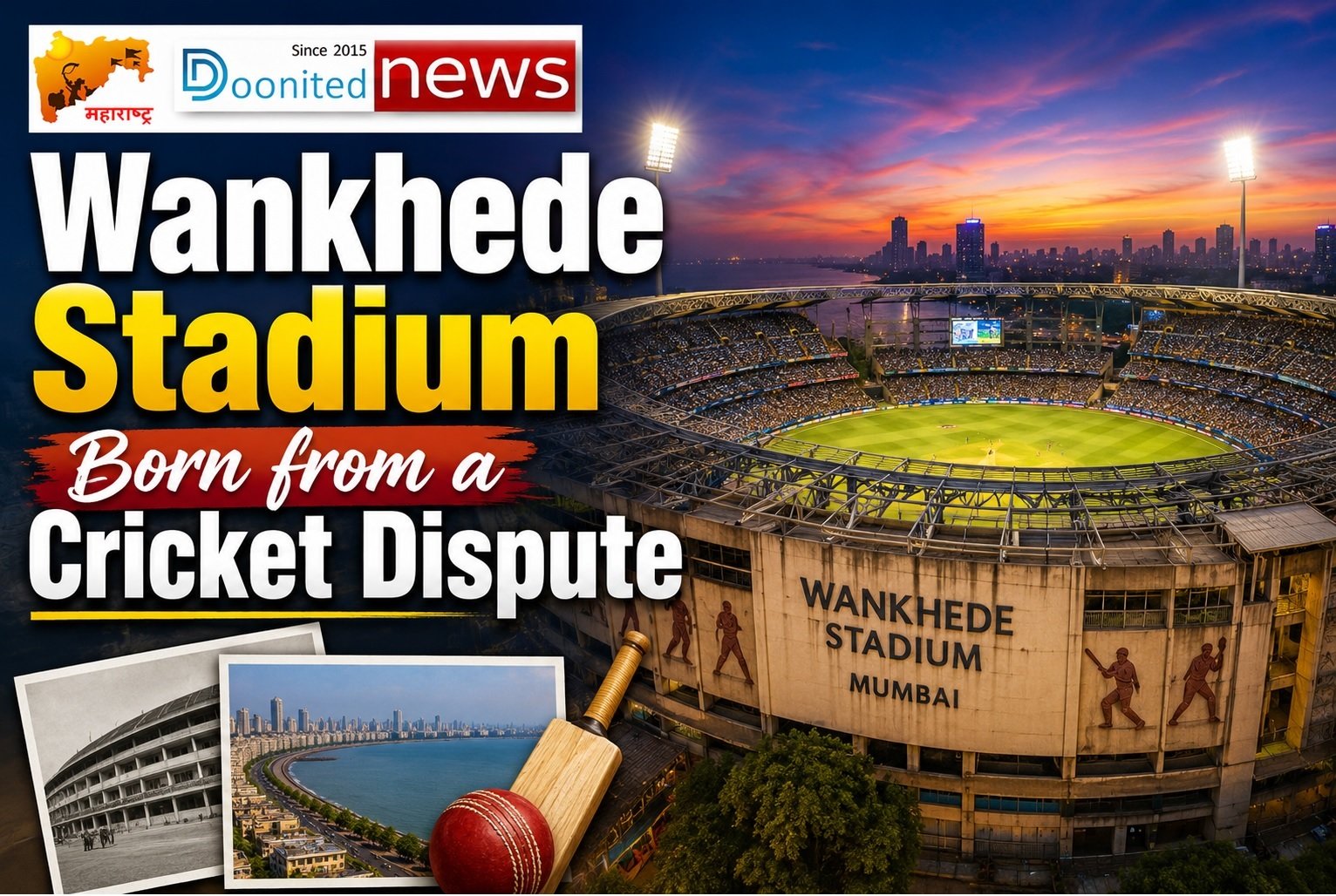
Wankhede Stadium: The Mumbai Cauldron Born from a Cricket Dispute
By Pradeep Banerjee | Sports Heritage
The Arabian Sea breeze rolls across Marine Drive as evening lights begin to glow in South Mumbai. Just beyond the curve of the Queen’s Necklace rises a stadium that has witnessed tears, triumphs, world records, and the roar of a cricket-mad city. Today, Wankhede Stadium is one of the most famous cricket grounds in the world, but its story began not with a six or a century—it began with a dispute.

A Stadium Built in a Hurry
In the early 1970s, Mumbai cricket was centered around the historic Brabourne Stadium. A disagreement over ticketing rights between the Cricket Club of India (CCI) and the Bombay Cricket Association (BCA) escalated into a major conflict. The BCA wanted greater control over cricket administration and revenue, while the CCI retained authority over Brabourne.
Rather than continue the battle, BCA president S.K. Wankhede chose a bold solution: build a new international stadium.
In an astonishing feat for that era, construction began in 1974 and was completed in less than 13 months. The venue was named after Sheshrao Krishnarao Wankhede, a senior politician and cricket administrator whose determination transformed Mumbai cricket forever.

The First Match: A New Era for Mumbai Cricket
Wankhede Stadium officially opened in 1974, and its first Test match was played between India and the West Indies. The crowd that gathered in South Mumbai sensed that a new chapter had begun. Brabourne had elegance; Wankhede had energy.
The stadium quickly became Mumbai’s premier international cricket venue, drawing passionate crowds from every corner of the city—from Girgaon and Dadar to Bandra and beyond.

Why Wankhede Feels Different
Ask any cricketer and they will tell you that Wankhede has a personality of its own. The stadium sits close to the Arabian Sea, and the sea breeze often influences swing bowling, especially during evening sessions.
Unlike many large modern stadiums, Wankhede’s stands are relatively close to the field. The result is an atmosphere that feels intimate, intense, and deafening. When Mumbai crowds erupt, players say the sound seems to fall directly onto the pitch.
The Night India Waited 28 Years
No moment defines Wankhede Stadium more than 2 April 2011.
India faced Sri Lanka in the final of the ICC Cricket World Cup. After decades of heartbreak and near misses, the nation watched as captain Mahendra Singh Dhoni launched Nuwan Kulasekara over long-on for a six that sailed into cricketing immortality.
“Dhoni finishes off in style” became one of the most replayed lines in sports broadcasting history. Fireworks exploded above the stadium, strangers embraced in the stands, and Mumbai did not sleep that night.

Sachin Tendulkar’s Emotional Farewell
Two years later, Wankhede hosted another unforgettable scene. In November 2013, Sachin Tendulkar played the final Test match of his career against the West Indies.
As he walked off the field for the last time, the entire stadium stood in tribute. His farewell speech, delivered with visible emotion, remains one of the most touching moments in Indian sporting history. For Mumbai, it felt less like a retirement and more like a family goodbye.

The IPL Fortress of Mumbai Indians
Since the birth of the Indian Premier League, Wankhede has become synonymous with the Mumbai Indians. The franchise has celebrated multiple title-winning campaigns here, and the stadium’s electric night atmosphere has become a signature image of the IPL.
Blue flags, drums, chants, and sea breeze combine to create one of the league’s most intimidating home venues.

Architecture and Modern Transformation
Ahead of the 2011 World Cup, Wankhede underwent a major redevelopment. The renovation increased comfort, improved sightlines, modernized hospitality areas, and upgraded player facilities while preserving the ground’s close-to-the-action feel.
|
Feature |
Details |
|---|---|
|
Location |
Churchgate, South Mumbai |
|
Established |
1974 |
|
Named after |
S.K. Wankhede |
|
First Test |
India vs West Indies (1974) |
|
Approx. Capacity |
33,000+ |
|
Home Team |
Mumbai Indians |
|
Major Highlight |
2011 World Cup Final |
A Stadium Woven into Mumbai’s Identity
Wankhede is not merely a sports venue; it is part of Mumbai’s emotional geography. Office workers check scores during meetings, local trains buzz with match discussions, and generations remember exactly where they were when India won the World Cup or when Sachin said goodbye.
On match days, the streets around Churchgate transform into a carnival of jerseys, flags, food vendors, and anticipation. Cricket here is not an event—it is a civic festival.

The Legacy of S.K. Wankhede
Perhaps the most remarkable aspect of the stadium’s story is that it was born from conflict. A disagreement over tickets ultimately gave India one of its greatest cricket cathedrals. S.K. Wankhede’s decision ensured that Mumbai cricket would have a home fully controlled by its own cricket administrators, and that decision changed the city’s sporting future.
More than fifty years later, every roar from the stands echoes that original act of determination.
More Than Concrete and Seats
Stadiums are often described by their dimensions, capacity, or facilities. Wankhede is better described by its memories: Gavaskar’s elegance, Tendulkar’s farewell, Dhoni’s six, IPL celebrations, monsoon clouds over Marine Drive, and the unending roar of Mumbai cricket fans.
In the heart of South Mumbai, Wankhede Stadium remains exactly what it became in 1974—a place where cricket is not just played, but lived.