Konkan Cuisine: A Journey Through Coconut, Kokum, Seafood and the Soul of Coastal Maharashtra
By Pradeep Banerjee | Editor, Doonited News Maharashtra

Drive south from Mumbai along Maharashtra’s Konkan coast and the landscape begins to change.
Concrete slowly gives way to coconut palms. Mango and cashew orchards appear beside village roads. The Western Ghats rise on one side while the Arabian Sea stretches along the other.
And somewhere inside a coastal home, a pan begins to sizzle.
Fresh fish is coated with spices. Coconut is grated for curry. Kokum adds its unmistakable sourness. Rice bhakri is prepared for lunch.
This is where the story of Konkan cuisine really begins.
It is tempting to describe Konkani food simply as “seafood and coconut.” But travel through Ratnagiri, Sindhudurg, Malvan and the wider coastal belt and that description quickly becomes inadequate.
Konkan cuisine is not one recipe book.
It is a food culture shaped by the Arabian Sea, heavy monsoon rainfall, rice cultivation, coconut, kokum, mangoes, cashews, local spices and generations of coastal communities.
And perhaps the best way to understand it is not by asking, “What should I eat?”
Instead ask:
Why does Konkan food taste the way it does?
The Geography That Created Konkan Cuisine

Food rarely develops independently of geography.
The Konkan is Maharashtra’s narrow coastal region between the Arabian Sea and the Western Ghats. Maharashtra Tourism describes the region through its beaches, coastal landscapes, forts, mangoes and distinctive cuisine.
That geography naturally influenced what people cooked.
The sea supplied fish and shellfish.
The warm, humid climate supported coconut.
Rice flourished in the high-rainfall coastal environment.
Kokum grew in the Western Ghats and Konkan belt.
Mangoes—especially Ratnagiri and Devgad’s celebrated Alphonso varieties—became inseparable from the region’s identity.
Cashew cultivation added another important agricultural product.
So the traditional kitchen worked largely with what the land and sea provided.
That is the first secret of Konkan cuisine:
It tastes like its geography.
1. Malvani Fish Curry — The Taste of the Konkan Sea

If one dish could introduce a visitor to coastal Maharashtra, Malvani fish curry would be a strong candidate.
The fish may vary depending on season and availability.
But the character of the curry comes from the balance of spices, coconut and souring ingredients.
Malvani cuisine, associated particularly with the Sindhudurg-Malvan region, is known for its seafood preparations and distinctive spice mixtures.
The colour may suggest aggression.
The flavour is more complicated.
There is heat.
Then coconut softens it.
Sourness follows.
The fish brings the sea into the dish.
And suddenly a simple plate of curry and rice becomes a geographical experience.
This isn’t food invented for restaurant menus.
It evolved naturally in fishing communities where the day’s catch could become the day’s meal.
Best enjoyed with: Steamed rice or rice bhakri.
2. Surmai Fry — When Fresh Fish Needs Very Little

Sometimes elaborate cooking improves an ingredient.
Sometimes it hides it.
A good surmai fry understands the difference.
Slices of kingfish are typically marinated with spices and souring agents before being coated—often with semolina or rice flour—and shallow-fried.
The outside becomes crisp.
Inside, the fish remains moist.
A squeeze of lime may be all that is needed.
There is an important principle hidden here.
When coastal communities have access to genuinely fresh seafood, the objective is not always to transform it.
Sometimes the cook simply creates enough flavour around the fish to allow the fish itself to remain the hero.
3. Bombil Fry — Mumbai and Konkan’s Unusual Coastal Favourite

The name confuses almost every first-time visitor.
Bombay duck isn’t duck.
It is fish.
Bombil—or Bombay duck—is strongly associated with Mumbai and Maharashtra’s coastal food traditions.
Fresh bombil has a delicate texture and relatively high moisture content. Preparing it well therefore requires technique.
When properly coated and fried, something remarkable happens.
The exterior becomes crisp while the interior remains extremely soft.
It is almost impossible to understand the dish from its appearance alone.
You have to break it open.
And then you understand why generations of coastal Maharashtrian families have kept it on their tables.
4. Kombdi Vade — When Chicken Curry Meets the Perfect Bread

Konkan cuisine is not only seafood.
And Kombdi Vade proves it.
The dish combines spicy Malvani-style chicken curry with deep-fried vade made using a mixture of flours.
The pairing is important.
A curry needs something capable of carrying it.
The vade absorbs the gravy while maintaining enough structure and texture to remain satisfying.
This is heavier, richer food than a simple fish-and-rice lunch.
It feels festive.
It feels communal.
And in many households, that is exactly what it is.
Kombdi Vade is strongly associated with Malvani food culture and is widely recognised as one of the region’s signature non-vegetarian combinations.
Best for: A serious Konkan lunch when you are not planning to count calories.
5. Solkadhi — The Pink Drink That Explains Konkan Cooking

Then comes perhaps the most beautiful colour on the Konkan dining table.
Pink.
Solkadhi combines kokum with coconut milk, usually accompanied by seasonings such as garlic, chilli or coriander depending on the household recipe.
It is commonly consumed alongside or after a meal.
But solkadhi is more than a drink.
It demonstrates the intelligence of regional cooking.
Look at a typical Malvani meal.
Spices can be intense.
Seafood can be rich.
Fried food may be present.
Then comes solkadhi—cool, sour, creamy and refreshing.
The meal creates its own balance.
That balance is one of the reasons traditional regional food systems deserve to be understood as complete cuisines rather than collections of isolated recipes.
6. Kokum — The Ingredient That Gives Konkan Its Sour Note

Ask what makes many Konkani dishes taste different from similar curries elsewhere in India and eventually you encounter kokum.
The fruit is native to India’s Western Ghats and is widely used along the western coast.
Its dried rind provides sourness and colour to food and drinks.
Unlike lemon, kokum contributes a deeper, fruitier acidity.
Unlike tamarind, its flavour has a different aromatic character.
It appears in curries.
It becomes sherbet.
It forms the foundation of solkadhi.
And yet outside western India, many people remain surprisingly unfamiliar with it.
Kokum is a reminder that regional cuisine often depends on ingredients whose importance is difficult to appreciate until you remove them.
Take kokum away from the Konkan kitchen and something fundamental changes.
7. Rice Bhakri — The Quiet Hero of the Coastal Meal

The spectacular dish gets photographed.
The supporting dish gets eaten.
That is the fate of rice bhakri.
Known in Marathi as tandalachi bhakri, this soft flatbread made from rice flour is an important accompaniment in parts of coastal Maharashtra.
Its mild flavour makes perfect sense.
Malvani curries can be intensely seasoned.
The bhakri does not compete with them.
It carries them.
Tear a piece.
Dip it into fish curry.
Let it absorb the gravy.
Now the meal works.
Sometimes the most important food on the table is the one nobody thinks to photograph.
8. Ukadiche Modak — When Konkan Food Becomes Devotion

Konkan cuisine is inseparable from Maharashtra’s festivals.
And few foods demonstrate that relationship more beautifully than Ukadiche Modak.
A delicate rice-flour covering encloses a filling generally made from grated coconut and jaggery.
The modak is then steamed.
Simple ingredients.
Considerable skill.
The outer shell must remain soft without breaking.
The filling must be moist but not watery.
The characteristic pleats require patient hands.
The dish is especially associated with Lord Ganesha and Ganesh Chaturthi.
In Konkan households, therefore, modak is not merely dessert.
It can be prasad, tradition and family memory in the same bite.
9. Ghavne and Amboli — Konkan’s Traditional Breakfast Story

Long before pancakes became café food, coastal Maharashtra had its own versions.
Ghavne are thin rice-based crepes associated with Konkan cooking.
Amboli is generally thicker and fermented, with a soft texture that makes it particularly good with chutneys or curries.
These dishes reveal another side of Konkan food.
Not every meal is fiery.
Not every meal contains fish.
The everyday kitchen also needs breakfast.
Food that can be prepared from locally available grain.
Food that works with coconut chutney.
Food that families can eat repeatedly without becoming tired of it.
That everyday simplicity is as important to understanding regional cuisine as the famous restaurant dishes.
10. Hapus Amba — When Ratnagiri’s Summer Arrives on a Plate

And suddenly almost everything else becomes secondary.
Hapus has arrived.
Alphonso mangoes grown in the Konkan—particularly Ratnagiri, Sindhudurg and adjoining areas—have become one of Maharashtra’s most recognisable agricultural products.
The Alphonso mango from Ratnagiri, Sindhudurg, Palghar, Thane and Raigad received a Geographical Indication registration, protecting its regional identity.
For Konkan families, however, mango season is more than an agricultural event.
It changes the kitchen.
Fresh mango is eaten as it is.
Aamras appears.
Raw mango enters pickles and drinks.
Mangoes are packed into boxes and sent to relatives.
The smell of ripe fruit fills rooms.
Food becomes a calendar.
You know what time of year it is because of what is on the table.
11. Mori Masala — The Dish Adventurous Seafood Lovers Seek

Some Konkan dishes are immediately familiar.
Mori masala is not one of them for many visitors.
Mori refers to shark used in traditional coastal preparations. The meat is cooked with a robust masala to produce a rich curry.
It demonstrates the extraordinary diversity of seafood traditionally consumed along the Maharashtra coast.
Pomfret.
Surmai.
Bangda.
Rawas.
Bombil.
Prawns.
Crab.
Shellfish.
Different fish behave differently in a pan.
That means the idea of one universal “fish curry recipe” makes little sense in a serious coastal kitchen.
The cook adapts to the catch.
12. Crab Masala — The Meal That Refuses to Be Eaten Politely

Some dishes demand table manners.
Crab masala demands commitment.
Shells have to be opened.
Fingers become covered in gravy.
Conversation slows because everyone is concentrating.
And nobody really cares.
A robust Malvani crab preparation combines the sweetness of crab meat with a spicy coconut-based masala.
This is not fast food.
It actively resists speed.
Perhaps that is part of its charm.
A crab meal forces everyone at the table to stay a little longer.
The Malvani Masala Question

People frequently ask:
What exactly is Malvani masala?
There isn’t necessarily one immutable formula used by every household.
Recipes can vary between families and communities.
Typically, blends involve combinations of dried chillies and aromatic spices, and the resulting masala forms part of the distinctive character of Malvani curries and meat preparations.
That variation matters.
Regional cooking was transmitted for generations through homes rather than industrial standardisation.
A grandmother’s masala might not taste exactly like her neighbour’s.
And both could still be authentically Malvani.
Authenticity does not always mean uniformity.
Sometimes it means continuity.
Vegetarian Konkan Cuisine Deserves More Attention


There is a common mistake in travel writing:
Konkan cuisine = seafood.
Seafood is undeniably important, but the equation is incomplete.
The region also has extensive vegetarian traditions built around rice, coconut, lentils, seasonal vegetables, jackfruit, gourds, colocasia leaves, raw mango, kokum and other locally available ingredients.
Festival days and religious traditions also influence what enters the kitchen.
This creates a parallel culinary world that visitors focused exclusively on fish often miss.
A proper exploration of Konkan food should therefore include both the fishing boat and the vegetable garden.
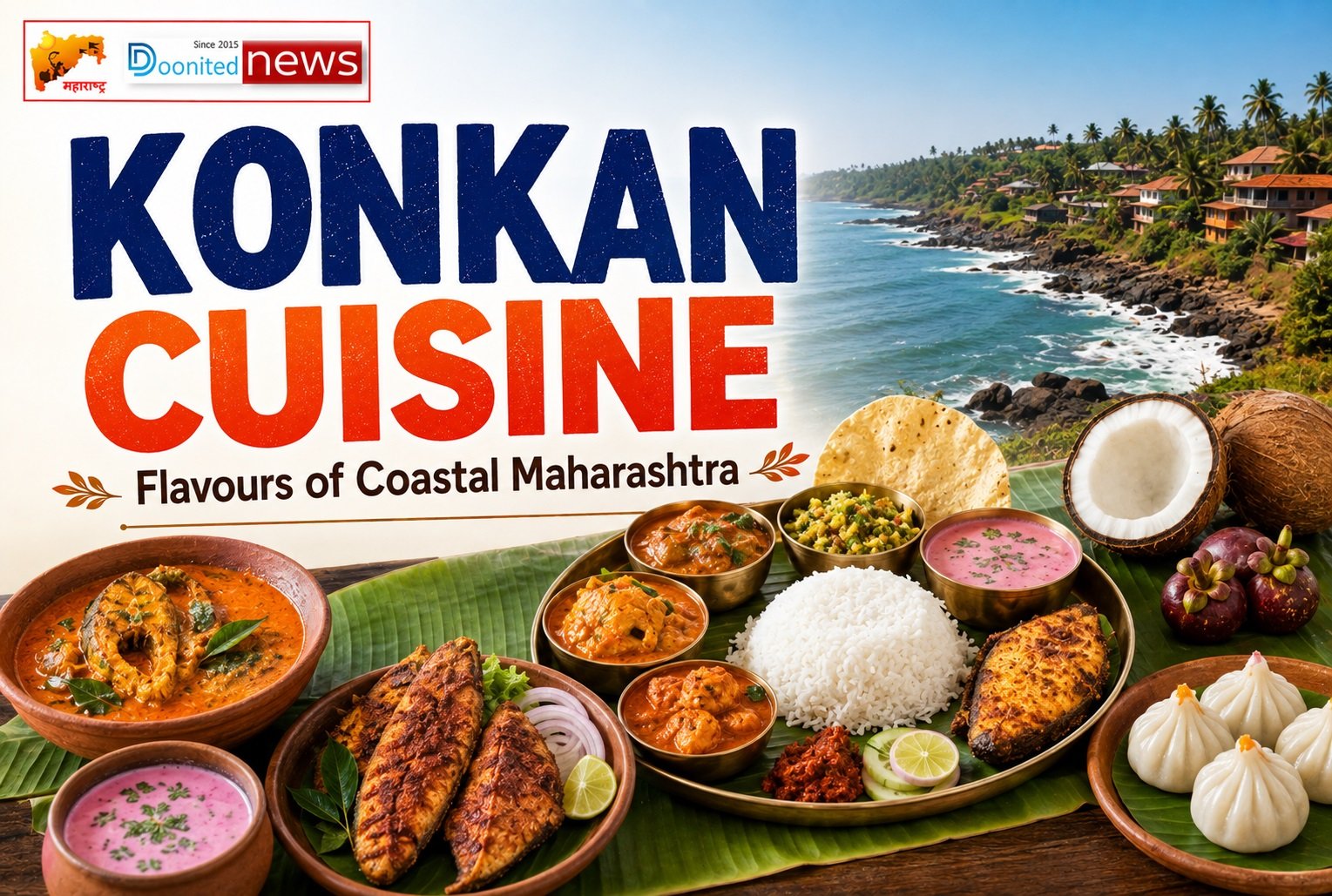
A Traditional Konkan Thali Is a Story on One Plate

Now imagine everything coming together.
A plate arrives.
Steamed rice sits at the centre.
Beside it is fish curry.
Then a crisp fried fish.
Perhaps a portion of prawns or shellfish.
Rice bhakri or vade.
A vegetable preparation.
Pickle.
And finally a glass of pink solkadhi.
Look at the plate carefully.
The entire geography of Konkan is present.
Sea → fish.
Fields → rice.
Palms → coconut.
Western Ghats → kokum and spices.
Village kitchens → recipes.
A thali is therefore not simply several dishes served together.
It is an edible map.
Ratnagiri, Sindhudurg and Malvan: Where Should a Food Traveller Go?

For travellers interested specifically in food, the southern Maharashtra coast offers extraordinary possibilities.
Malvan
Go for Malvani fish curries, Kombdi Vade, seafood thalis and solkadhi.
Sindhudurg
Explore coastal seafood, village cooking and dishes strongly influenced by coconut and local spice blends.
Ratnagiri
Seafood remains important, but the district’s culinary identity is also inseparable from Hapus mangoes, kokum and coastal agriculture.
The most memorable food may not always be inside the most polished restaurant.
Small family-run establishments and homestays can sometimes provide a closer experience of domestic Konkan cooking.
Konkan Food Changes With the Seasons
This is another reason the cuisine should not be reduced to a static restaurant menu.
Summer brings mangoes, raw mango preparations and seasonal fruit.
Monsoon changes fishing conditions and brings its own seasonal ingredients.
Ganesh Chaturthi brings modak and festival foods into homes.
Different fish and agricultural products become available at different times.
Traditional cuisine therefore follows nature more closely than a modern supermarket does.
The menu changes because the environment changes.
Why Coconut Appears Everywhere

Coconut may appear as:
Freshly grated coconut.
Roasted coconut.
Coconut milk.
Coconut-based gravy.
Chutney.
Dessert filling.
This isn’t accidental repetition.
Coconut is one of the region’s fundamental culinary resources.
And different treatments produce completely different flavours.
Fresh coconut brings sweetness and texture.
Roasting deepens flavour.
Coconut milk creates richness.
Combine it with chilli and kokum and you get another balance entirely.
One ingredient.
Many identities.
Konkan Cuisine Is Also the Story of Communities
No regional cuisine belongs to a single recipe or social group.
The Konkan coast has been home to numerous communities with their own culinary traditions, including Koli fishing communities, Malvani households and other coastal Maharashtrian groups, alongside religious and regional variations.
Mumbai’s Koli food traditions, for example, reflect the city’s older identity as a collection of fishing settlements long before it became a global metropolis.
Further south, Malvani cooking develops its own distinctive profile.
Travel further along India’s western coast and culinary influences continue changing again.
The boundaries on a political map are sharp.
Food boundaries rarely are.
The Biggest Mistake Tourists Make With Konkan Food
They order only one famous dish.
A traveller arrives in Malvan.
Orders fish thali.
Takes photograph.
Leaves.
But cuisine cannot be understood through one lunch.
Try breakfast.
Taste kokum.
Drink solkadhi.
Try a vegetarian preparation.
Eat rice bhakri.
Ask which fish is fresh today instead of automatically ordering pomfret.
Eat mango in summer.
Try modak during the festival season.
Then the food begins connecting to the place.
And once that happens, you are no longer simply eating.
You are travelling through taste.
Konkan Cuisine and Tourism: An Opportunity for Maharashtra

Maharashtra possesses all the ingredients required for serious culinary tourism.
The Konkan has:
Beaches.
Sea forts.
Fishing villages.
Mango orchards.
Cashew plantations.
Seafood.
Distinctive regional cuisine.
Festivals.
Homestays.
Local markets.
The opportunity is to connect them.
Imagine a traveller spending the morning visiting Sindhudurg Fort, eating a traditional Malvani lunch, visiting a local market in the afternoon and learning to prepare solkadhi or fish curry in a village kitchen.
That creates a much richer tourism experience than simply visiting a beach.
And importantly, culinary tourism can direct spending towards local cooks, farmers, fishermen, homestays and small food businesses.
What Should a First-Time Visitor Eat?
If this is your first serious encounter with Konkan cuisine, start with a combination rather than one dish:
Fish eater: Malvani fish curry + fried surmai/bangda + rice + solkadhi.
Chicken lover: Kombdi Vade + solkadhi.
Vegetarian: Rice bhakri/ghavne + seasonal vegetable preparations + coconut-based accompaniments + solkadhi.
Dessert/festival experience: Ukadiche Modak.
Summer essential: Ratnagiri or Devgad Hapus.
And if you are adventurous with seafood, explore crab, shellfish and whatever local fish is freshest that day.
Conclusion: Konkan Cuisine Is Maharashtra Served on a Plate

At first glance, Konkan food appears to be about flavour.
Spicy curry.
Sweet coconut.
Sour kokum.
Fresh fish.
Fragrant mango.
But spend longer with the cuisine and something deeper becomes visible.
The food tells you where people live.
What grows there.
What the sea provides.
When the rains arrive.
Which festivals families celebrate.
And what recipes one generation taught the next.
That is why the best regional cuisines cannot simply be transported from one place to another without losing something.
You can cook Malvani fish curry in Mumbai, Delhi or London.
But eating it near the Konkan coast—after passing coconut trees, fishing boats and village markets—changes the experience.
Because suddenly the ingredients have context.
The food has geography.
And the recipe has a story.
Perhaps that is the real secret of Konkan cuisine.
It isn’t simply food from Maharashtra’s coast.
It is the coast itself, served on a plate.