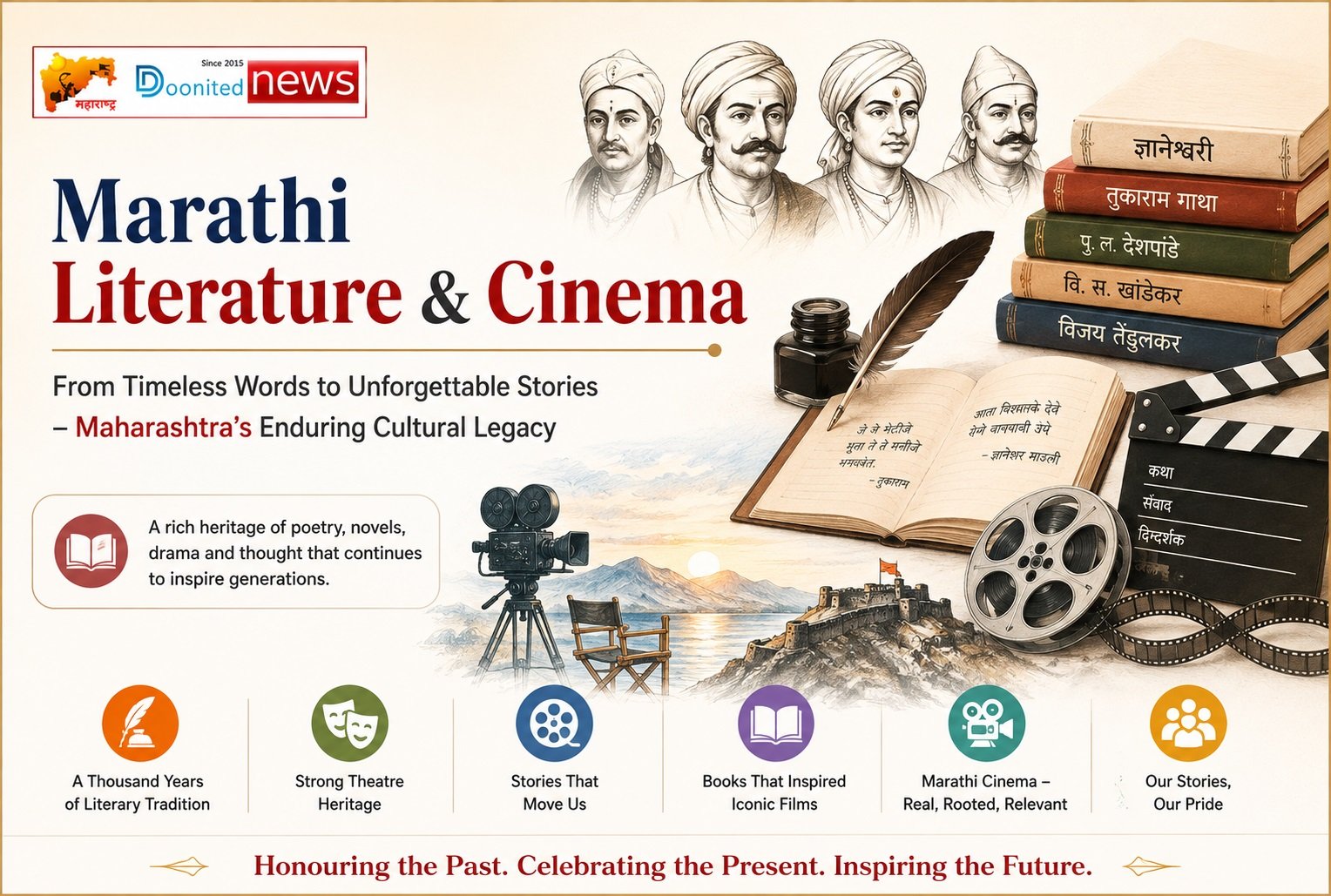
Marathi Literature and Cinema: How Maharashtra’s Stories Travel from the Written Word to the Screen
By Pradeep Banerjee | Editor, Doonited News Maharashtra
Maharashtra has given India great saints, social reformers, playwrights, poets, novelists, filmmakers and actors. But behind many of the state’s most powerful cultural expressions lies something even more fundamental:
the Marathi language and its tradition of storytelling.
From the devotional compositions associated with Maharashtra’s Bhakti tradition to modern novels, short stories and experimental theatre, Marathi literature has continuously reflected the changing character of society.
Cinema added another dimension to that tradition.
The screen gave Maharashtra’s storytellers the ability to transform words into images, characters into performances and social questions into experiences that could reach audiences far beyond the printed page.
This relationship between Marathi literature and Marathi cinema is one of the most fascinating aspects of Maharashtra’s cultural history.
And it remains relevant today.
In October 2024, Marathi received recognition as a Classical Language of India. The Government of India noted the language’s extensive historical and literary heritage, describing its literary tradition as extending over a thousand years.
Yet the significance of Marathi cannot be measured simply by its age.
Its real strength lies in the stories generations of Maharashtrians have told through it.
Marathi Literature: More Than a Thousand Years of Cultural Memory
Marathi literature cannot be separated from the history of Maharashtra.
According to the Ministry of Culture, Marathi has a rich literary tradition stretching back more than a millennium, encompassing poetry, prose and folklore. Government background material prepared when Marathi received Classical Language status also traces the linguistic tradition considerably further into earlier forms.
Over centuries, the language became a vehicle for spirituality, philosophy, social commentary, political thought, humour and everyday human experience.
This breadth is important.
Marathi literature was never confined to royal courts or intellectual elites.
Much of its enduring power came from its ability to communicate with ordinary people.
That characteristic would eventually make it particularly compatible with theatre and cinema.
The Bhakti Tradition Brought Literature to the People
One of the foundations of Marathi literary culture emerged through Maharashtra’s Bhakti movement.
Saint-poets used language to communicate philosophical and spiritual ideas in forms that ordinary people could understand and remember.
Figures such as Sant Dnyaneshwar, Sant Namdev, Sant Eknath and Sant Tukaram became central to this tradition.
Their compositions were not simply religious texts.
They became part of Maharashtra’s living cultural memory.
The abhang, ovi and other poetic forms moved through communities orally as well as through written traditions.
This created something culturally significant:
literature that could be heard, sung, remembered and shared.
Centuries later, cinema would operate on a similar principle—taking stories and ideas to mass audiences through an accessible medium.
From Saints to Social Reform
As Maharashtra changed, its literature changed with it.
Questions surrounding caste, inequality, education, women’s rights, colonialism and social reform became increasingly important.
Maharashtra produced influential thinkers and reformers whose writings contributed to debates extending far beyond literature itself.
The written word became an instrument for questioning established social structures.
This tradition of social interrogation would later become one of the defining characteristics of serious Marathi theatre and cinema.
A story did not necessarily exist only to entertain.
It could also ask uncomfortable questions.
That distinction helps explain why Marathi cultural production has repeatedly produced works dealing with politics, caste, gender, rural hardship and social inequality.
Marathi Theatre Became the Bridge
Between literature and cinema stands another enormously important Maharashtra institution:
Marathi theatre.
Theatre created a natural meeting point for writers, actors, directors and audiences.
It allowed literature to become performance.
Characters who had previously existed on paper could now speak before an audience.
Dialogue became central.
Conflict became visual.
Social commentary became immediate.
Over time, Maharashtra developed a remarkably strong theatrical culture ranging from musical theatre to experimental and politically engaged drama.
This theatre tradition would provide Marathi cinema—and Indian cinema more broadly—with writers, actors and directors.
Vijay Tendulkar Changed the Language of Modern Drama
Any serious discussion about modern Marathi literature, theatre and cinema must include Vijay Tendulkar.
Tendulkar’s plays confronted power, violence, gender relations and social hypocrisy with unusual intensity.
Works associated with him, including Shantata! Court Chalu Aahe, Sakharam Binder and Ghashiram Kotwal, became landmarks of modern Indian theatre.
His significance extended beyond theatre.
Tendulkar also worked in cinema, demonstrating how porous the boundaries between Marathi literary culture, theatre and filmmaking could become.
This interaction is crucial to understanding Maharashtra’s storytelling tradition.
A Marathi writer could be a playwright.
A playwright could become a screenwriter.
A theatrical actor could become a film actor.
And a literary idea could move between book, stage and screen.
P. L. Deshpande and the Marathi Middle-Class Experience
Not every important Marathi writer approached society through darkness or confrontation.
Purushottam Laxman Deshpande — popularly known as Pu. La. Deshpande — demonstrated the extraordinary cultural power of humour.
His observations of everyday personalities, social habits and middle-class Maharashtrian life made him one of the most beloved figures in Marathi literature.
Pu. La.’s appeal illustrates another important characteristic of Marathi storytelling:
its ability to discover extraordinary stories inside apparently ordinary lives.
A neighbour, teacher, musician, traveller or eccentric acquaintance could become unforgettable when observed by a gifted storyteller.
That observational tradition remains relevant to Marathi cinema.
Some of the most memorable regional films do not depend on superheroes or enormous spectacles.
They depend on recognisable people.
Literature Gave Marathi Cinema Strong Stories
Cinema needs many things—actors, directors, cinematography, music, editing and production.
But at its foundation, cinema needs a story.
This is where Maharashtra’s literary tradition has provided an enormous cultural reservoir.
Novels, plays, biographies and short stories offer filmmakers characters and conflicts that have already been explored through language.
But adaptation is not simply copying a book onto the screen.
Literature and cinema communicate differently.
A novelist can spend pages describing the internal thoughts of a character.
A filmmaker may need to communicate the same emotion through an expression, a pause, sound or a single visual composition.
That transformation from written language to visual language is where adaptation becomes a creative art of its own.
Marathi Cinema Has Deep Historical Roots
Marathi cinema occupies an important place in the development of Indian filmmaking itself.
Maharashtra’s connection with cinema goes back to the earliest decades of Indian motion pictures.
The state’s filmmakers subsequently helped develop filmmaking as both popular entertainment and serious artistic expression.
Among the most important figures was V. Shantaram, whose work demonstrated how cinema could combine visual innovation, music, drama and social themes.
That tradition established an important idea:
cinema could entertain audiences while still saying something meaningful about society.
This principle would reappear throughout Marathi film history.
Shyamchi Aai: When Literature Became Cinema
One of the clearest examples of the relationship between Marathi literature and cinema is Shyamchi Aai.
The literary work by Sane Guruji became one of Maharashtra’s most cherished stories, centred on childhood, motherhood, values and moral development.
Its screen adaptation became an important part of Marathi cinematic history.
What makes the example significant is not simply that a book became a film.
It demonstrates how a literary work deeply rooted in Maharashtrian cultural values could reach another generation through cinema.
This is precisely what strong adaptation can accomplish.
The book and film do not have to compete.
One can extend the cultural life of the other.
Sinhasan: Literature, Politics and Cinema Meet
Another extraordinary example is Sinhasan, directed by Jabbar Patel.
The film’s literary foundations were connected with the writings of Arun Sadhu, while Vijay Tendulkar was associated with its screenplay.
The result became one of Marathi cinema’s notable explorations of political power.
What makes Sinhasan culturally important is the combination involved:
literature + screenwriting + theatre-trained filmmaking + political observation.
It demonstrates what can happen when Maharashtra’s literary and cinematic traditions work together rather than independently.
Decades later, viewers continue to discuss the film’s portrayal of politics and power; contemporary Marathi-film communities still regularly revisit it.
Marathi Cinema’s Strength Has Often Been Realism
Marathi films have historically operated with budgets much smaller than mainstream Hindi cinema.
That limitation could have been purely a disadvantage.
Instead, it sometimes pushed filmmakers towards another strength:
storytelling rooted in reality.
Village life, family conflict, caste, education, migration, politics, farming, women’s experiences and changing social relationships have all provided material for Marathi filmmakers.
A compelling Marathi film does not necessarily require an enormous set.
Sometimes a village, a family and one unresolved social question are enough.
This is where literature again becomes relevant.
Great literature teaches storytellers to observe people.
The Rural Voice in Marathi Storytelling
Maharashtra is not only Mumbai and Pune.
It includes Vidarbha, Marathwada, Konkan, Khandesh, Western Maharashtra and numerous smaller cultural regions, each possessing its own speech, food, traditions and experiences.
Marathi literature has historically been able to capture these regional voices.
Cinema has increasingly attempted to do the same.
When filmmakers move outside metropolitan settings, the landscape itself becomes part of the narrative.
Agricultural uncertainty, migration, village politics, caste relationships, aspirations for education and tensions between tradition and modernity can all become cinematic subjects.
This regional diversity is one of Marathi storytelling’s greatest assets.
Vidarbha Deserves a Stronger Cinematic Voice
For Doonited News Maharashtra, this issue has particular relevance.
Vidarbha has its own cultural vocabulary, dialects, folk traditions, social history and stories.
Yet there remains an active discussion among Marathi cinema audiences about whether Vidarbha receives sufficient representation on screen.
Recent community discussions have specifically praised filmmakers who bring Vidarbha’s landscapes, dialects and cultural texture into Marathi films while questioning why the region remains less visible in mainstream Marathi cinema.
This is an opportunity rather than merely a criticism.
Vidarbha contains hundreds of stories waiting to be explored through literature and cinema.
Women Have Been Central to Marathi Storytelling
Marathi literature has also provided space for complex representations of women’s lives.
As society changed, writers and filmmakers increasingly examined questions of marriage, independence, work, sexuality, family expectations and patriarchal structures.
These themes moved naturally between literature, theatre and cinema.
Marathi cinema’s willingness at different points in its history to centre women’s experiences has become an important component of its cultural identity.
The strongest of these stories avoid reducing women to symbols.
Instead, they present them as individuals negotiating society, family and their own ambitions.
Dalit Literature Changed Maharashtra’s Literary Landscape
No account of modern Marathi literature would be complete without acknowledging the transformative importance of Dalit literature.
It brought experiences of caste discrimination, humiliation, resistance and identity directly into literary discourse.
The significance was not simply stylistic.
It challenged the question of who gets to tell Maharashtra’s story.
Autobiography, poetry and other literary forms allowed experiences historically marginalised from mainstream cultural narratives to enter public consciousness.
The impact of these movements extends beyond literature.
Contemporary cinema examining caste and social exclusion belongs to a wider intellectual environment shaped in part by these literary traditions.
The New Marathi Cinema
Contemporary Marathi cinema has demonstrated that regional films can achieve recognition without abandoning local identity.
Films rooted in specific villages, dialects or social realities can communicate universal emotions.
This is one of the paradoxes of good regional cinema:
the more authentic a story becomes, the less it sometimes needs to imitate supposedly “mainstream” culture.
Love, humiliation, ambition, family, inequality, friendship and loss do not require translation at an emotional level.
A distinctly Maharashtrian story can therefore travel far beyond Maharashtra.
Marathi Cinema Is Still Travelling Internationally
The international journey continues.
In July 2026, the Indian Film Festival of Melbourne announced a Marathi selection that included the feature Baapya, led by Rajshri Deshpande, alongside eight Marathi short films.
Such appearances matter because they allow Marathi storytelling to encounter audiences outside its traditional linguistic market.
Digital platforms have expanded this possibility even further.
Subtitles can now allow a film made in Marathi to be watched by someone who does not speak the language.
That changes the potential audience dramatically.
OTT Has Changed the Equation
For decades, regional cinema faced a distribution problem.
A Marathi film could receive critical appreciation but struggle to secure enough screens or remain in theatres long enough to build an audience.
Streaming platforms have changed part of that equation.
A viewer no longer necessarily needs to live in Maharashtra to discover Marathi cinema.
A Maharashtrian living in Delhi, Bengaluru, London, Dubai or New York can potentially access regional content digitally.
More importantly, non-Marathi audiences can discover it through subtitles.
This creates a major opportunity.
But discovery remains a challenge.
Making a film available is not the same as making audiences aware that it exists.
The Challenge: Will Young Maharashtrians Continue Reading Marathi?
Cinema may actually depend on an issue that appears unrelated to cinema:
reading.
If younger generations stop reading Marathi literature, filmmakers may gradually lose access to an enormous source of culturally rooted storytelling.
Reading develops something that algorithms cannot easily replace—deep familiarity with how a society thinks, speaks and remembers.
A strong future for Marathi cinema therefore also requires a strong future for Marathi books.
Libraries matter.
Publishers matter.
Bookstores matter.
Literary festivals matter.
Translations matter.
And parents introducing children to Marathi literature matter.
Classical Language Status Creates a New Opportunity
The recognition of Marathi as a Classical Language in 2024 should therefore be viewed as more than a symbolic honour.
The Union Cabinet’s decision recognised the historical depth and literary heritage of Marathi. Government information published in February 2026 continues to list Marathi among India’s eleven recognised Classical Languages.
Recognition can support research, preservation and greater academic attention.
But the greatest protection for a language does not come from official status alone.
It comes from use.
A language remains culturally powerful when people:
speak it, read it, write it, perform it, film it and create new ideas through it.
Literature and Cinema Need Each Other
Literature gives cinema depth.
Cinema gives literature another route to audiences.
Theatre connects both.
This relationship has helped Maharashtra create one of India’s distinctive storytelling cultures.
The future could strengthen that connection even further.
Imagine more Marathi novels being adapted into ambitious films and series.
Imagine contemporary writers working directly with filmmakers.
Imagine forgotten Marathi classics being rediscovered through cinema.
Imagine stories from Vidarbha, Konkan, Marathwada and tribal Maharashtra reaching international streaming audiences.
The material already exists.
The challenge is bringing writers, filmmakers, producers and audiences together.
Maharashtra’s Stories Should Travel Beyond Maharashtra
Regional identity does not have to mean regional limitation.
A story can be completely Marathi and still speak to the world.
Indeed, global cinema repeatedly demonstrates that audiences respond to culturally specific stories when the human emotions are authentic.
Maharashtra has the literature.
It has the theatrical tradition.
It has filmmakers.
It has actors.
It has more than a thousand years of literary heritage.
And now digital distribution provides unprecedented access to audiences.
The next step is confidence.
Marathi cinema does not need to become a smaller version of Bollywood.
It needs to become a stronger version of itself.
Conclusion: From the Written Word to the Moving Image
The story of Marathi literature and cinema is ultimately the story of Maharashtra telling its own story.
Saint-poets used Marathi to bring philosophy to ordinary people.
Writers used it to explore society.
Reformers used words to challenge injustice.
Playwrights brought those conflicts onto the stage.
Filmmakers transformed them into images.
And new generations continue the process through cinema and digital platforms.
The medium keeps changing.
The fundamental impulse does not.
Maharashtra wants to tell stories.
Its literature preserves memory.
Its theatre gives that memory a voice.
Its cinema gives it a face.
And together, they ensure that the experiences, contradictions, humour, struggles and imagination of Maharashtra continue travelling from one generation to the next.
The future of Marathi culture will therefore not be determined only by how carefully its classics are preserved.
It will also depend on how boldly the next generation creates new ones.