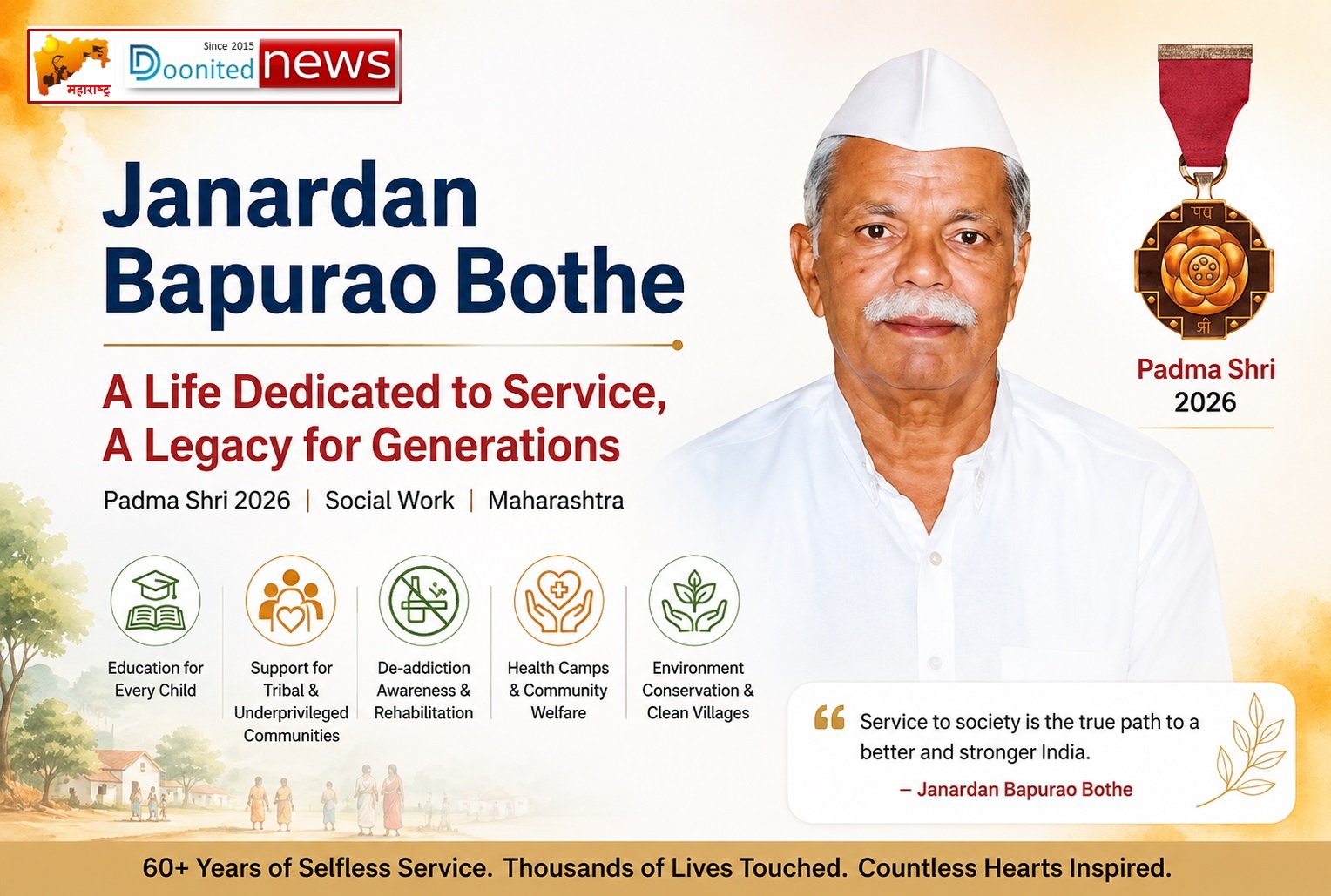
Janardan Bapurao Bothe: The Maharashtrian Who Dedicated His Life to Rural Service
By Pradeep Banerjee | Editor, Doonited News Maharashtra
In an age when success is often measured by wealth, fame, followers and public recognition, the life of Janardan Bapurao Bothe tells a very different story.
His journey is not primarily a story of personal achievement. It is a story of seva — service.
Born in a village in Maharashtra’s Washim district in 1939, Bothe went on to spend decades working for rural communities, education, social equality, de-addiction, environmental awareness and the philosophy associated with Rashtrasant Tukdoji Maharaj.
In 2026, that extraordinary journey received national recognition when Janardan Bapurao Bothe was honoured with the Padma Shri in the field of Social Work.
But the award is only the latest chapter.
To understand why his story matters, we need to go back more than six decades.
Who Is Janardan Bapurao Bothe?
Janardan Bapurao Bothe is a veteran Maharashtra social worker associated with the All-India Shri Gurudev Seva Mandal at Gurukunj Ashram, an institution founded by Rashtrasant Tukdoji Maharaj.
According to the official Padma Awards citation, Bothe was born on 25 November 1939 in Gogari village in Washim district, Maharashtra.
He completed his matriculation in 1958 and subsequently acquired professional training and certifications in areas including photography, music, stenography and typing.
But rather than pursuing a conventional professional life, Bothe’s journey became closely connected with the teachings and social mission of Rashtrasant Tukdoji Maharaj.
That association would eventually define his life’s work.
A Student Who Chose the Path of Seva
Bothe’s connection with the Shri Gurudev Seva Mandal began when he was a student.
He subsequently became a dedicated full-time sevak.
In 1960, he served as the personal secretary of Rashtrasant Tukdoji Maharaj, carrying out a range of responsibilities and accompanying the saint during his activities and travels.
This was much more than an administrative position.
It placed the young Bothe close to a social philosophy that regarded the development of India’s villages as essential to the development of the nation.
That philosophy would continue to influence his work for decades.
The Influence of Rashtrasant Tukdoji Maharaj
To understand Bothe’s work, it is important to understand the movement with which he became associated.
Rashtrasant Tukdoji Maharaj was deeply connected with rural awakening and social reform. His ideas emphasised community participation, cleanliness, social responsibility, moral development and village upliftment.
One of the important expressions of that philosophy is Gram Geeta, which places the village and its people at the centre of social transformation.
Bothe helped carry these principles into practical community initiatives.
His work has therefore combined spiritual values with grassroots social development rather than treating the two as separate worlds.
More Than Six Decades of Social Service
The scale of Janardan Bapurao Bothe’s contribution becomes clearer when viewed over time.
Contemporary reporting around his Padma Shri recognition describes a career of more than six decades devoted to social service and rural upliftment.
This longevity is significant.
Social transformation rarely happens through one campaign or one event. Rural development requires years of engagement with education, health, social habits, economic difficulties and community institutions.
Bothe remained connected with this work across generations.
That persistence is one of the most inspiring aspects of his story.
Education as an Instrument of Social Change
Education has been an important part of Bothe’s social mission.
According to his official Padma citation, schools and hostels were established in tribal and underprivileged areas, while free education and life-skills training benefited students from Dalit, Adivasi and economically weaker communities.
The importance of this work extends beyond the classroom.
For a child from an economically disadvantaged rural or tribal family, education can determine access to employment, independence and social mobility.
Supporting education in such communities therefore becomes a form of long-term social development.
Bothe’s work recognised that principle decades before discussions about inclusive development became commonplace.
Working With Tribal and Underprivileged Communities
One of the defining elements of Bothe’s work has been his involvement with socially and economically disadvantaged communities.
His official Padma citation notes his work supporting Dalit, Adivasi and economically weaker students and says he came to be respected as “Dalit Mitra.”
This aspect of his journey is particularly relevant to Maharashtra.
The state’s economic growth is substantial, but development is not experienced equally everywhere.
The realities of metropolitan Mumbai or rapidly developing Pune can be very different from those of tribal settlements and economically weaker rural communities.
Grassroots workers operate in this gap.
Their contribution may receive less media attention than large government projects, but their direct interaction with communities can have a lasting impact.
Fighting Addiction Through Community Awareness
Bothe’s work has also included de-addiction programmes.
Substance abuse can have devastating consequences for economically vulnerable families. Its effects extend beyond individual health to household finances, domestic relationships, children’s education and community stability.
Grassroots de-addiction therefore requires more than medical intervention.
It also requires awareness, counselling, social participation and behavioural change.
The official Padma citation identifies de-addiction programmes among the initiatives associated with Bothe’s work.
Health Camps and Community Welfare
Health awareness has been another component of the social initiatives associated with his work.
The Padma citation refers to health camps among the programmes he has led or supported.
In underserved areas, such initiatives can help connect people with health awareness and basic services.
Again, the larger philosophy becomes visible: rural development cannot be reduced to a single issue.
Education, health, sanitation, addiction, environment and social values are interconnected.
Cleanliness as a Social Movement
Long before cleanliness became a major theme of national public campaigns, the philosophy associated with Tukdoji Maharaj placed considerable importance on village cleanliness and community responsibility.
Bothe continued working within this tradition.
His official citation highlights grassroots initiatives focused on cleanliness, equality, character building and national integration.
The idea is simple but powerful.
A clean village cannot be created by government workers alone.
It requires community participation.
That same principle applies to many of Bothe’s areas of work: sustainable social change occurs when citizens become participants rather than merely beneficiaries.
Environmental Conservation and Rural Maharashtra
Environmental conservation has also become part of the wider service initiatives carried forward under Bothe’s leadership.
His official citation specifically identifies environmental conservation among the areas promoted through the organisation’s rural network.
This dimension has become increasingly relevant.
Rural Maharashtra faces environmental pressures involving water availability, changing climate conditions, agriculture and natural resources.
Environmental awareness at the village level is therefore not an abstract concern. It can directly affect livelihoods and future generations.
Leading the Shri Gurudev Seva Mandal
Bothe’s role expanded significantly over the decades.
According to the Government of India’s citation, he has served as General Secretary of the All-India Shri Gurudev Seva Mandal since 2001.
The citation states that under his leadership, service initiatives have operated through more than 10,000 rural branches, women’s groups and youth organisations.
That figure gives an indication of the organisational scale involved.
Running social initiatives across such a network requires more than personal commitment. It requires institution-building, coordination and the ability to transfer a philosophy of service from one generation of volunteers to another.
Women and Youth in Rural Development
The involvement of women’s groups and youth organisations is particularly significant.
Any sustainable rural-development movement eventually needs younger generations to participate.
Similarly, women cannot simply be treated as beneficiaries of development programmes. Their direct involvement in community organisations strengthens local decision-making and social change.
The structure described in Bothe’s Padma citation suggests an approach that seeks to involve different sections of society rather than concentrating activity in a single group.
Preserving the Philosophy of Gram Geeta
Another important part of Bothe’s contribution has been promoting the literature and philosophy of Rashtrasant Tukdoji Maharaj.
This is important because social movements can disappear when their ideas are not documented, communicated and passed to future generations.
The official citation notes Bothe’s efforts in promoting and propagating Tukdoji Maharaj’s literature and philosophy.
His work therefore represents not only social service but also preservation and transmission of an important Maharashtra intellectual and spiritual tradition.
Recognition Came Before the Padma Shri
The Padma Shri was not the first recognition of Bothe’s work.
According to his official government citation, he received the Dr. Babasaheb Ambedkar Dalit Mitra Sanstha Award in 1992.
In 2008, he was also honoured with the Maratha Vidarbha Bhushan Award by the Akola division of the All-India Maratha Seva Sangh.
Amravati University also recognised his efforts connected with promoting the literature and philosophy of Rashtrasant Tukdoji Maharaj.
These recognitions demonstrate that his contribution had been acknowledged within Maharashtra long before the national Padma honour arrived.
Padma Shri 2026: National Recognition for a Life of Service
In 2026, Janardan Bapurao Bothe was selected for one of India’s highest civilian honours.
The official Padma Awards database lists:
Janardan Bapurao Bothe — Padma Shri — Social Work — Maharashtra — 2026.
The recognition brought national attention to a life that had largely been devoted to grassroots work.
President Droupadi Murmu was scheduled to confer the honour at the civil investiture ceremony at Rashtrapati Bhavan on May 25, according to reporting ahead of the ceremony.
For Maharashtra, the honour also represented recognition of a tradition of social service rooted far beyond the state’s largest cities.
Why Janardan Bapurao Bothe Is an Inspiring Maharashtrian
There are many ways to define inspiration.
For some, it comes from extraordinary success in business.
For others, it comes from sport, cinema, science or public life.
Janardan Bapurao Bothe represents another form of inspiration — a lifetime spent building communities rather than a personal brand.
His journey demonstrates that social impact does not always happen through dramatic moments.
Sometimes it happens slowly.
A student receives education.
A family moves away from addiction.
A village organises a cleanliness initiative.
A young volunteer learns the meaning of social responsibility.
A disadvantaged child receives an opportunity that might otherwise have been unavailable.
Individually, such changes may never become national headlines.
Collectively, they can transform communities.
A Story From Vidarbha With a National Message
Bothe’s roots in Washim and his long association with the social movement established by Tukdoji Maharaj also make this an important Vidarbha story.
Maharashtra’s inspiring personalities do not emerge only from Mumbai and Pune.
Vidarbha has produced social reformers, artists, thinkers, entrepreneurs, sportspeople and grassroots workers whose contributions deserve wider recognition.
Bothe’s Padma Shri provides an opportunity to bring one such story to a broader audience.
But the deeper message goes beyond regional pride.
It asks a more fundamental question:
What does a successful life mean?
Is success only what an individual accumulates?
Or can it also be measured by what that individual gives to society?
Janardan Bapurao Bothe’s life offers one possible answer.
The Legacy of Seva
Awards are important because they bring public recognition to exceptional contributions.
But an award cannot adequately measure more than six decades of grassroots work.
The more enduring legacy is the network of institutions, volunteers, students and communities influenced by that work.
Bothe’s journey also demonstrates the importance of continuity.
Social service cannot depend entirely on one individual.
For a movement to survive, its ideas must be transmitted to younger people who can reinterpret them for changing times.
The challenge ahead for organisations such as the Shri Gurudev Seva Mandal will therefore be to preserve the core principles of service while addressing the problems facing rural India today.
What Maharashtra’s Younger Generation Can Learn From His Journey
Perhaps the strongest lesson from the Janardan Bapurao Bothe story is that meaningful change does not always require enormous resources.
It begins with participation.
Young Maharashtrians today have access to technology, education and communication tools that previous generations could hardly imagine.
These tools can be used not only for individual careers but also for community development.
Technology can support rural education.
Digital platforms can spread health awareness.
Young entrepreneurs can address agricultural and environmental problems.
Professionals can volunteer their skills.
Students can participate in community initiatives.
The methods may change, but the principle of seva remains relevant.
Conclusion: A Life Larger Than an Award
The Padma Shri 2026 placed Janardan Bapurao Bothe among the nationally recognised contributors to Indian society.
But his story began long before the award.
It began with a young student in Maharashtra who became associated with a movement of social service.
It continued through his work alongside Rashtrasant Tukdoji Maharaj, his involvement in education and rural upliftment, and decades of service through the Shri Gurudev Seva Mandal.
His work touched issues ranging from education and social equality to de-addiction, health, cleanliness, environmental conservation and community development.
More than six decades later, India recognised that contribution with the Padma Shri.
For Doonited News Maharashtra’s Inspiring Maharashtrians series, his story represents exactly what the category should celebrate:
Maharashtrians whose achievements are not only personal successes, but contributions that make society stronger.