
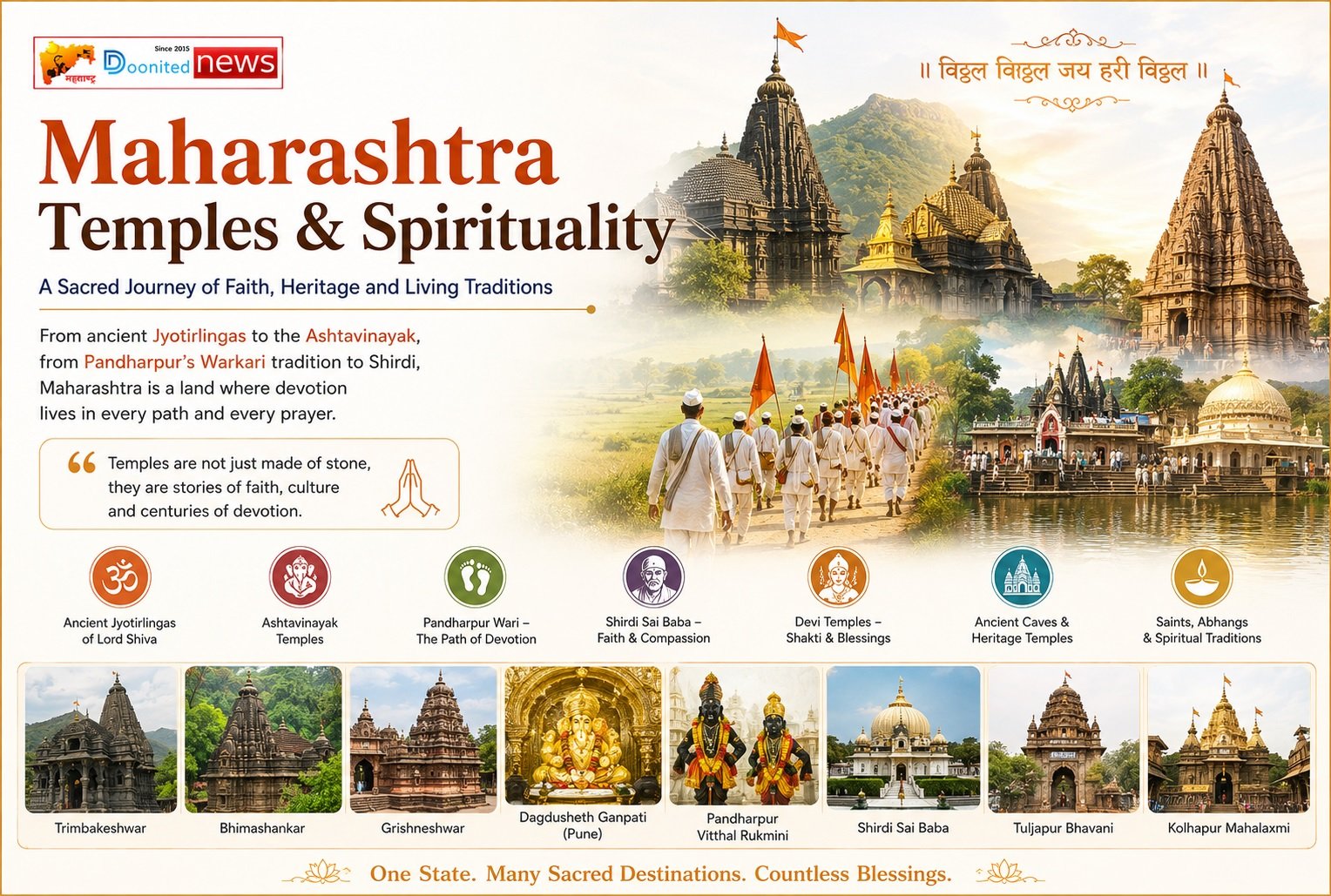
Maharashtra Temples and Spirituality: A Sacred Journey Through Faith, History and Living Traditions
By Pradeep Banerjee | Editor, Doonited News Maharashtra
Maharashtra is a land where spirituality is not confined within the walls of temples.
It lives in the footsteps of Warkaris walking towards Pandharpur. It echoes through the abhangs of Sant Tukaram. It appears in the chants of devotees at Trimbakeshwar, in the crowds seeking Ganpati’s blessings in Pune, in the ancient caves of the Sahyadris and in village shrines where traditions have survived for generations.
From the Jyotirlingas associated with Lord Shiva to the Ashtavinayak temples of Lord Ganesha, from Pandharpur’s Vitthal-Rukmini tradition to Shirdi’s Sai Baba, Maharashtra possesses one of India’s richest spiritual landscapes.
But Maharashtra temples and spirituality are about much more than famous pilgrimage destinations.
They tell a larger story about faith, architecture, saints, social movements, music, literature, pilgrimage and the relationship between ordinary people and the divine.
To understand Maharashtra, therefore, one must also understand its spiritual geography.
Why Maharashtra Is One of India’s Great Spiritual Landscapes
Few Indian states contain such a diverse combination of major Hindu pilgrimage traditions, saint movements and sacred architecture.
Maharashtra is associated with important centres of Shaivism, Vaishnavism, Ganapatya traditions, Shakti worship and the Bhakti movement.
The state also contains important Buddhist, Jain, Sikh, Islamic and other sacred sites, demonstrating that Maharashtra’s spiritual history extends across multiple faith traditions.
Within Hindu pilgrimage traditions alone, devotees travel to destinations associated with Shiva, Ganesha, Vitthal, Devi, Dattatreya, Khandoba and numerous regional deities.
Some temples are nationally famous.
Others are known primarily within their districts.
Yet both categories are important.
A small village temple may reveal as much about Maharashtra’s living spirituality as a major pilgrimage complex visited by millions.
The Jyotirlingas and Maharashtra’s Connection With Lord Shiva
Maharashtra occupies a special place in the sacred geography associated with Lord Shiva.
Among the most prominent Shiva pilgrimage destinations in the state are Trimbakeshwar near Nashik, Bhimashankar in Pune district and Grishneshwar near the Ellora caves.
These shrines are traditionally counted among the twelve Jyotirlingas revered by Shiva devotees.
Each has a different geographical and cultural setting.
Trimbakeshwar stands near the Brahmagiri hills and is closely associated with the origin of the Godavari River.
Bhimashankar lies amid the forested Sahyadri landscape.
Grishneshwar stands close to one of India’s greatest archaeological treasures—the Ellora cave complex.
Together, they demonstrate how Maharashtra’s spirituality is intertwined with geography.
Trimbakeshwar: Where Faith Meets the Godavari


The Trimbakeshwar Temple near Nashik is one of Maharashtra’s most important Shiva pilgrimage centres.
The temple is situated near Brahmagiri, traditionally associated with the origin of the sacred Godavari River.
This combination of temple, mountain and river makes Trimbakeshwar more than an architectural monument.
It is a complete sacred landscape.
Nashik and Trimbakeshwar also have an important connection with the Kumbh Mela, one of Hinduism’s largest pilgrimage gatherings.
For generations of devotees, therefore, the journey to Trimbakeshwar has connected worship of Shiva with reverence for the Godavari.
Bhimashankar: Spirituality in the Sahyadris
Bhimashankar offers a completely different spiritual atmosphere.
Located in the Western Ghats, the temple is surrounded by forest and mountainous terrain.
The region is also associated with the Bhimashankar Wildlife Sanctuary.
This creates a powerful relationship between spirituality and nature.
For pilgrims, the experience is not merely entering a temple.
The journey through the Sahyadris itself becomes part of the pilgrimage.
Maharashtra contains many such places where mountains, rivers, forests and temples form one spiritual environment.
Grishneshwar: A Jyotirlinga Beside Ellora
The Grishneshwar Temple, located near the Ellora caves in Chhatrapati Sambhajinagar district, adds another dimension to Maharashtra’s sacred heritage.
Here, spirituality stands beside extraordinary architectural history.
A visitor can experience a living Shiva temple and, nearby, encounter the monumental rock-cut heritage of Ellora.
This proximity reminds us that Maharashtra’s religious history was expressed not only through ritual but through architecture, sculpture and craftsmanship.
The Ashtavinayak: Eight Temples, One Sacred Journey
If Lord Shiva defines one major spiritual route through Maharashtra, Lord Ganesha defines another.
The famous Ashtavinayak pilgrimage connects eight revered Ganesh temples in Maharashtra.
Traditionally, devotees undertake the journey through the eight shrines in a prescribed sequence.
They include:
Mayureshwar at Morgaon, Siddhivinayak at Siddhatek, Ballaleshwar at Pali, Varadvinayak at Mahad, Chintamani at Theur, Girijatmaj at Lenyadri, Vighneshwar at Ozar and Mahaganapati at Ranjangaon.
Each temple has its own traditions and associated legends.
But together they create something larger—a spiritual circuit.
The pilgrimage itself becomes an act of devotion.
Why Lord Ganesha Has Such a Special Place in Maharashtra
It is difficult to separate Maharashtra’s cultural identity from Ganpati.
Lord Ganesha is worshipped across India, but Maharashtra developed an especially visible public relationship with Ganesh devotion.
That relationship reaches its most spectacular expression during Ganeshotsav.
Homes install Ganesh idols.
Public mandals create elaborate celebrations.
Devotional music fills neighbourhoods.
Families prepare modak.
And eventually, processions accompany the idols for immersion.
The festival combines private faith with public culture.
Dagdusheth Halwai Ganpati: A Pune Spiritual Landmark


Among Pune’s most recognisable religious landmarks is Shreemant Dagdusheth Halwai Ganpati Mandir.
The temple attracts devotees throughout the year, while Ganeshotsav brings particularly intense attention.
Its importance demonstrates how a temple can become part of a city’s identity.
For many visitors, a journey to Pune feels incomplete without darshan of Ganpati.
Pandharpur: The Spiritual Heart of the Warkari Tradition
Perhaps no tradition explains Maharashtra’s distinctive spirituality better than Pandharpur and the Warkari movement.


Pandharpur is home to the revered Shri Vitthal Rukmini Temple.
Devotees worship Vitthal—also affectionately called Vithoba or Panduranga—and Rukmini.
But Pandharpur’s significance cannot be understood only by studying the temple.
One must understand the Wari.
The Pandharpur Wari: When Walking Becomes Worship
Every year, vast numbers of Warkaris undertake the pilgrimage towards Pandharpur.
The journey is one of Maharashtra’s most extraordinary living traditions.
Devotees walk together.
They sing abhangs.
They carry saffron flags.
They chant the names of Vitthal.
The famous palkhi traditions associated with saints such as Sant Dnyaneshwar and Sant Tukaram form a central part of this spiritual movement.
For the Warkari, pilgrimage is not simply transportation from one location to another.
The walking itself is devotion.
Sant Dnyaneshwar and Alandi
Alandi, near Pune, occupies a central position in the spiritual geography of Maharashtra because of its association with Sant Dnyaneshwar.
Dnyaneshwar’s contribution extends far beyond religious devotion.
His Dnyaneshwari, a celebrated Marathi exposition of the Bhagavad Gita, became one of the foundational works of Marathi spiritual literature.
This is an important feature of Maharashtra’s spirituality.
The saints did not only establish places of worship.
They created literature.
They shaped language.
They influenced music.
And they carried philosophical ideas to ordinary people.
Sant Tukaram and Dehu
Sant Tukaram, associated with Dehu, became another towering figure in Maharashtra’s Bhakti tradition.
His abhangs continue to be sung centuries later.
That continuity is remarkable.
A composition does not remain culturally alive for centuries simply because historians preserve it.
It survives because ordinary people continue singing it.
Tukaram’s devotional poetry became part of Maharashtra’s collective cultural memory.
Through the Warkari tradition, those words continue travelling towards Pandharpur.
The Spiritual Power of the Abhang
Maharashtra’s spirituality cannot be understood without its music.
The abhang occupies a particularly important position.
These devotional compositions communicate faith through language accessible to ordinary people.
The tradition helped move spirituality beyond formal religious scholarship.
A farmer could sing an abhang.
A labourer could sing it.
A pilgrim walking towards Pandharpur could sing it.
A family could sing it at home.
Spiritual literature therefore became a people’s tradition.
Shirdi: A Spiritual Destination Beyond Religious Boundaries
Another of Maharashtra’s globally recognised pilgrimage destinations is Shirdi, associated with Sai Baba.

Shri Sai Baba Sansthan Temple attracts devotees from across India and abroad.
Sai Baba’s teachings are widely associated with faith, compassion, charity and harmony.
One of the phrases closely associated with his tradition is:
“Shraddha and Saburi” — Faith and Patience.
Shirdi demonstrates how a relatively small Maharashtra town can become an international spiritual destination.
Shani Shingnapur and the Power of Local Faith
Maharashtra also contains temples whose identity is deeply connected with distinctive local traditions.
Shani Shingnapur in Ahilyanagar district is one such place.
The village is famous for its devotion to Lord Shani and has long attracted pilgrims from across Maharashtra and beyond.
Its popularity demonstrates an important point.
Spiritual geography is not determined by the physical size of a temple.
Sometimes a tradition, belief or local story can give a place enormous religious significance.
Jejuri and Khandoba
Jejuri is closely associated with Lord Khandoba, a deity with deep importance in Maharashtra’s regional religious traditions.
The temple landscape is famously transformed by turmeric during celebrations and devotional gatherings.
Yellow becomes almost the colour of the sacred landscape.
Khandoba worship demonstrates how Maharashtra’s spiritual culture includes traditions rooted strongly in regional communities and folk belief.
This is essential to understanding the state’s religious identity.
Maharashtra’s spirituality is not only the story of nationally famous deities.
It is also the story of regional gods and local traditions.
Tuljapur and the Worship of Tulja Bhavani
The Shri Tulja Bhavani Temple is one of Maharashtra’s most important centres of Devi worship.
Tulja Bhavani occupies a significant place in Maharashtra’s religious and historical imagination.
The deity is particularly associated in popular tradition with Chhatrapati Shivaji Maharaj.
The temple therefore exists at an intersection of spirituality, regional identity and historical memory.
Kolhapur’s Mahalakshmi Temple
Kolhapur is home to another of Maharashtra’s major sacred destinations—the Shri Ambabai Mahalaxmi Temple.
The temple is an important centre of goddess worship and draws large numbers of pilgrims.
Its presence also demonstrates how Maharashtra’s historic cities often developed around overlapping identities.
Kolhapur is a royal city.
It is a food destination.
It is associated with wrestling and craftsmanship.
And it is a major pilgrimage centre.
Spiritual heritage is woven into the larger cultural identity of the city.
Nashik: A City Where Mythology, River and Pilgrimage Meet
Nashik occupies a special position in Maharashtra’s spiritual geography.
The Godavari flows through the city.
Ramkund is an important sacred location.
The wider region contains sites connected through religious traditions with the Ramayana.
And nearby Trimbakeshwar adds the significance of a Jyotirlinga.
Nashik is also one of the locations associated with the Kumbh Mela cycle.
The result is a spiritual landscape extending beyond any single temple.
Maharashtra’s Ancient Caves Are Also Sacred Spaces
Maharashtra’s spiritual heritage predates many of its famous standing temples.
The state contains extraordinary rock-cut religious architecture.
Ajanta and Ellora are internationally famous examples.
At Ellora, Buddhist, Hindu and Jain monuments exist within one remarkable archaeological landscape.
The Kailasa Temple at Ellora is particularly extraordinary.
Carved from rock, the monumental complex demonstrates the ambition and skill of ancient Indian craftsmen.


These sites remind visitors that Maharashtra’s spiritual history extends across many centuries and religious traditions.
Spirituality Beyond Hindu Temples
A comprehensive understanding of Maharashtra spirituality must also recognise the state’s religious diversity.
Maharashtra contains Buddhist caves and pilgrimage centres, Jain temples, Sikh gurdwaras, churches, mosques and Sufi shrines.
Nagpur occupies a particularly important place in modern Buddhist history because of Deekshabhoomi, associated with Dr B. R. Ambedkar’s conversion to Buddhism in 1956.
Deekshabhoomi has subsequently become a major site of pilgrimage and remembrance.
This diversity makes Maharashtra’s spiritual heritage broader than any single religious tradition.
Temples Were Also Centres of Community Life
Historically, temples often performed functions beyond worship.
They could become meeting places.
Festivals brought communities together.
Markets developed around pilgrimage routes.
Artists, musicians, craftspeople and performers found audiences.
Food was distributed.
Travellers found places of rest.
In this sense, a temple was sometimes both a sacred institution and a social institution.
Even today, major pilgrimage centres generate substantial local economic activity through accommodation, transportation, food, flowers, religious items and other services.
Architecture Tells Another Spiritual Story
Maharashtra’s temples also preserve architectural history.
Different periods produced different building styles.
Stone temples, rock-cut monuments, medieval shrines and later structures demonstrate changing techniques and artistic preferences.
The Hemadpanti architectural tradition, commonly associated with medieval Maharashtra, is particularly recognisable at numerous temples.
Studying a temple therefore involves more than identifying the deity.
Its walls can reveal the period in which it was built.
Its sculptures can reveal artistic traditions.
Its inscriptions may provide historical information.
Its renovations can reveal how generations continued using the sacred site.
Every old temple is potentially an archive made of stone.
Legends and Documented History Must Be Distinguished
Temple stories frequently combine history with religious tradition and local legend.
Both are culturally important—but they are not the same type of evidence.
A temple may have a documented construction date.
It may also have a traditional story connecting it with an ancient deity, saint or event.
Responsible cultural journalism should preserve the tradition without presenting every legend as verified historical fact.
The correct approach is to tell readers clearly:
what historical evidence indicates, what religious texts or traditions say, and what local devotees believe.
Doing so does not weaken the spiritual story.
It makes it more credible.
Why Temple Legends Matter
Even when a story cannot be historically verified, it can still have cultural importance.
Why?
Because legends reveal how communities understand a sacred place.
A story repeated for hundreds of years can influence rituals, festivals and pilgrimage patterns.
It can explain why devotees perform a particular act.
It can become part of a town’s identity.
Therefore, legends should neither be dismissed nor automatically treated as historical facts.
They should be documented as living traditions.
Festivals Transform Temples Into Living Cultural Centres
Temples become particularly vibrant during festivals.
Ganeshotsav transforms Maharashtra’s Ganesh temples and public spaces.
Ashadhi Ekadashi draws attention towards Pandharpur.
Mahashivratri brings large numbers of Shiva devotees to temples.
Navratri energises Devi shrines.
Local yatras transform villages and towns.
During such events, spirituality interacts with music, food, clothing, commerce and community identity.
This is why temple culture belongs not only in a religion section.
It is also part of Maharashtra’s broader cultural heritage.
Pilgrimage Is Also a Journey Through Maharashtra
Temple tourism offers another way of discovering the state.
Consider the diversity of landscapes encountered through pilgrimage alone.
Trimbakeshwar takes visitors towards the hills near Nashik.
Bhimashankar takes them into the Sahyadris.
Pandharpur brings them towards the Chandrabhaga river.
Shirdi introduces another part of western Maharashtra.
Tuljapur leads towards the Marathwada region.
Grishneshwar brings pilgrims beside Ellora.
Deekshabhoomi brings them to Nagpur.
A spiritual journey becomes a geographical journey.
The Economic Importance of Temple Tourism
Pilgrimage also supports local economies.
A major temple creates demand for hotels, guest houses, restaurants, taxis, buses, guides, flower sellers, small shops and numerous other services.
Festivals multiply that activity.
This means that preserving pilgrimage destinations is not only a religious or cultural issue.
It can also be an economic-development issue.
But growth must be managed carefully.
Uncontrolled commercialisation can damage precisely the heritage and atmosphere that make a sacred destination valuable.
The Challenge of Protecting Ancient Temples
Maharashtra’s temple heritage faces several challenges.
Ageing structures require conservation.
Large crowds can place pressure on historic sites.
Unplanned construction can alter traditional surroundings.
Pollution can affect sacred rivers and pilgrimage areas.
Commercial development can overwhelm heritage architecture.
Modernisation is sometimes necessary for safety and accessibility, but it should not destroy historical character.
Conservation therefore requires cooperation between temple authorities, government agencies, historians, conservation specialists and local communities.
Technology Is Changing the Pilgrimage Experience
Modern spirituality is also adapting to technology.
Devotees increasingly use websites and mobile services to obtain information about temples, travel routes, accommodation and darshan arrangements.
Digital payment systems have changed donations.
Social media brings temple festivals to audiences worldwide.
Video allows devotees living abroad to remain connected with Maharashtra’s sacred traditions.
This creates enormous opportunities.
But digital information also brings a responsibility to prevent misinformation.
Temple history circulating online should be checked against reliable sources whenever possible.
Young Maharashtra and Spiritual Heritage
One of the most important questions is whether younger generations will continue engaging with Maharashtra’s spiritual traditions.
The answer may depend on how those traditions are communicated.
Young audiences often want to know more than:
“Which temple should I visit?”
They also want to know:
Who built it?
How old is it?
Why is the deity important?
What does the architecture mean?
What is history and what is legend?
Which saint is associated with the place?
Why does a particular festival happen there?
This creates an opportunity for a new form of spiritual storytelling—one based on faith, history and evidence together.
Why Maharashtra’s Temple Stories Must Be Documented
Famous temples are already widely documented.
Smaller temples are more vulnerable.
A village shrine may contain an old inscription.
A local priest may know an oral tradition passed down through generations.
An annual festival may preserve a ritual whose origins are no longer widely understood.
An old temple structure may be replaced before anyone properly documents it.
This is why local journalism has an important role.
Not every heritage story needs to begin in Mumbai or Pune.
Some of Maharashtra’s most valuable stories may be hidden in a village that rarely appears in mainstream media.
The Spiritual Map of Maharashtra Is Still Being Written
Maharashtra’s spiritual identity is not merely a chapter from the past.
It remains alive.
Warkaris still walk.
Abhangs are still sung.
Ganpati still arrives in homes every year.
Pilgrims still climb temple steps.
Families still travel together for darshan.
Village yatras still bring communities together.
Young people still photograph ancient temples and share their stories digitally.
Tradition has changed its methods of communication, but it has not disappeared.
Conclusion: Maharashtra Is a Journey of Faith
What makes Maharashtra temples and spirituality extraordinary is not simply the number of famous pilgrimage destinations.
It is the diversity of spiritual experiences.
There is Shiva at Trimbakeshwar and Bhimashankar.
There is Ganesha across the Ashtavinayak route and in Pune’s Ganpati tradition.
There is Vitthal waiting for the Warkaris at Pandharpur.
There is Sai Baba at Shirdi.
There is Tulja Bhavani at Tuljapur and Mahalakshmi at Kolhapur.
There are ancient Buddhist, Hindu and Jain monuments carved into Maharashtra’s rock.
There is Deekshabhoomi in Nagpur.
There are saints whose words continue to be sung centuries after their lives.
And beyond these famous destinations are thousands of smaller temples, shrines and sacred traditions embedded in Maharashtra’s villages and towns.
Together, they tell us something important.
Maharashtra’s spiritual heritage does not live only in stone.
It lives in journeys, songs, stories, rituals, memories and people.
A temple may be the destination.
But in Maharashtra, very often, the journey itself becomes the prayer.