By Pradeep Banerjee | Editor, Doonited News Maharashtra
Maharashtra can be explored through its magnificent forts, ancient temples, festivals, literature and cinema. But there is another way to understand the state—through its food.
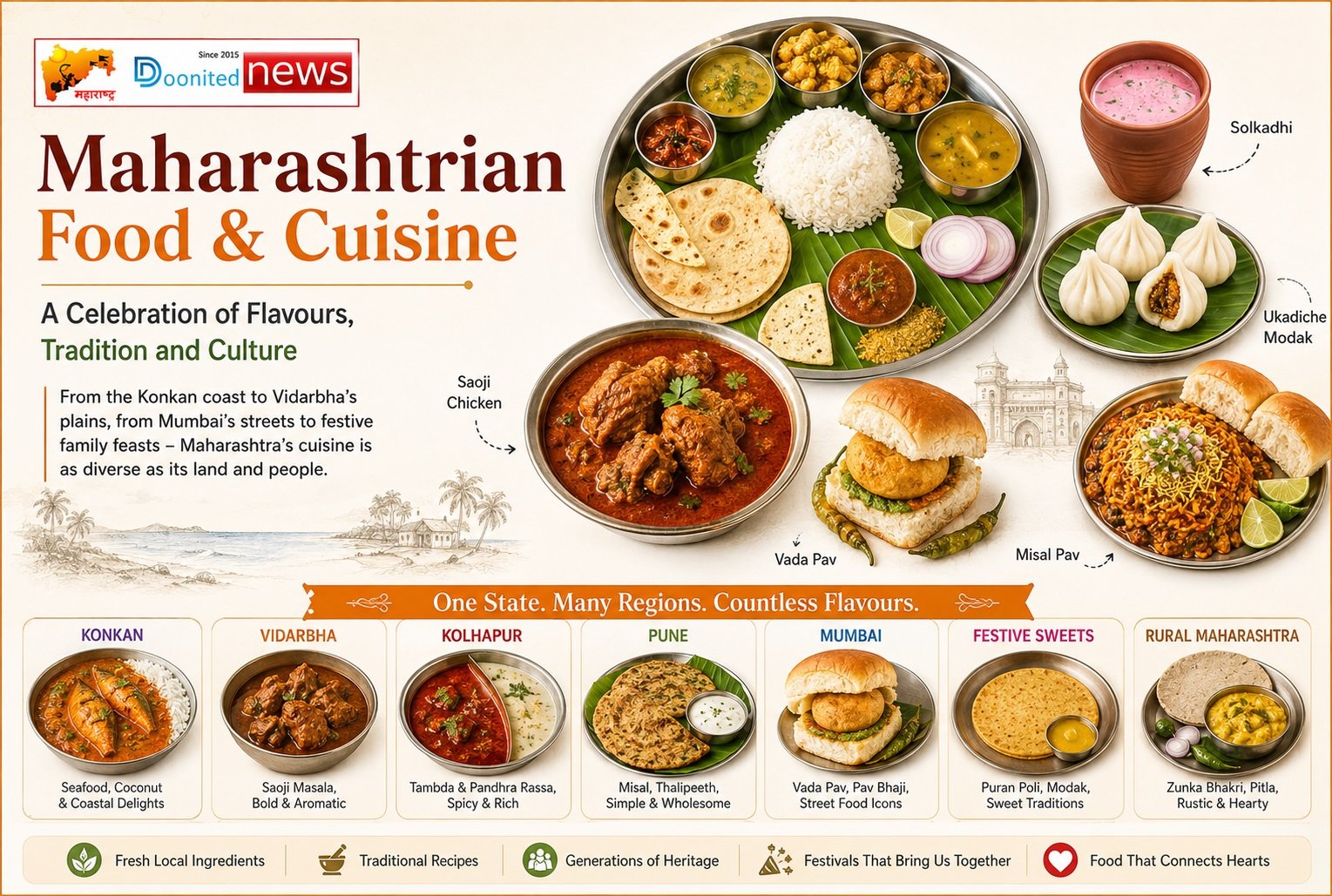
Maharashtrian food and cuisine is not one single culinary tradition. It is a collection of regional cuisines shaped by Maharashtra’s coastline, mountains, farms, cities, communities, religious traditions and changing seasons.
From fiery Saoji mutton in Nagpur and rustic Varhadi food to Malvani fish curry on the Konkan coast, Kolhapur’s celebrated tambda and pandhra rassa, Mumbai’s vada pav, Pune’s misal and festive favourites such as puran poli and ukadiche modak, every region contributes something different.


Together, these foods tell a much larger story.
They tell us what Maharashtra grows, how its people lived, how geography influenced cooking and how recipes travelled from one generation to another.
In Maharashtra, food is not simply something to eat.
Food is heritage.
Why Is Maharashtrian Cuisine So Diverse?
Maharashtra stretches from the Arabian Sea to the heart of Central India.
That enormous geographical diversity has naturally influenced what people eat.
Along the Konkan coast, fish, rice, coconut and kokum play major roles.
Move inland and jowar, bajra, pulses, peanuts, sesame and stronger spice mixtures become more prominent.
Vidarbha developed its own bold Varhadi and Saoji traditions.
Khandesh became known for powerful spice profiles.
Kolhapur developed a cuisine famous for its robust meat preparations.
Mumbai created a completely different food culture shaped by migration, industry, railway commuters and fast urban life.
This is why there is no single answer to the question:
What is authentic Maharashtrian food?
There are many authentic Maharashtrian cuisines.
Vidarbha: Bold Flavours From Eastern Maharashtra
For anyone exploring Maharashtra through food, Vidarbha deserves special attention.
Its cooking can be rustic, intensely aromatic and unapologetically spicy.
Peanuts, sesame, dried coconut, chillies and complex spice mixtures feature prominently in different preparations.
Nagpur, in particular, has developed a culinary identity that extends well beyond the orange for which the city is nationally famous.
Two foods tell that story particularly well:
Saoji cuisine and tarri poha.
Saoji Mutton: Nagpur’s Fiery Culinary Signature
Saoji food is one of Nagpur’s most distinctive culinary traditions.
Associated with the Saoji community, the cuisine is particularly renowned for its intensely flavoured meat preparations.
Saoji mutton can appear dark, rich and formidable.
But describing it simply as “very spicy mutton” misses what makes the cuisine distinctive.
Its character comes from the combination and treatment of spices, with recipes varying between cooks and families.
The result can be a deeply aromatic gravy whose heat is only one part of its personality.
For travellers interested in Nagpur’s cultural identity, Saoji food offers something particularly valuable: a cuisine strongly connected to the city and its community history.
Interestingly, Saoji cuisine is now travelling far beyond Nagpur. In May 2026, the Economic Times reported on a Japanese chef serving Maharashtra’s Saoji dishes at his restaurant in Fukuoka, Japan—an indication of how regional Indian cuisines can find completely new audiences internationally.
Tarri Poha: How Nagpur Starts the Morning

If Saoji represents the heavier side of Nagpur’s culinary personality, tarri poha represents its street-food soul.
Poha is eaten across many parts of India, but Nagpur gave the familiar breakfast its own fiery personality.
Soft flattened rice is accompanied by or topped with spicy tarri, with combinations of sev, chopped onion, coriander and lemon commonly completing the plate.
The contrast is what makes it work.
Soft poha.
Crunchy toppings.
Hot tarri.
Fresh lemon.
And, very often, a cup of tea nearby.
For many Nagpur residents, tarri poha is not merely breakfast.
It belongs to the rhythm of the city.
Varhadi Cuisine: The Taste of Rural Vidarbha
Nagpur is only one part of the Vidarbha food story.
The broader Varhadi cuisine reflects the agricultural landscape of the region.
Its food includes both vegetarian and non-vegetarian preparations and often makes intelligent use of locally available grains, pulses, peanuts and spices.
This is where cuisine becomes historical evidence.
Look carefully at an old regional recipe and it can tell you what crops were available, what could be stored through difficult seasons and how households cooked before modern refrigeration and packaged foods.
Food can be a record of how people adapted to the land.
Konkan Cuisine: When Maharashtra Meets the Sea
Travel west towards the Arabian Sea and the food changes.

The Konkan’s long coastline created a cuisine in which seafood naturally became important.
Fish, prawns, rice, coconut and kokum are characteristic ingredients in different coastal preparations.
The flavours can be spicy, tangy, coconut-rich and deeply aromatic.
This is a completely different Maharashtra from the inland cuisine of Vidarbha.
Yet both belong to the same state.
Malvani Fish Curry: Spice Meets the Arabian Sea
Malvani cuisine is among Maharashtra’s best-known coastal food traditions.
Fish curries, fried fish, seafood and chicken preparations make extensive use of regional spices and coconut.
Malvani fish curry beautifully demonstrates the relationship between geography and food.
The sea provides the fish.
The coastal environment provides coconut.
Regional spice traditions provide the character.
Put them together and a landscape becomes a cuisine.
Solkadhi: The Flavour of Kokum and Coconut
After a spicy coastal meal comes one of the Konkan’s most recognisable accompaniments: solkadhi.
Traditionally associated with kokum and coconut milk, its distinctive pink colour makes it visually recognisable.
Its flavour contrasts wonderfully with an intensely spiced meal.
Tangy, refreshing and deeply associated with coastal Maharashtra, solkadhi shows how even a relatively simple preparation can become a marker of regional identity.
Kolhapur: Maharashtra Turns Up the Heat
Travel towards Kolhapur and Maharashtra changes flavour again.
Kolhapuri cuisine has acquired a reputation for bold spice and powerful meat dishes.
But once again, heat alone does not explain the cuisine.
Complex masalas and traditional preparation techniques give Kolhapuri food its identity.
Two names have become particularly famous:
Tambda Rassa and Pandhra Rassa.

Tambda refers to red, while pandhra refers to white.
The visual contrast is striking.
One brings the characteristic red colour and stronger heat associated with the spicy gravy; the other provides a contrasting pale preparation with a different flavour profile.
Together, they have become symbols of Kolhapur’s culinary identity.
Misal Pav: Maharashtra’s Great Regional Debate

Few foods reveal Maharashtra’s regional diversity as entertainingly as misal pav.
At its core, misal generally brings together a pulse-based preparation, spicy gravy, farsan or crunchy toppings and pav.
But the similarities end quickly.
Pune has its versions.
Nashik has another tradition.
Kolhapur has its interpretation.
Other Maharashtra towns have their own favourites.
Ask people which city makes the best misal and you may start an argument that lasts longer than the meal.
There is no need to declare one the winner.
The variations are the story.
They demonstrate how a dish changes as it travels.
Mumbai’s Vada Pav: Food Designed for a Moving City
Then comes Mumbai.

Mumbai’s enormous population and commuter culture created demand for food that could be affordable, filling and eaten quickly.
Vada pav answered that need brilliantly.
The construction is remarkably straightforward: a spiced potato vada inside pav, typically accompanied by chutneys and chilli.
But culturally, it became something much larger.
Railway commuters eat it.
Students eat it.
Office workers eat it.
Tourists seek it out.
It is difficult to imagine Mumbai’s street-food identity without it.
A humble snack became a symbol of India’s largest city.
Pav Bhaji: Another Mumbai Classic


Pav bhaji tells another distinctly urban story.
A richly spiced vegetable bhaji served with buttered pav became one of Mumbai’s most recognisable foods.
Its popularity proves an important point about culinary heritage:
A dish does not need royal origins to become historically important.
Sometimes millions of ordinary people create history simply by eating something for generations.
Puran Poli: The Taste of Celebration
Move from Mumbai’s streets into the Maharashtrian home and another food world appears.


Puran poli is one of Maharashtra’s beloved festive preparations.
The sweet flatbread traditionally contains a filling based on cooked lentils and jaggery.
But the real story of puran poli is not simply its ingredients.
It is how the recipe survives.
One generation watches another.
Techniques are demonstrated rather than written.
Families develop their own preferences.
A grandmother’s method becomes the family standard.
Food becomes memory.
And memory becomes heritage.
Ukadiche Modak: When Food Becomes Devotion

Few Maharashtra foods have a stronger religious association than modak.
The sweet is closely associated with Lord Ganesha and becomes particularly important during Ganeshotsav.
The traditional steamed ukadiche modak, generally made with a rice-flour exterior and coconut-jaggery filling, occupies a special place in Maharashtrian homes.
During Ganesh Chaturthi, preparing modak can itself become part of family devotion.
The kitchen becomes connected with the prayer room.
Food becomes prasad.
This is where cuisine, family and spirituality meet.
Sabudana Khichdi: From Fasting Food to Everyday Favourite

Sabudana khichdi is closely associated with fasting traditions.
Tapioca pearls, peanuts and permitted seasonings create a preparation that is filling while fitting within common fasting practices.
But its popularity has moved beyond religious observance.
Today many people happily eat sabudana khichdi simply as breakfast or a snack.
It demonstrates how ritual foods can gradually become everyday foods.
Thalipeeth: Maharashtra’s Traditional Multigrain Food

Long before multigrain became a fashionable word on food packaging, Maharashtrian kitchens were making thalipeeth.
The savoury flatbread is traditionally prepared with bhajani, a mixture incorporating roasted grains and pulses.
Served with curd, butter or accompaniments, it represents the practical intelligence of traditional home cooking.
Good food did not always require expensive ingredients.
It required understanding ingredients.
Zunka-Bhakri and Pitla-Bhakri: Food of Rural Maharashtra

Some of Maharashtra’s most culturally important foods are also its simplest.
Zunka-bhakri and pitla-bhakri belong to this tradition.
Gram flour provides the foundation for zunka and pitla, while bhakri may be prepared from grains such as jowar or bajra.
Onion and chilli can complete an uncomplicated meal.
These foods tell the story of agricultural Maharashtra.
Farmers and labourers needed meals that were practical, affordable and satisfying.
Traditional cuisine evolved around those realities.
Bharli Vangi: Making the Ordinary Extraordinary

A brinjal is an ordinary vegetable.
Bharli vangi demonstrates what Maharashtrian cooking can do with it.
Stuffing and masala transform the vegetable, with ingredients such as peanuts, sesame, coconut and spices appearing in different family and regional recipes.
There may be no single universally correct recipe.
That is exactly the point.
Traditional cuisine belongs to communities and households, not only cookbooks.
Kothimbir Vadi: When Coriander Becomes the Main Ingredient

Coriander is usually the garnish.
In kothimbir vadi, it becomes the star.
Combined with gram flour and spices and traditionally steamed before further preparation in many recipes, the dish turns an everyday herb into a distinctive Maharashtrian snack.
Again, traditional cooking demonstrates its ability to create memorable food from inexpensive, familiar ingredients.
Khandesh: Another Fiery Maharashtra
Northern Maharashtra adds another layer through Khandeshi cuisine.


Strong spice mixtures, including preparations associated with kala masala, help create the region’s culinary personality.
Shev bhaji is among the dishes associated with Khandesh, while the region also has distinctive meat preparations.
Khandesh provides another reminder that the word “spicy” means very different things in different parts of Maharashtra.
Marathwada: Cuisine Shaped by a Drier Land
Marathwada’s food traditions reflect the realities of its geography and agricultural history.
Jowar, bajra, pulses and chillies have all played important roles in local cooking.
A region with different rainfall and agricultural conditions naturally develops different food habits from the lush Konkan coast.
This is why traditional food can be described as edible geography.
The land influences the crop.
The crop influences the kitchen.
And eventually, the kitchen becomes culture.
The Maharashtrian Thali: Maharashtra on One Plate

A traditional Maharashtrian thali brings many elements of this culinary philosophy together.
Rice.
Dal.
Vegetables.
Bhakri or poli.
Chutneys.
Pickles.
Sweets.
Regional accompaniments.
A festive thali may become considerably more elaborate.
The important idea is balance.
Rather than treating every preparation as an isolated dish, the thali creates a complete meal in which different tastes and textures complement each other.
Festivals Are Keeping Maharashtra’s Recipes Alive
Some recipes survive because Maharashtra’s festivals keep demanding their return.
Ganeshotsav brings modak.
Festive occasions bring puran poli.
Fasting traditions preserve sabudana preparations.
And Diwali produces an extraordinary collection known as faral.

Chakli, chivda, karanji, ladoo and other preparations fill homes during the festive season.
But faral is not merely a collection of snacks.
Families share it.
Neighbours exchange it.
Visitors are offered it.
Food becomes a form of social connection.
Can Maharashtrian Cuisine Become a Major Tourism Attraction?
Absolutely—and Maharashtra already possesses the raw material.
Imagine exploring the state through a culinary itinerary:
Breakfast with tarri poha in Nagpur.
Saoji or Varhadi food in Vidarbha.
Misal in Pune or Nashik.
Tambda and pandhra rassa in Kolhapur.
Fresh seafood and solkadhi along the Konkan.
Vada pav in Mumbai.
Traditional puran poli in a Maharashtrian household.
And ukadiche modak during Ganeshotsav.
That is not simply a food tour.
It is a journey through Maharashtra itself.
Why Traditional Maharashtrian Recipes Need to Be Preserved
Modern life is changing the kitchen.
Families are smaller.
Cooking time is shorter.
Packaged food is readily available.
Some traditional ingredients can be difficult to obtain.
Recipes once transmitted through generations can disappear when nobody records them.
Preserving Maharashtrian food heritage therefore requires more than writing ingredient lists.
We need to document:
Who traditionally prepared the dish?
Which part of Maharashtra did it come from?
Was it everyday food or festival food?
Which locally grown ingredients shaped it?
How did different communities prepare it?
And how has the recipe changed?
Those details transform a recipe into cultural history.
Conclusion: One Maharashtra, Thousands of Flavours
What does Maharashtra taste like?
There is no single answer.
It tastes like coconut and kokum on the Konkan coast.
It tastes like Saoji masala and tarri poha in Nagpur.
It tastes like tambda rassa in Kolhapur.
It tastes like Mumbai’s vada pav.
It tastes like misal, thalipeeth, bharli vangi and kothimbir vadi.
It tastes like the bhakri of rural Maharashtra.
It tastes like puran poli prepared for a celebration.
And it tastes like steaming ukadiche modak offered to Lord Ganesha.
Every region contributes another flavour.
Every community contributes another technique.
Every household contributes another variation.
Together, they create Maharashtrian cuisine—not simply a collection of dishes, but a living record of Maharashtra’s geography, agriculture, faith, history and people.
When Maharashtra preserves its traditional food, it is therefore preserving much more than recipes.
It is preserving a part of Maharashtra itself.