
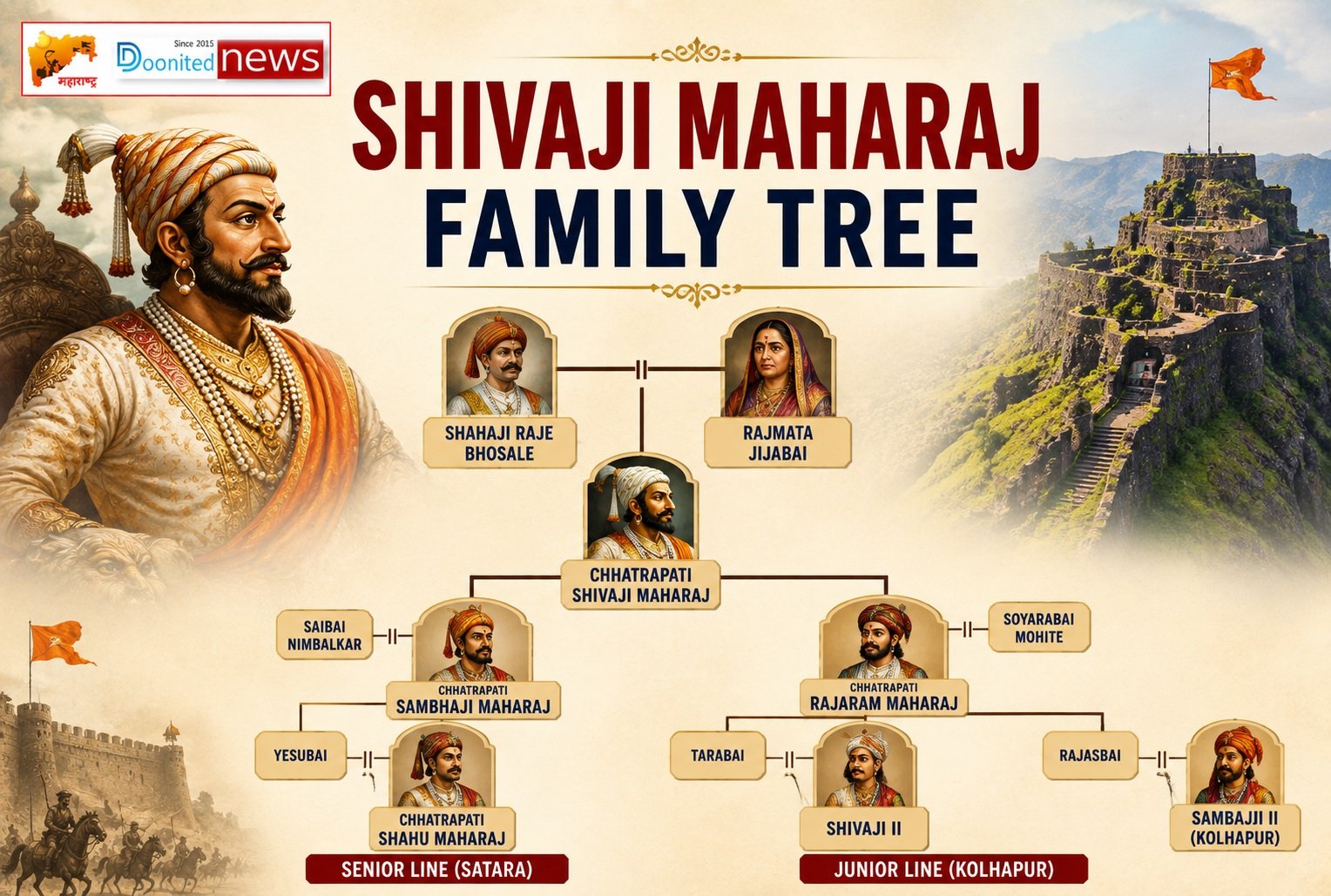
Chhatrapati Shivaji Maharaj Family Tree: The Royal Family That Shaped Maratha History
By Pradeep Banerjee | Editor, Doonited News Maharashtra
A family tree is normally a record of births, marriages and generations.
The family tree of Chhatrapati Shivaji Maharaj, however, became something much larger.
One branch produced Chhatrapati Sambhaji Maharaj, whose reign ended with his execution during the conflict with Aurangzeb. Another produced Chhatrapati Rajaram Maharaj, who continued Maratha resistance during an exceptionally difficult period. Rajaram’s wife Maharani Tarabai subsequently emerged as one of the most consequential women in Maratha political history. And Sambhaji’s son Shahu later became central to another phase of Maratha power. Maharashtra’s historical Gazetteers document this succession from Sambhaji to Rajaram and subsequently to Shahu and the Kolhapur branch.
But to understand this dynasty, we have to begin before Shivaji Maharaj.
We have to begin with his parents.

The Family Tree at a Glance
For readers who want the basic lineage first, the principal succession can be understood like this:
Shahaji Raje Bhosale + Jijabai
↓
Chhatrapati Shivaji Maharaj
↓
Chhatrapati Sambhaji Maharaj — elder son
→ Shahu Maharaj
Chhatrapati Rajaram Maharaj — younger son
→ through Tarabai: Shivaji II
→ through Rajasbai: Sambhaji II of Kolhapur
This simplified tree concentrates on the lines most important to the later political succession. The wider Bhosale family was considerably more complex.
And behind that tree lies an extraordinary story.
Shahaji Raje Bhosale — The Father Before the Founder

Before Shivaji Maharaj created an independent kingdom, his father Shahaji Raje Bhosale had already established the family’s position within the turbulent politics of the Deccan.
This was a seventeenth-century world in which the Deccan Sultanates, the Mughal Empire and numerous military elites competed for territory and influence.
Shahaji was a military commander who served different Deccan powers during his career.
That political environment is important because Shivaji did not emerge in isolation.
He was born into a family already familiar with warfare, administration, landholding, diplomacy and the shifting alliances of Deccan politics.
But another person would have an enormous influence on the young Shivaji.
His mother.
Rajmata Jijabai — The Mother Behind the Maharaj

The story of Shivaji Maharaj’s family cannot be told simply through kings.
Rajmata Jijabai stands at its emotional centre.
She was the daughter of Lakhuji Jadhav of Sindkhed Raja and the wife of Shahaji.
Much of Shivaji’s formative period was spent under her influence.
Popular memory in Maharashtra remembers Jijabai—or Jijau—as the mother who helped shape the character of the future Chhatrapati through religious, ethical and cultural instruction.
Historical storytelling sometimes embellishes precise conversations between Jijabai and the young Shivaji, so those dramatic dialogues should not automatically be treated as documentary fact.
What is beyond dispute is her central position in Shivaji’s life.
One Maharashtra Gazetteer account of Shivaji’s return after his escape from Agra describes him arriving in disguise and falling at his mother’s feet; after initially failing to recognise him, she realised her son had returned.
It is a striking image.
The warrior who had challenged some of the greatest powers of his time returned home first as a son.
Shivaji Maharaj — The Generation That Changed the Family’s Destiny

Shivaji Maharaj transformed the Bhosale family’s political position.
Through a combination of military strategy, fort control, administration, diplomacy and political ambition, he established an independent Maratha kingdom.
The symbolic culmination came at Raigad in 1674, when Shivaji was formally crowned Chhatrapati.
Raigad was no longer simply a fort.
It was a capital.
And the Bhosales were no longer merely another important warrior family.
They had established a royal house.
Yet building a kingdom creates another question:
Who inherits it?
That question would eventually transform Shivaji’s family story into a struggle for succession.
The Wives of Chhatrapati Shivaji Maharaj
Historical sources and genealogical accounts associate Shivaji Maharaj with several marriages.
The names commonly recorded include:
Saibai Nimbalkar, Soyarabai Mohite, Putalabai Palkar, Sakvarbai Gaikwad, Kashibai Jadhav, Sagunabai Shirke, Lakshmibai Vichare and Gunwantibai Ingale.
Spellings and details can vary among historical and genealogical sources, and the surviving evidence is considerably stronger for some members of the royal household than others.
Two women are particularly important to the succession story:
Saibai, mother of Sambhaji, and Soyarabai, mother of Rajaram.
Their sons would become the two principal male lines through which the immediate dynasty continued.
Saibai and Sambhaji — The Elder Branch

Saibai came from the Nimbalkar family and was Shivaji Maharaj’s first wife.
Their son was Sambhaji, born in 1657.
Saibai died while Sambhaji was still young, and the prince grew up in a political environment very different from an ordinary childhood.
He was not simply Shivaji’s son.
He was the potential heir to a kingdom still being created.
That position brought privilege.
But it also brought danger.
Chhatrapati Sambhaji Maharaj — The Eldest Son
After Shivaji Maharaj’s death in 1680, succession did not proceed peacefully.
At the time, Sambhaji was at Panhala.
Soyarabai and some ministers supported her young son Rajaram. Maharashtra’s Gazetteer records describe Rajaram being placed on the throne at Raigad before Sambhaji took control of the situation. Sambhaji ultimately entered Raigad and established his authority.
This is one of the most dramatic episodes in the Bhosale family story.
The founder was dead.
The Mughal threat remained enormous.
And the royal household itself was divided over succession.
Sambhaji emerged as Chhatrapati.
His reign lasted until 1689, when he was captured and executed under Aurangzeb’s authority. Maharashtra’s Gazetteer records the execution and the subsequent captivity of Sambhaji’s son.
But Sambhaji’s branch did not disappear.
His son would return decades later.
His name was Shahu.
Shahu Maharaj — The Captive Prince Who Returned
Sambhaji Maharaj and Yesubai had a son who became known as Shahu Maharaj.
Following the Mughal capture of the royal family, Shahu spent years in captivity.
Then history changed again.
After Aurangzeb’s death in 1707, Shahu was released.
The Maharashtra Gazetteer records that many Marathas accepted him as the rightful representative of Sambhaji’s senior branch.
But another powerful claimant already existed.
That claimant represented Shivaji Maharaj’s younger son’s branch.
And behind that claimant stood one of the most formidable women in Maratha history.
Tarabai.
Soyarabai and Rajaram — The Younger Branch
Soyarabai was the mother of Rajaram, Shivaji Maharaj’s younger son.
Rajaram was still a child when Shivaji died.
The struggle following Shivaji’s death briefly placed Rajaram at the centre of the succession dispute, but Sambhaji ultimately established himself as ruler.
For several years Rajaram remained secondary to his elder brother.
Then Sambhaji was killed.
Suddenly the younger brother became indispensable.
Chhatrapati Rajaram Maharaj — Keeping the Maratha Resistance Alive

After Sambhaji’s death and the capture of Sambhaji’s young son, Rajaram became the effective Maratha ruler.
The political situation was desperate.
Aurangzeb’s campaign against the Marathas had intensified.
Rather than allowing the royal line to be eliminated, Rajaram continued the resistance and eventually operated from Gingee (Jinji) in present-day Tamil Nadu for part of the struggle.
This geographical shift is one of the remarkable chapters of Maratha history.
A dynasty born in the forts of the Sahyadris was now coordinating resistance hundreds of kilometres away.
Rajaram later returned to Maharashtra.
He died in 1700 at Sinhagad, according to the Gazetteer account.
Once again, the dynasty faced the same question:
Who would lead now?
The answer was Rajaram’s widow.
Maharani Tarabai — The Woman Who Refused to Surrender

If Shivaji Maharaj’s family tree were simply a chart of fathers and sons, Tarabai would demonstrate why that chart is inadequate.
She was Rajaram’s wife and the daughter of Maratha commander Hambirrao Mohite.
After Rajaram’s death, Tarabai took charge on behalf of her young son Shivaji II.
The Maharashtra Gazetteers describe her assuming control of the administration while her son was still a child.
She led during one of the hardest phases of the Mughal-Maratha conflict.
Then Shahu returned from captivity.
And the family tree became a political map.
Tarabai supported the claim of Rajaram’s branch.
Shahu represented Sambhaji’s senior branch.
The dispute ultimately contributed to the development of separate centres of royal authority associated with Satara and Kolhapur.
A disagreement within Shivaji’s descendants had helped reshape the political geography of the Maratha state.
Shivaji II — Tarabai’s Son
Tarabai’s son Shivaji II was placed on the throne while still a child.
His claim represented Rajaram’s line against Shahu’s claim through Sambhaji.
But palace politics continued.
Rajaram had another wife, Rajasbai.
And she had a son of her own.
Sambhaji II.
The Kolhapur Gazetteer records that political developments eventually removed Tarabai and Shivaji II from power, while Rajasbai’s son Sambhaji was placed on the gadi.
This illustrates how complicated the Bhosale genealogy becomes after Shivaji Maharaj.
The dynasty was no longer simply:
father → eldest son → grandson.
Marriage alliances, captivity, warfare, competing queens, rival heirs and political factions all influenced succession.
From One Household to Satara and Kolhapur

This is where the family tree becomes particularly important.
Through Sambhaji Maharaj, the senior line continued to Shahu Maharaj, whose political centre became Satara.
Through Rajaram Maharaj, another branch developed around Kolhapur amid the struggles involving Tarabai, Shivaji II, Rajasbai and Sambhaji II.
The Kolhapur Gazetteer explicitly documents these competing descendants and the political struggle between Shahu and Rajaram’s branch.
This was not merely a private royal dispute.
It affected the organisation of Maratha power.
And during Shahu’s period, another office became increasingly important:
the Peshwa.
The Maharashtra Gazetteer records Shahu establishing his capital at Satara and appointing Balaji Vishwanath as his chief minister or Peshwa.
The political structure of the Maratha state was evolving again.
Chhatrapati Shivaji Maharaj’s Family Tree — Simplified Lineage
For WordPress, you can place this section inside a highlighted box:
Shahaji Raje Bhosale
married
Rajmata Jijabai
⬇
Chhatrapati Shivaji Maharaj
Important consorts in the succession story:
Saibai Nimbalkar
⬇
Chhatrapati Sambhaji Maharaj
married Yesubai
⬇
Chhatrapati Shahu Maharaj
→ Senior/Satara succession
Soyarabai Mohite
⬇
Chhatrapati Rajaram Maharaj
Rajaram’s subsequent family included:
Rajaram + Tarabai
⬇
Shivaji II
Rajaram + Rajasbai
⬇
Sambhaji II
→ associated with the Kolhapur succession
This is intentionally a simplified political genealogy, rather than an exhaustive genealogy of every spouse, daughter, child, adoption and collateral Bhosale branch.
What About Shivaji Maharaj’s Daughters?
This is an important point because many popular internet “family trees” focus almost exclusively on male succession.
Historical genealogies also record daughters of Shivaji Maharaj, with names commonly given including Sakhubai, Ranubai, Ambikabai, Rajkunvarbai, Kamalabai and Deepabai/Balibai, although spellings, maternal attribution and some genealogical details vary between secondary sources.
For a news/history article, I recommend not presenting every daughter’s maternal lineage as undisputed fact without a dedicated genealogical source, because different online family trees frequently contradict one another.
The royal women nevertheless mattered considerably through marriage alliances connecting the Bhosale household with other prominent Maratha families.
That is another reason a family tree should never be understood merely as a succession chart.
Why Shivaji Maharaj’s Family Tree Matters

Look at the family again.
Shahaji belonged to the complicated military politics of the Deccan.
Jijabai became one of Maharashtra’s most revered maternal figures.
Their son Shivaji established an independent kingdom.
His eldest son Sambhaji inherited that kingdom during intense Mughal pressure.
After Sambhaji’s death, Rajaram continued resistance.
After Rajaram’s death, Tarabai assumed leadership on behalf of her son.
Then Shahu, Sambhaji’s son, returned from captivity and asserted the senior branch’s claim.
This was not a dynasty enjoying uninterrupted palace life.
For generation after generation, members of the family encountered war, imprisonment, succession disputes, exile, political rivalry and the possibility that the state itself might disappear.
Yet it did not disappear.
That may be the most remarkable aspect of the family story.
A Dynasty Bigger Than a Bloodline
It is tempting to think of the Bhosale family simply as the descendants of one great king.
History tells a more complicated story.
Shivaji Maharaj created institutions, military networks and a political idea capable of surviving the death of its founder.
That is important.
A kingdom dependent entirely upon one individual often collapses when that individual disappears.
Shivaji died in 1680.
The struggle continued.
Sambhaji died in 1689.
The struggle continued.
Rajaram died in 1700.
The struggle continued under Tarabai.
Shahu returned.
The political structure evolved again.
The dynasty changed.
The Maratha state changed.
But the political legacy survived.
The Women in Shivaji Maharaj’s Family Deserve More Attention
There is another lesson hidden inside the family tree.
Look carefully and women repeatedly appear at decisive moments.
Jijabai during Shivaji’s formative years.
Saibai as mother of the senior heir Sambhaji.
Soyarabai in the succession politics following Shivaji’s death.
Yesubai amid the catastrophe following Sambhaji’s capture.
Tarabai as ruler and political strategist after Rajaram’s death.
Rajasbai in the subsequent Kolhapur succession struggle.
A conventional family tree puts kings in large boxes and spouses in smaller ones.
History does not work that way.
In the Bhosale story, several women were active participants in dynastic politics.
Tarabai in particular cannot meaningfully be treated as a footnote to her husband.
She became one of the central political figures of her era.
From Shivneri to Raigad—and Beyond

The geography of Shivaji Maharaj’s family reads almost like a map of Maratha history.
Shivneri — associated with Shivaji’s birth.
Pune — central to his formative years and early political development.
Raigad — the capital and site of his coronation.
Panhala — central to the succession crisis involving Sambhaji.
Gingee — associated with Rajaram’s resistance far from Maharashtra.
Sinhagad — where Rajaram died.
Satara — the later centre associated with Shahu.
Kolhapur — the centre of Rajaram’s competing branch.
These are not isolated tourist destinations.
They are chapters in the same family story.
Conclusion: One Family, Several Generations, an Extraordinary Legacy
The family tree of Chhatrapati Shivaji Maharaj begins as genealogy but quickly becomes the history of Maharashtra itself.
At its centre stands Shivaji Maharaj.
Behind him were Shahaji Raje and Rajmata Jijabai.
After him came Sambhaji Maharaj and Rajaram Maharaj.
Then came another generation—Shahu, Shivaji II and Sambhaji II—along with powerful royal women such as Yesubai and Tarabai.
Their relationships were not always harmonious.
Their political interests sometimes collided.
Their claims to succession divided supporters.
Yet collectively, this family carried the Maratha political legacy beyond the lifetime of its founder.
Perhaps that is why Shivaji Maharaj’s family tree remains so fascinating.
It isn’t simply about asking:
“Who was related to whom?”
The more interesting question is:
“How did one family survive repeated crises and continue influencing the history of Maharashtra long after its founder was gone?”
And once we ask that question, the family tree stops looking like a chart.
It becomes a story of Maharashtra.