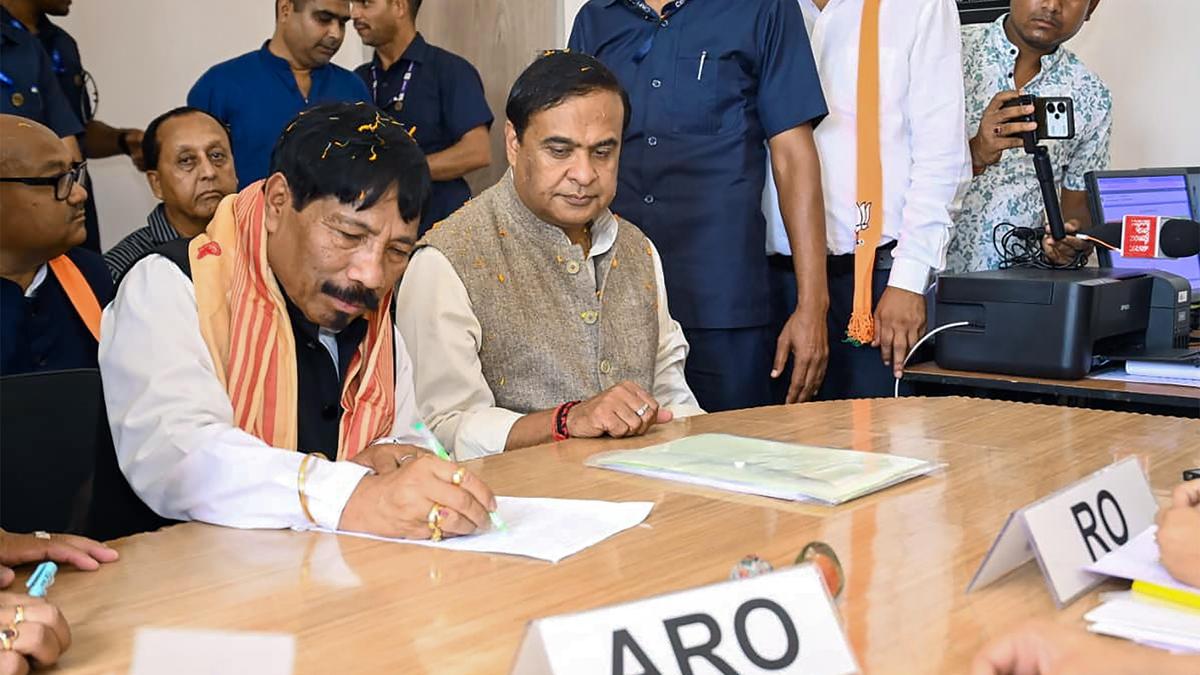
Atul Bora, AGP president and party candidate from Bokakhat constituency, filing his nomination in the presence of Assam CM Himanta Biswa Sarma in Golaghat on Monday.
| Photo Credit: PTI
While an upstart born in the aftermath of the anti-Citizenship (Amendment) Act protests manages to hold its own against the principal Opposition party, the one synonymous with regionalism in Assam is in terminal decline even after enjoying the perks of power for the past decade.
The Raijor Dal, with party chief Akhil Gogoi its sole MLA in the outgoing Assembly and that too as an Independent contesting from jail, has managed to wrangle 11 seats from the Congress after calling off alliance talks and announcing candidates for 13 seats.
The Asom Gana Parishad (AGP), BJP’s junior partner in the ruling National Democratic Alliance, has been given 26 seats. The headline number remains intact from the last election in 2021 – the party contested the same number of seats and won nine – but it’s the constituencies AGP has been relegated to that betrays the steady slide and dwindling bargaining chips vis-a-vis- its senior partner.
Party president and Minister Atul Bora keeps his Bokakhat constituency and Cabinet colleague Keshab Mahanta has been renominated from Kaliabor. Diptimayee Choudhury, the wife of party elder Phani Bhushan Choudhury, who now represents Barpeta in the Lok Sabha after serving eight consecutive terms as MLA from Bongaigaon, has been renominated. Prithviraj Rabha will defend his Tezpur seat while Prodip Hazarika has been shifted to Sivasagar from Amguri due to delimitation.
These are perhaps the only hurrahs for the regional outfit that was forged in the crucible of the Assam Agitation, swept to power in the mid-1980s, and secured another term in government a decade later. Thirteen of the AGP’s candidates this time are from the minority community, the highest proportion among parties barring Badruddin Ajmal’s All India United Democratic Front (AIUDF).
While Mr. Bora explained it away as winnability arithmetic and “local dynamics”, the plain truth is that the BJP, which named no Muslim candidate among its 89, has saddled its ally with the bulk of the post-delimitation constituencies with heavy minority concentration.
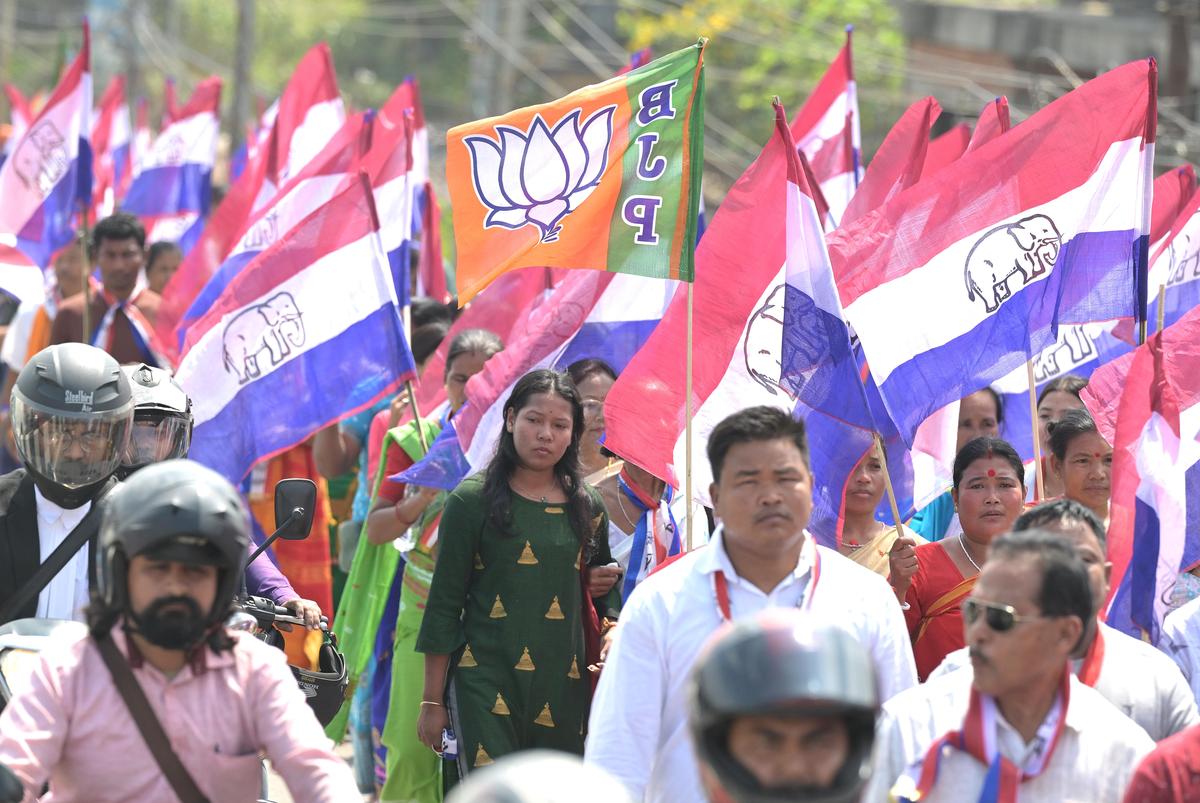
AGP and BJP supporters during a joint rally on the last day of filing nominations, on the streets of Guwahati.
| Photo Credit:
RITU RAJ KONWAR
Local dynamics can scarcely explain the dropping of AGP veteran and party general secretary Ramendra Narayan Kalita, a five-time MLA from Guwahati West constituency, ostensibly on the ground that his constituency is a delimitation casualty. He could have been fielded from the new Guwahati Central seat, which subsumes segments of the abolished seat – instead, the BJP has named Vijay Kumar Gupta.
Tensions had been brewing at the grassroots in several constituencies where local leaders and workers of the AGP fancied the regional party’s chances. The demand was most vociferous in Dergaon and Khumtai in Golaghat district, and Barhampur in Nagaon district; the incumbent legislator in Dergaon is from AGP, and Barhampur – a seat with nostalgic value for having twice elected former Chief Minister Prafulla Kumar Mahanta – had been ceded to the BJP only in 2021. The AGP gets to contest none of the three this time round.
The diminishing coalition returns for the AGP vis-a-vis BJP with respect to seat distribution comes on the back of similar heartburn in the run-up to the 2021 election.
Back then, the regional party contested 26 seats and won nine, but several constituencies historically associated with it – including Patacharkuchi (now Bajali), Kamalpur, Lakhimpur and Naharkatiya, apart from Barhampur – were wrested by the BJP.
The big flip
The AGP, then the incumbent party in power, first allied with the BJP in the 2001 Assembly election that heralded an uninterrupted 15-year Congress rule under current Assam chief Gaurav Gogoi’s father Tarun Gogoi. The party lost power, shedding 39 seats from its 1996 tally of 59, while its junior ally added an equal number of seats to its previous tally of four. By the time the 2016 Assembly election came round, the BJP emerged as the single-largest party with 60 MLAs while AGP won 14 seats.
It’s not inconceivable that the now-junior ally could still match the win count from the 2021 poll, a prospect burnished by the entry of two incumbent MLAs from the Barak Valley from the AIUDF and the BJP’s vote-transfer heft after two terms in power. But the senior and junior tags have flipped irreversibly, and junior is constantly losing ground.
Published – March 24, 2026 12:12 am IST
Doonited Affiliated: Syndicate News Hunt
This report has been published as part of an auto-generated syndicated wire feed. Except for the headline, the content has not been modified or edited by Doonited