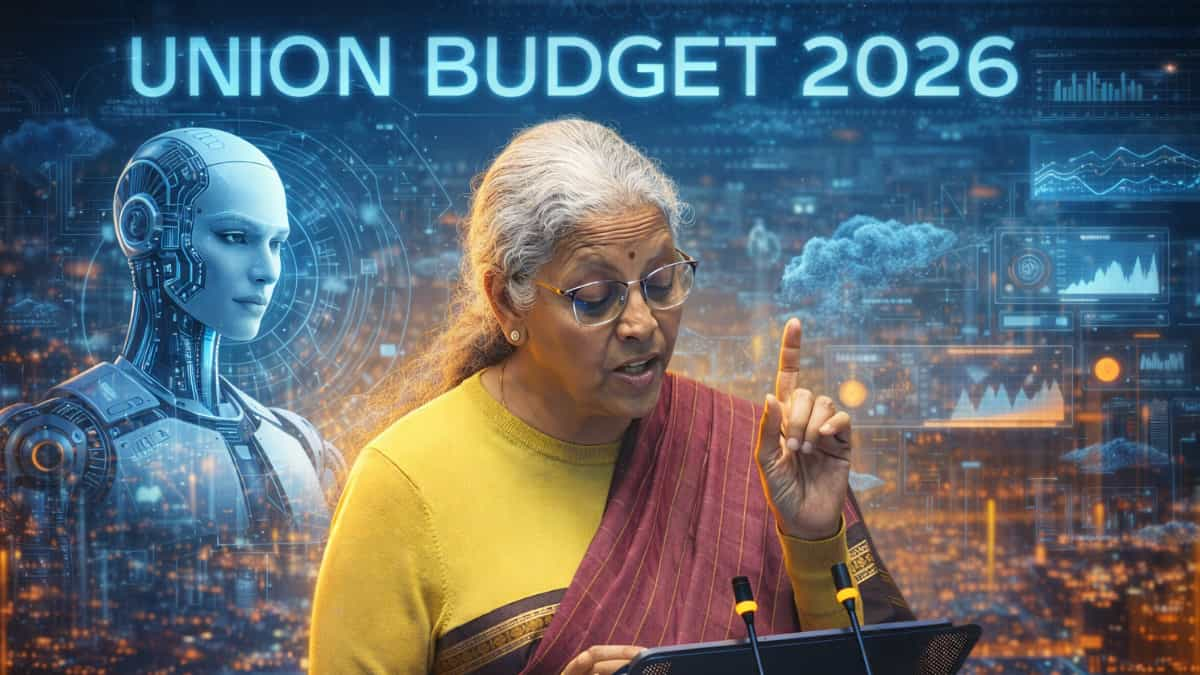
Union Budget 2026: Artificial intelligence, which has captured global attention, featured prominently in Finance Minister Nirmala Sitharaman’s record ninth consecutive Union Budget 2026-27 speech, delivered in Parliament on Sunday.
There was no flashy headline or standalone “AI package,” but AI resonated across governance, jobs, agriculture, education, healthcare, and even customs and security.
From helping farmers make better decisions to strengthening classrooms and enhancing border security, Sitharaman positioned AI as a core tool for India’s growth throughout her speech. In governance, it is described as a force multiplier for improving public service delivery. The Budget also highlighted initiatives such as the AI Mission and the National Quantum Mission while emphasising the need to assess its impact on labour markets, job roles, and future skill requirements.
A key announcement was the launch of Bharat-VISTAAR, a multilingual AI tool designed to expand linguistic accessibility. The platform will integrate AgriStack portals and the Indian Council of Agricultural Research’s (ICAR) agricultural practice packages to provide farmers with customised advisory services. AI is being positioned as a foundational element of India’s growth and reform agenda.
AI for farmers, classrooms and ‘Divyangjan’
One of the more grounded announcements came in agriculture. The government proposed Bharat-VISTAAR, a multilingual AI platform that will integrate AgriStack portals and ICAR’s agricultural practice packages with AI systems.
“I propose to launch Bharat-VISTAAR—a multilingual AI tool that shall integrate the AgriStack portals and the ICAR package on agricultural practices with AI systems. This will enhance farm productivity, enable better decisions for farmers and reduce risk by providing customised advisory support,” Sitharaman said.
Healthcare and accessibility also found space in the AI push. The Budget flagged R&D and integration of AI into assistive devices for Persons with Disabilities, manufactured by ALIMCO. Education, meanwhile, will see AI modules embedded directly into the national curriculum — from school level onwards — along with training programmes for teachers.

Source: Ministry of Finance
As Sitharaman put it, “21st century is technology driven. Adoption of technology is for the benefit of all people — farmers in the field, women in STEM, youth keen to upskill and ‘Divyangjan’ to access newer opportunities.”
Jobs, Skills and a committee watching it all
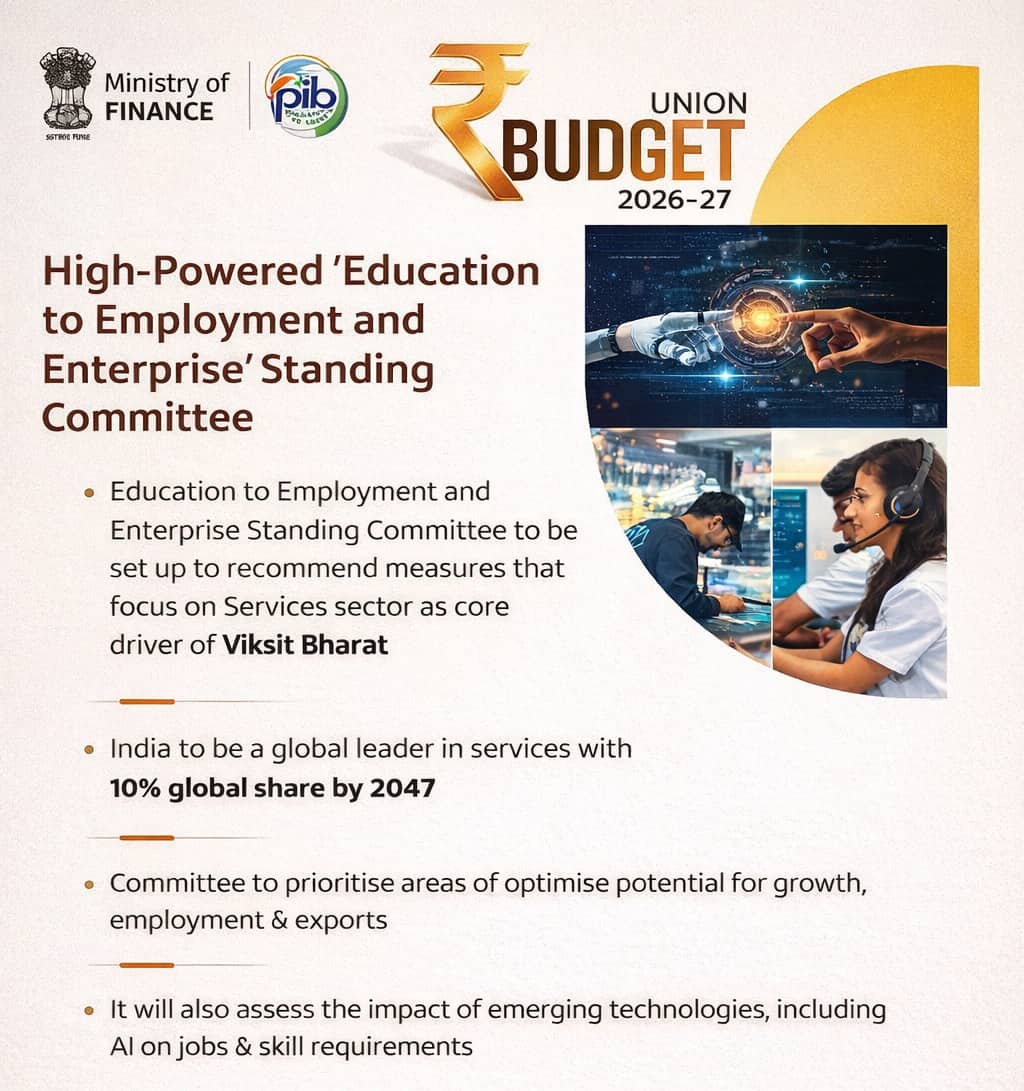
Behind the optimism, the government also acknowledged disruption. To track how AI and other emerging technologies affect employment, Sitharaman announced a high-powered standing committee focused squarely on the services sector.
“I propose to set up a high-powered Education to Employment and Enterprises Standing Committee to recommend measures that focus on the services sector as a core driver of economic growth,” Sitharaman said.
The committee will work towards positioning India as a global services leader, with a target of securing a 10 per cent share in the global services market by 2047. It will also assess how technologies such as AI are reshaping jobs and skill requirements.
Source: Ministry of Finance
Reiterating the government’s long-term vision, Sitharaman said, “I propose to set up a High-Powered ‘Education to Employment and Enterprise’ Standing Committee to recommend measures that focus on the Services Sector as a core driver of Viksit Bharat. This will make us a global leader in services, with a 10 per cent global share by 2047. The Committee will prioritise areas to optimise the potential for growth, employment and exports. They will also assess the impact of emerging technologies, including AI, on jobs and skill requirements and propose measures thereof.”
Data centres: The real power play
For cloud services, the Union Budget brought in a tax holiday until 2047 for foreign companies offering services globally through data centres located in India, provided Indian customers are served through an Indian reseller. It also proposed a 15 per cent safe harbour on costs for related-party data centre services.
The measures are aimed at strengthening India’s position in the global cloud computing and artificial intelligence ecosystem, with industry veterans drawing parallels to earlier policy support that helped shape the country’s information technology sector.
Motilal Oswal Financial Services co-founder and chairman Raamdeo Agrawal called it a moment comparable to the IT incentives of the 1990s in conversation with Zee Business Managing Editor Anil Singhvi.
“The growth orientation was there, of course, but the move made specifically for data centers—this is as big a move as the one made for software in the 1990s, when tax-free status was given. This time, they’ve gone straight up to 2047. In my view, this is one of the biggest and most aggressive steps in the entire budget,” he said.
He also cautioned that the impact will unfold gradually. “It’s something that is very important for society, but it’s also a very big change. It won’t happen overnight or tomorrow, but over a one-, two-, or three-year horizon… this will have a major impact on other parts of the economy as well.”
Digital knowledge grid and AVGC push
The central government also announced plans to establish a National Destination Digital Knowledge Grid to digitally document cultural, spiritual and heritage sites across the country. The initiative is expected to generate employment opportunities for local researchers, historians, content creators and technology partners.
Sitharaman also unveiled support for India’s AVGC (Animation, Visual Effects, Gaming and Comics) sector, announcing that the Indian Institute of Creative Technologies, Mumbai, will set up 15,000 content labs across secondary schools and colleges.
Economic Survey: A reality check
While the Budget set the tone, the Economic Survey 2025–26, presented earlier, stressed the need for India to develop its own AI solutions instead of relying heavily on foreign companies. It noted that while AI is still at an early stage globally, India has a unique opportunity to shape its growth in a way that generates quality jobs and long-term value.
The Survey flagged challenges such as shortages of graphics processing units (GPUs), high costs, limited chip supply, and delays in data centre expansion due to hardware constraints. It added that access to GPUs is likely to remain a major bottleneck for AI growth globally. At the same time, the Survey highlighted India’s strengths, including its position as a leading contributor to global AI research, a large pool of skilled technical talent, and access to extensive domestic data across sectors such as health, agriculture, finance and public services.
Doonited Affiliated: Syndicate News Hunt
This report has been published as part of an auto-generated syndicated wire feed. Except for the headline, the content has not been modified or edited by Doonited