
From Yoga to Ayurveda: How India’s Ancient Wellness Traditions Became a Global Conversation
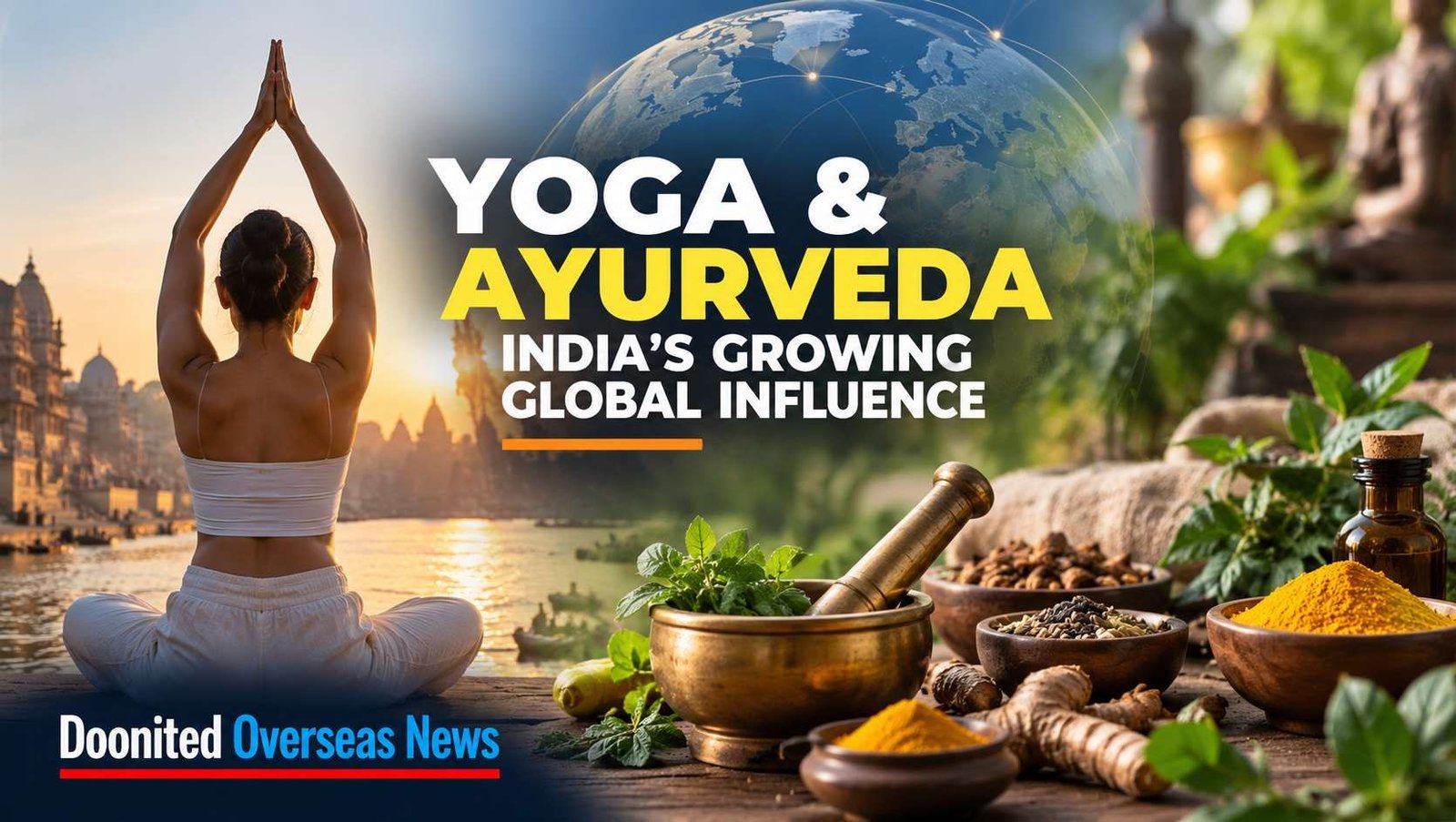
Yoga is now practised across continents, while Ayurveda has moved from Indian households and specialist centres into the international wellness economy. The bigger question is whether India can turn that cultural reach into credible, evidence-based global influence.
India’s influence on the world is increasingly visible in places that have little to do with Bollywood, cricket or information technology.
It can be seen in a yoga class in New York, an Ayurveda centre in Europe, meditation programmes in universities, Indian-inspired wellness retreats in Southeast Asia and growing international interest in plant-based and traditional approaches to health.
What began as ancient Indian knowledge systems has become part of a much larger global conversation about well-being, prevention, healthy ageing and holistic health.
But there is an important distinction between cultural popularity and medical credibility.
India’s next challenge is not simply to persuade more people around the world to practise yoga or buy Ayurvedic products. It is to ensure that the international growth of these traditions is accompanied by standards, evidence, qualified practitioners, consumer protection and respect for the knowledge from which they originated.
That is where India’s cultural diplomacy story becomes more interesting.
Yoga has already crossed the cultural boundary
Few Indian traditions have travelled as successfully as yoga.
The scale of its international reach was visible again in 2026. For the 12th International Day of Yoga, more than 210 Indian Missions were scheduled to organise events at nearly 2,500 locations worldwide. The year’s theme was “Yoga for Healthy Ageing,” shifting attention from yoga as a one-day cultural celebration toward its potential role as a continuing wellness practice. Press Information Bureau
That global network is significant.
Yoga is no longer practised only by people specifically interested in Indian philosophy or spirituality. It has been incorporated into gyms, workplaces, schools, rehabilitation programmes, wellness centres and personal health routines in countries far removed from South Asia.
India’s diplomatic institutions have played a role in that expansion, but the movement’s longevity ultimately depends on local practitioners and communities.
This is one reason yoga represents a particularly successful form of cultural influence.
A country does not need to persuade everyone to adopt its entire culture.
Sometimes a single practice becomes universal enough to create a lasting association with the culture from which it originated.
The diaspora is part of the bridge
Indian communities abroad have long served as cultural bridges, helping introduce yoga, meditation, vegetarian food, Ayurveda, classical arts and festivals to their local communities.
In many countries, Indian-origin entrepreneurs have also created yoga studios, Ayurvedic clinics, wellness businesses, restaurants, food brands and educational programmes.
The diaspora therefore operates at two levels.
It preserves traditions for Indian families living outside India.
At the same time, it can translate those traditions for a non-Indian audience.
That second function is particularly important.
A practice becomes globally sustainable when it can be understood outside its original cultural context without losing its identity.
The challenge is to make Indian traditions accessible without reducing them to stereotypes or commercial clichés.
Ayurveda faces a different test
Ayurveda’s international journey is more complicated than yoga’s.
Yoga can be practised as physical exercise, meditation or a broader mind-body discipline without necessarily making a claim to replace conventional medical treatment.
Ayurveda involves medicines, therapeutic practices, practitioners and health claims.
That brings regulation and evidence into the centre of the international discussion.
The World Health Organization has already recognised this need.
Its WHO benchmarks for the practice of Ayurveda establish minimum requirements covering practitioner qualifications, safety, quality assurance, facilities, health products, regulation and ethical considerations. WHO has also published benchmarks for Ayurveda training. World Health Organization
That is an important development because global acceptance cannot depend solely on cultural enthusiasm.
If Ayurveda is going to become part of international health and wellness systems, patients need to know:
- Who is qualified to practise?
- What treatments are being offered?
- What evidence supports a particular intervention?
- What are the potential risks?
- How are products tested?
- How should Ayurvedic treatment interact with conventional medicines?
These questions are not an attack on Ayurveda.
They are precisely the questions that any health system must ask when a traditional practice enters a modern healthcare environment.
India’s most important global institution may be in Jamnagar
Perhaps the most consequential development in this story is not another yoga event.
It is the establishment of the WHO Global Traditional Medicine Centre in Jamnagar, Gujarat.
WHO established the centre in 2022 with foundational support from the Government of India. Its mandate is explicitly international: to build evidence, data, standards and innovation around traditional medicine rather than simply promote Indian systems abroad. World Health Organization
India committed an estimated US$250 million toward establishing and supporting the centre, including infrastructure and operational support. In 2024, India separately committed US$85 million over 10 years for the centre’s programme of work. World Health Organization
That changes the nature of India’s cultural diplomacy.
Instead of saying:
“The world should accept our traditional knowledge because it is ancient,”
the more powerful proposition is:
“Let’s investigate traditional knowledge using modern science, establish standards and determine where it can contribute safely.”
That is a much stronger global position.
Traditional knowledge meets modern science
The WHO centre’s mandate includes evidence and learning, data and analytics, sustainability and equity, and innovation and technology. WHO says the centre is intended to support countries in developing evidence-based policies, standards and regulation for traditional medicine. World Health Organization
This is particularly relevant in an age of artificial intelligence and biotechnology.
Traditional medicine contains enormous amounts of historical knowledge about plants, formulations, practices and therapeutic traditions.
But historical use is not automatically equivalent to clinical proof.
Modern research can potentially investigate traditional practices through:
- clinical studies;
- pharmacological research;
- genomics;
- digital health;
- data analytics;
- AI-assisted evidence mapping;
- quality-control technologies;
- and systematic safety monitoring.
WHO itself notes that traditional medicine research is increasingly intersecting with technologies such as AI, genomics and other scientific approaches. World Health Organization
That creates an intriguing possibility.
India’s ancient knowledge could become part of a modern global research ecosystem without being frozen in the past.
Food is becoming another form of cultural diplomacy
Yoga and Ayurveda are only part of India’s wellness influence.
Indian food traditions are also travelling.
Turmeric, spices, lentils, fermented foods, vegetarian cooking, millets, herbal beverages and regional dietary traditions increasingly appear in international discussions around plant-based eating and healthy lifestyles.
But here too, caution is necessary.
It would be misleading to suggest that every traditional Indian food practice has been scientifically proven to provide particular medical benefits.
The more interesting story is cultural.
Indian food offers the world a different vocabulary of eating—one built around diversity of ingredients, spices, regional traditions and combinations of plant-based foods.
For the diaspora, food is often the easiest cultural entry point.
A person may never study Sanskrit philosophy or visit an Ayurvedic clinic, but they may encounter India through a thali, masala chai, turmeric or a vegetarian meal.
Cultural influence frequently begins with something as ordinary as food.
From cultural export to global wellness economy
There is also a substantial commercial opportunity.
The global wellness economy has expanded far beyond conventional healthcare. Consumers spend on fitness, nutrition, mindfulness, spa services, supplements, retreats and preventive health.
Indian businesses are therefore operating in an international market where the country’s cultural heritage has considerable recognition.
But that opportunity comes with a warning.
India should not allow “Ayurveda” or “Indian wellness” to become labels applied to products that have little meaningful connection with Indian traditions or inadequate quality controls.
Authenticity matters commercially as well as culturally.
If international consumers encounter exaggerated health claims, poorly regulated products or unqualified practitioners, the damage does not remain with one company.
It can affect confidence in the wider tradition.
This is why international standards could ultimately become an advantage for India’s wellness industry.
The diaspora’s next opportunity
For Overseas Indians, the growth of global wellness creates opportunities beyond cultural preservation.
Indian-origin professionals are increasingly active in:
- wellness entrepreneurship;
- yoga education;
- nutrition;
- hospitality;
- healthcare;
- research;
- natural products;
- wellness tourism;
- digital health;
- and cross-border education.
That creates a new form of diaspora entrepreneurship.
The next generation may not simply run an Indian restaurant or cultural organisation.
They could build global wellness companies rooted in Indian knowledge but designed for international consumers.
That requires a different skill set: scientific literacy, regulatory knowledge, product development, international marketing and cultural sensitivity.
The strongest businesses are likely to be those that combine these capabilities rather than relying purely on the “ancient Indian wisdom” label.
The credibility challenge
India’s cultural influence is already substantial.
The harder task is turning influence into trusted global knowledge.
Yoga has already achieved extraordinary cultural acceptance. Ayurveda has growing international visibility. Indian food, meditation and wellness practices continue to enter global lifestyles.
But global recognition creates responsibility.
India must distinguish:
tradition from marketing,
wellness from medical treatment,
historical knowledge from scientifically established evidence,
and cultural pride from exaggerated claims.
That distinction will determine whether India’s wellness influence remains a fashionable global trend or becomes a durable part of international health and lifestyle culture.
India’s soft power is becoming everyday power
There is something particularly interesting about the way these traditions have travelled.
A government can sign a diplomatic agreement.
A corporation can acquire a foreign company.
A technology company can sell software overseas.
But cultural influence works differently.
It enters people’s lives quietly.
A yoga mat.
A meditation session.
A bowl of dal.
A turmeric-based product.
An Ayurvedic consultation.
A wellness retreat.
A festival.
These are small points of contact, but multiplied across millions of people they can reshape perceptions of a country.
That is the deeper significance of India’s wellness traditions abroad.
Yoga and Ayurveda are no longer simply exports of Indian culture. They are becoming part of a global conversation in which India is increasingly being asked to contribute knowledge, standards and evidence.
For the Indian diaspora, that creates an unusual opportunity: to be both custodians of heritage and participants in its modern evolution.
The next stage of India’s cultural diplomacy may therefore depend less on telling the world about India’s ancient past—and more on demonstrating how that knowledge can responsibly contribute to the world’s future.

World Beyond the News
Dolphins Use Individual Signature Whistles
Bottlenose dolphins develop distinctive whistles that function somewhat like individual acoustic identifiers.
The Pacific Is Earth’s Largest Ocean
The Pacific Ocean covers more area than any other ocean basin and stretches between Asia, Australia and the Americas.
Artificial Intelligence Learns Statistical Patterns
Modern machine-learning systems identify patterns in large datasets and use those patterns to generate predictions or outputs.
Why Some Stories Spread So Quickly
Emotion, novelty, visual appeal and easy sharing can make a story travel rapidly across social platforms.