
BharatGen: How India Is Building AI That Speaks to Its Diaspora
India’s BharatGen is moving beyond the idea of a single home-grown chatbot. With multilingual foundation models, speech, document intelligence and India-specific datasets, the government-supported initiative is attempting to build an AI layer that understands the country’s languages and social context — with potential implications far beyond India’s borders.
Artificial intelligence is becoming global. The data, however, is not equally global.
Many of the world’s most powerful AI systems were developed primarily around languages, datasets and cultural contexts in which English dominates. That does not make them incapable of serving Indian users, but it can leave important gaps when the task involves India’s many languages, scripts, administrative documents, cultural references and local knowledge systems.
That is the problem BharatGen is attempting to address.
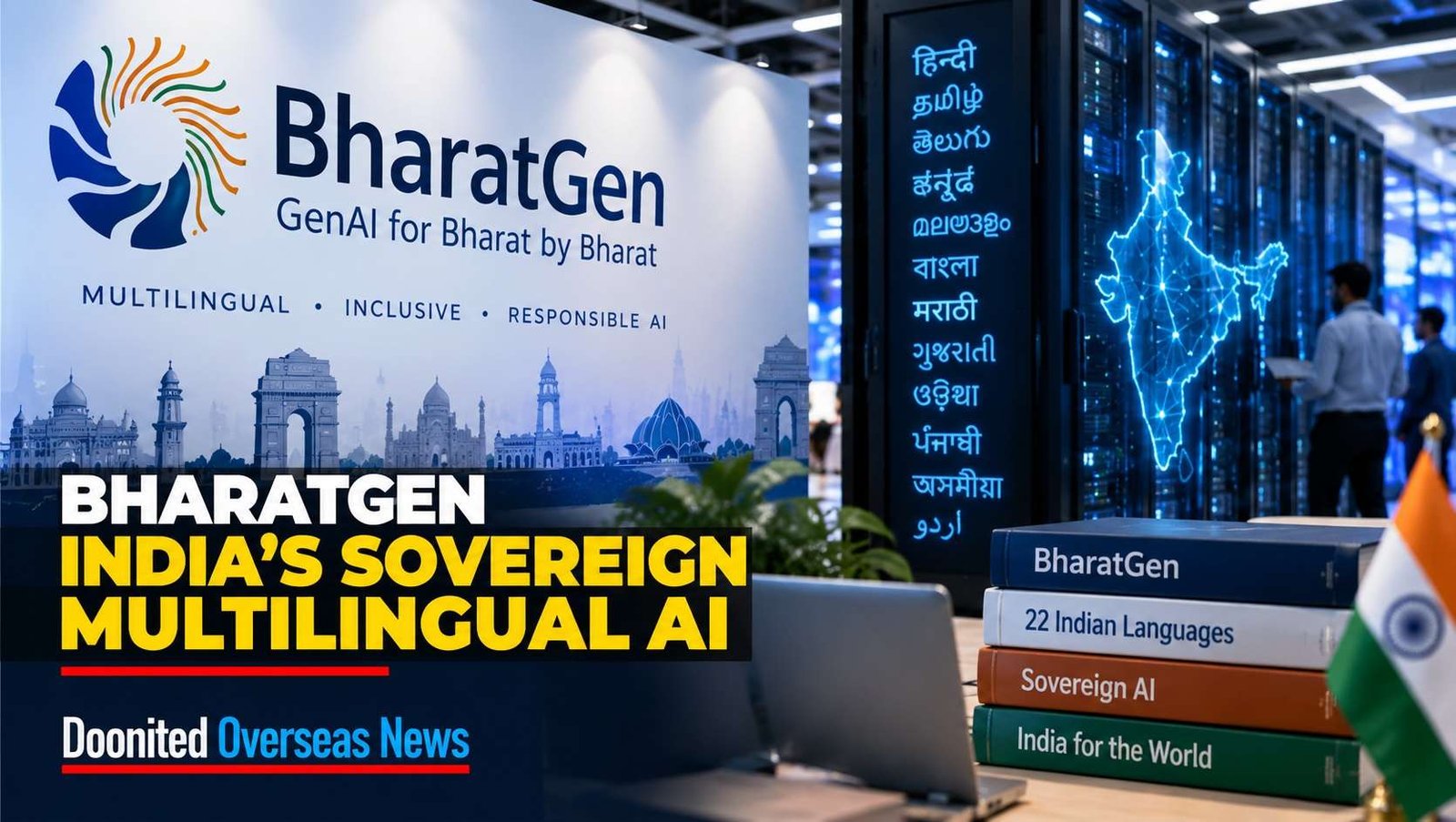
Led by IIT Bombay through the National Mission on Interdisciplinary Cyber-Physical Systems (NM-ICPS), with support from India’s Department of Science and Technology and the IndiaAI Mission, BharatGen has developed a family of sovereign, multilingual and multimodal AI models. The initiative was launched in June 2025 and is now part of India’s wider push to develop domestic foundational AI capabilities.
For Indians living overseas, however, BharatGen is more than another Indian technology project.
Its significance lies in a question that increasingly matters to the global Indian community:
Can AI understand India not merely as a market, but as a multilingual civilisation whose people, languages and cultural identities extend far beyond India’s borders?
From one AI model to an ecosystem
BharatGen should not be viewed simply as India’s answer to ChatGPT.
It is being developed as an ecosystem spanning text, speech and vision-language technologies, alongside datasets and domain-specific models.
Its flagship text system, Param2, is a 17-billion-parameter mixture-of-experts model. BharatGen says it was trained on approximately 22 trillion tokens and supports English plus all 22 Scheduled Indian languages. Its capabilities include reasoning, mathematics, coding and tool calling. Bharat Gen
The broader stack includes:
- Shrutam, for automatic speech recognition.
- Sooktam, for text-to-speech.
- Patram, a 7-billion-parameter vision-language document model designed to understand complex Indian documents.
- AyurParam, AgriParam, FinanceParam and LegalParam, specialised models targeting Indian knowledge and sectoral applications.
This architecture matters because real-world AI rarely involves text alone.
A citizen might speak rather than type. A government employee might need to process a scanned document. A farmer might need information in a regional language. A lawyer might need to search Indian legal material.
BharatGen is therefore trying to build AI around the way people actually interact with institutions.
The language problem is bigger than translation
For the Indian diaspora, the most interesting part of BharatGen may be its linguistic strategy.
India’s scheduled languages are not simply alternative versions of English. They contain different scripts, linguistic structures, cultural references and patterns of spoken communication.
And Indian languages do not stop at India’s borders.
Hindi, Punjabi, Tamil, Telugu, Gujarati, Bengali, Malayalam, Marathi and other Indian languages are spoken by diaspora communities across North America, Britain, the Gulf, Southeast Asia, Africa, Europe and Australasia.
That creates a potentially important international use case.
An AI system that can understand a grandmother speaking Punjabi in Canada, a Tamil-speaking family in Singapore, a Hindi-speaking student in Britain or a Telugu-speaking entrepreneur in the United States is addressing a problem that is simultaneously Indian and global.
The value is not merely translation.
It is linguistic continuity.
For diaspora families, language is often one of the strongest links to cultural identity. Better AI support for Indian languages could eventually make education, digital content, accessibility tools and communication more useful for people who live thousands of kilometres from India.
That potential should not be confused with a guarantee: performance across every dialect, accent and real-world context still needs independent evaluation.
Bharat Data Sagar: the less visible strategic asset
Perhaps the most strategically important part of BharatGen is not Param2.
It is the data behind the models.
BharatGen’s Bharat Data Sagar initiative is intended to create large India-centric datasets covering language, culture, heritage and other domains. The project’s stated objective is to improve India’s control over the data resources required for future AI development.
This addresses one of the fundamental realities of modern AI:
Models are only as good as the data and evaluation systems behind them.
India has enormous amounts of potentially valuable material — literature, newspapers, government records, educational content, legal documents, agricultural knowledge and multilingual speech.
But digitising, cleaning, licensing, annotating and evaluating that material at scale is difficult.
BharatGen’s own current dataset programme includes benchmarks and datasets covering areas such as law, finance, agriculture, Ayurveda and low-resource Indic languages.
For the global Indian community, this raises an interesting possibility. The next generation of AI systems may need diaspora-generated language and cultural data as well as data originating inside India.
That could make overseas Indians participants in the development of Indian-language AI rather than simply consumers of it.
From research project to national infrastructure
India’s government has put significant resources behind the broader sovereign-AI effort.
BharatGen received ₹988.6 crore under the IndiaAI Mission in 2025, with the funding intended to scale foundational and multimodal models and support models ranging up to much larger parameter sizes.
Separately, the government says the IndiaAI Mission has supported 20 indigenous foundation-model proposals, including BharatGen, and has expanded shared AI compute infrastructure. By August 2026, more than 38,000 GPUs had been empanelled through the programme, with further capacity being added.
That is important because sovereign AI requires more than a good research paper.
It requires compute, data, researchers, infrastructure, deployment partners and users.
BharatGen’s partnership ecosystem has consequently expanded beyond academia. The initiative has announced collaborations involving industry, government departments and state governments, while its public materials show models and datasets being made available through platforms including AI Kosh and Hugging Face.
Why sovereignty matters to Indians overseas
“Sovereign AI” can sound like a geopolitical slogan.
There is, however, a practical dimension.
When a country relies entirely on AI infrastructure controlled elsewhere, it can have less control over model availability, data governance, deployment conditions, costs and the technological assumptions embedded in the systems it uses.
For India, with its population scale and linguistic diversity, that dependence could become significant.
For the diaspora, the question is slightly different.
Indian-origin companies and professionals increasingly operate between multiple jurisdictions. They may build products in the United States, employ teams in India, serve customers in the Gulf and Europe, and use Indian languages in their customer interfaces.
An India-centric AI ecosystem could eventually provide another layer of infrastructure for those businesses.
But cross-border deployment will still depend on privacy laws, intellectual-property rules, AI regulation, data-transfer requirements and the licensing terms attached to particular models and datasets.
“Sovereign” does not automatically mean “globally deployable.”
The public-service opportunity
BharatGen’s strongest argument may ultimately be in applications rather than benchmark scores.
The government has identified healthcare, agriculture, education and governance among potential application areas. BharatGen has already developed specialised models for agriculture, Ayurveda, finance and law.
Consider the diaspora implications.
An Indian citizen overseas may need to understand an Indian government document, navigate a legal or financial process in India, communicate with relatives in a regional language or access information about a public service.
A future multilingual AI layer could potentially make such interactions easier.
For diaspora communities, there is also an educational opportunity. Children raised outside India often understand an Indian heritage language but may not read or write it fluently. Better speech, translation and educational AI could help maintain those connections.
Again, these are potential applications, not claims that BharatGen currently provides all of these services.
The difficult questions India still has to answer
BharatGen’s ambition is substantial, but the project should not be judged only by the number of languages or parameters.
The harder questions are about quality, safety, transparency and adoption.
Does the model perform equally well across all 22 languages?
How does it handle dialects and code-switching?
How are copyrighted materials handled?
How is sensitive personal information protected?
How frequently are models evaluated for bias and hallucination?
Who can audit the training data?
And how open will the most advanced models actually be?
These questions matter particularly because India plans to use AI in areas where mistakes can have real consequences.
The government itself acknowledged in February 2026 that the framework governing access, pricing, data sharing and safeguards for BharatGen was still being worked out.
That is not necessarily a weakness. It is a reminder that building a sovereign model is only the first stage.
The global Indian opportunity
There is a larger story here.
India’s technology relationship with its diaspora has historically moved through software services, engineering talent, startups and global technology companies.
AI adds another dimension: language and cultural infrastructure.
Indian-origin researchers abroad can contribute to evaluation and research. Diaspora entrepreneurs can build applications around Indian-language models. Universities can collaborate on low-resource language research. Community organisations can help test systems in real-world linguistic environments.
The diaspora can also provide something AI developers cannot manufacture in a laboratory: living multilingual communities.
That could become valuable as India tries to make its AI models internationally useful without stripping away the cultural context that makes them distinctive.
BharatGen should not be celebrated simply because it is “Indian-made.”
Its real test is harder.
Can India build AI that is technically competitive and genuinely useful across its extraordinary linguistic diversity? Can it create trustworthy data, rigorous evaluation and responsible governance? Can its models become useful beyond India’s borders without compromising privacy or cultural integrity?
If it succeeds, BharatGen could represent something more important than another national LLM.
It could become part of a new model of technological globalisation in which countries do not have to choose between using international AI and preserving their own linguistic and cultural identity.
For the Indian diaspora, that distinction is particularly meaningful.
India’s AI future may not only be about building machines that understand India. It may be about building machines that allow Indians around the world to remain connected to it.


World Beyond the News
Octopuses Can Change Their Appearance
Octopuses can rapidly alter their skin colour and texture to communicate, camouflage themselves and respond to danger.
Some Cities Exist Across Two Continents
A small number of cities are geographically associated with two continents, creating unusual cultural and geographic identities.
Earth’s Climate Is Measured in Many Ways
Scientists track temperature, atmospheric gases, sea level, ice cover and other indicators rather than relying on a single climate number.
Streaming Changed How Audiences Discover Shows
Recommendation systems and global streaming releases allow audiences to discover programmes far beyond their original markets.