
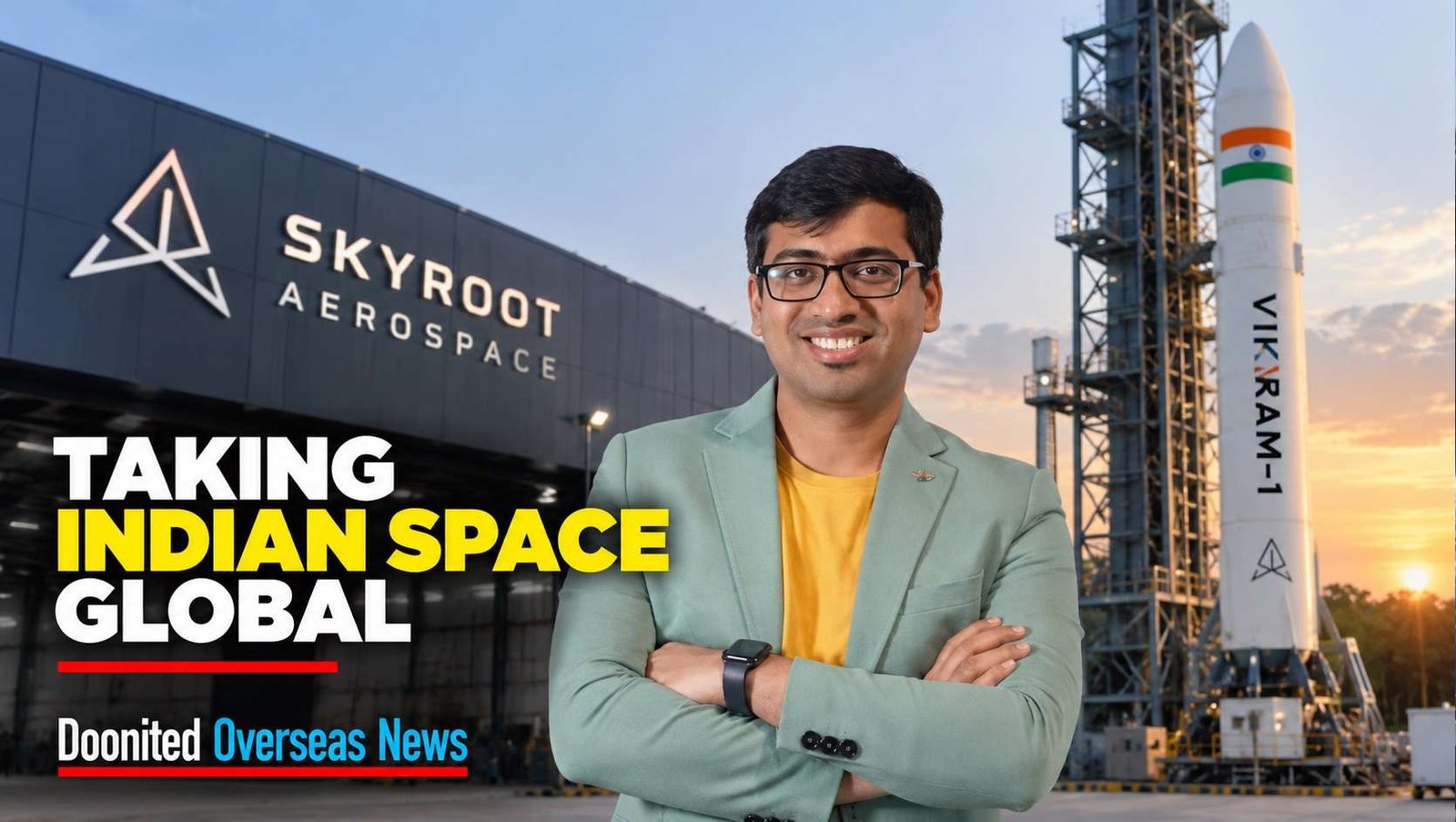
Pawan Kumar Chandana: The Indian Space Entrepreneur Taking Private Rockets Global
After spending years inside ISRO, Pawan Kumar Chandana helped build Skyroot Aerospace into a private launch company capable of reaching orbit. Vikram-1’s July 2026 success has now turned that ambition into a commercial proposition — and TIME’s recognition of Chandana puts a new face on India’s rapidly expanding space economy.
For decades, India’s space story was overwhelmingly associated with one institution: ISRO.
That story is changing.
On July 18, 2026, a rocket developed by Hyderabad-based Skyroot Aerospace lifted off from Sriharikota and successfully reached Low Earth Orbit. It was not simply another Indian launch. It was the first time a private Indian company successfully conducted an orbital launch from Indian soil.
Behind that achievement is Pawan Kumar Chandana, Skyroot’s co-founder and CEO, a former ISRO scientist who moved from designing space systems inside India’s national space programme to building a private company capable of selling launch services to customers around the world.
His inclusion in TIME100 Next 2026, a list recognising emerging leaders shaping the future, gives the achievement a wider international context. TIME describes TIME100 Next as a platform for people shaping the future and defining the next generation of leadership. TIME
For Doonited Overseas, Chandana’s story is particularly relevant because it represents an important evolution in the Indian diaspora-and-global-technology narrative: Indian talent is not only helping international companies build the future; increasingly, Indian engineers are building globally oriented technology companies from India itself.
From ISRO scientist to private-space entrepreneur
Chandana’s career began within India’s government space programme.
After studying mechanical engineering and thermal sciences at IIT Kharagpur, he spent several years at the Vikram Sarabhai Space Centre, one of ISRO’s principal centres for launch-vehicle development.
That experience gave him exposure to the highly specialised world of propulsion, thermal systems and launch vehicles.
In 2018, Chandana and fellow former ISRO engineer Bharath Daka co-founded Skyroot Aerospace in Hyderabad.
The decision was significant because India’s private space sector was still in its early stages.
The government’s 2020 reforms subsequently opened space activities to private companies, while the creation of IN-SPACe provided a regulatory and facilitation mechanism for non-governmental entities. The policy environment enabled startups to participate in areas previously dominated by government institutions. ISRO
Skyroot became one of the most visible beneficiaries of that change.
Vikram-S proved the concept
The company’s first major public milestone came in November 2022.
Vikram-S, an all-carbon-composite suborbital rocket, launched from Sriharikota on November 18, 2022.
It did not reach orbit, and it was never intended to. Its purpose was to validate technologies required for Skyroot’s future orbital vehicles.
Skyroot says the mission demonstrated its in-house solid propulsion system, avionics, telemetry and carbon-composite structures. The government subsequently described Vikram-S as India’s first privately developed rocket to launch from Sriharikota. Skyroot
The lesson was straightforward: a private Indian company could move beyond designing components or building satellites and attempt the much harder job of developing an entire launch vehicle.
But the real test was still ahead.
Vikram-1 changes the equation
On July 18, 2026, Skyroot’s Vikram-1 launched from the Satish Dhawan Space Centre.
ISRO confirmed that the mission successfully placed two satellites, SCOPE and Grahaa, into Low Earth Orbit, while other payloads were used for in-orbit experiments.
The four-stage vehicle was developed for small-satellite launches and has a stated capacity of up to 350 kilograms to Low Earth Orbit. Skyroot says the rocket combines solid-fuel boosters with a liquid-powered upper stage and an all-carbon-composite structure.
The government has highlighted several technologies incorporated into the vehicle, including a 3D-printed liquid engine and carbon-composite stages. Press Information Bureau
But perhaps the most important achievement was not any individual component.
It was integration.
A commercial orbital launcher must combine propulsion, structures, avionics, navigation, telemetry, flight control, safety and payload operations into one system that works on schedule.
Vikram-1 demonstrated that Skyroot could do that.
The ISRO connection remains important
There is a useful irony in Chandana’s story.
Skyroot’s success is often described as evidence of India’s private space revolution, but the private sector did not develop in isolation from ISRO.
ISRO and IN-SPACe supported Skyroot’s Vikram-1 mission by providing access to facilities, testing infrastructure, technical support and launch-related assistance. ISRO says its facilities at Sriharikota were used for solid-motor casting and testing, while its Liquid Propulsion Systems Centre supported testing of the Vikram-1 upper-stage liquid engine.
IN-SPACe played a regulatory and facilitation role, helping Skyroot access government facilities and obtain the necessary launch clearances.
This is an important distinction for understanding India’s emerging space economy.
The story is not private sector versus ISRO.
It is increasingly private sector plus public infrastructure and expertise.
That model could become one of India’s biggest competitive advantages if it can be sustained.
The commercial opportunity is global
Small satellites have transformed the economics of space.
Earth observation, communications, scientific research, climate monitoring and technology demonstrations are generating demand for launch capacity. Companies increasingly want launches that are predictable, flexible and tailored to their orbital requirements.
Skyroot is positioning Vikram-1 directly in that market.
The company currently advertises both dedicated and rideshare missions, with the ability to provide custom orbital parameters and payload configurations. Its launch-service platform is explicitly designed for international customers as well as Indian missions.
This is where Chandana’s achievement becomes more than a national milestone.
India is trying to become a commercial space hub, not simply a country capable of launching its own spacecraft.
The government’s July 2026 assessment put India’s space-startup count at more than 400, compared with one startup in 2014, and projected the country’s space economy to grow from roughly $8.4 billion to $40–45 billion by 2030. These are government projections rather than guaranteed outcomes, but they demonstrate the scale of India’s ambition.
Vikram-II is the next test
Vikram-1 is not the end of Skyroot’s launch programme.
The company is developing Vikram-II, a larger vehicle using a cryogenic engine.
Skyroot currently lists a target of up to 900 kg to Low Earth Orbit and up to 600 kg to Sun-synchronous orbit, with a planned 2027 launch.
If achieved, that would move Skyroot into a substantially different part of the launch market.
But this is also where the difficulty increases.
A successful maiden orbital launch establishes credibility. Building a commercially reliable launch service requires repeated successful missions, competitive pricing, insurance acceptance, manufacturing scale, launch cadence and customer confidence.
Space companies do not become global simply because one rocket works.
They become global when customers repeatedly trust them with expensive spacecraft.
Why this matters to Indians overseas
Chandana’s career offers an interesting lesson for the global Indian technology community.
Indian engineers have long been prominent inside NASA, SpaceX, Boeing, aerospace suppliers, semiconductor companies and research universities.
The emerging Indian space-startup ecosystem creates another route.
Instead of moving abroad to work on advanced aerospace technology, engineers can increasingly build advanced aerospace companies from India and for international markets.
That creates opportunities for the diaspora in several directions.
Indian-origin engineers abroad can become collaborators, investors, suppliers or customers. International venture capital can participate in Indian space companies. Overseas satellite operators can become launch customers. Indian professionals with expertise in aerospace regulation, insurance, manufacturing and international business can help connect Indian launch providers to global markets.
The relationship therefore becomes more circular.
Talent can move from India to the world — and experience, capital, partnerships and markets can move back toward India.
The bigger challenge: becoming dependable
There is a temptation to compare every ambitious space entrepreneur with Elon Musk.
That comparison is less useful than it sounds.
India does not need a copy of SpaceX. Its opportunity is to develop a commercially viable launch ecosystem suited to its own strengths: engineering talent, relatively cost-conscious manufacturing, an established national space programme and an expanding domestic satellite market.
Skyroot’s real challenge now is repeatability.
Can Vikram-1 fly regularly?
Can Skyroot maintain quality as production increases?
Can Vikram-II deliver the promised increase in payload capacity?
Can international customers be persuaded to book launches years in advance?
And can India develop enough launch infrastructure, suppliers, insurance and regulatory capacity to support multiple private providers?
Those questions will determine whether July’s achievement becomes the beginning of a business or simply a historic milestone.
Doonited Overseas Editorial View
Pawan Kumar Chandana’s story is ultimately bigger than one rocket.
It represents a generational transition in Indian technology.
A former ISRO engineer moved from working inside a government space institution to creating a private company, and that company has now successfully carried customer satellites into orbit from India. The public institution that helped train the ecosystem is increasingly becoming an enabler of private competition rather than its only participant.
That is a significant change.
For the global Indian community, the message is equally important.
India’s technology story is no longer restricted to software services or large IT companies. Space launch, advanced manufacturing, propulsion, robotics and deep technology are becoming new arenas in which Indian talent can build globally relevant businesses from India.
TIME’s recognition of Chandana is therefore timely.
The next chapter of India’s space story may not be written only by national missions.
It may be written by entrepreneurs who take Indian engineering, public-sector experience and private capital — and turn them into companies competing for customers in the global space economy.

World Beyond the News
Octopuses Can Change Their Appearance
Octopuses can rapidly alter their skin colour and texture to communicate, camouflage themselves and respond to danger.
Some Cities Exist Across Two Continents
A small number of cities are geographically associated with two continents, creating unusual cultural and geographic identities.
Earth’s Climate Is Measured in Many Ways
Scientists track temperature, atmospheric gases, sea level, ice cover and other indicators rather than relying on a single climate number.
Streaming Changed How Audiences Discover Shows
Recommendation systems and global streaming releases allow audiences to discover programmes far beyond their original markets.