
India’s Technology Sovereignty Push: From Space Docking to Homegrown Chips and Earth Observation
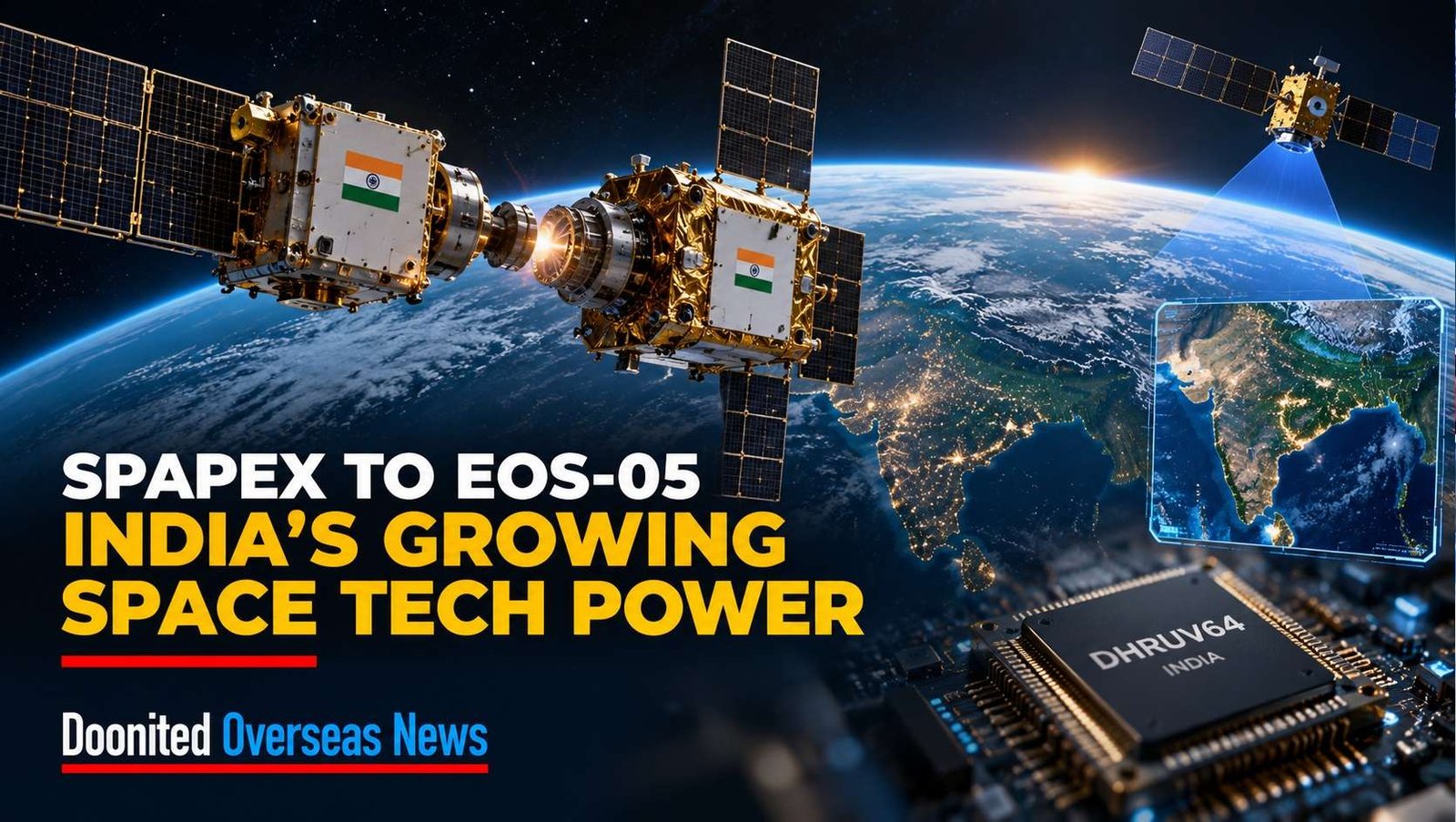
India’s technology-sovereignty strategy is increasingly moving beyond individual breakthroughs. SpaDeX has demonstrated autonomous orbital docking, ISRO and SCL have developed indigenous space-grade processors, DHRUV64 has expanded the domestic RISC-V processor pipeline, and EOS-05 is adding a new geosynchronous Earth-observation capability. Together, they show how India is trying to control more of the critical technology stack — with implications for the global Indian technology community.
India’s technological sovereignty is no longer confined to a slogan about manufacturing products domestically.
The more consequential question is whether the country can control critical technologies at the level of algorithms, processors, spacecraft systems, data and infrastructure.
Recent developments across India’s space and semiconductor programmes suggest that this is increasingly the direction of travel.
The country’s SpaDeX mission demonstrated autonomous rendezvous, docking and undocking between two spacecraft, including electrical power transfer. ISRO and its Semiconductor Laboratory have developed indigenous processors qualified for demanding space applications. C-DAC’s DHRUV64 has added a domestically developed 64-bit RISC-V processor to India’s wider chip-design effort. And in September 2026, ISRO launched EOS-05, described by the agency as India’s first imaging satellite from geosynchronous orbit.
Taken together, these are more significant than four unrelated technology stories.
They point toward a strategy in which India is attempting to reduce dependence on external technology at several layers of strategically important infrastructure.
For the global Indian community, that matters because the diaspora is deeply embedded in the international technology, engineering, semiconductor, aerospace and data ecosystems that will determine whether this strategy succeeds.
SpaDeX: learning to build infrastructure in orbit
The Space Docking Experiment, or SpaDeX, began with the launch of two small spacecraft aboard PSLV-C60 on December 30, 2024.
The mission’s objective was deliberately narrow but technically demanding: demonstrate the ability of two spacecraft to rendezvous, approach one another and dock in orbit.
The first docking took place on January 16, 2025. The spacecraft were subsequently undocked on March 13. On April 20, ISRO completed a second docking, this time fully autonomously from an inter-satellite distance of 15 metres, followed by successful electrical power transfer between the spacecraft on April 21.
That capability has strategic importance because future missions do not necessarily have to launch as one enormous spacecraft.
ISRO itself identifies docking as an enabling technology for missions involving multiple launches, the Bharatiya Antariksh Station (BAS) and future lunar exploration. The agency specifically describes SpaDeX as a precursor to autonomous docking needed for Chandrayaan-4.
Chandrayaan-4 illustrates why.
ISRO’s approved mission architecture involves multiple launches whose components will be assembled by docking in Earth orbit before the combined spacecraft travels toward the Moon. The mission will also require docking after lunar sample collection before the samples can be returned to Earth.
India therefore isn’t merely demonstrating that it can dock two satellites.
It is developing a building block for more complex space infrastructure.
ISRO says the SpaDeX achievement made India the fourth nation to demonstrate docking in space.
The processor inside the spacecraft matters too
A spacecraft can be brilliantly designed and still depend on components that a country cannot easily replace.
That makes indigenous semiconductor capability particularly important for strategic space systems.
In March 2025, ISRO and the Semiconductor Laboratory (SCL), Chandigarh handed over the first batches of two indigenous 32-bit processors — VIKRAM3201 and KALPANA3201.
VIKRAM3201 is described by the government as India’s first fully Make-in-India 32-bit microprocessor qualified for the harsh environmental conditions of launch vehicles. It was fabricated at SCL’s 180-nanometre CMOS facility and is an evolution of the earlier VIKRAM1601 processor used in launch-vehicle systems.
KALPANA3201 is a 32-bit SPARC V8 RISC processor developed for space applications and tested with flight software.
These are not consumer processors intended to compete with the world’s fastest laptop or smartphone chips.
That is not their purpose.
Space electronics have different requirements. Radiation tolerance, reliability, predictable behaviour and long-term availability can matter more than consumer-market performance.
India’s objective is therefore better understood as strategic component independence, not an attempt to replace every foreign semiconductor.
DHRUV64 takes the processor story beyond space
The next layer is broader.
In December 2025, C-DAC unveiled DHRUV64, described by the government as India’s first homegrown 1.0 GHz, 64-bit dual-core microprocessor. It was developed under the Microprocessor Development Programme and supported through the Digital India RISC-V programme.
DHRUV64 is significant because it uses the RISC-V architecture, an open instruction-set architecture that allows developers to design processors without depending on proprietary instruction-set licensing in the same way as some established commercial architectures.
That does not make the chip automatically secure, superior or globally competitive.
But it gives India an important foundation for building domestic processor design expertise.
The government identifies potential applications across strategic and commercial systems, while C-DAC says next-generation processors including Dhanush and Dhanush+ are already under development.
This is where technological sovereignty becomes more interesting.
The real objective is not necessarily to manufacture every chip inside India immediately.
It is to ensure that Indian researchers and companies have the design capability, intellectual property, engineering expertise and software ecosystem necessary to develop critical processors without being entirely dependent on foreign technology decisions.
EOS-05: a new view from geosynchronous orbit
The third part of the story is data.
On September 4, 2026, ISRO’s GSLV-F17 successfully placed EOS-05 into a sub-geosynchronous transfer orbit. ISRO describes EOS-05 as India’s first imaging satellite from geosynchronous orbit. Subsequent orbit-raising manoeuvres were successfully conducted, with the spacecraft planned to reach geosynchronous orbit at 85.5° East.
This is an important distinction from the claim that EOS-05 is already providing continuous 24/7 hyperspectral surveillance with images refreshed every 30 minutes.
That specific claim is not supported by the current ISRO mission documentation I found.
As of October 6, 2026, ISRO’s official information confirms the launch and orbit-raising operations, and describes EOS-05 as an Earth-observation spacecraft and India’s first imaging satellite from geosynchronous orbit. ISRO
That is already significant without adding specifications that have not been established by authoritative sources.
The strategic attraction of geosynchronous Earth observation is clear, however. A spacecraft operating from such an orbit can provide a different observation geometry from conventional low-Earth-orbit satellites, potentially supporting applications where frequent observation of a broad region is valuable.
The ultimate usefulness will depend on the spacecraft’s actual instrument performance, data products, operational availability and user access.
Why these technologies belong in the same story
At first glance, orbital docking, microprocessors and Earth observation have little in common.
They actually form a technology chain.
Docking provides the ability to assemble and service complex systems in space.
Processors provide the computational control required to operate spacecraft and other strategic systems.
Earth observation produces information that can support agriculture, disaster management, infrastructure planning, environmental monitoring and national-security decision-making.
The more of that chain India can design and control, the less vulnerable it becomes to a disruption in any single external technology dependency.
This is the deeper meaning of technological sovereignty.
It is not autarky.
India will continue to work with international partners, buy components and participate in global technology markets. ISRO itself has a long history of international cooperation.
The strategic objective is to ensure that critical capabilities have credible domestic alternatives.
What this means for the Indian diaspora
This is where the global Indian connection becomes especially relevant.
Indian-origin professionals are major participants in aerospace, semiconductors, software, artificial intelligence, robotics and advanced manufacturing across the United States, Europe, Israel, Singapore, the Gulf and other technology centres.
The emergence of an Indian deep-tech ecosystem creates opportunities for that talent to connect with Indian institutions and companies.
A semiconductor engineer working in California might collaborate with an Indian chip-design startup. An aerospace researcher in Europe could contribute to a university–ISRO programme. A diaspora entrepreneur could help commercialise Indian space-derived technologies in overseas markets.
There is also a commercial dimension.
India’s growing space ecosystem is creating opportunities for private companies alongside traditional government institutions. ISRO’s own recent material emphasises increasing industry participation in the space sector. Press Information Bureau
The diaspora therefore has the potential to act not merely as an audience for India’s technological rise but as a bridge between Indian capability and global markets, capital, research and talent.
The difficult part starts after the breakthrough
Technology demonstrations attract attention because they provide a clear moment of success.
Building an ecosystem is harder.
India will need sustained investment in semiconductor fabrication, advanced packaging, electronic design automation, radiation-hardened components, software toolchains, testing and certification.
Space systems need years of reliability data.
Processors need developers and applications, not just successful prototypes.
Earth-observation satellites need dependable data products and customers.
And indigenous technology must eventually compete on performance, cost, reliability and support — not merely on its national origin.
That is where India’s technological-sovereignty project will ultimately be judged.
Doonited Overseas Editorial View
India’s space and semiconductor achievements are most interesting when viewed not as isolated national milestones but as pieces of technological infrastructure.
SpaDeX demonstrates that India can master increasingly autonomous operations in orbit.
VIKRAM3201 and KALPANA3201 demonstrate indigenous capability in space-grade processing.
DHRUV64 expands India’s domestic processor-design pipeline into a broader computing ecosystem.
EOS-05 adds another layer to India’s Earth-observation capability.
None of these achievements means India has become technologically independent. Nor should that be the standard.
The more realistic and strategically valuable goal is technological resilience: having enough domestic knowledge, intellectual property, engineering talent and infrastructure that India can make critical decisions without being completely constrained by external suppliers.
For the global Indian community, that creates a new kind of connection to India.
The Indian diaspora has spent decades helping build the world’s technology companies and research institutions. The next chapter could involve something more reciprocal — global Indian talent helping India build the strategic technologies that will define its place in the next generation of space, semiconductor and data infrastructure.
That is a much bigger story than a single rocket launch or a single processor.
It is the story of a country trying to own more of the technology stack on which its future depends.

World Beyond the News
Why Elephants Stay Close to Their Herd
Elephants live in highly social family groups and use calls, touch and body movements to maintain strong bonds.
Most of the Deep Ocean Remains Difficult to Explore
Extreme pressure, darkness and distance make deep-ocean exploration one of Earth’s greatest scientific challenges.
Spacecraft Can Travel Without Traditional Roads
Spacecraft use carefully calculated trajectories and gravity assists to travel enormous distances through space.
Why Movie Trailers Are Released in Stages
Major films often use teaser trailers, full trailers and final promotional spots to build awareness over time.