
India’s artificial-intelligence story is entering a more consequential phase.
The question is no longer simply whether Indian companies can build AI products for the Indian market. The bigger question is whether those products can travel—across languages, industries, regulatory environments and national borders.
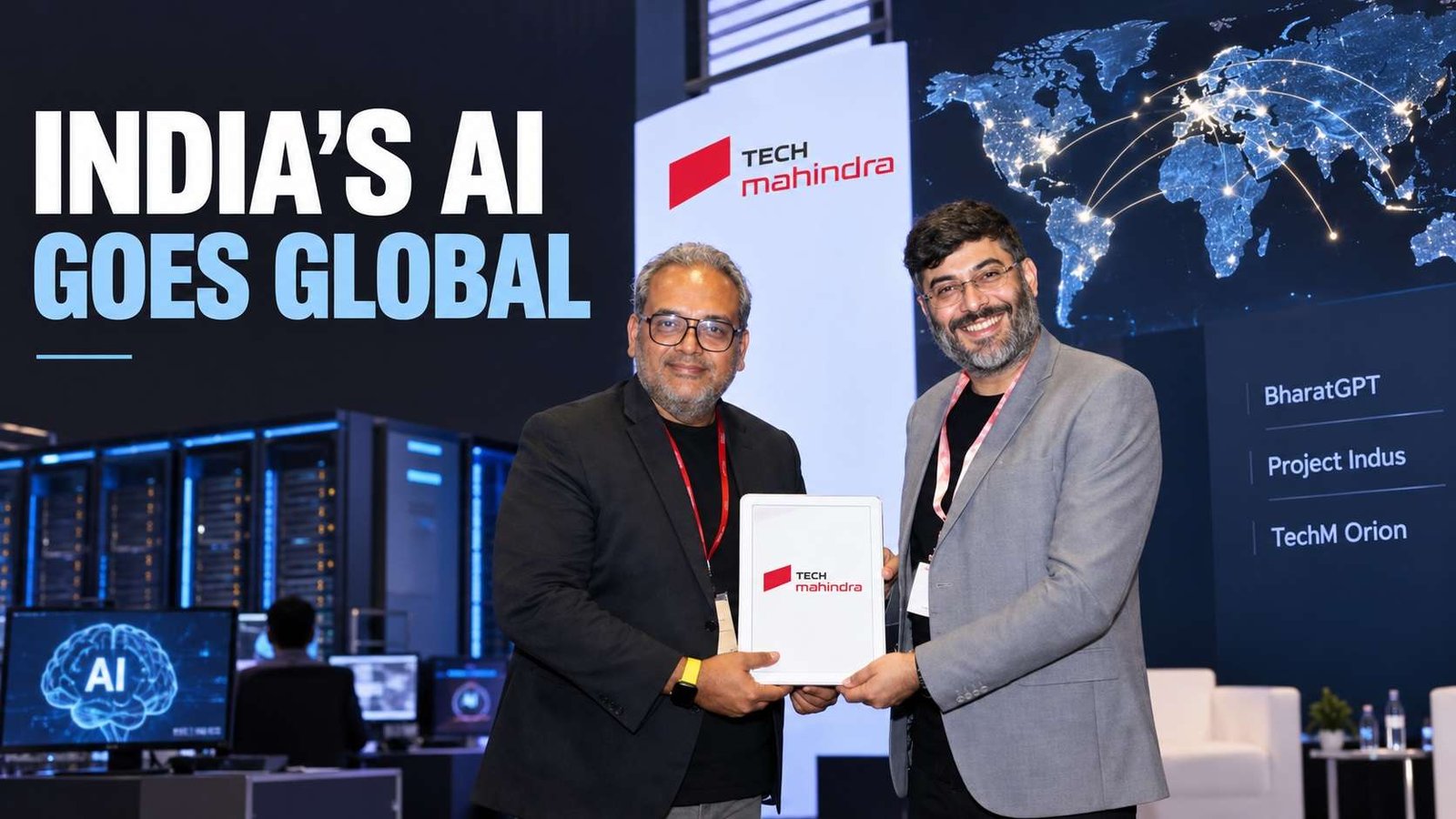
A new partnership between CoRover.ai and Tech Mahindra is attempting to answer that question.
Announced on September 22, the collaboration aims to combine CoRover’s BharatGPT with Tech Mahindra’s Project Indus and TechM Orion to develop AI solutions for enterprise, government and societal applications, with an explicit ambition to take India-origin capabilities into international markets.
That makes the partnership interesting for a reason beyond the two company names.
It represents an emerging Indian model of AI development: combine locally relevant language and AI capabilities with large-scale engineering, implementation and international distribution.
The hard part, of course, begins after the press release.
Three AI Platforms, One Larger Ambition
The partnership brings together three different technology components.
CoRover’s BharatGPT is positioned as a multilingual generative and conversational AI platform designed around Indian users and use cases. CoRover says BharatGPT supports more than 14 Indian languages through voice and is available across voice, video and text. The company also describes deployments across areas including government, travel, banking, healthcare and customer service.
Tech Mahindra’s Project Indus is its multilingual language-model initiative focused on Indian languages. Tech Mahindra says its current work includes Project Indus 2.0, focused on Hindi and its dialects.
Then there is TechM Orion, Tech Mahindra’s agentic-AI platform. The company describes Orion as an enterprise platform designed to allow AI agents to reason, plan and execute complex workflows across enterprise systems, with more than 200 pre-built agents.
Put simply:
BharatGPT brings conversational and multilingual AI capabilities.
Project Indus brings language-model expertise focused on Indian languages.
Orion brings an enterprise agentic-AI layer.
The partnership intends to combine these capabilities rather than treat them as isolated technologies.
Why This Matters Beyond India
The global AI market is dominated by companies with enormous computing resources, research budgets and established international customer bases.
India is unlikely to reproduce that model simply by building another general-purpose chatbot.
Its more distinctive opportunity may lie elsewhere.
India has an unusually complex linguistic and administrative environment. AI systems designed to work across Indian languages, public services, regulated sectors and large populations can develop capabilities that have relevance in other multilingual and emerging markets.
That is where this partnership’s international ambition becomes interesting.
A government in Africa, Southeast Asia or the Middle East may not necessarily need another consumer chatbot.
It may need an AI system that can operate in several local languages, integrate with government workflows, maintain data controls and provide citizen services.
An enterprise may need an AI agent that can work with existing systems rather than replace everything.
That is a different commercial proposition.
The “Sovereign AI” Opportunity
One of the most important phrases in the announcement is sovereign AI.
The term broadly refers to countries or institutions seeking greater control over AI infrastructure, data, models and deployment.
The attraction is obvious.
Governments increasingly have questions about where sensitive data is processed, which jurisdictions control the underlying technology and how AI systems can be adapted to local laws, languages and national priorities.
CoRover positions BharatGPT as a sovereign AI platform and says it can be deployed on edge, on-premises, cloud or hybrid environments.
Tech Mahindra brings something different to the equation: the ability to implement technology at enterprise scale.
The company says it has more than 146,000 professionals across 90 countries, giving the partnership an established international delivery network.
That combination could be commercially significant.
Building an AI model is one challenge.
Getting a multinational bank, telecom company, government department or healthcare organisation to deploy it safely is another.
The second challenge is where large IT-services companies can matter.
From “Made in India” to “Deployed From India”
There is an important distinction here.
India has long been a major exporter of software services. Its IT companies built systems for global customers, frequently using technologies developed elsewhere.
The next phase could be different.
Indian companies increasingly want to develop intellectual property, platforms and AI products originating in India, and then sell or deploy those capabilities internationally.
The CoRover–Tech Mahindra partnership fits that broader evolution.
It is not merely about providing Indian engineers to global customers.
It is about taking Indian-developed AI capabilities to those customers.
That is a more valuable position in the technology chain.
India Has a Language Advantage—If It Can Turn It Into a Product Advantage
India’s linguistic diversity is often described as a problem for technology.
In AI, it can also become a testing ground.
An AI system that must operate across Indian languages, dialects and different cultural contexts faces challenges that a monolingual system may not encounter.
CoRover says its broader platform supports more than 100 international languages while BharatGPT focuses particularly on Indian-language capabilities.
But language support alone does not create a global AI business.
Accuracy matters.
Context matters.
Security matters.
Latency matters.
Integration matters.
And customers ultimately care about whether the system solves a real business or public-service problem.
A chatbot that speaks 100 languages but gives the wrong answer in all 100 is not exactly a technological revolution.
The Real Test Will Be Adoption
This is where the announcement needs to be read carefully.
The partnership has been announced with a global ambition. It says the companies will explore applications across public institutions, citizen services and enterprise transformation.
That is promising, but it is not the same as announcing a list of major international customers already deploying a combined CoRover–Tech Mahindra platform.
The difference is important.
AI companies worldwide are currently making ambitious claims about agents, sovereign AI, multilingual models and autonomous workflows.
The market will eventually separate the demonstrations from the deployments.
For India, the real milestone will be when an overseas government, bank, telecom operator or multinational enterprise chooses an India-origin AI platform because it performs better—or offers a better combination of cost, localisation, security and deployment flexibility.
That is when “India-built AI” becomes a commercial category rather than a national slogan.
Why Tech Mahindra Matters
CoRover brings startup-style product development and its BharatGPT platform.
Tech Mahindra brings engineering resources, enterprise relationships and global implementation capabilities.
That division of strengths is arguably the most logical aspect of the partnership.
Startups can build quickly.
Large technology companies can distribute and implement at scale.
Neither side necessarily has to become the other.
Instead, they can use complementary capabilities.
Tech Mahindra’s recent AI activity also shows that the company is building a broader AI ecosystem. Its current portfolio includes agentic AI, large language models, industrial digital twins and partnerships with technology companies such as NVIDIA and ServiceNow.
The CoRover relationship therefore fits into a wider push rather than appearing as an isolated AI announcement.
The Global Indian AI Opportunity
For India, the strategic opportunity goes beyond these two companies.
The country has a large technology workforce, a growing startup ecosystem, significant digital-public infrastructure and an enormous domestic market in which AI systems can be tested at scale.
India’s challenge is converting those advantages into exportable technology.
The UPI story demonstrated how an India-origin digital infrastructure concept can attract international interest.
AI could eventually produce similar examples—but only if Indian companies move from pilots to repeatable global products.
That requires more than good algorithms.
It requires sales teams, legal expertise, cybersecurity, cloud infrastructure, local partnerships, regulatory knowledge and long-term customer support.
Globalisation is not just a technology problem.
It is a distribution problem.
What Could Go Wrong?
There are also legitimate risks.
AI markets are moving extraordinarily quickly. Today’s language model can become yesterday’s architecture surprisingly fast.
Indian companies also face intense competition from American, Chinese, European and other Asian AI developers.
Sovereign AI projects can become expensive if governments demand customised infrastructure for every deployment.
And localisation can create a paradox: the more a system is adapted to individual countries, the more difficult it can become to scale economically.
There is therefore no guarantee that every India-origin AI platform will become a global success.
The opportunity is substantial.
So is the execution challenge.
India’s AI Moment Is Becoming More Global
The CoRover–Tech Mahindra partnership arrives at an important moment for India’s technology industry.
India is increasingly trying to move up the technology value chain—from IT services toward intellectual property, platforms, AI models and digital infrastructure.
The global market provides the ultimate test.
Indian AI will have to compete not because it is Indian, but because it is useful.
That is a much tougher—and ultimately healthier—standard.
Doonited Editorial Perspective
The significance of this partnership should not be measured by the size of the announcement or the number of AI buzzwords attached to it.
The real significance is the business model it represents.
CoRover has developed AI capabilities around multilingual, conversational and sovereign use cases. Tech Mahindra has the engineering scale, enterprise relationships and international footprint to potentially take those capabilities much further.
If that combination produces successful deployments overseas, India gains something more valuable than another AI headline.
It gains an exportable technology capability.
That is the real prize.
India’s next technology story should not be merely that Indian engineers built AI for foreign companies.
It should be that global organisations chose AI products originating in India because they solved problems the global market actually had.
DOONITED INSIGHT
India’s AI opportunity may not be to build the world’s biggest model. It may be to build AI that understands the world’s most complicated real-world environments—and then export that expertise.
The CoRover–Tech Mahindra partnership is an early example of that approach.
Meaningful Learning for Readers
The most important question when evaluating India’s AI progress is not simply:
“Did India build an AI model?”
It is:
“Can India build, deploy, support and scale AI products that customers around the world are willing to pay for?”
That is the transition from technological capability to technological power.
And that is where India’s AI story is now becoming genuinely interesting.


World Beyond the News
Bees Communicate Where Food Is
Honeybees use movement patterns known as waggle dances to communicate information about food locations.
Street Food Reflects Local History
Many famous street foods developed from migration, trade, local ingredients and the everyday needs of working communities.
A Day on Venus Is Extremely Long
Venus rotates so slowly that one rotation relative to distant stars takes longer than its trip around the Sun.
Human Achievement Continues to Push Limits
Athletes, engineers, scientists and explorers regularly establish new benchmarks in speed, endurance, scale and precision.