
China’s Memory-Chip Breakthrough: Why India’s Semiconductor Ambition Is Watching Closely
As China pushes deeper into advanced memory manufacturing, India is trying to build something larger than a chip factory — an entire semiconductor ecosystem.
The semiconductor race is entering a more complicated phase.
It is no longer simply a contest over who can manufacture the fastest processor or build the world’s most advanced fabrication plant. Memory chips, advanced packaging, semiconductor equipment, materials, chip design and supply-chain resilience are becoming equally important pieces of the global technology puzzle.
That is why a fresh development from China deserves attention in India.
Chinese memory-chip manufacturer ChangXin Memory Technologies (CXMT) has announced that its fifth-generation DRAM technology platform has entered mass production. The company says its new process improves memory density, power efficiency and production yields, strengthening its ability to compete in a global memory market dominated by Samsung, SK hynix and Micron.
For India, this is not simply another China technology story.
It is a reminder of how quickly the global semiconductor map is changing while India is attempting to establish its own place within it.
The Memory-Chip Race Is Getting Serious
DRAM is the working memory used by computers, smartphones, servers and many other electronic devices.
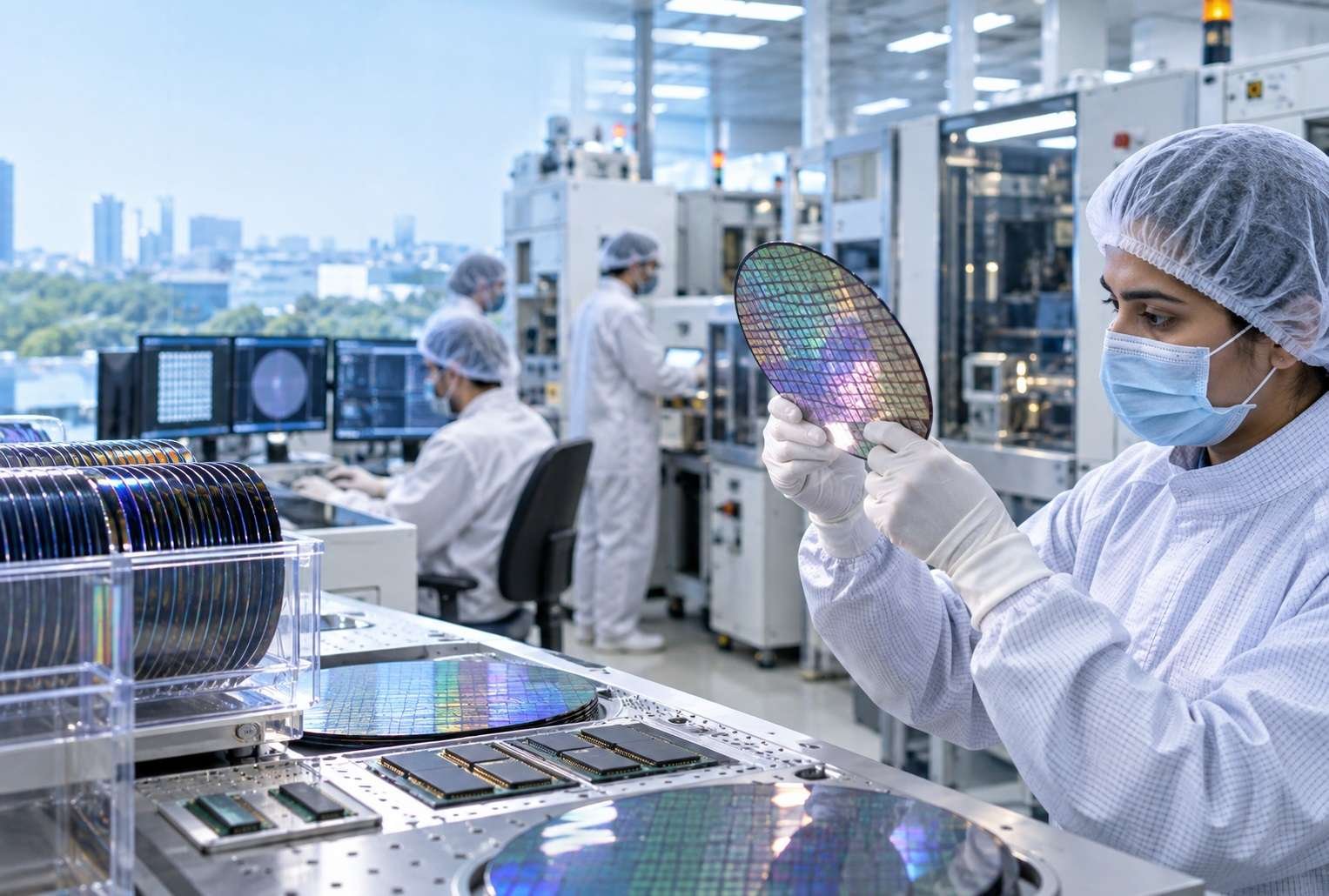
CXMT says its new fifth-generation platform uses advanced patterning techniques to reduce feature spacing to 11.95 nanometres. The company says the process can produce at least 50% more chip dies per wafer than its previous generation. It has also introduced 24-gigabit LPDDR5X memory products aimed at mobile and portable applications.
Those are company-reported specifications, and they should be treated as such rather than as independent proof that CXMT has displaced the established leaders.
But the broader development is significant.
China is demonstrating that restrictions on access to some advanced semiconductor technologies do not automatically stop domestic technological development. Chinese companies are continuing to invest in manufacturing capability, equipment partnerships and indigenous supply chains.
The lesson for other countries is uncomfortable but useful:
Semiconductor capability is built over years, not announced in a press conference.
Why India Should Pay Attention
India’s semiconductor ambition has often been discussed in terms of fabs — large facilities where chips are manufactured on silicon wafers.
That is important.
But a semiconductor industry needs much more than a fab.
It needs:
- Chip designers
- Semiconductor equipment
- Materials
- Packaging and testing
- Skilled technicians
- Research institutions
- Supply-chain companies
- Customers
- Reliable infrastructure
- Capital
- Intellectual property
India’s latest policy direction increasingly recognises this broader requirement.
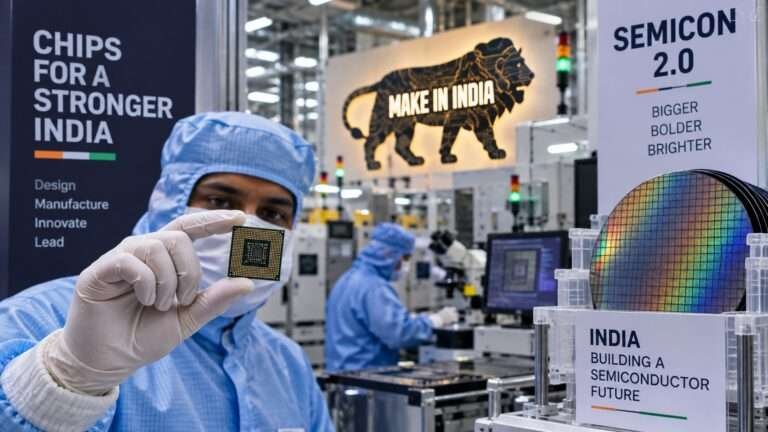
The government has positioned Semicon 2.0 around design, semiconductor equipment and materials, advanced packaging, research and development, supply chains and talent. At SEMICON India 2026, the government said roughly ₹1 lakh crore of investment commitments had emerged and that close to 1 lakh employment opportunities were expected across the ecosystem.
That is a significant shift in emphasis.
The objective is no longer simply:
“Build a chip factory.”
It is increasingly:
“Build the ecosystem around the chip factory.”
Applied Materials Brings Another Piece of the Puzzle
The timing is particularly interesting because semiconductor-equipment company Applied Materials has announced plans to invest $5 billion in India over the next decade.
The company says the investment will broaden its footprint in India, with activity covering areas including research, supply-chain development and workforce expansion. The announcement came during SEMICON India 2026, which brought together more than 600 companies from 52 countries.
Equipment matters enormously.
A semiconductor fab cannot simply purchase a building, install some machines and start producing world-class chips. Manufacturing depends on highly specialised equipment and processes capable of repeatedly producing billions of tiny structures with extraordinary precision.
So when a major semiconductor-equipment company expands its Indian presence, the significance extends beyond the headline investment figure.
It potentially strengthens one of the less glamorous — but absolutely essential — layers of the semiconductor ecosystem.
And semiconductors have never been particularly glamorous objects anyway.
Nobody buys a smartphone because its DRAM chip looks beautiful.
Yet without that tiny piece of silicon, the beautiful smartphone becomes a rather expensive paperweight.
India Has Made Progress — But the Hard Part Remains
India is no longer starting from zero.
The government says 12 semiconductor projects have been approved under its programme, while commercial production has begun at some packaging facilities. Earlier approved projects include Micron’s semiconductor assembly and test facility in Gujarat and Tata Electronics’ large semiconductor manufacturing project.
India has also approved projects covering different parts of the semiconductor value chain, including fabs, packaging and compound semiconductors.
But there is an important reality that should not disappear beneath investment announcements.
India still has to prove that it can build a competitive semiconductor manufacturing ecosystem at scale.
The distinction matters.
Investment commitments are not the same as operational capacity.
Approved projects are not the same as commercial production.
Commercial production is not automatically the same as globally competitive production.
That is where the next phase of India’s semiconductor journey becomes considerably harder.
China and India Are Playing Different Games
It would be misleading to suggest that India is simply racing China chip-for-chip.
China already has a substantial electronics manufacturing base and a much deeper semiconductor production ecosystem.
CXMT’s achievement is part of China’s long-running effort to increase domestic semiconductor capability and reduce dependence on foreign technologies.
India is at a different stage.
Its opportunity is partly created by the global desire among companies to diversify supply chains beyond concentrated manufacturing hubs.
That gives India an opening.
But an opening is not a victory.
To convert it into a durable advantage, India needs to build capabilities that companies cannot easily replace elsewhere.
The Missing Middle: Packaging, Materials and Equipment
One of the most important insights from the current semiconductor race is that the industry is not only about fabrication.
Advanced packaging is becoming increasingly important as chip designers look for ways to combine different components and improve performance.
Semiconductor materials and equipment are equally strategic.
India’s Semicon 2.0 programme explicitly includes these areas, reflecting an attempt to build domestic capability across more of the value chain.
This could prove especially important for India.
A country does not necessarily have to dominate every stage of semiconductor production to become strategically important.
It can become highly competitive in selected segments and connect those capabilities into a broader ecosystem.
That is how industrial clusters are built.
What About India’s Talent?
India’s strongest existing advantage is arguably its human capital.
The country already has a large semiconductor design community, with Indian engineers working for major global technology companies.
The challenge is to connect that design strength with manufacturing, packaging, materials and equipment expertise.
A semiconductor engineer who designs a chip in Bengaluru and a manufacturing engineer operating a fabrication process in Gujarat are part of the same economic chain — but India’s long-term ambition requires the links between them to become stronger.
The government has said Semicon 2.0 will include efforts to train one lakh technicians over the coming years.
That may sound less exciting than a billion-dollar investment announcement.
It may ultimately be more important.
Factories need people.
Sophisticated factories need highly trained people.
The AI Connection
There is another reason the memory-chip story matters.
Artificial intelligence is dramatically increasing demand for computing infrastructure, and AI systems require enormous amounts of memory and bandwidth.
The semiconductor industry is therefore experiencing a broader investment cycle driven by AI demand.
India’s semiconductor opportunity is consequently linked not only to smartphones and automobiles but also to:
AI infrastructure, data centres, cloud computing, telecommunications, defence electronics and industrial automation.
That gives India’s semiconductor strategy a much larger economic context.
The chip industry is becoming infrastructure for the digital economy itself.
India’s Real Test
The temptation in technology policy is to count investment announcements.
There is nothing wrong with counting them.
But eventually the scoreboard has to become more demanding.
How many chips are being produced?
What types of chips?
At what yields?
At what cost?
How much domestic value is being created?
How many Indian companies supply the ecosystem?
How much intellectual property is being developed domestically?
How many skilled professionals are being trained?
And, perhaps most importantly, will international customers trust Indian semiconductor supply chains enough to make them a permanent part of their global manufacturing strategy?
Those are harder questions.
They are also the questions that matter.
The Bigger Picture
CXMT’s latest move demonstrates that China’s semiconductor ambitions are becoming increasingly sophisticated. The company says its new memory platform has entered mass production and can improve density, efficiency and wafer productivity.
India, meanwhile, is building its own semiconductor capabilities through government incentives, private investment, global partnerships, packaging facilities, equipment investments and semiconductor design.
The two countries are not at identical points in the semiconductor journey.
But the global technology competition is making one thing clear:
The countries that control more of the semiconductor value chain will have greater influence over the technologies that power the next decade.
For India, the opportunity is therefore much bigger than producing a few categories of chips.
The ambition should be to become a dependable part of the world’s semiconductor architecture — from design to equipment, materials to manufacturing, packaging to talent.
That will take time.
It will also take patience, engineering discipline and considerably fewer PowerPoint presentations than the semiconductor industry normally produces.
The Doonited Insight
China’s memory-chip breakthrough offers India a useful lesson: semiconductor leadership is not won by one spectacular fab or one large investment. It is built layer by layer.
India has begun building those layers.
The real measure of success will be whether they eventually connect into a functioning, competitive ecosystem that can serve both Indian demand and global markets.
In the semiconductor race, the smallest components may be measured in nanometres.
The industrial ambition behind them has to be measured in decades.

World Beyond the News
Birds Can Navigate Using Earth’s Magnetic Field
Several bird species can sense Earth’s magnetic field, helping them navigate during long-distance migration.
Fermentation Is a Global Food Tradition
People across continents have used fermentation for centuries to preserve food and create distinctive flavours.
Modern Batteries Store Energy Chemically
Rechargeable batteries repeatedly move ions between electrodes, allowing electrical energy to be stored and released.
Why Songs Become Global Hits
Streaming platforms, short-form video, playlists and international collaborations can rapidly carry music across borders.