
India Is Becoming the Global Office Behind the World’s Biggest Companies
Walgreens’ Chennai move highlights how India’s Global Capability Centres are evolving from back offices into strategic engines of global business
A few decades ago, when a multinational company moved work to India, the conversation was usually about one thing: cost.
Today, that explanation is becoming increasingly incomplete.
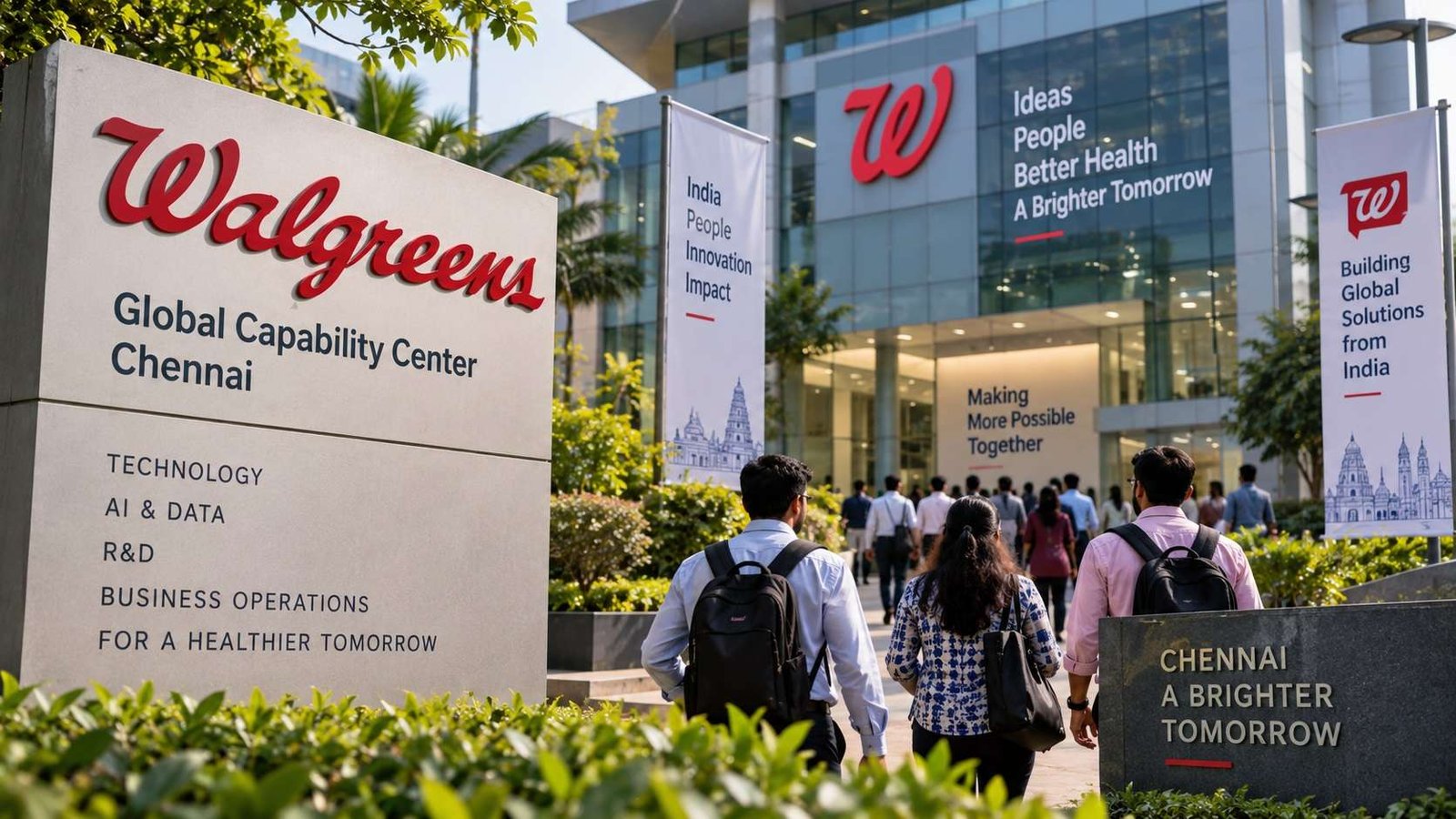
The latest example comes from Chennai, where US-based healthcare and pharmacy company Walgreens plans to establish its first Global Capability Centre (GCC) in India, with more than 250 jobs expected in the centre’s first year. The facility will focus on technology and business services and is planned for DLF Downtown in Taramani.
On the surface, 250 jobs may look modest against India’s enormous employment market.
But the more interesting story is what those jobs represent.
India’s GCC industry has moved far beyond the traditional image of an offshore back office. According to the latest NASSCOM-Zinnov GCC Landscape Report, India had 2,117 GCCs operating across 3,728 units and employing about 2.36 million professionals in FY2026. The ecosystem generated an estimated $98.4 billion in revenue.
That is no longer merely an outsourcing story.
It is a story about where global companies choose to build expertise.
From Back Office to Business Engine
The original GCC model was relatively straightforward.
A multinational company could locate certain functions in India, access a large skilled workforce and operate those functions at a lower cost than in many developed markets.
That model has not disappeared. Cost efficiency still matters.
But the work itself has changed.
India’s GCCs increasingly handle functions such as software development, finance, research and development, engineering, analytics and artificial intelligence. NASSCOM’s GCC research says more than half of India’s GCCs have moved toward portfolio and transformation-hub roles, while engineering R&D centres have grown faster than the broader GCC ecosystem.
In other words, the Indian office is increasingly being asked not merely to execute instructions from headquarters, but to solve problems for headquarters.
That is a significant distinction.
A spreadsheet prepared in Bengaluru is useful.
A new global analytics platform designed in Bengaluru is strategically important.
Why Walgreens Matters
Walgreens’ Chennai announcement fits into this broader transformation.
The company says its proposed centre will concentrate on technology and business services, with further expansion planned. Chennai already hosts technology operations of global companies including Citi, Barclays and American Express.
For Chennai, therefore, the Walgreens announcement is not simply another corporate arrival.
It adds another global company to an ecosystem that has been building for years.
The location also matters.
Taramani sits within Chennai’s established technology corridor, giving companies access to an existing pool of technology and business-services talent. The Tamil Nadu government has also been actively developing its GCC ecosystem and promoting Chennai as a destination for high-value corporate operations.
There is a larger lesson here: global companies tend to follow ecosystems, not just individual incentives.
A company wants skilled workers. Those workers want infrastructure, transport, housing and professional networks. Vendors and service providers follow the companies. Universities and training institutions respond to the demand.
Eventually, a technology corridor becomes self-reinforcing.
India’s Talent Advantage Is Becoming More Specialized
India’s biggest GCC advantage is often described simply as its large talent pool.
Size matters, but specialization matters more.
The country has developed deep pools of professionals in software engineering, finance, healthcare, analytics, cybersecurity, cloud computing and increasingly artificial intelligence.
The latest GCC research points to a growing AI capability inside these centres, with Indian GCCs increasingly taking responsibility for AI products, platforms and infrastructure for their parent organizations.
That changes the career proposition for Indian professionals.
The opportunity is no longer limited to working for an Indian outsourcing company serving a foreign client.
An engineer in India can increasingly work inside the global organization itself, contributing to products, systems and decisions used across several countries.
That is a considerably different career pathway.
The Rise of the Indian Global Professional
There is also a less visible consequence.
When global companies establish strategic centres in India, they create opportunities for professionals who want international exposure without necessarily relocating permanently to New York, London, Singapore or another global business centre.
The global workplace is, in effect, coming to India.
A professional sitting in Chennai, Hyderabad, Pune, Bengaluru or Delhi can collaborate with colleagues across time zones and contribute to projects serving customers thousands of kilometres away.
The geography of work is changing.
And India is benefiting from that change.
But There Is a Catch
There is a temptation to celebrate every new GCC announcement as proof that India has “won” the global jobs race.
That would be too simplistic.
GCC growth does not automatically mean that every technology graduate will find a high-paying job.
The industry is becoming more demanding at exactly the same time that artificial intelligence is changing the nature of work.
A company may need fewer people to accomplish a task if technology makes each employee considerably more productive.
The recent restructuring at some corporate technology centres illustrates this tension. The GCC model is expanding, but the number of employees is not necessarily the only measure of success.
The more important question is:
What kind of work is India attracting?
If India attracts research, product engineering, AI, cybersecurity, healthcare technology and strategic business functions, the economic value can be substantially greater than simply adding headcount.
That is why the quality of GCC jobs matters as much as the quantity.
Chennai’s Opportunity
Walgreens’ proposed centre offers Chennai another opportunity to deepen its position in healthcare technology and business services.
The city already has a significant technology ecosystem. The addition of a global healthcare company could potentially create opportunities across technology, operations and related professional services, although the precise scale and nature of future expansion have not yet been disclosed.
Tamil Nadu’s government has said the centre will create more than 250 employment opportunities in its first year, with expansion planned subsequently.
The sensible way to view that announcement is therefore not as “250 jobs solved India’s employment problem.”
It plainly does not.
Instead, it is one more indicator of where the next generation of global corporate work is being located.
The Bigger Indian Story
India’s GCC transformation is ultimately about something larger than foreign companies opening offices.
It is about a change in India’s position in the global value chain.
For years, the country was often described as the place where global companies could get work done efficiently.
Increasingly, the proposition is becoming:
India is where global companies can build, analyse, engineer and innovate.
That distinction matters.
The latest numbers tell the scale of the transformation: more than 2,100 GCCs, roughly 2.36 million professionals and an estimated $98.4 billion ecosystem in FY2026.
Walgreens’ Chennai announcement is one small piece of that much larger picture.
And perhaps the most interesting part is what happens next.
If India’s GCCs continue moving toward AI, research, product engineering and strategic decision-making, the country’s role in the world economy may increasingly be measured not by how cheaply India can perform global work, but by how much of the world’s important work is being created here.
That is a much bigger story than a new office opening in Chennai.
The Doonited Insight
India’s GCC revolution is moving from “work done in India” to “global capabilities built in India.”
For Indian professionals, the real opportunity will depend on whether education and skills development keep pace with that transition. For companies, the challenge will be finding people capable of working at the intersection of technology, domain expertise and global business.
The next GCC race may therefore not be about who can hire the most people.
It may be about who can build the smartest global team in India.

World Beyond the News
Birds Can Navigate Using Earth’s Magnetic Field
Several bird species can sense Earth’s magnetic field, helping them navigate during long-distance migration.
Fermentation Is a Global Food Tradition
People across continents have used fermentation for centuries to preserve food and create distinctive flavours.
Modern Batteries Store Energy Chemically
Rechargeable batteries repeatedly move ions between electrodes, allowing electrical energy to be stored and released.
Why Songs Become Global Hits
Streaming platforms, short-form video, playlists and international collaborations can rapidly carry music across borders.