
Saudi Oil Pipeline Attack: A pipeline in the Saudi Arabian desert may sound like a problem thousands of kilometres away from India.
It isn’t.
When the East-West Pipeline, also known as the Petroline, was hit by drone attacks on September 10, the immediate concern was Saudi Arabia’s ability to move crude from its oil-producing east to the Red Sea. But the consequences extend much further — into international oil prices, shipping routes, freight costs and eventually the economics of one of the world’s largest oil-importing countries: India.
The important point, however, is not that India suddenly faces an oil shortage.
The bigger risk is that getting the oil India needs could become more expensive.
What happened to Saudi Arabia’s oil route?
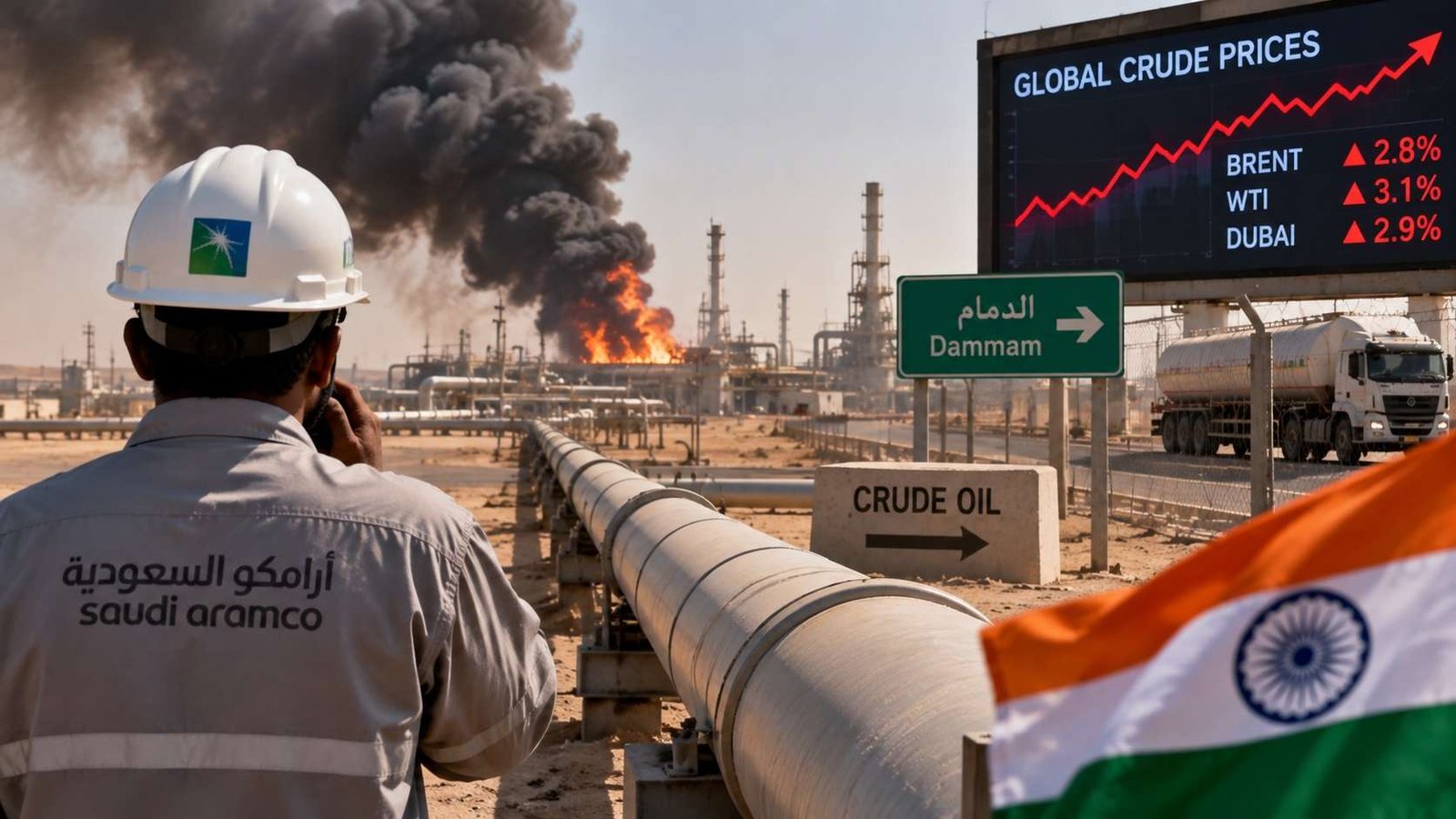
Saudi Arabia temporarily shut its roughly 1,200-kilometre East-West Pipeline after attacks struck two pumping stations in the Riyadh and Madinah regions on September 10.
The pipeline runs from the kingdom’s eastern oil-producing region towards Yanbu, a major Red Sea export facility.
Its nominal capacity is about 7 million barrels of crude a day, although the quantity actually being transported has been significantly lower. Recent reporting estimates that around 4 million barrels per day had been moving through the route during the present disruption.
That distinction matters.
A pipeline does not need to operate at its maximum capacity to be strategically important. Its real value lies in providing an alternative route when another route becomes dangerous or unavailable.
And that is precisely why Petroline matters now.
The pipeline was Saudi Arabia’s detour around Hormuz
The Strait of Hormuz is one of the world’s most important energy chokepoints.
Saudi Arabia normally exports much of its crude through terminals connected to the Persian Gulf. Moving crude by pipeline to Yanbu allows the kingdom to send oil towards global markets without first putting every barrel through Hormuz.
That made the East-West Pipeline an insurance policy.
But the latest attack has demonstrated an uncomfortable reality:
An alternative route is only an alternative if it remains operational.
With maritime traffic through Hormuz already severely disrupted by the wider regional conflict, and risks also affecting the Bab el-Mandeb and Red Sea, the loss of part of Saudi Arabia’s bypass capacity adds another layer of uncertainty to global oil logistics.
The irony is almost too perfect for an economics textbook: build a bypass to avoid one bottleneck, and suddenly the bypass itself becomes the bottleneck.
Oil prices: a warning, not a one-way escalator
The pipeline shutdown initially intensified concerns about global crude availability.
Brent crude had already crossed the $100-per-barrel level during the recent escalation. But the market response is not simply “pipeline attacked, therefore oil only goes higher.”
On September 17, Brent futures actually fell about 1.2% to around $104.59 a barrel in early trading after reports that Saudi Arabia was arranging additional crude shipments to Asian refiners through ship-to-ship transfers off Oman’s Sohar port.
That is an important part of the story.
Saudi Arabia is not sitting still while the pipeline is offline. It is attempting to reroute barrels, restore part of the pipeline’s capacity and use other export options.
Reuters also reported that the additional Saudi supplies through Oman were helping ease immediate supply fears, although they were not expected to completely replace the volumes affected by the disruption.
So the question for the oil market is no longer simply:
“Was the pipeline attacked?”
It is:
“How long will the disruption last, and what other routes remain reliably available?”
Why India has a lot at stake
India imports the overwhelming majority of the crude oil it consumes.
That makes international oil prices particularly important for the Indian economy.
According to recent analysis by The Indian Express, Saudi Arabia supplied around 7–8% of India’s crude imports in recent months. In August, India’s Saudi imports were estimated at about 332,000 barrels per day, or approximately 7.2% of total Indian oil imports for that month.
That means Indian refiners have alternatives — but replacing disrupted Saudi barrels can become more expensive when competing with refiners across Asia and Europe for the same available cargoes.
And crude oil is only the first part of the equation.
Longer shipping routes can mean higher freight costs. Regional security concerns can increase insurance premiums. Limited tanker availability can add another layer of cost.
Then there is the rupee.
India buys crude in dollars. If international oil prices rise while the rupee is under pressure against the dollar, the domestic economic impact can become larger.
The result can eventually appear in places that have nothing visibly to do with a Saudi pipeline: transportation costs, industrial inputs, inflation expectations, the trade deficit and the country’s overall import bill.
India does have buffers
There is, however, an important positive side to India’s position.
India’s crude procurement has become considerably more diversified. Indian refiners buy oil from multiple geographical sources, and the country’s large refining system provides flexibility in processing different crude grades.
Recent reporting also indicates that India continues to receive energy supplies despite the disruption, while authorities are monitoring the situation and relying on alternative routes and existing inventories.
That means the immediate question is not whether India can obtain oil at all.
It is whether India can obtain enough oil without paying a significantly higher geopolitical premium.
That is a much more complicated problem.
The six-week question
Saudi Arabia is reportedly working to restore part of the affected pipeline capacity within days, while a return to full operation could take around six weeks, according to the information cited by TOI and market reports.
The length of the outage therefore matters enormously.
If repairs progress quickly and alternative shipping routes remain available, the market could gradually calm.
If the disruption lasts for weeks while Hormuz and Red Sea risks continue, refiners will have to compete harder for alternative crude.
And if additional oil infrastructure or shipping routes are attacked, the problem could become substantially larger.
That is why markets are watching the pipeline not simply as a piece of Saudi infrastructure, but as one component of an increasingly interconnected energy-security problem.
Doonited Editorial Perspective
For India, this episode offers a useful lesson about energy security.
Energy security does not mean simply having oil in the ground somewhere in the world. It means having multiple suppliers, multiple routes, adequate inventories, flexible refineries and enough financial resilience to absorb sudden price shocks.
India has made progress on several of these fronts, particularly through diversification of crude sources and its large refining capacity.
But the vulnerability remains obvious: India cannot control the geopolitical conditions through which much of its imported energy travels.
That is why every pipeline, tanker route and maritime chokepoint matters.
The Saudi pipeline attack is therefore not just a Middle Eastern security story. It is an economic story with an Indian price tag.
And the most important number may not be the headline price of Brent tomorrow morning.
It may be the cumulative cost of keeping millions of barrels moving safely for the next several weeks.
The Doonited Insight
India’s oil vulnerability is less about finding the next barrel and more about finding the next reliable route for that barrel.
That distinction is becoming increasingly important in a world where traditional energy corridors can be disrupted — and even the alternative corridors designed to protect them can come under attack.

World Beyond the News
Dolphins Use Individual Signature Whistles
Bottlenose dolphins develop distinctive whistles that function somewhat like individual acoustic identifiers.
The Pacific Is Earth’s Largest Ocean
The Pacific Ocean covers more area than any other ocean basin and stretches between Asia, Australia and the Americas.
Artificial Intelligence Learns Statistical Patterns
Modern machine-learning systems identify patterns in large datasets and use those patterns to generate predictions or outputs.
Why Some Stories Spread So Quickly
Emotion, novelty, visual appeal and easy sharing can make a story travel rapidly across social platforms.