
Tata’s Global Bet: How an Indian Conglomerate Turned Foreign Brands Into a Two-Way Bridge Between India and the World
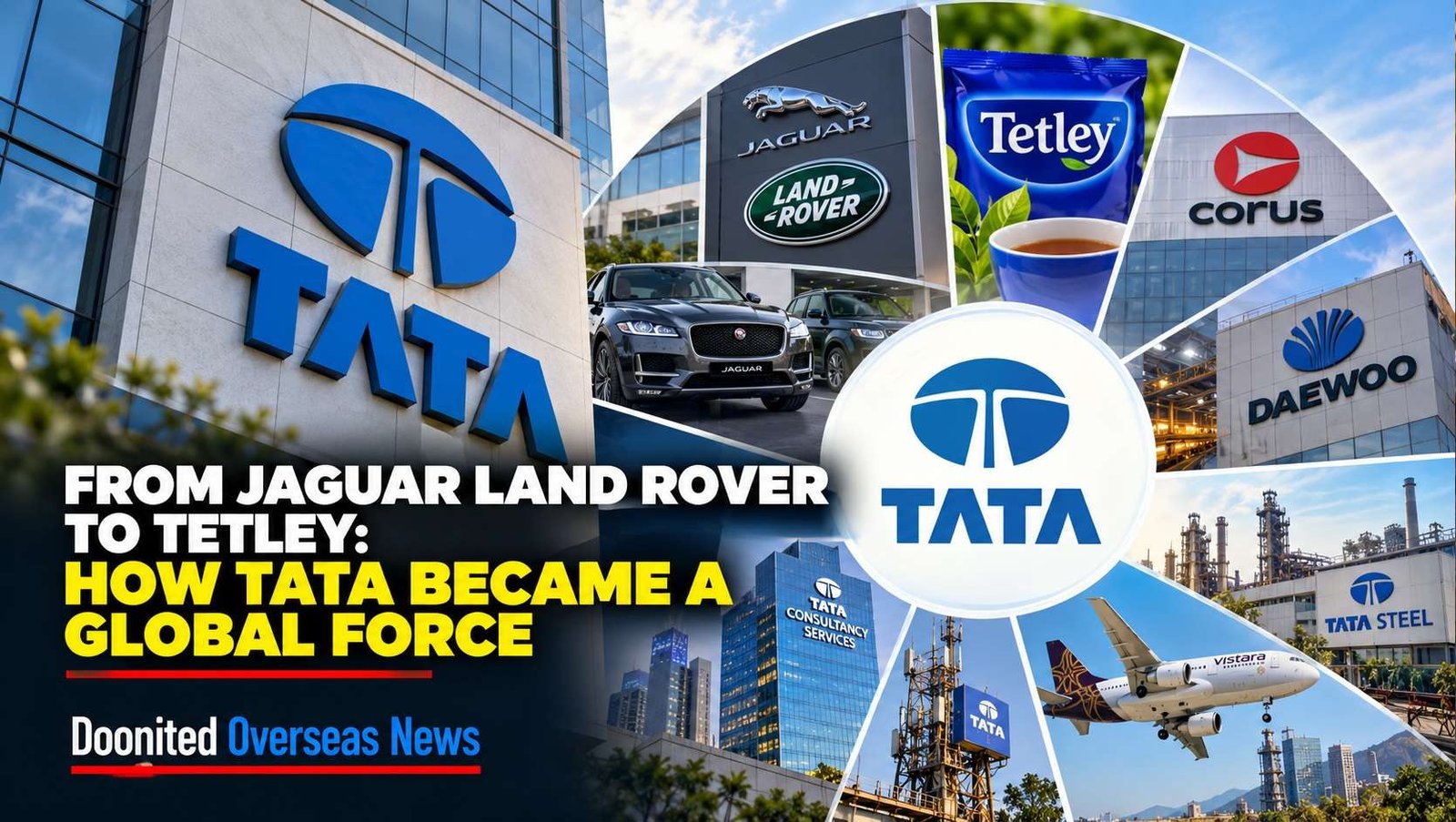
From Tetley in Britain and Daewoo Commercial Vehicles in South Korea to Corus and Jaguar Land Rover, Tata’s overseas acquisitions helped transform an India-focused industrial group into a genuinely global enterprise. Today, the more interesting question is not which foreign brands Tata owns, but how those businesses have been reshaped as part of an increasingly international Indian corporate ecosystem.
For decades, the story of Indian business going global was largely about exports: Indian companies manufactured products at home and sold them overseas.
The Tata Group helped change that model.
Beginning with the acquisition of British tea company Tetley in 2000, Tata companies embarked on a series of high-profile international acquisitions that put Indian ownership behind some of the world’s best-known businesses. Tata’s own historical account lists Tetley, Corus, Jaguar Land Rover, Daewoo Commercial Vehicles and other overseas acquisitions as part of that internationalisation drive.
The significance for the Indian diaspora is larger than corporate deal-making.
Millions of Indians live and work in countries where Tata businesses now operate. Tata’s globalisation has therefore created a different kind of India-world connection: Indian capital and management operating inside established international industrial, consumer and technology ecosystems.
And unlike a simple foreign-brand takeover story, the Tata experience shows that globalisation works in both directions.
Tetley: India’s tea story enters Britain
One of Tata’s earliest major international acquisitions of the modern era was Tetley.
In 2000, Tata Tea acquired the British tea company, then around 160 years old. Tata’s corporate history identifies the transaction as a major milestone in the group’s international expansion.
Tetley was not simply an Indian company buying an overseas asset and replacing it with an Indian brand.
The brand retained its British identity and international consumer positioning while becoming part of the Tata consumer-products portfolio.
Today, Tata Consumer Products describes Tetley as a British icon with more than 180 years of heritage and a presence in more than 40 countries, including the UK, Canada and the United States.
That is an important lesson in international acquisitions.
A successful multinational does not necessarily erase the identity of a foreign brand. Sometimes the value lies precisely in preserving what consumers already recognise while providing the financial resources, distribution and management capabilities to expand it.
For the Indian diaspora, this also creates an interesting cultural overlap: an Indian-owned company operates a British heritage brand that is consumed by customers across multiple countries, including markets with large Indian-origin populations.
Daewoo: learning to manufacture globally
In 2004, Tata Motors acquired the heavy commercial-vehicle business of South Korea’s Daewoo Motors. Tata’s historical timeline records the acquisition as a significant step in the group’s expansion, while Tata Motors’ own investor material describes Daewoo Commercial Vehicle as its first overseas acquisition and says the transaction became a wholly owned subsidiary in March 2004.
This was strategically different from buying a consumer brand.
Tata Motors was acquiring industrial capability, products, engineering experience and access to an established Asian commercial-vehicle market.
The business subsequently became Tata Daewoo, and Tata Motors continues to identify South Korea as part of its international automotive footprint.
The acquisition illustrates a less visible aspect of India’s globalisation: Indian companies were not only purchasing brands; they were also acquiring technology, manufacturing know-how and international operating experience.
Corus: the acquisition that announced India’s industrial ambitions
Then came Corus.
In April 2007, Tata Steel completed its £6.2-billion acquisition of Corus Group, whose operations were concentrated in the UK and Netherlands. Tata Steel said the combined business would have a presence in 45 countries and become one of the world’s largest steel producers at the time.
The deal was enormous by Indian corporate standards.
Tata Steel itself described the transaction as transforming the company from a domestic producer into an international steel company with global scale.
Corus brought Tata Steel access to highly developed European markets, advanced products and technology-intensive operations. Tata Steel’s annual report at the time specifically identified Corus’s strong research-and-development capabilities and high-end manufacturing as strategic advantages of the combination.
But the Corus story also demonstrates why overseas acquisitions are difficult.
Global scale does not automatically translate into easy profitability. European energy costs, steel cycles, environmental regulation, labour issues and the transition to low-carbon production have all affected Tata Steel’s European operations.
Today, Tata Steel’s UK business is undergoing another transformation.
At Port Talbot in Wales, the company has moved away from its traditional blast-furnace model and is building a roughly 3.2-million-tonne electric arc furnace, backed by a £500-million UK government contribution within a wider £1.25-billion transformation. Tata Steel expects the new facility to cut site-level carbon emissions by about 90%. Tata Steel
So the Corus acquisition is no longer simply a story about an Indian company buying a British steelmaker.
It has become a story about whether an Indian multinational can help reshape an important European industrial operation for the low-carbon economy.
Jaguar Land Rover: perhaps Tata’s most recognisable global acquisition
In 2008, Tata Motors completed the purchase of Jaguar and Land Rover’s businesses from Ford for US$2.3 billion. Tata Motors’ contemporaneous annual report recorded that JLR had manufacturing, engineering and design operations in Britain, with sales in more than 100 countries.
The symbolism was hard to miss.
An Indian automotive company had acquired two of Britain’s most internationally recognisable automotive marques.
But the acquisition was ultimately more important as a business strategy than as a nationalistic trophy.
Jaguar Land Rover remained a British-designed and globally marketed luxury automotive business, while Tata Motors provided ownership and capital support.
Today, Tata’s corporate automotive overview describes Jaguar Land Rover as Britain’s largest automotive manufacturer and identifies it as a Tata Motors subsidiary. Tata Motors also has international operations including South Korea, South Africa and Indonesia.
The JLR story therefore demonstrates another principle of successful international ownership: the nationality of the parent company does not have to determine the identity of the customer-facing brand.
A Range Rover sold in London, New York or Dubai can remain unmistakably Range Rover even though its ultimate corporate ownership is Indian.
Tata is now much bigger than its famous acquisitions
It would be easy to reduce Tata’s globalisation story to a list of famous acquisitions.
That would miss the bigger transformation.
The Tata Group now describes itself as a global enterprise comprising 31 companies, operating in more than 100 countries across six continents. In FY2024–25, Tata companies collectively generated more than $180 billion in revenue and employed more than one million people.
The group’s latest corporate reporting also says Tata businesses are present in more than 150 countries, serving hundreds of millions of consumers worldwide. Tata Group
And the group’s international presence is not dependent solely on acquisitions.
TCS has become a global technology-services company. Tata Communications operates international digital networks. Tata Technologies works with global automotive and industrial customers. Tata Consumer Products manages an international consumer portfolio. Tata Motors operates manufacturing and distribution networks outside India.
The group has therefore evolved from buying foreign companies to operating as a multinational whose businesses are structurally global.
What Tata’s model means for Indians overseas
For the Indian diaspora, there is a particularly interesting consequence.
When an Indian multinational establishes a substantial presence abroad, it creates more than corporate revenue.
It creates jobs, supplier relationships, professional opportunities, technology partnerships and local community connections.
An Indian-origin engineer working in Britain, a technology professional in the United States, a manufacturing specialist in South Korea or a manager in Europe may interact with an Indian-headquartered corporation without necessarily experiencing it as an “Indian company” in the traditional sense.
That is arguably one of the most significant stages of India’s corporate globalisation.
The Indian diaspora is no longer simply a bridge through which foreign companies enter India.
Indian companies themselves are becoming part of the economic landscape in which the diaspora lives.
The harder lesson: global ownership brings global responsibility
There is, however, a danger in presenting overseas acquisitions as uncomplicated success stories.
Owning an international company means inheriting its difficult markets as well as its valuable brands.
Tata Steel’s current UK transition demonstrates this clearly. Port Talbot’s traditional steelmaking ended during the 2024 transition, affecting workers and the surrounding industrial community, while the replacement EAF project promises a lower-emission future. Tata Steel has also reported workforce transition measures and restructuring associated with the change. Tata Steel
That is what mature globalisation looks like.
It involves investment, but also restructuring. It creates jobs, but technologies can change employment patterns. It protects heritage brands, but those brands still have to compete. It opens markets, but exposes Indian companies to foreign regulation, currencies, energy prices, labour relations and geopolitical risk.
The Tata model has therefore moved well beyond the symbolism of an Indian company owning a British or Korean brand.
The bigger Indian story
The most important development may be the psychological one.
When Tetley was acquired in 2000, the deal was widely seen as evidence that Indian companies could buy established Western brands.
When Corus and Jaguar Land Rover followed, the message became stronger: Indian corporations could manage assets at global scale.
Two decades later, the question has changed.
It is no longer simply whether an Indian company can own a global brand.
It is whether Indian companies can build multinational organisations capable of innovating, investing, employing people and meeting environmental and regulatory expectations across very different societies.
That is a much higher standard.
And it is precisely why Tata’s global journey matters to Overseas Indians.
For Indians living abroad, the globalisation of Tata represents a reversal of an older economic relationship. India is not merely sending talent, services and products to the world.
Indian capital, management and institutions are now embedded in the economies where that diaspora lives.
From a British tea brand to a British luxury-car manufacturer, from South Korean commercial vehicles to European steelmaking, Tata’s overseas journey has become one of the clearest examples of India’s transition from an emerging-market exporter to a multinational corporate power.
The real measure of that transformation will not be the number of foreign brands acquired.
It will be whether those businesses can continue to create value—locally, globally and sustainably—under Indian ownership.

World Beyond the News
Birds Can Navigate Using Earth’s Magnetic Field
Several bird species can sense Earth’s magnetic field, helping them navigate during long-distance migration.
Fermentation Is a Global Food Tradition
People across continents have used fermentation for centuries to preserve food and create distinctive flavours.
Modern Batteries Store Energy Chemically
Rechargeable batteries repeatedly move ions between electrodes, allowing electrical energy to be stored and released.
Why Songs Become Global Hits
Streaming platforms, short-form video, playlists and international collaborations can rapidly carry music across borders.