
Sundar Pichai: The Indian-Origin CEO Steering Google Through the Global AI Race
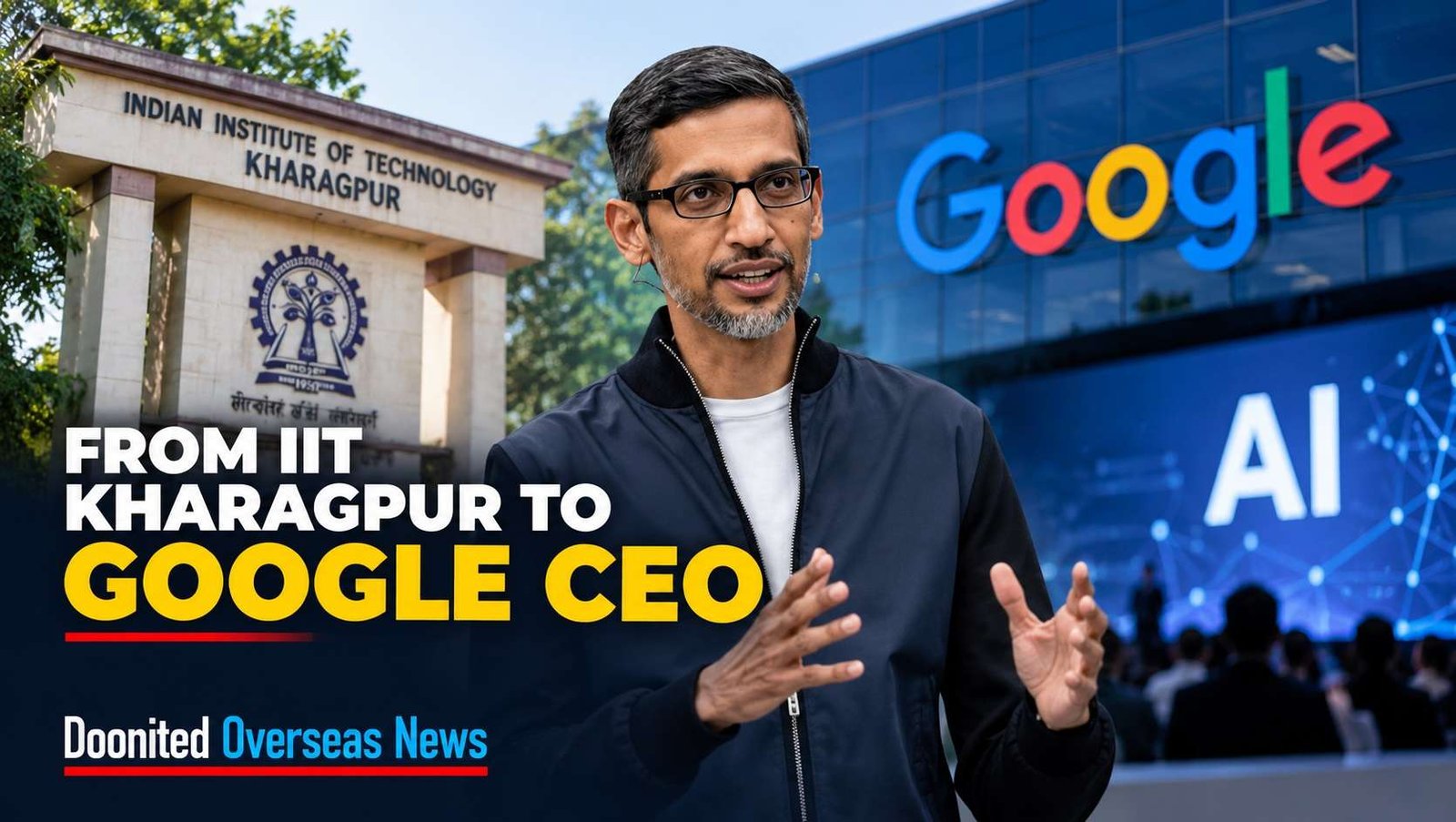
From IIT Kharagpur and Stanford to the top of Google and Alphabet, Sundar Pichai has become one of the most consequential Indian-origin leaders in global technology. In 2026, his challenge is no longer simply managing Google—it is reshaping one of the world’s biggest technology ecosystems around artificial intelligence.
Sundar Pichai’s rise from India to the leadership of Google and Alphabet is already one of the defining stories of the Indian diaspora in global business.
But in 2026, his significance extends beyond the familiar success story of an Indian engineer reaching Silicon Valley.
Pichai is now directing one of the world’s largest technology companies through what he describes as a profound platform shift: artificial intelligence.
That makes his leadership relevant not only to Google users or technology investors, but also to the millions of Indians and Indian-origin professionals working across the global technology economy.
The question is increasingly whether Pichai can turn Google’s enormous advantages in Search, Android, Cloud, YouTube, data centres, custom chips and AI research into a coherent advantage in the rapidly intensifying global AI race.
From IIT Kharagpur to Google’s top job
Pichai joined Google in 2004 and subsequently held senior responsibility for some of the company’s most important products and platforms, including Search, Chrome, Maps, Android, Gmail and Google Workspace.
He became Google’s CEO in October 2015 and Alphabet’s CEO in December 2019. Alphabet’s corporate biography records his education at the Indian Institute of Technology Kharagpur, Stanford University and the Wharton School. Alphabet Investor Relations
His early Google career was particularly important because it was built around products rather than corporate finance.
Chrome became a major gateway to the web. Android became the world’s dominant mobile operating system. Those experiences gave Pichai an unusual understanding of how technology platforms acquire users, developers and businesses at enormous scale.
That background now matters enormously.
AI is no longer simply another Google product.
It is increasingly becoming a layer across Google’s existing ecosystem.
Pichai’s biggest transformation: making Google AI-first
Google began publicly describing its move toward an AI-first strategy years before the current generative-AI boom.
In 2026, Pichai’s argument is that the company must approach AI across the entire technology stack—from computing infrastructure and custom silicon to research, foundation models, applications and consumer products.
At Google I/O 2026, he described this as a “full-stack” approach to AI. Google said its models were processing more than 3.2 quadrillion tokens a month, while more than 8.5 million developers were building applications with its models each month.
The scale is important.
Google is not attempting to build a single successful chatbot.
It is attempting to embed AI into Search, Android, Chrome, YouTube, Maps, Workspace, Cloud and the Gemini ecosystem.
That is a considerably larger undertaking.
Gemini is becoming the centre of the strategy
The most visible expression of this strategy is Gemini.
Google reported in May that the Gemini app had surpassed 900 million monthly active users, compared with 400 million a year earlier, and that it was available across more than 230 countries and more than 70 languages.
Google also introduced Gemini 3.5 Flash, Gemini Omni and a growing range of agentic capabilities at I/O 2026. The company’s direction is increasingly moving from AI that merely generates answers toward AI that can take actions on behalf of users.
That distinction could become critical.
The first generation of consumer AI was largely about asking questions and generating content.
The next generation is likely to be about completing tasks.
Google is positioning Gemini to sit inside that transition.
The battle is also about infrastructure
Perhaps the least visible part of Pichai’s strategy is infrastructure.
AI requires enormous quantities of computing power, electricity, data-centre capacity and high-speed connectivity.
Google therefore has an advantage that many AI startups do not: it controls much of the underlying infrastructure required to train and operate large AI systems.
At I/O 2026, Pichai highlighted Google’s TPU infrastructure and said its training architecture could distribute workloads across more than one million TPUs globally.
Google is also making major infrastructure investments outside the United States.
In India, the company has committed approximately $15 billion over five years from 2026 to 2030 toward its first AI hub in Visakhapatnam, including gigawatt-scale compute infrastructure and an international subsea gateway. Construction of the hub began in April 2026.
This is where Pichai’s Indian connection becomes particularly interesting.
India is not merely the country where he was educated.
It is becoming an important component of Google’s global AI infrastructure strategy.
The India connection is becoming strategic
Google’s India initiatives increasingly extend beyond conventional outsourcing or software engineering.
In February, Google announced America-India Connect, linking the company’s Indian AI infrastructure investment with new subsea and fibre-optic routes connecting India with Singapore, South Africa, Australia and other locations across the Southern Hemisphere.
The company subsequently expanded its India AI initiatives through Google I/O Connect India, focusing on areas including multilingual AI, healthcare, cloud infrastructure, developers, startups and cybersecurity.
Google DeepMind has also worked with Indian institutions through national AI partnerships focused on science, education, resilience and public services. blog.google
The significance is bigger than Google’s India business.
It suggests a model in which India can function simultaneously as:
a market, an engineering and research base, an AI infrastructure location, a developer ecosystem and a source of global technology talent.
That is a very different relationship from the earlier outsourcing-driven image of India’s technology sector.
What Pichai’s story means for the Indian diaspora
For Overseas Indians, Pichai’s career represents something broader than individual achievement.
The Indian diaspora has become deeply embedded in the global technology industry, particularly in the United States. Indian-origin engineers, researchers, founders and executives occupy important positions across Silicon Valley and the wider technology ecosystem.
But Pichai’s career also illustrates an important feature of global migration.
Talent does not necessarily remain tied to the country where it was educated.
Pichai’s technical education in India became one part of a career that crossed countries, universities, companies and industries before eventually reaching the highest level of global corporate leadership.
His story therefore resonates with Indian students and professionals considering education or careers abroad.
The route is no longer simply:
India → foreign university → foreign job.
It can become:
India → global expertise → international leadership → influence on technology used worldwide.
India could become part of the next global AI workforce
Google’s 2026 India initiatives also highlight another important issue: the relationship between AI infrastructure and human capital.
Google DeepMind announced an AI Research Foundations curriculum intended to strengthen advanced AI capabilities among Indian students and AI builders. Google described the programme as a way to contribute to an India-originated AI-ready workforce with global relevance.
That creates an interesting opportunity for India’s diaspora.
Indian-origin professionals abroad can potentially become bridges between AI ecosystems in India, the United States, Europe, Southeast Asia and other markets.
The opportunity is not limited to software engineers.
AI requires researchers, chip designers, data-centre specialists, cybersecurity experts, product managers, lawyers, policy specialists, energy professionals, educators and entrepreneurs.
The global AI economy is therefore likely to create a much broader professional network than the technology industry of the previous generation.
But Pichai’s challenge is enormous
The positive narrative should not obscure the scale of Google’s challenge.
Microsoft, OpenAI, Meta, Amazon, Anthropic and a rapidly growing field of AI companies are competing for developers, enterprise customers, computing capacity and consumer attention.
Google’s historical strength can even become a complication.
Search, advertising and its enormous existing product ecosystem generate vast amounts of revenue. But AI may fundamentally change how people discover information and interact with software.
Pichai therefore has to perform a difficult balancing act:
protect Google’s existing businesses while simultaneously helping build technologies that could disrupt them.
That may be one of the most consequential management challenges in modern technology.
Google’s Q2 2026 results showed strong momentum, with Alphabet reporting 24% year-over-year revenue growth and Google Search and Other revenue growth of 17%. Pichai has argued that AI is increasingly expanding the company’s products rather than simply cannibalising them.
Whether that remains true over the long term is one of the major questions facing the company.
The Indian-origin CEO at the centre of a global transition
Sundar Pichai’s story has therefore entered a different chapter.
The remarkable part is no longer simply that an Indian-born engineer became CEO of Google.
It is that an Indian-origin executive now sits at the centre of a technological transformation that could affect search, education, employment, software development, healthcare, communications, business and government services around the world.
And India itself is becoming part of that transformation through infrastructure, talent, startups, research and connectivity.
Pichai’s greatest test will not be whether Google produces another impressive AI model.
It will be whether Google can convert its extraordinary combination of global reach, computing infrastructure, research capability, consumer products and developer ecosystem into a durable leadership position in the age of AI.
For the Indian diaspora, there is an equally important lesson.
Pichai’s journey demonstrates that the global Indian is no longer simply participating in the world’s technology economy.
In some cases, Indian-origin leadership is helping determine where that economy goes next.

World Beyond the News
Why Elephants Stay Close to Their Herd
Elephants live in highly social family groups and use calls, touch and body movements to maintain strong bonds.
Most of the Deep Ocean Remains Difficult to Explore
Extreme pressure, darkness and distance make deep-ocean exploration one of Earth’s greatest scientific challenges.
Spacecraft Can Travel Without Traditional Roads
Spacecraft use carefully calculated trajectories and gravity assists to travel enormous distances through space.
Why Movie Trailers Are Released in Stages
Major films often use teaser trailers, full trailers and final promotional spots to build awareness over time.