
India’s Fifth-Generation Fighter Race Enters Critical Phase: Bharat Forge Consortium Joins Tata and L&T in ₹15,000-Crore AMCA Contest
India’s ambition to develop an indigenous fifth-generation stealth fighter has reached a decisive stage, with three private-sector contenders competing to become the development-cum-production partner for the Advanced Medium Combat Aircraft (AMCA). The Bharat Forge–BEML–Data Patterns consortium is among the contenders. The programme could reshape India’s aerospace manufacturing capabilities, create opportunities across international technology supply chains and strengthen the country’s position in the global defence industry.
The race to build India’s next-generation fighter gathers momentum
India’s ambitious effort to develop its own fifth-generation stealth fighter has entered an important phase, bringing the country’s private defence manufacturing industry into one of its most technologically demanding competitions.
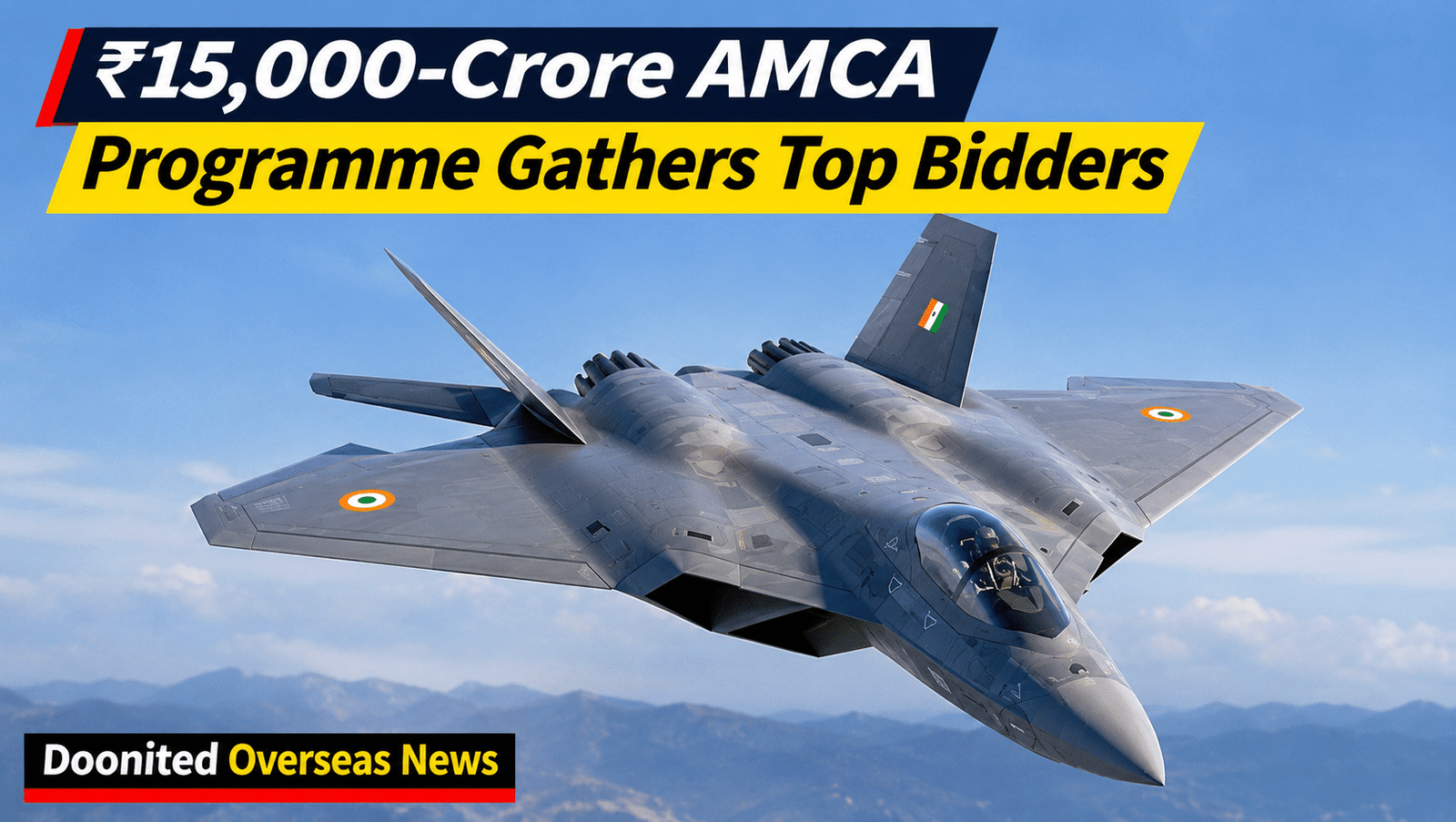
Three Indian industry groups have submitted proposals for the development-cum-production partner (DCPP) role in the Advanced Medium Combat Aircraft (AMCA) programme, a project estimated at approximately ₹15,000 crore for prototype development.
Among the three contenders is a consortium led by Bharat Forge, working alongside public-sector engineering company BEML and defence electronics specialist Data Patterns.
The other contenders are an L&T-led consortium involving Bharat Electronics Limited (BEL) and Dynamatic Technologies, and Tata Advanced Systems Limited (TASL), which has submitted an independent proposal.
According to The Times of India, all three submitted their bids by the October 30, 2026 deadline. The proposals were opened on November 1, and the evaluation process is underway.
The competition represents a significant development in India’s defence industrial strategy: the government is seeking a private-sector-led partner to help transform an indigenous aircraft design into flying prototypes and eventually a production programme.
Bharat Forge consortium brings together three industrial capabilities
The participation of Bharat Forge, BEML and Data Patterns brings together three different areas of industrial expertise.
Bharat Forge is an established engineering and manufacturing company with capabilities in advanced forging, precision manufacturing and defence-related production.
BEML has experience in heavy engineering, defence mobility systems and manufacturing specialised equipment for strategic sectors.
Data Patterns operates in the defence and aerospace electronics segment, including avionics, radar-related systems, electronic warfare and other mission-critical technologies.
Their participation is significant because a modern stealth fighter cannot be developed through aircraft manufacturing expertise alone. It requires coordination across structural engineering, advanced materials, electronics, flight-control systems, sensors, software and weapons integration.
However, the consortium’s participation should not be confused with winning the contract. Its technical capabilities and commercial proposal must still be assessed against those of the other two bidders.
The final selection will determine which industrial group receives the opportunity to work alongside India’s Aeronautical Development Agency (ADA), the organisation responsible for designing the aircraft.
What exactly is India developing?
The Advanced Medium Combat Aircraft is India’s proposed indigenous fifth-generation, twin-engine stealth fighter.
The programme is intended to incorporate several advanced military aviation technologies, including:
Stealth-oriented airframe design and internal weapons bays.
Advanced radar and sensor-fusion capabilities.
Artificial intelligence-assisted avionics.
Supercruise capability, subject to final design and testing.
Advanced electronic warfare systems.
Integration of modern air-to-air and air-to-ground weapons.
The programme received Cabinet Committee on Security approval in March 2024, with approximately ₹15,000 crore allocated for its development and prototype phase.
The initial industrial assignment involves developing five flying prototypes. According to reporting by The Times of India, these aircraft are expected to undertake approximately 1,800 test sorties over seven years to validate flight performance, stealth characteristics, sensors, propulsion and weapons integration.
This is a complex development programme rather than an ordinary aircraft manufacturing contract.
The engine question remains one of the biggest challenges
One of the most important technical questions surrounding AMCA is its propulsion system.
The proposed initial aircraft configuration is expected to use two GE F414 engines, subject to the proposed arrangements involving Hindustan Aeronautics Limited (HAL) and US-based General Electric.
The longer-term ambition is to develop a more powerful indigenous engine for subsequent versions of the aircraft.
This is a particularly important challenge because advanced fighter engines require sophisticated engineering, materials capable of withstanding extreme temperatures, precision manufacturing and extensive testing.
In November 2026, Defence Secretary Rajesh Kumar Singh indicated that the government was considering both public-sector and private-sector approaches to developing an indigenous aero-engine, with the intention of encouraging cooperation across industry and research institutions.
The engine question illustrates why the AMCA programme cannot be judged solely by the selection of an aircraft manufacturing partner. India’s ability to develop critical technologies domestically will determine how much strategic independence the programme ultimately delivers.
What the programme means for overseas Indians
For the Indian diaspora, the AMCA competition is not an immigration, OCI or NRI policy development. It does not directly change visa eligibility, overseas employment rights or citizenship rules.
Its relevance lies elsewhere: India’s emerging position as a more substantial aerospace and defence technology economy.
Thousands of Indian-origin professionals work across international engineering, aerospace, advanced manufacturing, electronics, software and research ecosystems. As India’s domestic aerospace capabilities expand, the potential for professional knowledge exchange, research collaboration and international industrial partnerships becomes increasingly important.
The programme could also become relevant to overseas Indian entrepreneurs and investors following India’s advanced manufacturing sector.
However, these are potential areas of future engagement, not confirmed AMCA recruitment programmes or investment opportunities. No specific overseas Indian participation arrangements have been announced as part of the current bidding process.
The broader economic context is encouraging. According to India’s Ministry of Defence, defence exports reached a record ₹23,622 crore in FY2024–25, representing 12.04% growth over the previous financial year. Private-sector companies contributed ₹15,233 crore of those exports.
India also exported defence equipment, components and systems to approximately 80 countries during that financial year.
These figures demonstrate that India’s defence manufacturing industry is already developing international commercial connections. Whether the AMCA ecosystem can eventually contribute advanced aerospace products to this wider export landscape remains to be seen.
December could bring the next major announcement
The immediate question is which of the three contenders will emerge as the preferred development-cum-production partner.
On November 16, Defence Secretary Rajesh Kumar Singh indicated that the government hoped to announce the winner within approximately a month. He reiterated the significance of establishing India’s first private-sector-led fighter aircraft prototype production line.
The announcement was reiterated in subsequent reporting on November 18.
Nevertheless, selecting the winning bidder will not mean that the aircraft is ready for production. Detailed development, prototype construction, engine integration, flight testing and certification will remain substantial tasks.
Earlier programme expectations have pointed towards a first flight around 2028, but that should be treated as a development target rather than a guaranteed milestone. The broader induction outlook has been reported around 2034–35, subject to technical progress and programme execution.
India’s aerospace ambitions will be judged by execution
The AMCA competition is about more than three companies competing for a ₹15,000-crore development opportunity.
It represents an important test of whether India can combine government-led aerospace research with private-sector engineering, advanced manufacturing and international technology cooperation to build a sophisticated military aircraft.
For overseas Indians, the larger story is India’s evolving industrial relationship with the world. A successful programme could strengthen India’s reputation in advanced engineering, create opportunities for international collaboration and deepen its participation in global aerospace supply chains.
But ambition alone will not establish technological leadership. The real measure of success will be a reliable engine strategy, successful flight testing, genuine domestic technological capability and the ability to deliver the aircraft within realistic timelines.
The winner of the AMCA competition may be announced within weeks. India’s larger test, however, will take years to complete.

World Beyond the News
Why Elephants Stay Close to Their Herd
Elephants live in highly social family groups and use calls, touch and body movements to maintain strong bonds.
Most of the Deep Ocean Remains Difficult to Explore
Extreme pressure, darkness and distance make deep-ocean exploration one of Earth’s greatest scientific challenges.
Spacecraft Can Travel Without Traditional Roads
Spacecraft use carefully calculated trajectories and gravity assists to travel enormous distances through space.
Why Movie Trailers Are Released in Stages
Major films often use teaser trailers, full trailers and final promotional spots to build awareness over time.