
Akash Goes Global: Why India’s Air Defence System Matters Beyond Central Asia
India’s Akash air-defence system has moved from an indigenous military programme to an export product with customers across the South Caucasus and Central Asia. The significance is bigger than another missile sale: it shows India beginning to compete for influence in a defence market historically shaped by Russia and increasingly contested by China, Turkey and other suppliers.
For decades, the map of India’s defence relationships was relatively easy to read.
Russia was central to India’s military hardware ecosystem. Western suppliers occupied important niches. Israel became a significant technology partner. And China was largely viewed as the strategic competitor rather than a market opportunity.
That map is changing.
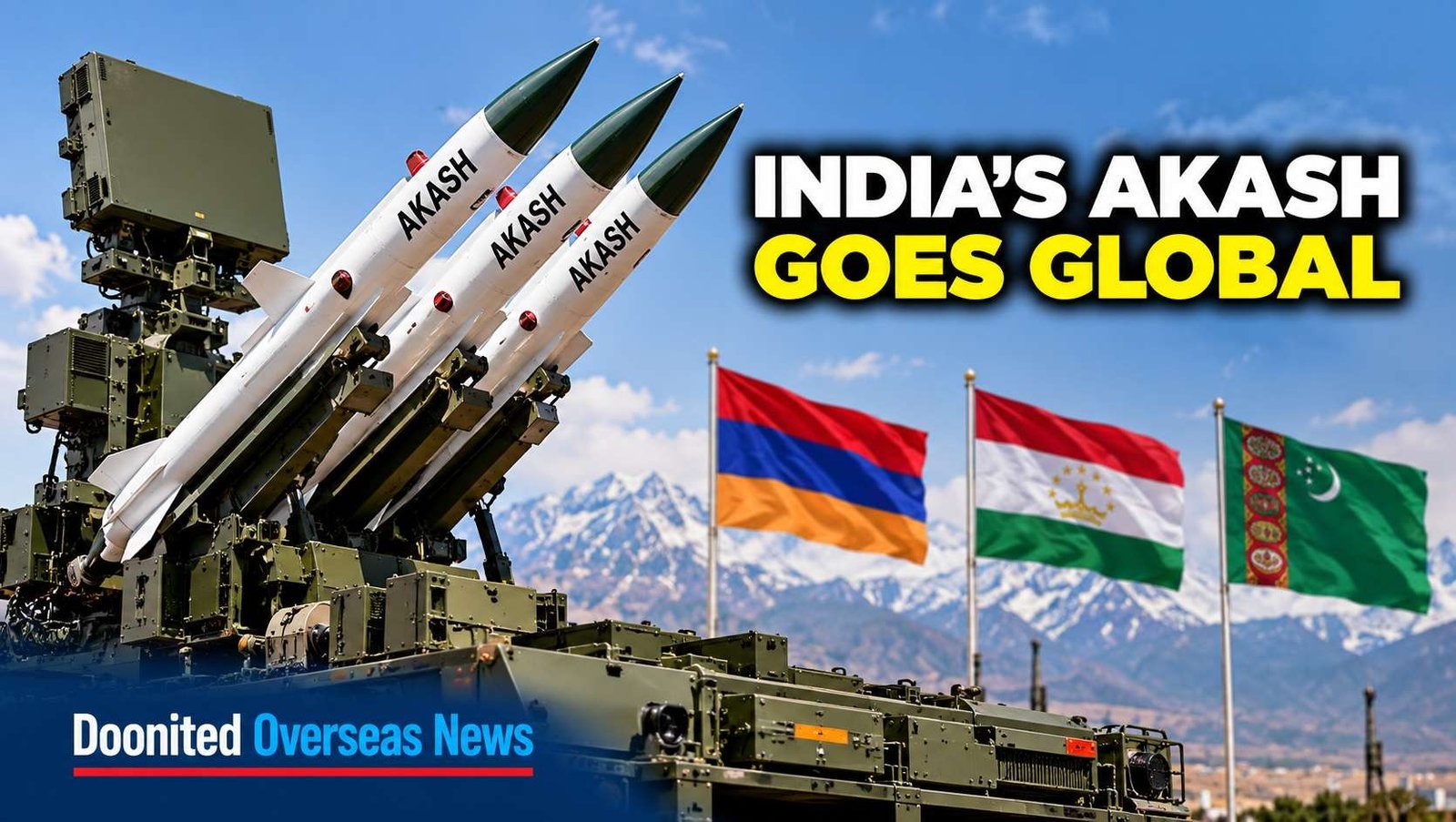
India’s indigenous Akash surface-to-air missile system has now been exported to Armenia, Tajikistan and Turkmenistan, according to Defence Secretary Rajesh Kumar Singh. Armenia was the first foreign customer and acquired multiple batteries; Singh subsequently confirmed exports to Tajikistan and Turkmenistan. He described Akash as one of India’s defence-sector success stories and said its production had stabilised.
The geography is important.
Armenia is in the South Caucasus. Tajikistan and Turkmenistan are in Central Asia.
That distinction matters because the development is not simply an “Akash enters Central Asia” story.
It is the emergence of an Indian-made air-defence system across a wider Eurasian security neighbourhood.
From Indian requirement to export product
Akash was developed by the Defence Research and Development Organisation and is manufactured through India’s defence industrial ecosystem, including Bharat Dynamics Limited and Bharat Electronics Limited.
DRDO describes the system as a short-range surface-to-air missile system designed to protect vulnerable areas and points against air attacks. It can engage multiple targets in group or autonomous modes and is mounted on mobile platforms. The system is operational with both the Indian Air Force and Indian Army.
That history matters because defence exports are rarely just about selling a finished object.
A country buying a missile system is also buying training, maintenance, spares, electronics, radar integration, ammunition replenishment and long-term technical relationships.
The first successful export therefore has a multiplier effect.
If the customer is satisfied, the manufacturer gains a reference customer.
And in defence, reputation travels slowly—but it can travel a long way.
Armenia was the breakthrough
Armenia became the first international customer for Akash, with a deal signed in 2022 for multiple systems.
Its decision was significant because Armenia had traditionally been deeply connected to Russian defence equipment. DRDO material has described Armenia as the first foreign customer for Akash and reported interest from other countries.
The Armenian relationship also illustrated a broader transformation in the South Caucasus.
Countries that historically relied heavily on Russian defence equipment have increasingly explored alternative suppliers.
That trend did not begin entirely with the war in Ukraine. But Russia’s prolonged war effort, changing regional security relationships and Moscow’s stretched resources have accelerated questions about diversification.
A 2026 analysis by the Center for Strategic and International Studies says Russia’s grip over Central Asia has weakened, while its arms exports to the region have declined amid the demands of the Ukraine war. At the same time, China has expanded military-security engagement and Turkey has increased its regional defence footprint.
That is the strategic environment into which Akash has arrived.
Why Tajikistan and Turkmenistan matter
Tajikistan and Turkmenistan are not interchangeable customers.
They have different security priorities, military structures and foreign-policy relationships.
But both sit in a region where Soviet and Russian military legacies remain important.
Their acquisition of Akash therefore gives India something that cannot be measured solely in rupees or dollars: a foothold in a new defence relationship.
The important caveat is that public information does not establish precisely why either government selected Akash.
It would be tempting to conclude that they are simply replacing Russian equipment because of supply problems.
The evidence does not justify that certainty.
What can be said is that Central Asian states have been diversifying their external relationships. Research from Jamestown in 2026 describes Central Asian governments as increasingly diversifying and indigenising defence procurement, while CSIS has documented the region’s changing relationship with Russia and growing Chinese and Turkish engagement.
Akash enters that competitive market as one more option.
That alone is strategically meaningful.
India is not trying to become Russia overnight
It would be a mistake to read three Akash customers as proof that India has suddenly become a major global arms supplier on the scale of Russia, the United States or China.
India is not there.
But the direction is significant.
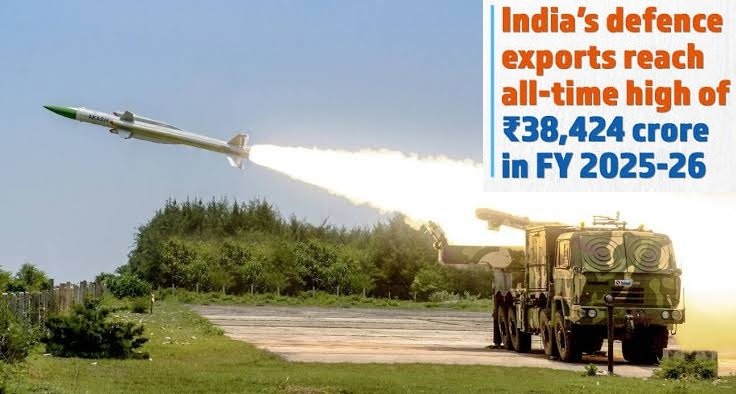
Indian defence exports reached a record ₹38,424 crore in FY2025–26, up 62.66% from ₹23,622 crore the previous year, according to the Ministry of Defence. The government says Indian defence products are now exported to more than 80 countries.
Defence production also reached a record ₹1.78 lakh crore in FY2025–26.
The export story is therefore connected to something larger: India’s attempt to build an industrial base capable of designing, manufacturing and selling defence equipment internationally.
Akash is one product inside that larger industrial strategy.
Cost matters—but it is not enough
One reason Indian defence products may attract international interest is price competitiveness.
Defence Secretary Rajesh Kumar Singh has previously identified cost advantage as one of India’s strengths in defence exports.
That could be important for countries that need modern air defence but cannot—or do not want to—purchase the most expensive systems available from major Western suppliers.
But price alone does not win defence contracts.
A missile system has to work.
It has to integrate with radars and command networks.
It has to be supportable over decades.
Spare parts have to remain available.
Personnel have to be trained.
And the supplier has to remain politically and commercially reliable.
The real test for Akash is therefore not the signing of another export announcement.
It is whether India can build a reputation for consistent delivery, training, maintenance and upgrades.
Akash is evolving too
The system being exported should not be viewed as frozen technology.
DRDO’s Akash Prime incorporates an indigenous active radio-frequency seeker intended to improve accuracy, while the Akash-NG programme represents a newer configuration with a different architecture and enhanced capabilities.
That matters commercially.
Defence customers do not buy technology only for today’s threat environment.
They want confidence that the supplier can upgrade it tomorrow.
If India can keep improving Akash while maintaining production stability and support for earlier configurations, the export opportunity becomes much larger than a single-generation missile sale.
The China factor is real—but should not be exaggerated
Turkmenistan’s military inventory already includes Chinese air-defence systems, according to current reporting.
That makes the country’s acquisition of an Indian system particularly interesting.
But it would be simplistic to describe every Indian defence sale in Central Asia as an attempt to “counter China”.
Countries purchase military equipment for their own reasons.
They may want capability, price, diversification, interoperability, political flexibility or simply another supplier.
Central Asian governments have increasingly pursued multi-vector foreign policies rather than placing every strategic requirement in one country’s hands.
India can benefit from that environment without turning every sale into an anti-China alliance.
That distinction matters for India’s diplomacy.
What does this mean for Overseas Indians?
For Indians living abroad, the significance goes beyond military hardware.
The rise of defence exports changes the international economic identity of India.
For much of the modern era, India’s global reputation was strongest in sectors such as information technology, pharmaceuticals, engineering services and professional talent.
Defence manufacturing adds another layer.
An Indian engineer working overseas, an Indian-origin entrepreneur looking at aerospace supply chains, a student considering defence technology or a diaspora professional following India’s economic transformation is increasingly watching a country that is trying to export complex industrial systems, not merely services.
That creates potential opportunities across engineering, electronics, software, manufacturing, logistics, maintenance and research.
But it also raises expectations.
A successful defence-export industry requires standards, quality control, after-sales support and international credibility. It cannot be sustained by patriotic marketing alone.
For the Indian diaspora, that is the more important story.
The larger map is changing
The Akash’s movement into Central Asia does not mean Russia has disappeared, China has been displaced or India has become the dominant defence supplier.
None of those claims can be justified.
What has changed is the number of choices available to countries that once operated within much narrower defence relationships.
India is becoming one of those choices.
That is strategically valuable.
And it may be even more valuable if India learns how to turn individual export successes into long-term industrial partnerships.
The DOONITED view
The most interesting part of the Akash story is not that an Indian missile has travelled abroad.
It is where it has travelled.
From Armenia in the South Caucasus to Tajikistan and Turkmenistan in Central Asia, Akash is entering a region where defence relationships are becoming more diversified and competition among external powers is increasing.
India should resist the temptation to declare victory too early.
A missile sale is an achievement.
A reliable global defence-support ecosystem is a much bigger achievement.
The next test is whether India can provide customers not merely with a weapon, but with the confidence that the technology, training, upgrades and industrial support will still be there years after the contract is signed.
If Akash can become that kind of product, its biggest export may not be a missile at all. It may be India’s credibility as a defence manufacturer.


World Beyond the News
Birds Can Navigate Using Earth’s Magnetic Field
Several bird species can sense Earth’s magnetic field, helping them navigate during long-distance migration.
Fermentation Is a Global Food Tradition
People across continents have used fermentation for centuries to preserve food and create distinctive flavours.
Modern Batteries Store Energy Chemically
Rechargeable batteries repeatedly move ions between electrodes, allowing electrical energy to be stored and released.
Why Songs Become Global Hits
Streaming platforms, short-form video, playlists and international collaborations can rapidly carry music across borders.