
What the Numbers and Arabian Sea Collision Reveal
The question has returned to the headlines after an unusual incident in the Arabian Sea:
Can the Indian Navy defeat the Pakistan Navy?
The immediate trigger is not a war.
It is a collision.
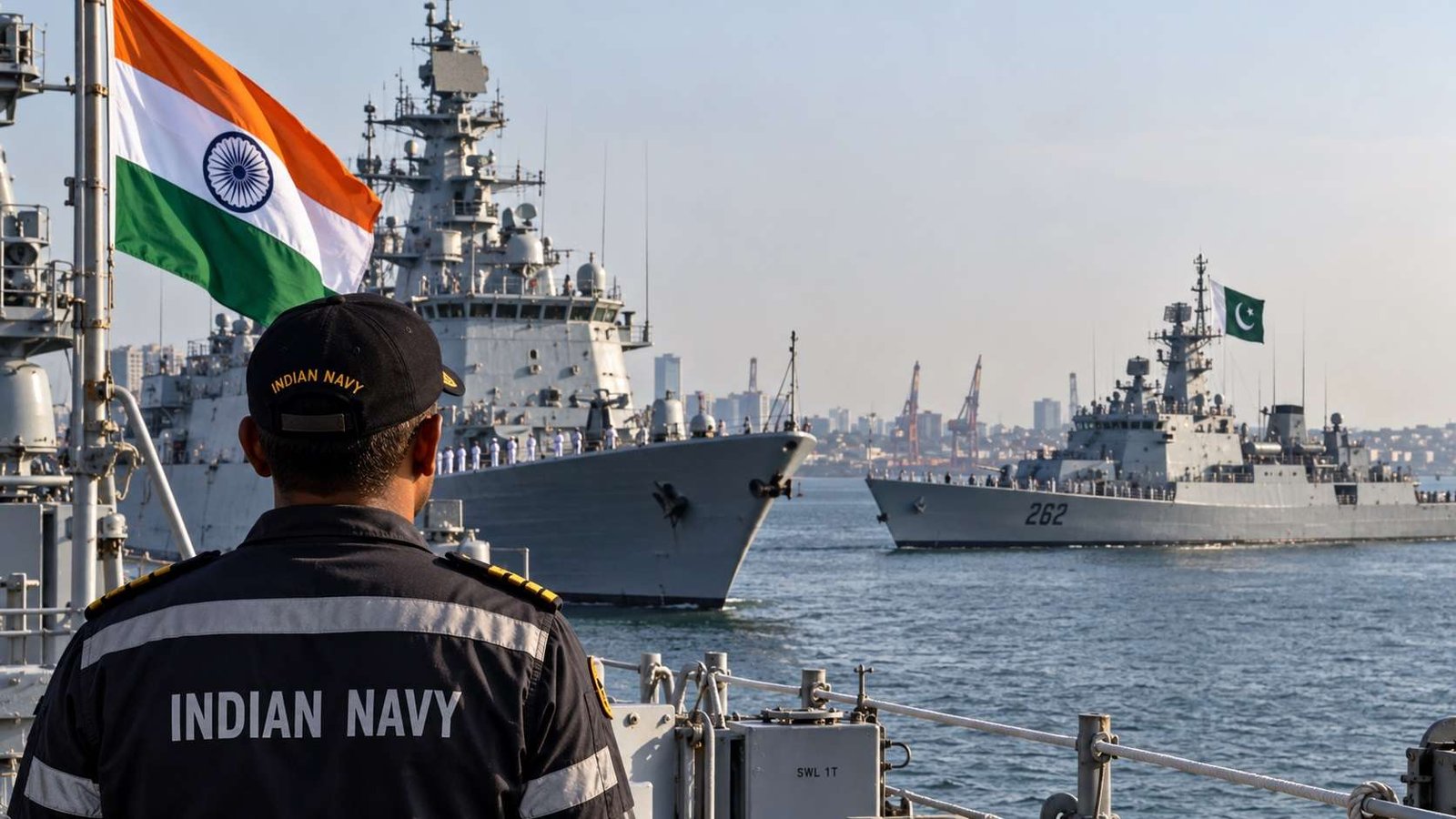
On the evening of 15 September 2026, an Indian Navy frontline warship and the Pakistani naval vessel PNS Hunain collided in the northern Arabian Sea. India subsequently summoned Pakistan’s chargé d’affaires and lodged a formal protest. Pakistan, in turn, also protested, giving a different account of the incident and describing the Indian ship’s manoeuvres as provocative.
The incident did not become a naval battle.
But it has revived the larger question of comparative naval power.
And here the answer requires considerably more nuance than an internet AI summary saying that India is “vastly stronger” and could “easily” win.
India Has a Clear Numerical Advantage
There is little controversy over the broad direction of the numbers.
The exact fleet totals differ between open-source databases because researchers classify patrol craft, auxiliaries, support vessels and operational status differently.
Global Firepower’s 2026 comparison lists:
| Naval capability | India | Pakistan |
|---|---|---|
| Fleet strength | 343 | 120 |
| Aircraft carriers | 2 | 0 |
| Submarines | 18 | 8 |
| Destroyers | 13 | 0 |
| Frigates | 18 | 9 |
| Corvettes | 21 | 6 |
| Patrol vessels | 146 | 79 |
The same source therefore shows India with more than twice Pakistan’s reported overall fleet strength, alongside major advantages in carriers, submarines and principal surface combatants.
Another 2026 database produces higher totals—357 Indian vessels against 152 Pakistani vessels—but reaches the same broad conclusion about the structural difference between the two navies.
So the first fact is straightforward:
India has a substantially larger conventional navy.
But ships on a spreadsheet do not fight wars.
Crews do.
Sensors do.
Aircraft do.
Submarines do.
Logistics do.
And geography certainly does.

The Aircraft Carrier Gap Is Hard to Ignore
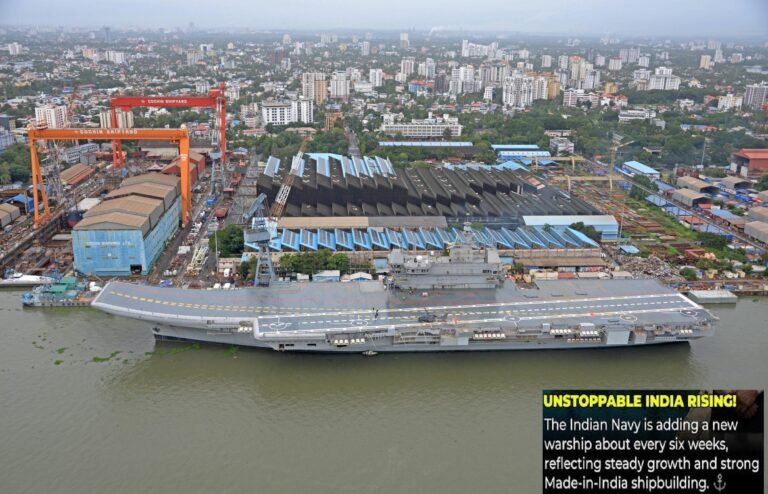
India operates two aircraft carriers.
Pakistan operates none.
That difference is strategically important.
An aircraft carrier provides a navy with a mobile airfield at sea, allowing fixed-wing aircraft to operate far from land bases.
India’s carrier fleet includes INS Vikramaditya and the indigenously built INS Vikrant.
INS Vikrant is particularly significant because it represents India’s ability to design and construct a large aircraft carrier domestically.
But even here, the simple comparison “two versus zero” needs context.
Aircraft carriers are not independent weapons.
They require escorts, submarines, airborne surveillance, logistics, maintenance and trained personnel.
A carrier battle group is a system.
The ship is merely the most visible part of it.
Pakistan’s Strategy Is Different
Pakistan does not need to match India’s fleet ship-for-ship.
Its maritime requirements are different.
Pakistan has a much shorter coastline and concentrates much of its naval strategy around the Arabian Sea, maritime approaches and the defence of its ports.
That encourages a sea-denial approach.
The objective of sea denial is not necessarily to control an entire ocean.
It is to make an opponent’s operations sufficiently dangerous that operating in a particular area becomes difficult or costly.
Submarines are particularly valuable for this purpose.
And Pakistan’s submarine capability deserves serious attention.
The 2026 Global Firepower inventory lists eight Pakistani submarines against 18 Indian submarines.
Pakistan is also modernising its underwater fleet with Chinese-origin systems, meaning that the submarine equation will remain an important element of the maritime balance.
This is why “India has more ships” does not automatically translate into “India can do anything it wants at sea.”
The Arabian Sea Is Not a Chessboard
The recent collision illustrates another problem with simplistic comparisons.
According to India, the incident occurred in international waters, while Pakistan gave a different account and said the Indian vessel’s manoeuvres were provocative. Both governments subsequently took diplomatic action.
Indian reporting said the Pakistani vessel sustained damage and returned to port, while the Indian vessel continued its mission.
Those facts do not establish that one navy “won” a confrontation.
There was no battle.
There was no exchange of weapons.
And there was no demonstrated test of either navy’s full combat capability.
Calling it a victory would therefore be an analytical stretch.
What the incident does demonstrate is something less dramatic but important:
naval operations between rival states can become dangerous very quickly.
Why India’s Advantage Is Larger Than Fleet Numbers
India’s maritime advantage comes from several layers.
It has:
Two aircraft carriers
A larger submarine force
A substantially larger surface fleet
Destroyers and modern frigates
Naval aviation
Long-range maritime surveillance capabilities
Two major coastlines
Island territories
A growing domestic naval shipbuilding industry
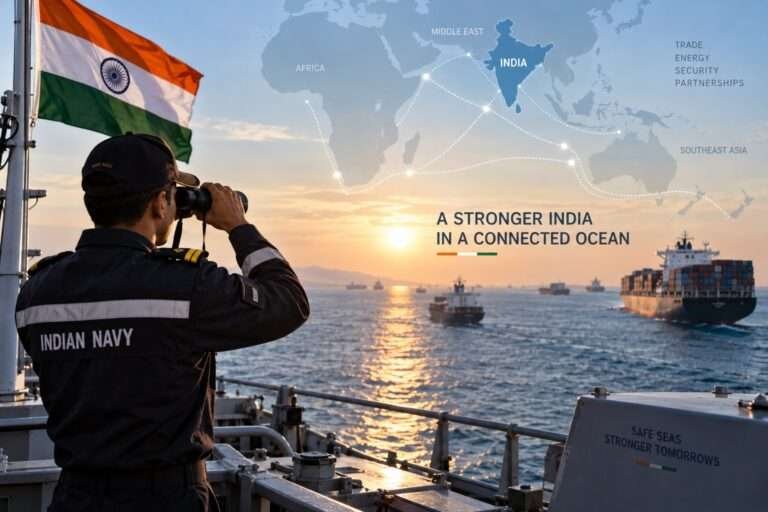
India also has strategic interests extending across both the Arabian Sea and Bay of Bengal and into the wider Indian Ocean.
That requires a navy capable of sustained operations well beyond India’s immediate coastline.
Pakistan’s navy has a more geographically concentrated mission.
So the two fleets should not be judged as though they were designed to perform exactly the same job.

But Pakistan Can Still Make the Maritime Equation Difficult
A smaller navy can remain dangerous.
Pakistan’s submarine force, coastal geography, anti-ship capabilities and Chinese-origin equipment give it tools for sea denial.
That means India’s numerical advantage does not eliminate operational risk.
For example, a submarine does not have to defeat an entire carrier group to affect its behaviour.
If commanders believe an area contains an underwater threat, they may have to deploy additional surveillance aircraft, helicopters, escorts and other anti-submarine resources.
That consumes time and resources.
In naval warfare, forcing the opponent to spend resources can itself be strategically valuable.
This is one reason submarine warfare receives so much attention even when submarine numbers are relatively small.
What About Destroyers and Frigates?
This is another area where the comparison is striking.
Global Firepower lists:
- 13 Indian destroyers vs 0 Pakistani
- 18 Indian frigates vs 9 Pakistani
- 21 Indian corvettes vs 6 Pakistani
These vessels provide different combinations of air defence, anti-surface warfare, anti-submarine warfare, missile capability and fleet escort functions.
India’s larger destroyer fleet gives it substantially greater capacity to build layered task groups around high-value assets.
Pakistan’s smaller fleet has to make more selective use of its available combatants.
Again, however, quantity is only one part of capability.
Training, readiness, sensors, missiles, electronic warfare, intelligence and command-and-control can materially affect how individual platforms perform.
The Chinese Factor
Any serious India–Pakistan naval comparison also has to account for China’s role in Pakistan’s naval modernisation.
Pakistan has acquired Chinese-designed and Chinese-built naval systems, including frigates and submarines.
This gives Pakistan access to a major external defence-industrial partner.
For India, the strategic environment is consequently broader than a two-country contest.
The Indian Navy must think about the Arabian Sea, the Bay of Bengal, the Indian Ocean and China’s growing maritime presence.
That is one reason India’s naval modernisation cannot be understood solely through the India–Pakistan lens.
Can India “Defeat” Pakistan’s Navy?
The answer depends entirely on what defeat means.
If the question is whether India possesses the larger conventional naval force, the answer is clearly yes.
If the question is whether India has greater capacity for sustained blue-water operations, the available fleet structure strongly points in that direction.
If the question is whether India would automatically destroy Pakistan’s navy in a future war, there is no responsible way to guarantee that outcome.
A conflict would depend on:
- The objectives of both sides
- Location and duration of operations
- Submarine activity
- Maritime surveillance
- Air power
- Missile employment
- Readiness and training
- Logistics and resupply
- Port infrastructure
- Electronic warfare
- Intelligence
- Rules of engagement
- The possibility of escalation
A navy’s strength is therefore better understood as capacity, not as a guaranteed prediction of what happens in a war.
The AI Overview Gets One Thing Right—and One Thing Wrong
The AI-generated comparison is directionally correct when it says India possesses a much larger naval force.
Its fleet comparison also correctly identifies India’s aircraft carriers, destroyers and larger submarine fleet as major structural advantages.
But the word “easily” is where the analysis becomes unreliable.
Pakistan does not need to defeat the Indian Navy ship-for-ship.
Its strategic problem is different.
It needs to protect its maritime approaches and make Indian naval operations sufficiently difficult and risky to influence the outcome of a particular conflict.
That is a much more realistic way to understand sea denial.
And it is why the number of ships alone cannot answer the question.
The Collision Is a Warning, Not a War
The September 2026 collision should also be kept in perspective.
India has described the Pakistani vessel’s conduct as unacceptable and unprofessional, while Pakistan has presented its own account and protested India’s conduct.
Until the competing claims are independently resolved, the incident should not be turned into evidence of a decisive combat advantage.
What it does demonstrate is the importance of communication, safe navigation and established confidence-building arrangements between two militaries operating in proximity.
There is a certain irony here.
The internet wants to know which navy would win a war.
Professional navies have a much more immediate interest in ensuring that two warships do not accidentally create one.

DOONITED EDITORIAL PERSPECTIVE
India clearly possesses a much larger conventional naval force than Pakistan.
That is an important fact and should not be artificially softened.
But responsible defence journalism should also resist turning a capability comparison into a war prediction.
India’s advantage is strongest when viewed across the entire maritime system: carriers, submarines, surface combatants, naval aviation, surveillance, geography and industrial capacity.
Pakistan’s smaller force nevertheless retains meaningful sea-denial capabilities, particularly underwater.
The real strategic lesson is therefore not “India can easily win.”
It is that India has greater maritime capacity, while Pakistan retains specific capabilities capable of imposing operational risk.
That is a much more useful—and much more defensible—conclusion.
The Learning Point
For readers trying to understand India–Pakistan naval power, forget the social-media scoreboard for a moment.
Look at five things:
Fleet composition.
Submarine capability.
Naval aviation and surveillance.
Logistics and industrial capacity.
Geography and strategic objectives.
Those factors tell us considerably more than simply counting ships.
India enters any conventional naval comparison with a substantial structural advantage.
But the purpose of naval power is not to win internet arguments.
It is to deter conflict, protect maritime interests and ensure that when crises occur, they do not escalate beyond control.

World Beyond the News
Dolphins Use Individual Signature Whistles
Bottlenose dolphins develop distinctive whistles that function somewhat like individual acoustic identifiers.
The Pacific Is Earth’s Largest Ocean
The Pacific Ocean covers more area than any other ocean basin and stretches between Asia, Australia and the Americas.
Artificial Intelligence Learns Statistical Patterns
Modern machine-learning systems identify patterns in large datasets and use those patterns to generate predictions or outputs.
Why Some Stories Spread So Quickly
Emotion, novelty, visual appeal and easy sharing can make a story travel rapidly across social platforms.