

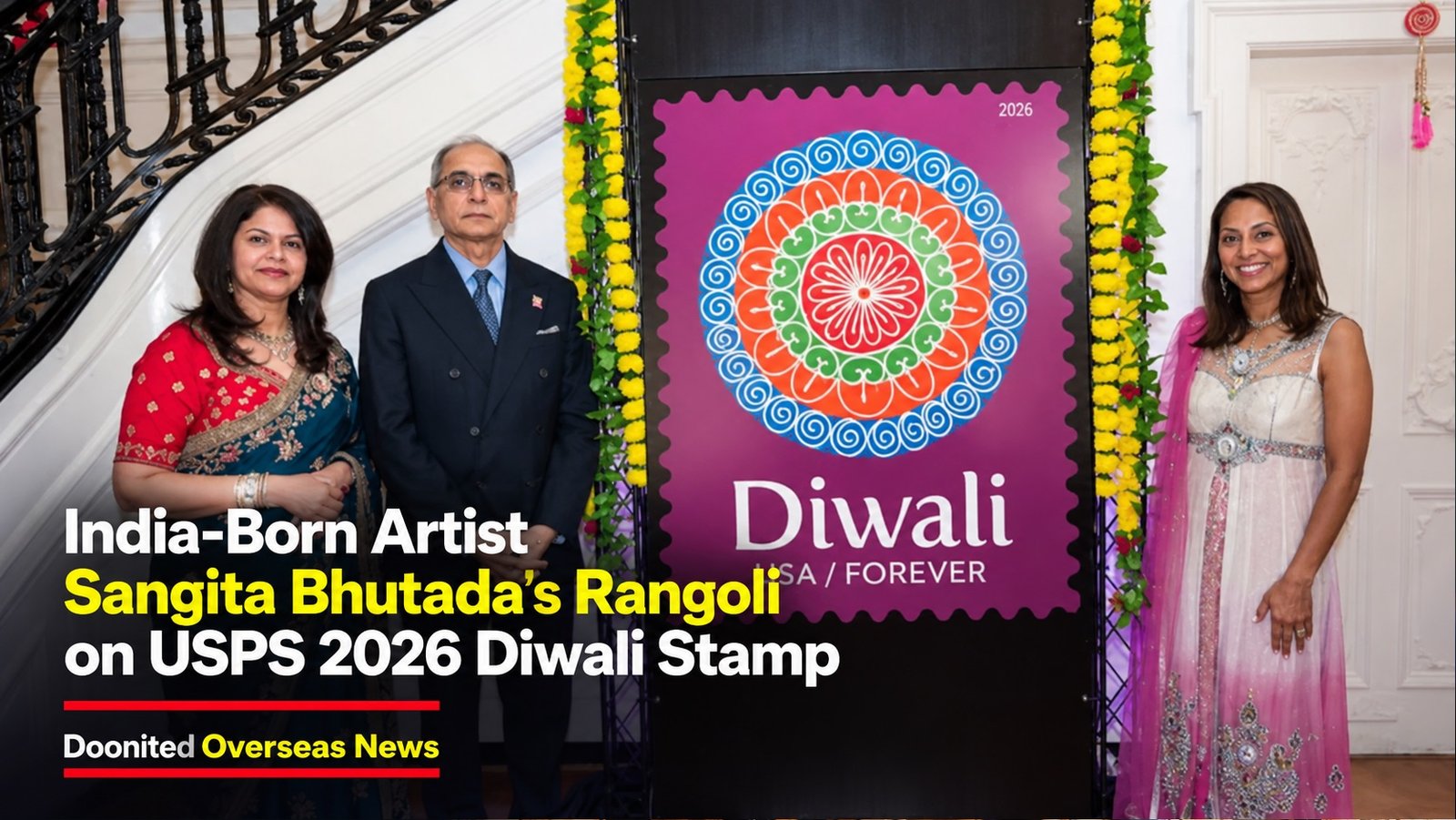
Sangita Bhutada: How an Indian-American Artist Brought Rangoli to the US Postal Service’s Diwali Stamp
An eight-foot rangoli created by India-born, Houston-area artist Sangita Bhutada is the centrepiece of the United States Postal Service’s 2026 Diwali Forever stamp. Printed in an initial quantity of 20 million, the design brings a traditional Indian folk art into one of America’s most familiar public communication systems.
An art form traditionally created on floors outside homes has found an unexpected new canvas: an American postage stamp.
On October 21, 2026, the United States Postal Service (USPS) unveiled its latest Diwali Forever stamp at the Embassy of India in Washington, D.C. At its centre is an intricate, colourful rangoli created by Sangita Bhutada, an India-born artist who has lived in the Houston area for many years.
The release marks the second time the USPS has issued a stamp dedicated to Diwali, following its inaugural design in 2016. The new issue has an initial print quantity of 20 million stamps, giving Bhutada’s interpretation of a traditional Indian art form a substantial national platform. The stamp is available in sheets of 20 through US post offices and the USPS online store.
For the Indian-American community, the design represents more than a seasonal celebration. It offers a visible example of how cultural traditions carried across borders can become part of the wider American cultural landscape.
Nearly 30 Years of Rangoli Practice
Bhutada has practised rangoli for nearly three decades. The traditional art involves arranging coloured powders, sand, rice flour or other materials into decorative patterns, often featuring geometric forms, flowers and symmetrical motifs.
During Diwali, rangoli is commonly created at entrances, courtyards and other spaces around homes. Depending on regional customs and family traditions, these designs may welcome guests, express devotion, symbolise auspiciousness or simply add colour to the celebration.
Its temporary nature is part of its character. A rangoli is made by hand, experienced in its setting and eventually swept away or allowed to disappear. Translating such work into a postage stamp therefore required more than producing an attractive pattern: the design had to retain its detail when reduced to a fraction of its original size.
According to the USPS, Bhutada constructed the work using coloured sand and starch-based powders in blue, orange, green, red and white. The vivid palette appears against a purple background, helping the intricate shapes stand out.
An Eight-Foot Artwork, Made for a Tiny Canvas
The original rangoli measured eight feet in diameter. Bhutada spent approximately eight to ten days creating it—considerably longer than the four to six hours she would typically spend on a rangoli, according to the USPS account.
The process began with sketches. Bhutada reportedly submitted multiple concepts after being approached by the postal service, before developing the selected design on the floor. She used her fingers and, at times, a kitchen strainer to distribute the coloured materials.
Photographer Bijay Dixit, a longtime friend based in the Houston area, photographed the completed work. The photograph became the basis for the stamp image.
The production team then translated the photograph into a compact postal design. Jennifer Arnold was the stamp designer, while William J. Gicker served as art director. The official USPS stamp announcement also credits Daryl DeMont as the modeller.
This collaboration highlights an important distinction: the rangoli itself is Bhutada’s artwork, while the final stamp is the result of a wider process involving photography, design, art direction and printing.
The USPS used offset printing with microprinting. The resulting stamp measures approximately 0.91 by 1.19 inches overall—an unusually small format for a work that began as an eight-foot installation.
What the Stamp Means for Indian Americans
The unveiling took place at the Indian Embassy in Washington, D.C., with India’s Ambassador to the United States, Vinay Mohan Kwatra, and USPS Senior Vice President Shibani Gambhir among those associated with the launch.
The symbolism is significant. Diwali is celebrated by millions of people in the United States, including Hindus, Sikhs, Jains and others whose traditions and interpretations of the festival differ. The USPS describes the stamp as a celebration of the festival, while its official announcement recognises the different religious meanings attached to Diwali.
For Indian Americans, public recognition of a cultural practice can help make a community’s heritage more familiar to people outside it. A postage stamp is particularly effective in this respect because it circulates beyond festival venues, cultural institutions and diaspora organisations. It can travel with ordinary correspondence and reach people who might never attend a Diwali celebration.
The USPS says its stamps have commemorated cultures from around the world since 1893. The 2026 Diwali issue belongs to that broader tradition of reflecting the many cultural influences present in American life.
However, one commemorative stamp should not be mistaken for a complete measure of cultural inclusion. Its significance lies in the public recognition it provides, while lasting understanding depends on continued cultural exchange, education and representation.
From Community Tradition to National Recognition
The initial print quantity of 20 million stamps is notable, but it is important to interpret the figure correctly. It represents the USPS’s announced print quantity—not evidence that all 20 million have already been purchased or used.
The stamp is a Forever stamp, meaning it remains valid for domestic First-Class Mail weighing up to one ounce even if the applicable postage rate increases. It is sold in sheets of 20 and was priced at 82 cents per stamp when listed by the USPS for release. International mail may require a different postage rate.
For readers in the Indian diaspora, the issue also offers a reminder that cultural heritage does not have to remain confined to its place of origin. Traditions can be sustained by families and communities abroad, adapted to new settings and shared with wider audiences without losing their connection to their roots.
Bhutada’s rangoli began as a painstaking arrangement of coloured materials on a floor. Through photography and stamp design, it became a portable image of Indian artistic practice—one that can accompany letters across the United States.
The broader achievement is not simply that rangoli has appeared on a stamp. It is that an art form often created for a particular home, occasion and moment has been recognised in a format designed to circulate widely.
For the Indian-American community, that is a meaningful form of visibility: heritage expressed not only through festivals and private celebrations, but also through the everyday symbols of public life.

World Beyond the News
Octopuses Can Change Their Appearance
Octopuses can rapidly alter their skin colour and texture to communicate, camouflage themselves and respond to danger.
Some Cities Exist Across Two Continents
A small number of cities are geographically associated with two continents, creating unusual cultural and geographic identities.
Earth’s Climate Is Measured in Many Ways
Scientists track temperature, atmospheric gases, sea level, ice cover and other indicators rather than relying on a single climate number.
Streaming Changed How Audiences Discover Shows
Recommendation systems and global streaming releases allow audiences to discover programmes far beyond their original markets.