
When NRI Parents Send Their Children to India: The Family Decision Behind a Complicated Choice
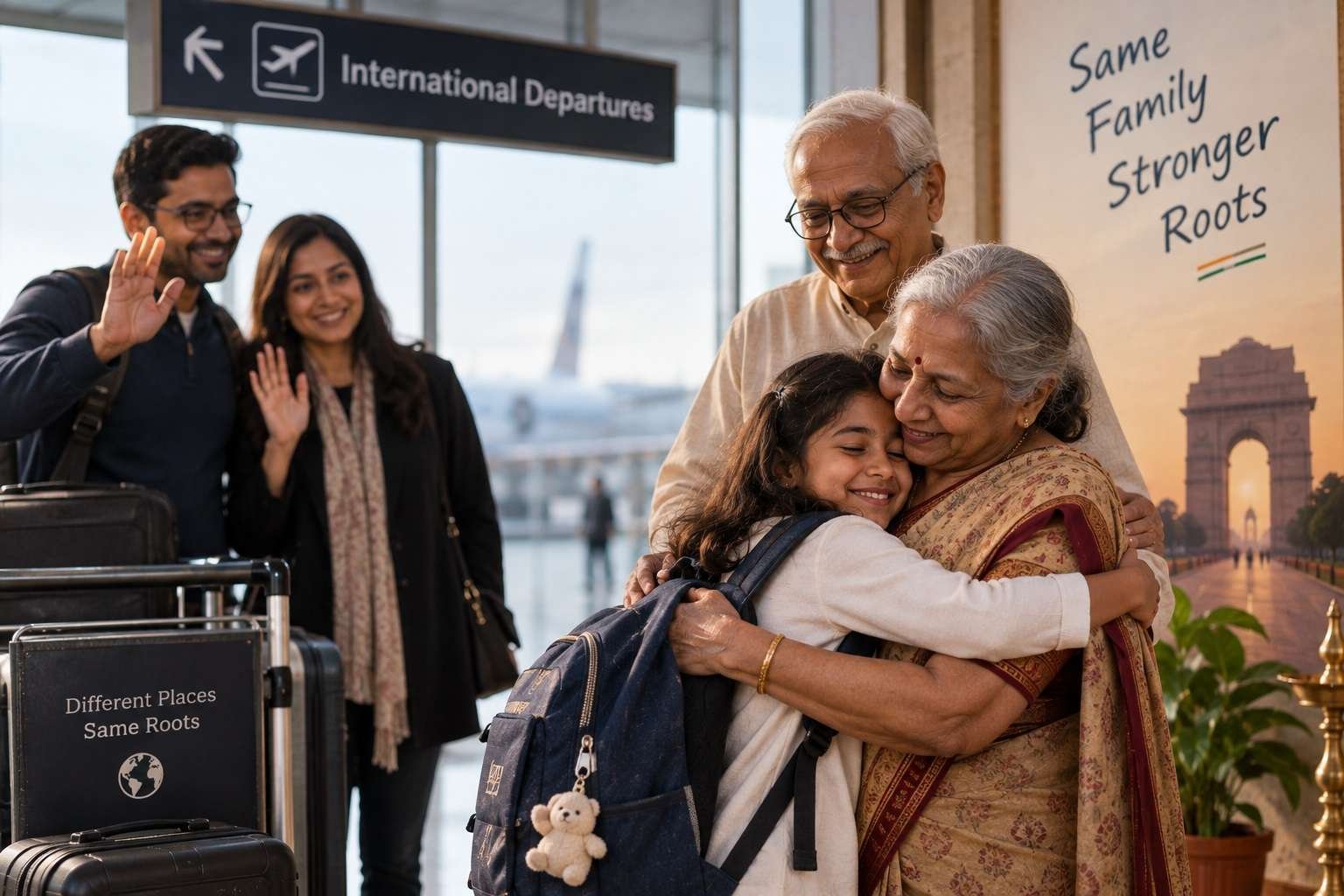
For many Indian families living abroad, the question of where a child should grow up does not end at the airport.
Sometimes it begins there.
A child may be born in Australia, the United States, Canada, Britain or the Gulf, while grandparents, cousins and the wider family remain thousands of kilometres away in India.
Then comes the practical question:
Should the child spend an extended period in India?
For some families, the answer is yes.
The reasons can be deeply emotional, intensely practical—or a mixture of both.
Grandparents may provide childcare.
Children may spend more time around relatives.
Parents may want them to experience Indian languages, festivals and family traditions.
And in some cases, India may offer an education option that makes financial sense.
But this is not a simple story of Indians abroad “sending children home.”
It is a much more complicated negotiation between family, identity, education, money and geography.
The extended family is part of the equation
The idea of family responsibility extending beyond parents is familiar across much of Indian society.
The SBS Voices article by Zoya Patel describes her experience growing up with a grandmother who travelled from Fiji to Australia for extended periods to help care for grandchildren. It also recounts Indian-Australian families whose children spent periods in India with grandparents while parents established their lives in Australia.
The underlying idea is straightforward.
A child does not necessarily belong only to a nuclear household.
Grandparents, aunts, uncles and cousins can all have important roles.
That does not mean every Indian family follows this model.
Modern Indian families are increasingly nuclear, geographically dispersed and professionally mobile.
But the extended-family network remains an important resource for many diaspora households.
And when grandparents are in India while parents are abroad, geography can turn that resource into a major family decision.

Why India can feel like a cultural classroom
Parents living abroad often worry about something that cannot be taught entirely through a weekend language class:
everyday cultural familiarity.
A child can learn Hindi, Punjabi, Tamil, Bengali, Marathi or another Indian language at school or through online lessons.
But language is different when it is spoken around the dinner table.
Diwali is different when grandparents are preparing for it.
A family wedding is different when dozens of relatives are present.
A summer in India can expose a child to grandparents, cousins, neighbourhood life, regional food, local festivals and family histories in ways that are difficult to reproduce thousands of kilometres away.
That is the strongest argument for cultural immersion.
It is not necessarily about rejecting the child’s country of birth.
It is about adding another layer to the child’s identity.
The “village” can be useful—but it is not automatically perfect
The idea that “it takes a village to raise a child” sounds particularly attractive when parents are juggling demanding careers.
Grandparents can provide companionship, supervision and continuity.
The SBS account describes this arrangement not simply as babysitting, but as an assumed family responsibility in some Indian households.
There is an important economic dimension too.
Professional childcare in some Western cities can be extremely expensive.
A grandparent helping with school runs, meals and everyday supervision can make an enormous difference to working parents.
But there is a danger in romanticising the arrangement.
Grandparents are not an unlimited childcare service.
They have their own health, routines and lives.
And children who spend long periods away from their parents can experience emotional strain.
A 2025 qualitative study of migration and families in India also found concerns about grandparents and other guardians being unable to adequately supervise children’s education and health practices in some left-behind-child situations.
So the “village” can be powerful.
But a village still needs good planning.

Education is another reason—but not a universal one
Education can complicate the calculation.
For some families, schooling or university in India can be less expensive than equivalent education abroad.
India also has established mechanisms specifically designed to connect diaspora children with Indian higher education.
The Ministry of External Affairs’ Scholarship Programme for Diaspora Children (SPDC) was introduced to make undergraduate education in Indian institutions accessible to children of NRIs and people of Indian origin. The current programme offers 150 scholarships annually and has been extended to eligible diaspora children from all countries.
That is an important institutional signal.
India is not merely receiving returning diaspora families informally.
It also has programmes designed to encourage diaspora youth to engage with Indian education and society.
But an important correction is necessary:
A scholarship programme does not mean every NRI child receives an NRI quota or automatic admission advantage.
Admission rules vary by institution and programme.
Families need to examine the actual eligibility requirements rather than relying on informal advice.
The question parents sometimes avoid: what does the child want?
This may be the most important issue.
Parents may think:
“India will give my child culture.”
Grandparents may think:
“The child will be happier with us.”
The parents may think:
“We can manage work better.”
But the child may have a completely different view.
A teenager who has spent their entire life in Melbourne, Toronto or New York may experience a move to an Indian school not as a cultural homecoming but as a major disruption.
The education system may be different.
Teaching styles may be different.
Friendships have to be rebuilt.
Academic expectations may change.
The child may understand India culturally but still feel socially foreign there.
This is particularly important for second-generation diaspora children.
Having Indian ancestry does not automatically mean feeling culturally Indian in every environment.
Identity cannot be assigned like a school uniform.
The reverse culture shock is real
There is an interesting irony here.
Parents may send children to India so that they become more familiar with Indian culture.
But the child may discover that India itself has changed.
The India their parents remember from childhood may not be the India they encounter.
Cities have transformed.
Schools have changed.
Technology has changed relationships.
Young Indians have different expectations.
And the family itself may have changed.
Meanwhile, the child has changed too.
The result can be something neither side anticipated:
the child is culturally connected to India but does not necessarily feel completely at home there.
That is not failure.
It is what happens when identity develops across borders.
Returning to India as a family is different from sending a child
There is another important distinction.
Some families do not merely send children to India temporarily.
They eventually decide to move back to India themselves.
That is a much larger decision.
Employment, housing, schooling, healthcare, taxation, finances, social networks and lifestyle all become part of the calculation.
The Desi Return analysis makes precisely this point, highlighting weak planning, unrealistic expectations, family disagreement and poor timing as factors that can make a return difficult.
The lesson is simple:
A return should be designed, not improvised.
The same applies to a child’s temporary move.

What works best?
There is no universal formula.
For one family, several months with grandparents may work beautifully.
For another, regular summer visits may be enough.
A third family may choose an Indian boarding school or university.
Another may remain overseas but create strong connections through language classes, community organisations, festivals and extended family visits.
And some families will conclude that their children should remain entirely in the country where they were raised.
All of those decisions can be reasonable.
The objective should not be to produce a particular kind of Indian child.
It should be to produce a secure, educated and culturally confident young person.
DOONITED Editorial Perspective
There is a romantic story about diaspora families:
“They send their children back to India so they don’t forget their roots.”
It makes for a good headline.
Reality is more complicated.
Sometimes it is about culture.
Sometimes grandparents need each other.
Sometimes childcare is expensive.
Sometimes parents are establishing themselves overseas.
Sometimes education economics matter.
Sometimes immigration uncertainty influences family planning.
And sometimes a child simply wants to spend time with grandparents.
We should therefore be careful about judging the decision as either patriotic or regressive.
A family is not abandoning its culture because it raises a child abroad. Nor is it necessarily making the wrong choice by sending a child to India for a period of time.
The real question is whether the arrangement works for the child.
That is the standard that should come first.
The bigger insight
The Indian diaspora has created something unusual.
Children can grow up with one passport, attend school in another country, speak several languages, celebrate festivals from their parents’ homeland and spend summers with grandparents thousands of kilometres away.
Their identity does not have to fit neatly inside one national box.
India’s relationship with its diaspora should therefore not be measured only through remittances or investment.
It can also be measured through relationships between generations.
A grandparent teaching a child a family recipe.
A child learning a language from an elderly relative.
A teenager discovering the town where a parent grew up.
A university student choosing to study in India.
These are small interactions.
But multiplied across millions of diaspora families, they become something much larger.
A living connection between generations and countries.
And perhaps that is the real reason some NRI parents send their children to India.
Not simply to make them “more Indian.”
But to make sure that a part of their family story remains personally theirs.

World Beyond the News
Bees Communicate Where Food Is
Honeybees use movement patterns known as waggle dances to communicate information about food locations.
Street Food Reflects Local History
Many famous street foods developed from migration, trade, local ingredients and the everyday needs of working communities.
A Day on Venus Is Extremely Long
Venus rotates so slowly that one rotation relative to distant stars takes longer than its trip around the Sun.
Human Achievement Continues to Push Limits
Athletes, engineers, scientists and explorers regularly establish new benchmarks in speed, endurance, scale and precision.