

Where Do Indians Live Around the World? The Countries With the Biggest Indian Communities
For a country of more than a billion people, India has an interesting paradox.
One of the world’s largest populations is also one of the world’s most geographically dispersed communities.
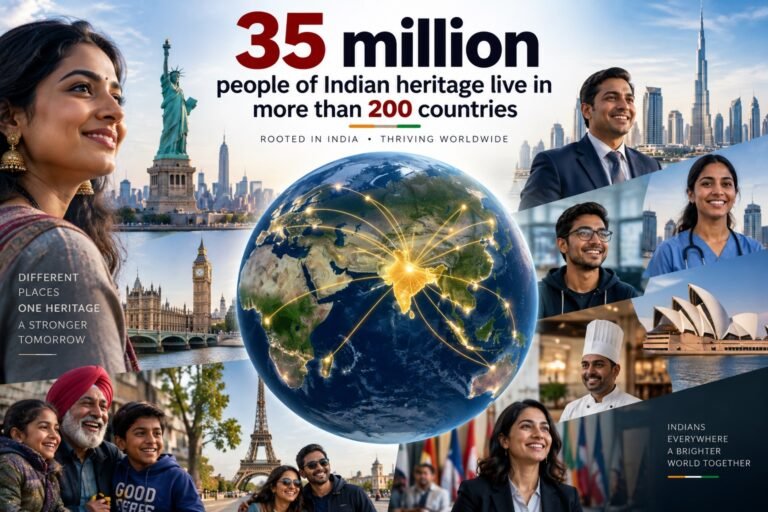
From the Gulf to North America, from Britain and Australia to Southeast Asia and Africa, people with connections to India have built homes, businesses, careers and communities thousands of kilometres from the country their families once called home.
And the map is much bigger than the familiar destinations of the Indian overseas population.
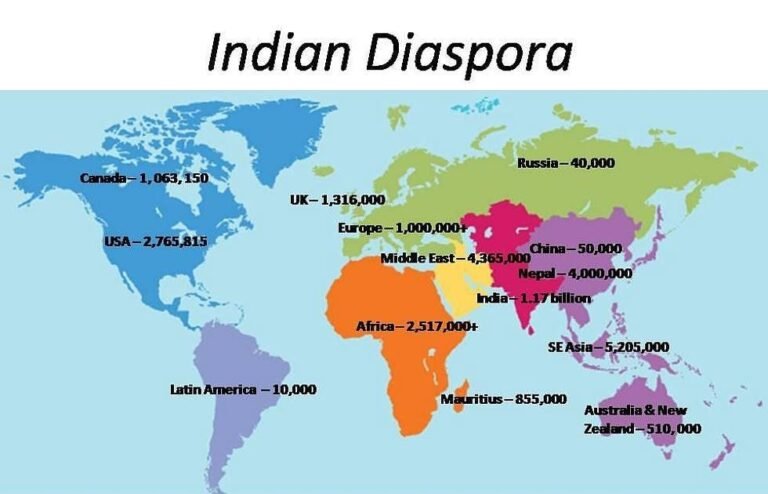
The Indian presence stretches across the United Arab Emirates, the United States, Saudi Arabia, the United Kingdom, Canada, Australia, Oman, Kuwait, Singapore, Qatar, South Africa, New Zealand and many other countries.
This is not simply a story about migration.
It is a story about how an Indian community became a global network.
First, an important distinction: Who counts as an Indian abroad?
This question sounds simple but isn’t.
An Indian citizen living overseas is not necessarily the same thing as a person of Indian origin who holds another country’s citizenship.
For example, someone born in India and working in Dubai may be an Indian citizen.
A second-generation Indian American born in New Jersey is generally not.
Yet both may be part of what people casually call the “Indian diaspora.”
The Indian government’s Ministry of External Affairs uses separate categories for NRIs and PIOs/people of Indian origin, and its country-wise data therefore needs to be interpreted carefully.
This distinction matters when comparing countries.
Otherwise, we end up comparing apples, oranges and—quite possibly—mangoes.
The Gulf: India’s enormous overseas neighbourhood
If you want to understand where Indians actually live overseas, start with the Gulf.
The United Arab Emirates has one of the world’s largest Indian communities.
Indians are present across the UAE’s economy—from construction and logistics to healthcare, finance, technology, retail, hospitality and entrepreneurship.
Dubai’s skyline provides an especially visible reminder of this connection.
But the Indian presence in the Gulf isn’t limited to Dubai’s corporate towers.
Indian workers and professionals are also deeply embedded in the everyday economy of Abu Dhabi, Sharjah and other emirates.
The relationship is economically significant in both directions.
Indians earn abroad and send money home, while Indian businesses increasingly use the Gulf as a commercial gateway connecting South Asia, Africa and the wider Middle East.

Saudi Arabia: another giant Indian community
Saudi Arabia is another major destination for Indians.
The community includes engineers, healthcare professionals, technicians, construction workers, businesspeople and other professionals.
The scale of Indian employment in Saudi Arabia reflects the country’s enormous development programme and the long-standing economic relationship between India and the Gulf.
But there is an important lesson here.
A large Indian community does not automatically mean a community made up of wealthy professionals.
The overseas Indian population is economically diverse.
At one end are highly paid executives and entrepreneurs.
At the other are workers whose remittances may represent a major part of their family’s household income in India.
Treating “the Indian diaspora” as a single economic class therefore gives a distorted picture.
United States: from migration to influence
The United States represents a different model.
The Indian American population is relatively smaller than the enormous Indian communities found in some Gulf states, but its economic and institutional influence is substantial.
Indian Americans are prominent in technology, medicine, academia, finance, entrepreneurship and other professional fields.
Indian-origin executives have reached the top of major American corporations.
Indian Americans have also entered politics at increasingly senior levels.
This gives the community an unusual combination of economic capital, professional expertise and institutional influence.
But numbers alone don’t explain the story.
A community’s influence depends on education, income, entrepreneurship, political participation and institutional networks—not merely population size.
United Kingdom: one of the oldest modern Indian communities
Britain has one of the world’s most established Indian-origin communities.
The relationship has historical roots going back well beyond modern immigration.
Today, British Indians are visible across business, politics, medicine, education, entertainment, retail and professional services.
Indian food has become part of Britain’s mainstream culinary culture.
Diwali celebrations are held publicly in major British cities.
Indian-origin politicians have held senior government positions.
And London has developed into one of the world’s important centres for Indian business and professional networks.
The British Indian story demonstrates another aspect of migration:
The second and third generations can become deeply embedded in their adopted country while maintaining strong cultural connections with India.
Canada: migration, education and a rapidly growing community
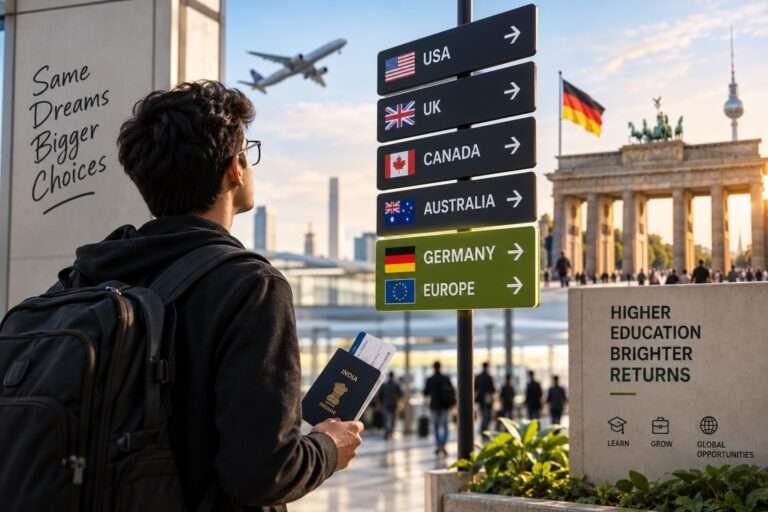
Canada has also become a major destination for Indians, particularly through education and skilled migration.
Indian-origin Canadians are prominent in business, healthcare, technology, transport, professional services and politics.
But Canada’s experience also demonstrates why diaspora statistics must be read alongside immigration policy.
Changes to student visas, temporary migration and permanent-residence policies can alter the composition and growth of an overseas Indian community quite quickly.
The community isn’t a fixed number.
It changes with:
immigration policy + employment + education + family migration + return migration.
That equation is increasingly important for anyone trying to understand global Indian migration.
Australia: education became a major bridge
Australia has developed a substantial Indian community, with Indian students playing an important role in recent migration.
Over time, many students transitioned into professional careers and permanent communities.
Indian Australians are now visible across technology, healthcare, education, hospitality, business and skilled professions.
Australia also illustrates how international education can become a migration pipeline.
A student who arrives at 22 may become a professional, then a permanent resident, then a business owner—and eventually raise children who identify simultaneously with Australia and their Indian heritage.
Migration isn’t one event.
It can be a multi-generation process.
Singapore: small country, highly visible Indian presence
Singapore’s Indian community is particularly interesting because of the country’s size.
Indians constitute an important part of Singapore’s multicultural society, with deep connections in business, technology, finance, education and professional services.
The Indian community includes long-established Tamil Singaporeans as well as newer Indian expatriates and professionals.
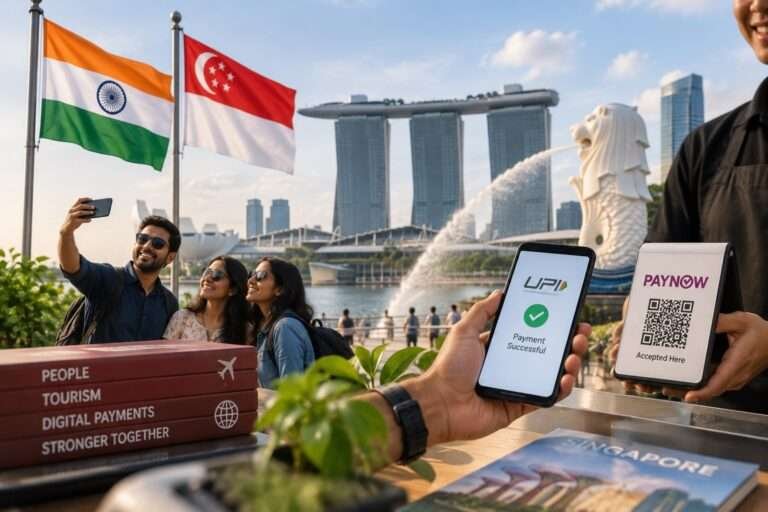
Singapore also functions as an important commercial bridge between India and Southeast Asia.
That makes its Indian community disproportionately relevant to business connectivity.
Mauritius and Africa: the forgotten chapters
The global Indian story did not begin with Silicon Valley.
Indian communities have existed for generations in Mauritius, South Africa, East Africa and other parts of the continent.
Mauritius is perhaps the most striking example.
People of Indian origin form a substantial majority of the country’s population, and Indian cultural, linguistic and religious traditions have become deeply integrated into Mauritian national life.
South Africa has another historically important Indian community.
The story includes migration during the colonial era, indentured labour, commercial migration and later generations of professionals and entrepreneurs.
It is a reminder that the Indian diaspora is not simply a product of the IT revolution.
Its roots are much older.

So where are the biggest Indian communities?
There is no single universally correct ranking because different datasets measure different things.
For Indian citizens living abroad, Gulf countries dominate several of the major destinations.
For the broader Indian-origin population, countries such as the United States, Canada, the United Kingdom, Mauritius and South Africa become particularly important.
And when the definition changes again—to include historical communities and descendants—the map becomes even larger.
That is why a responsible article should avoid declaring a simplistic “Top 10 Indian diaspora countries” without specifying the dataset and definition.
The numbers are important.
The definition behind the numbers is even more important.
Why this global spread matters to India
The diaspora creates value in several ways.
Remittances
Overseas Indians send enormous amounts of money to India, supporting households and contributing to foreign-exchange inflows.
Business
Indian-origin entrepreneurs establish companies and create commercial links between India and international markets.
Skills
Professionals abroad can transfer expertise, establish research partnerships and mentor businesses.
Education
Indian students and academics create institutional links between universities.
Culture
Food, festivals, music, cinema and yoga have carried Indian cultural influence far beyond India’s borders.
Diplomacy
Large Indian-origin communities can also contribute to stronger people-to-people relationships between India and other countries.
The result is something larger than migration.
It is connectivity.
DOONITED Editorial Perspective
India should resist the temptation to measure its diaspora only by population rankings.
The more interesting question is not:
“How many Indians live there?”
It is:
“What kind of relationship has that community built with both India and its adopted country?”
A community of two million people can have enormous economic influence.
A smaller community can be strategically important because of its location, professional expertise or political participation.
And a community of several hundred thousand workers may have extraordinary importance to Indian households because of remittances.
So the global Indian map is not simply a population map.
It is a map of capital, labour, skills, culture and relationships.
That may be the real strength of India’s diaspora.
The bigger insight
The Indian diaspora is not one community living in different countries.
It is thousands of communities shaped by different histories.
The Indian engineer in California, nurse in London, entrepreneur in Dubai, student in Melbourne, professional in Singapore and family in Mauritius may have completely different lives.
Yet together they form something remarkable:
one of the world’s most extensive networks linking a single country of origin with multiple economies and societies.
And that makes the Indian diaspora much more than a migration story.
It is one of India’s most important global assets—provided India understands that people abroad are partners, not merely sources of remittances.

World Beyond the News
Bees Communicate Where Food Is
Honeybees use movement patterns known as waggle dances to communicate information about food locations.
Street Food Reflects Local History
Many famous street foods developed from migration, trade, local ingredients and the everyday needs of working communities.
A Day on Venus Is Extremely Long
Venus rotates so slowly that one rotation relative to distant stars takes longer than its trip around the Sun.
Human Achievement Continues to Push Limits
Athletes, engineers, scientists and explorers regularly establish new benchmarks in speed, endurance, scale and precision.