
India and Singapore: The Relationship You Can Now See, Spend and Travel Through
More than 600,000 Indian visitors in six months is impressive. But the more interesting India-Singapore story is what happens after the plane lands.
Singapore has long been one of India’s most important partners in Southeast Asia.
The relationship has traditionally been discussed in the language of diplomacy: trade, investment, technology, finance, infrastructure and strategic cooperation.
But increasingly, the relationship can be experienced in much simpler ways.
An Indian family lands at Changi Airport.
A student begins university.
A professional attends a business meeting.
A tourist pays for lunch.
An entrepreneur meets an investor.
And increasingly, the Indian visitor can use a digital payment system without treating an international transaction like a small banking expedition.
That is the fascinating part of the India-Singapore story in 2026.
The bilateral relationship is becoming increasingly visible in everyday life.

More than 600,000 Indian visitors
India remains one of Singapore’s most important tourism markets.
More than 600,000 Indian visitors travelled to Singapore during the first half of 2026, according to figures reported from Singapore Tourism Board data.
The number is significant because Singapore is not simply benefiting from India’s enormous population.
It has deliberately developed a sophisticated tourism proposition for Indian travellers — combining food, shopping, entertainment, family holidays, business travel, events and increasingly personalised experiences.
The Singapore Tourism Board’s longer-term Tourism 2040 strategy is explicitly focused on attracting visitors who value distinctive experiences while making tourism growth more sustainable.
That matters because tourism competition in Asia is intense.
Singapore cannot simply assume that Indian travellers will keep returning because the skyline looks good in photographs.
The city-state has to keep giving them reasons to come back.
India’s tourists are becoming more valuable to Singapore
Visitor numbers tell only half the story.
Tourist spending matters too.
The Singapore Tourism Board reported that India was already among Singapore’s top five visitor-arrival markets in 2025, with 1.2 million Indian visitors for the full year.
The Indian market therefore represents something much larger than a temporary travel boom.
There is a large base of repeat travellers, families, business visitors, students and increasingly affluent consumers.
Singapore is also trying to capture younger Indian travellers through experiences involving food, entertainment, music, culture and lifestyle.
That is smart tourism strategy.
The Indian traveller is not one homogeneous customer.
A family from Mumbai, a software professional from Bengaluru, a student from Delhi and a business traveller from Hyderabad may all visit the same country — but they are not looking for the same Singapore.
The High Commission is another bridge
Tourism is only one part of the people-to-people relationship.
The High Commission of India in Singapore continues to maintain an extensive bilateral-information and community-engagement presence, including its India-Singapore relations material and newsletters.
That institutional connection matters because a modern diaspora relationship involves more than cultural celebrations.
It includes consular services, education, business networks, community engagement and communication between Indian citizens and their government.
A diplomatic mission is therefore no longer just a place where ambassadors meet government officials.
For an overseas Indian, it can become something much more practical:
the government office that helps when something goes wrong.
And that is perhaps one of the least glamorous but most important functions of diplomacy.

Then something remarkable happened on the smartphone
Perhaps the most revealing indicator of how the relationship is evolving is not found at an embassy or airport.
It is found on a mobile phone.
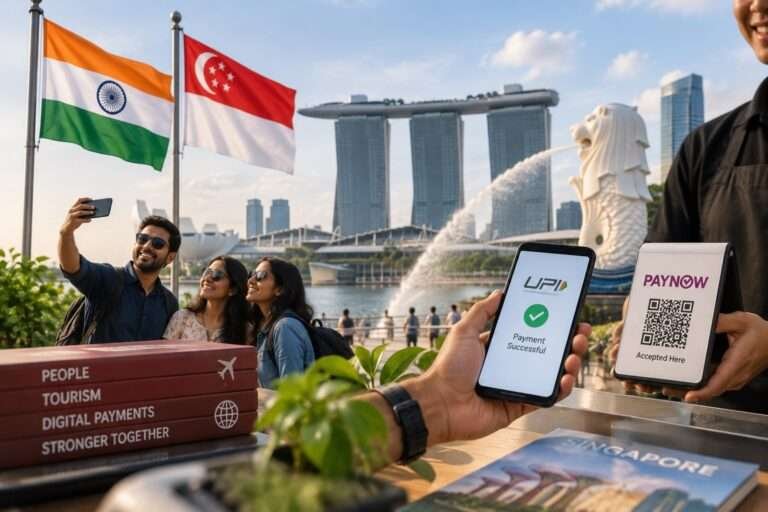
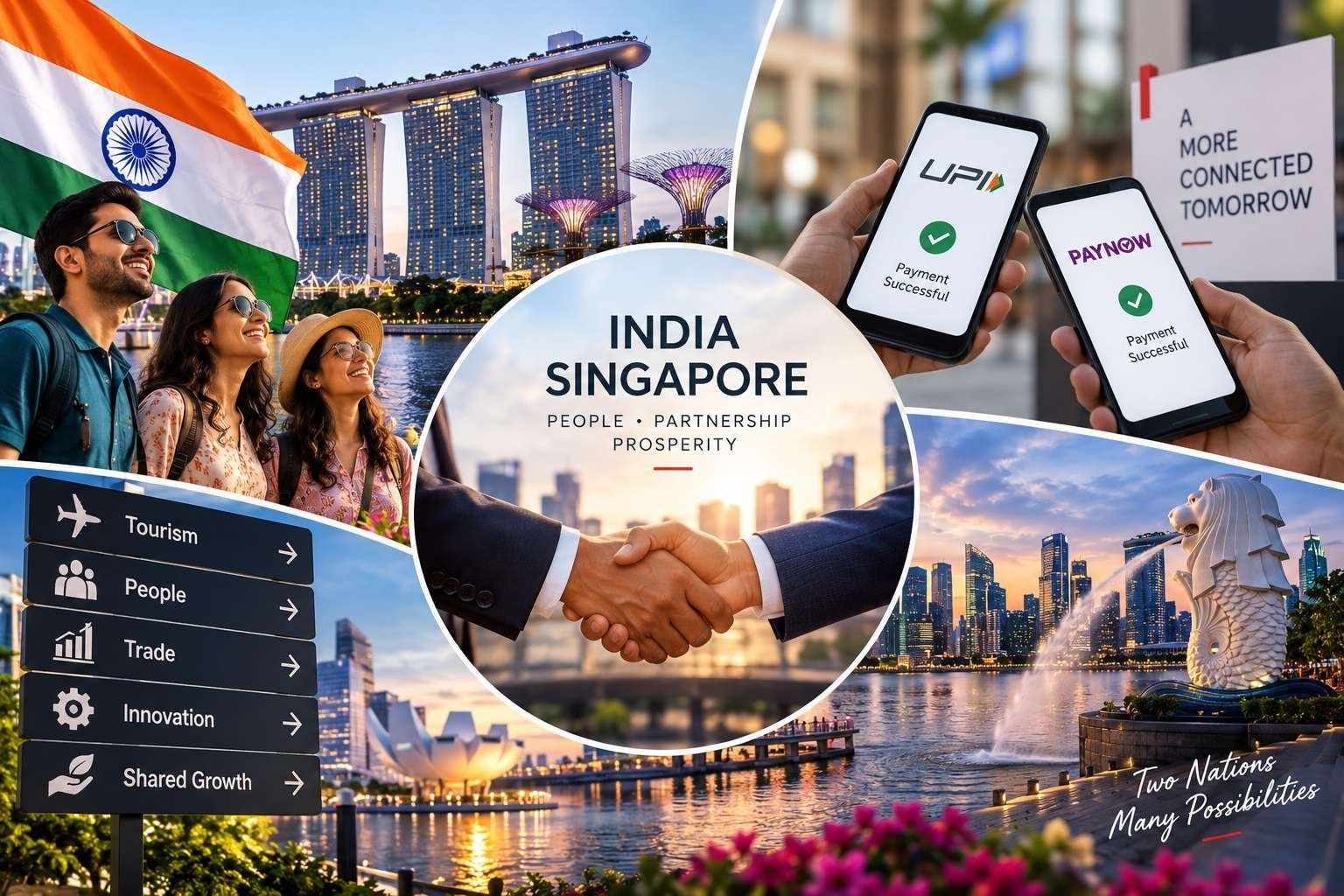
India’s UPI and Singapore’s PayNow systems are connected, allowing cross-border payments between participating users.
Singapore’s Deputy Prime Minister and Minister for Trade and Industry Gan Kim Yong said in August 2026 that transaction value through the collaboration had reached close to S$21 million during the first half of 2026.
That was more than six times the transaction value in the first half of 2025.
This is an important number.
But its real significance is not simply the amount.
It is the fact that cross-border digital payments are becoming normal enough to measure at scale.
The calculation illustrates the speed of growth.
If S$21 million were exactly six times the previous year’s value, the corresponding H1 2025 figure would be:
S$21 million ÷ 6 = S$3.5 million.
Because the government described the 2026 figure as more than six times H1 2025, the actual comparable 2025 amount was below that simple S$3.5 million benchmark.
That is rapid growth.
Why digital payments matter
For a tourist, the advantage is convenience.
For a small business, it can be much more important.
Cross-border payment systems can reduce friction, speed up transactions and potentially lower some of the costs associated with traditional international transfers.
And the ambition goes beyond India and Singapore.
Singapore says Project Nexus is intended to connect multiple domestic instant-payment systems. India is one of its founding members, along with five ASEAN countries including Singapore, with implementation targeted for 2027.
If that happens successfully, today’s bilateral payment bridge could become part of a much larger regional network.
That is where a seemingly technical financial-development story becomes strategically important.
A traveller may simply see a faster payment.
A business economist sees the gradual construction of regional digital infrastructure.
India and Singapore are also talking about the next economy
The relationship is expanding beyond tourism and payments.
At the Fourth India-Singapore Ministerial Roundtable on 20 August 2026, the two countries discussed cooperation covering digitalisation, advanced manufacturing, skills, connectivity, healthcare, capital markets and other areas.
Air connectivity was also discussed, particularly in light of increasing investment, trade and two-way traffic. Singapore said aviation authorities would continue discussions on opportunities to improve connectivity.
This is important because India-Singapore relations are increasingly connected to the economic priorities of the next decade.
Semiconductors.
Digital finance.
Advanced manufacturing.
Artificial intelligence.
Skills.
Capital markets.
Connectivity.
These are not simply traditional diplomatic subjects.
They are the infrastructure of economic competitiveness.

Singapore’s own economy is changing too
The relationship is also occurring while Singapore itself is undergoing economic transformation.
Singapore’s Ministry of Trade and Industry said the economy grew 6.1% year-on-year in the first half of 2026, while its August forecast upgraded expected full-year growth to 4.5%–5.5%.
Manufacturing has also been benefiting from strong electronics and AI-related demand.
The country’s manufacturing sector grew 12.2% year-on-year in Q2 2026, with electronics and precision engineering benefiting from AI-related demand for semiconductors and semiconductor manufacturing equipment.
That creates another layer to the India-Singapore relationship.
India is not simply sending tourists to Singapore.
The two countries are increasingly trying to connect their economic capabilities.
But bigger numbers do not automatically mean a better relationship
There is a temptation in bilateral reporting to treat every rising statistic as evidence that everything is going perfectly.
That would be too easy.
More tourists can create pressure on infrastructure.
More digital payments require strong cybersecurity and consumer protection.
More business integration creates regulatory challenges.
Greater air connectivity requires airport and airline capacity.
And economic cooperation has to produce tangible value rather than merely generate impressive announcements.
Singapore’s own Tourism 2040 strategy recognises the need for quality and sustainable tourism, not simply unlimited visitor growth.
That is a useful lesson for India too.
Growth is valuable.
But unmanaged growth eventually sends the bill.
The DOONITED Perspective
There is a curious irony in modern diplomacy.
Governments still issue statements about friendship, partnership and strategic cooperation.
But ordinary people increasingly judge those relationships through much simpler questions:
Can I travel easily?
Can I pay easily?
Can I study there?
Can my business operate there?
Can I find reliable information when something goes wrong?
Those questions may sound less impressive than a ministerial communiqué.
They are actually more revealing.
Because a successful bilateral relationship eventually becomes almost invisible.
You stop noticing the bridge because crossing it has become normal.
That may be exactly where India-Singapore relations are heading.
The takeaway
The latest India-Singapore numbers tell a story larger than tourism.
More than 600,000 Indian visitors in the first half of 2026 demonstrate the strength of the people-to-people connection.
The country’s broader tourism data confirms India’s importance as a major visitor market.
Meanwhile, close to S$21 million in UPI-PayNow transaction value in H1 2026, more than six times the previous year’s level, shows that the digital connection is becoming increasingly practical.
And cooperation is expanding into advanced manufacturing, digitalisation, skills, capital markets and connectivity.
The real India-Singapore story, therefore, is no longer simply about two governments maintaining friendly relations.
It is about two economies and two societies becoming easier to connect.
For the Indian traveller, that may mean a simpler holiday.
For the student, a wider opportunity.
For the entrepreneur, another market.
For the investor, another bridge.
And for both countries, something much more valuable:
a relationship that increasingly works in real life, not only on paper.

World Beyond the News
Bees Communicate Where Food Is
Honeybees use movement patterns known as waggle dances to communicate information about food locations.
Street Food Reflects Local History
Many famous street foods developed from migration, trade, local ingredients and the everyday needs of working communities.
A Day on Venus Is Extremely Long
Venus rotates so slowly that one rotation relative to distant stars takes longer than its trip around the Sun.
Human Achievement Continues to Push Limits
Athletes, engineers, scientists and explorers regularly establish new benchmarks in speed, endurance, scale and precision.