
Is America’s Skilled-Worker Door Getting Narrower?
For years, the H-1B visa has been one of the most important bridges between India and the United States.
An engineer could study in India, build a career, receive an opportunity from an American company and eventually move across the world to work on technology, finance, healthcare or research.
For thousands of Indian professionals, that journey became almost routine.
In 2026, it is anything but routine.
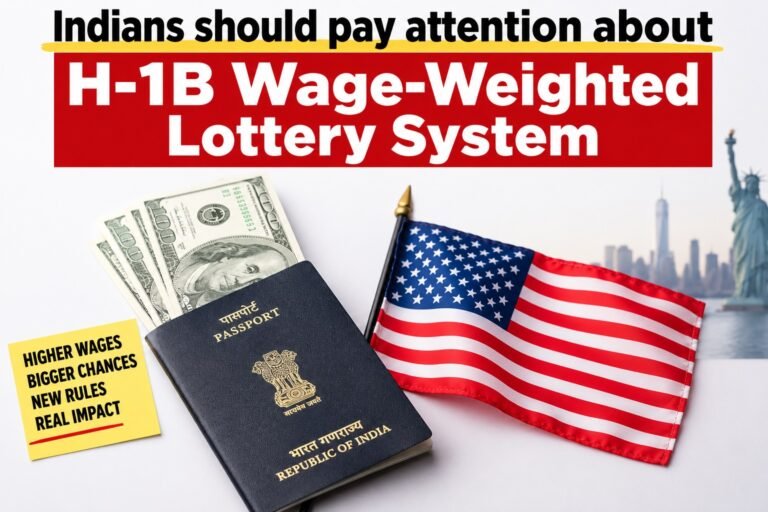
The United States has tightened the H-1B system through higher costs, greater scrutiny and a new wage-weighted selection process. At the same time, visa-stamping backlogs in India have created another problem: even professionals with approved status can face uncertainty when they need to travel and obtain a visa stamp.
The result is not simply a visa-policy story.
It is becoming a story about India’s skilled workforce, American competitiveness and the future of global technology talent.
H-1B Visa Changes and Indians
The answer is simple: Indians are the largest group of H-1B beneficiaries.
According to U.S. Citizenship and Immigration Services data, 71% of approved H-1B petitions in FY2024 were for beneficiaries born in India, compared with about 12% for China.
That does not mean 71% of every H-1B application or every Indian applicant is guaranteed approval. It means that among approved petitions recorded by USCIS, Indian-born beneficiaries accounted for that proportion.
But the statistic illustrates India’s extraordinary position in America’s skilled-worker ecosystem.
And Washington knows it.
The lottery is no longer quite a lottery
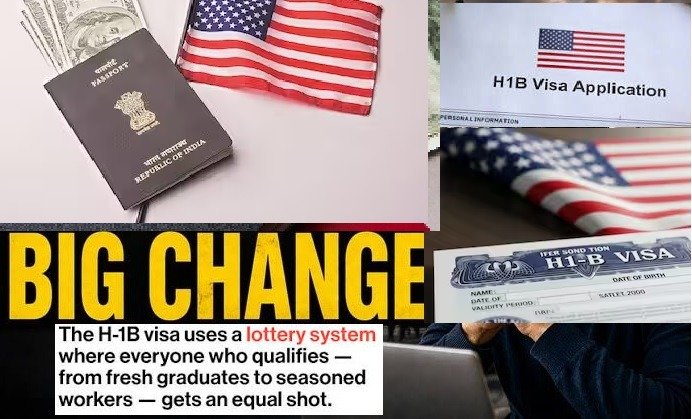
The biggest structural change is the introduction of a weighted selection system.
Previously, the H-1B cap-subject registration process used a random selection mechanism when registrations exceeded available numbers.
For FY2027, USCIS moved to a system that gives greater weight to registrations associated with higher Department of Labor wage levels. The new system became effective February 27, 2026.
The basic logic is straightforward:
Higher-paid positions receive greater selection weight.
The government says the objective is to favour higher-skilled and higher-paid foreign workers while protecting American wages and employment opportunities.
For highly experienced Indian professionals in senior technology, engineering, finance or specialist roles, that could be relatively favourable.
For lower-paid entry-level positions, however, the mathematics becomes less attractive.
This is important because the H-1B system has historically served a wide range of specialty occupations.
The new model effectively says:
If you want access to scarce visa slots, your economic value matters more than it used to.
The visa lottery has acquired a salary spreadsheet.
Then came the money
The financial pressure is even more dramatic.
In September 2025, the Trump administration introduced a $100,000 payment requirement for certain new H-1B petitions under a presidential proclamation. The measure contained important exceptions, including certain existing H-1B holders, renewals and people already in the United States changing status. The Indian government documented these exemptions in a February 2026 Rajya Sabha response.
But the legal and policy situation has continued to evolve.
In August 2026, the Department of Homeland Security proposed an additional $103,265 fee for cap-subject H-1B petitions. The proposal is not the same thing as a final universal fee, and it remains part of an evolving legal and regulatory process.
That distinction matters enormously.
Headlines saying “H-1B now costs $200,000” can be misleading if they simply add separate measures together as though every employer will automatically pay both.
The real story is more complicated:
H-1B sponsorship has become significantly more expensive and legally uncertain.
For employers, that changes the calculation.
Indian IT companies are already adapting
This is where the story gets particularly interesting for India.
Indian technology companies traditionally used the H-1B system partly to move skilled employees to the United States for client projects.
But the economics are changing.
Reuters reported that the number of H-1B holders employed by Indian IT companies has declined significantly over the past five years as those companies increasingly hire workers locally in the United States.
Indian IT firms have also been expanding offshore and nearshore delivery models and increasing recruitment of U.S. citizens and permanent residents.
That could sound like bad news for Indian professionals.
But there is another side.
If more complex technology work remains in India, Indian engineers may increasingly work on sophisticated global projects without physically relocating to America.
That could accelerate India’s development as a global technology-delivery and innovation centre.
The paradox is fascinating:
A policy designed partly to reduce foreign-worker dependence in America could unintentionally encourage more high-value work to remain in India.
The visa stamp is another problem
Getting an H-1B petition approved is not necessarily the end of the journey.
Indian professionals who need visa stamping have also faced severe appointment delays.
Reports in early 2026 showed H-1B interview appointments at U.S. consulates in Delhi, Mumbai, Chennai, Hyderabad and Kolkata being pushed into 2027 in many cases.
The Indian government’s own February 2026 response confirms that several H-1B and H-4 appointments scheduled in December 2025 were rescheduled following expanded online-presence vetting.
The U.S. State Department announced that from December 15, 2025, it would conduct online-presence review for H-1B applicants and their dependents.
For an applicant, this is more than bureaucracy.
Imagine working in America, travelling to India for an important family event, attending your visa interview and then discovering that the next available appointment has moved months into the future.
Suddenly the family wedding has acquired an immigration subplot.
India’s government is watching carefully
The Indian government’s response is noteworthy for its measured tone.
In its Rajya Sabha answer, the Ministry of External Affairs said visa decisions are sovereign matters for the United States.
At the same time, it emphasised that skilled-talent mobility has long contributed to technology advancement, innovation, economic growth and wealth creation in both India and the United States.
That is an important diplomatic position.
India is not arguing that America has no right to regulate its immigration system.
It is arguing that the movement of skilled people has produced economic value on both sides.
The government also said that, as of February 2026, there was not yet comparable data to quantify the impact of the new measures specifically on Indian nationals.
That caution is worth retaining.
It is too early to declare either that Indian professionals are being driven out of America or that nothing important has changed.
Both would be premature.
Is this bad for America too?
This is the other side of the debate.
The U.S. government’s argument is that the H-1B programme should protect American workers and discourage employers from using foreign labour as a cheaper substitute.
That is a legitimate policy objective.
But there is an economic counter-question:
What happens if the cost of accessing global talent becomes so high that American companies simply take more of the work elsewhere?
Technology companies compete globally.
Universities compete for researchers.
Hospitals compete for specialised medical professionals.
Start-ups compete for engineers.
A talented person does not necessarily have to choose America.
Canada, Britain, Australia, Germany and other economies also compete for skilled international workers.
If the United States makes legal talent mobility substantially more expensive and unpredictable, some workers and employers may simply reorganise.
The global economy has no shortage of countries willing to put out a welcome mat.
India may have an unexpected opportunity
This is perhaps the most constructive part of the story.
India should not view the changing H-1B environment merely as a problem for Indians wanting to move to America.
It could also be viewed as a strategic opportunity to make India itself more attractive for global work.
If companies can build sophisticated engineering, AI, semiconductor, cybersecurity, financial-technology and research operations in India, then Indian professionals can participate in global projects without depending entirely on physical relocation.
Global Capability Centres are already expanding in India.
Indian cities can increasingly become locations where American, European and Asian companies conduct high-value technology and research work.
That changes the question.
Instead of asking:
“How many Indians can go to America?”
India could increasingly ask:
“How much of the world’s high-value work can be done from India?”
That is a much more ambitious question.
But India should not celebrate too early
There is a temptation to say, “Excellent, let everyone stay in India.”
Reality is more complicated.
International mobility creates knowledge exchange, professional networks, research partnerships and entrepreneurship.
Indian professionals who work in America often acquire experience, contacts and capital that can eventually benefit India.
The objective should therefore not be to stop Indians from going abroad.
It should be to ensure that India benefits whether they stay, travel, return or build global businesses from India.
That requires better research ecosystems, universities, infrastructure, intellectual-property protection, high-end manufacturing and opportunities for ambitious professionals.
Talent does not stay merely because someone asks it politely.
It stays where opportunity lives.
DOONITED Editorial Perspective: The real competition is for talent
The H-1B debate is often presented as India versus America.
That is too simplistic.
The deeper competition is countries versus countries for skilled human capital.
America wants talented workers who contribute to its economy.
India wants its highly skilled citizens to have opportunities while also strengthening India’s own economy.
Neither objective is inherently unreasonable.
The danger begins when immigration policy becomes so unpredictable that businesses cannot plan and professionals cannot make rational long-term decisions.
The United States can legitimately demand higher wages, stronger compliance and better protection for American workers.
But if the policy becomes excessively costly or uncertain, American companies may discover that talent is wonderfully mobile.
And India should understand the other side of that equation.
This is India’s opportunity to build an economy where an engineer does not have to leave India to work on the world’s most ambitious projects.
The best answer to a narrower visa door is not resentment. It is a bigger door at home.
What readers should remember
The H-1B system is changing significantly: selection now gives greater weight to higher-paid roles, sponsorship costs have risen sharply, additional fees remain under legal and regulatory debate, and visa processing has experienced serious delays.
Indians are disproportionately affected because they represent the largest share of H-1B beneficiaries.
But the long-term consequence may go beyond immigration.
If Indian companies and global businesses respond by placing more sophisticated work, research and technology operations in India, the H-1B disruption could accelerate a transformation that is already underway.
The question for India is therefore not simply whether Indians can continue going to America.
It is whether India can become so globally competitive that the world’s best opportunities increasingly come to India — or can be performed from India.
That is the bigger story.

World Beyond the News
Birds Can Navigate Using Earth’s Magnetic Field
Several bird species can sense Earth’s magnetic field, helping them navigate during long-distance migration.
Fermentation Is a Global Food Tradition
People across continents have used fermentation for centuries to preserve food and create distinctive flavours.
Modern Batteries Store Energy Chemically
Rechargeable batteries repeatedly move ions between electrodes, allowing electrical energy to be stored and released.
Why Songs Become Global Hits
Streaming platforms, short-form video, playlists and international collaborations can rapidly carry music across borders.