
Sir Shankar Balasubramanian: The Indian-Born Scientist Behind a DNA Sequencing Revolution
Born in Chennai and based at the University of Cambridge, Sir Shankar Balasubramanian has helped reshape modern genomics. His 2026 Wolf Prize in Chemistry recognises a scientific breakthrough that made large-scale DNA sequencing faster, more accessible and increasingly important to medical research.
A scientific breakthrough recognised on the world stage
A person’s DNA contains biological information that can help researchers investigate inherited conditions, understand cancer and study how diseases develop. Reading that information, however, was once a slow and expensive undertaking.
The development of next-generation DNA sequencing changed that equation. Among the scientists responsible was Sir Shankar Balasubramanian, an Indian-born British chemist whose work helped make it possible to analyse millions of DNA fragments in parallel.
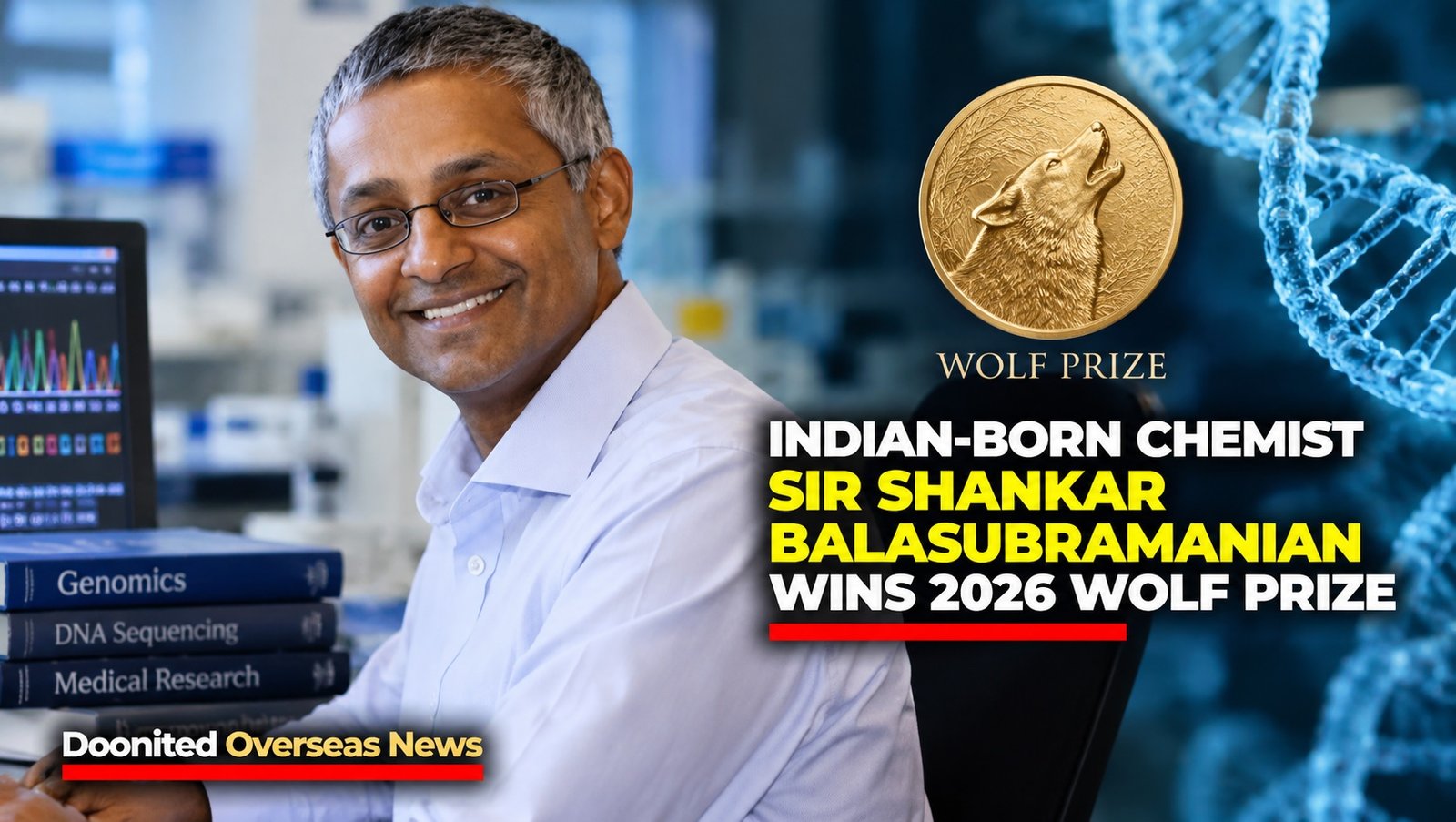
In October 2026, Balasubramanian was awarded the Wolf Prize in Chemistry, jointly with fellow Cambridge scientist Sir David Klenerman and French scientist Pascal Mayer of the University of Strasbourg. The award recognised their contributions to the development of impactful, low-cost, large-scale DNA sequencing methods for genomic medicine.
The recognition places a major scientific achievement by an Indian-born researcher in the international spotlight. More importantly, it highlights the role that fundamental chemistry can play in creating technologies that influence medical research, diagnostics and the development of treatments.
For the global Indian community, Balasubramanian’s career offers a story of scientific innovation that crosses national boundaries. His work was developed in Britain, commercialised through a Cambridge-linked company and incorporated into sequencing technology used by research institutions around the world.
From Chennai to Cambridge
Balasubramanian was born in Madras, now Chennai, in 1966. He moved to Britain with his family as a baby and grew up in rural Cheshire, England.
His scientific journey led him to the University of Cambridge, where he studied natural sciences before completing a doctorate in chemistry. After research in the United States, he returned to Cambridge in 1994 to begin his independent academic career.
He went on to become the Herchel Smith Professor of Medicinal Chemistry in Cambridge’s Yusuf Hamied Department of Chemistry and a senior group leader at the Cancer Research UK Cambridge Institute.
His research has extended beyond sequencing itself to the chemistry of nucleic acids, including modified DNA bases and unusual structures known as G-quadruplexes. These structures are of interest because of their potential roles in regulating biological processes, including mechanisms associated with cancer.
This combination of fundamental chemistry and biomedical research helps explain the wider significance of his work. Understanding DNA requires more than identifying its sequence: scientists must also investigate how genetic information is organised, regulated and connected to disease.
How Solexa changed DNA sequencing
The story of Solexa sequencing began with research into how DNA-building molecules could be observed as an enzyme copied genetic material.
In the mid-1990s, Balasubramanian and Klenerman explored ways to use fluorescently labelled nucleotides and surface-based techniques to observe DNA synthesis. Their research led to a different approach to sequencing: rather than reading DNA fragments one at a time, the method would enable large numbers of fragments to be analysed simultaneously.
This principle, known as massively parallel sequencing, became central to next-generation sequencing.
The researchers founded the company Solexa in 1998 to develop and commercialise the technology. Its scientific and commercial development involved further research, engineering and additional technological advances, including methods for generating clusters of DNA molecules that could be read efficiently.
Solexa was acquired by US biotechnology company Illumina in 2007. The sequencing-by-synthesis technology developed from this work subsequently became a foundation of Illumina’s sequencing platforms.
The impact was substantial. Parallel processing increased the amount of DNA that could be read in a sequencing run, while technological improvements helped bring down the cost per genome.
The Wolf Foundation describes the work of Balasubramanian, Klenerman and Mayer as helping enable millions of DNA fragments to be sequenced in parallel, dramatically increasing speed while reducing costs.
Claims of a million-fold improvement should be understood in the context of historical comparisons in sequencing speed and cost, rather than as a single performance measure that applies identically to every instrument or clinical test.
Why cheaper sequencing matters for medicine
Lower-cost sequencing has expanded the scale at which scientists can investigate human biology.
In cancer research, sequencing can help identify genetic alterations within tumours and support studies of why cancers behave differently or respond differently to treatment. In rare-disease research, it can help scientists search for genetic variants that may explain a patient’s condition. Researchers also use sequencing to investigate infectious diseases, population genetics and biological processes that conventional methods could not examine at comparable scale.
Large-scale projects illustrate the technology’s reach. Cambridge identifies initiatives such as the 100,000 Genomes Project, the International Cancer Genome Project and GenomeAsia 100K among the programmes supported by Solexa-Illumina sequencing technology.
For researchers, the ability to process large volumes of genetic information creates opportunities to compare samples, investigate disease mechanisms and identify patterns that would otherwise be difficult to detect.
But sequencing is not a cure in itself. A genetic result must be interpreted correctly, considered alongside other clinical evidence and translated into an appropriate medical decision. Not every genetic variant has a known significance, and not every finding leads to an effective treatment.
Access also remains uneven. The cost of a sequencing instrument or a genome run is only one part of the total expense. Sample collection, laboratory infrastructure, data storage, analysis, clinical interpretation and specialist expertise all affect whether a service can be delivered affordably.
The technology has made many forms of genetic investigation more practical, but the benefits depend on how effectively health systems and research institutions use it.
Scientific entrepreneurship and the value of research
Balasubramanian’s career also illustrates how university research can become a commercial technology.
Solexa emerged from fundamental scientific work at Cambridge. Its eventual acquisition by Illumina demonstrated how research in an academic laboratory could lead to a company with international reach and a lasting role in biotechnology.
That journey was not simply a matter of one discovery moving directly from a laboratory to a finished product. It required funding, company formation, further technical development and collaboration across scientific and commercial teams.
It also underscores the importance of sustained support for basic research. Scientists often begin by investigating questions whose practical applications are not yet clear. Some discoveries later become the foundations for technologies that influence entire industries.
Balasubramanian’s achievements have attracted several major honours. He shared the Breakthrough Prize in Life Sciences in 2022 with Klenerman and Mayer, received the Millennium Technology Prize with Klenerman in 2020 and was knighted in 2017. The 2026 Wolf Prize adds another major international recognition to this record.
A global Indian achievement with practical consequences
Balasubramanian’s story is not simply about an Indian-born scientist receiving an international award. It is about how research carried out across institutions and national borders can reshape the tools available to science and medicine.
His experience also provides a useful example for Indian students and researchers considering international careers. Scientific progress often depends on specialised expertise, long-term institutional support, collaboration and the ability to translate research into practical applications.
For India and its diaspora, the broader question is how to strengthen those conditions across countries: supporting fundamental research, building connections between universities and industry, developing skilled researchers and ensuring that scientific advances reach populations beyond the best-funded laboratories.
DNA sequencing has made enormous progress, but the next challenge is to translate that capacity into reliable, equitable and clinically meaningful benefits. Balasubramanian’s work helped make the technology possible at scale. Its continuing impact will depend on the scientists, clinicians, institutions and health systems that turn genetic information into better understanding and care.

World Beyond the News
Dolphins Use Individual Signature Whistles
Bottlenose dolphins develop distinctive whistles that function somewhat like individual acoustic identifiers.
The Pacific Is Earth’s Largest Ocean
The Pacific Ocean covers more area than any other ocean basin and stretches between Asia, Australia and the Americas.
Artificial Intelligence Learns Statistical Patterns
Modern machine-learning systems identify patterns in large datasets and use those patterns to generate predictions or outputs.
Why Some Stories Spread So Quickly
Emotion, novelty, visual appeal and easy sharing can make a story travel rapidly across social platforms.