

From Ahmedabad to American Television: How Rahul Agarwal Rethought the Everyday Spoon
Indian-origin designer Rahul Agarwal secured a reported US$350,000 investment deal on Shark Tank USA for Polygons, a company that turns six conventional measuring spoons into two compact, foldable tools. His journey offers a wider lesson for overseas Indian entrepreneurs: innovation can begin with an ordinary object, but turning a clever idea into a global business demands years of development, manufacturing discipline and commercial execution.
An everyday kitchen utensil rarely attracts the attention of investors on American television. Rahul Agarwal’s measuring spoon did exactly that.
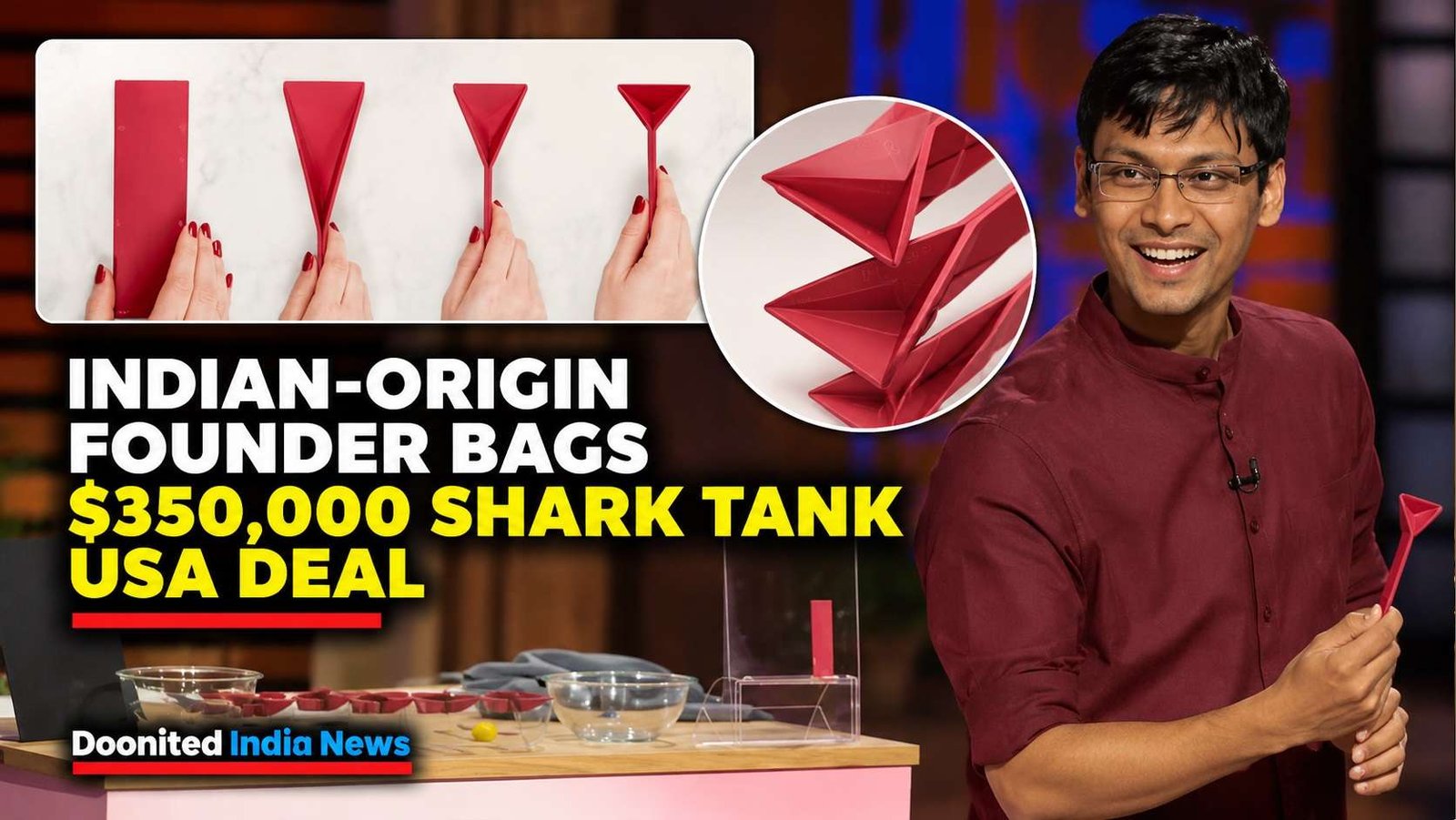
The Indian designer, founder of Polygons, appeared on Shark Tank USA with a product that challenges a familiar assumption: that measuring spoons must come as a collection of separate utensils. His alternative is a pair of slim, foldable tools designed to provide six different measurements while taking up less storage space.
The pitch reportedly secured a US$350,000 deal with investor Lori Greiner and guest investor Mindy Kaling. The agreement was reported as 8% equity in the company plus an additional 2% in advisory shares, implying a valuation of approximately US$3.5 million.
The headline figure is impressive, but the more revealing story is what preceded it. Agarwal’s product was not an overnight invention created for a television appearance. Its development involved design experimentation, manufacturing difficulties and the challenge of persuading consumers to reconsider an object they have used for generations.
For Indian-origin entrepreneurs building businesses abroad, Polygons illustrates how a design idea can travel from an educational environment in India to an international consumer market—and why the distance between invention and commercial success can be considerable.
An ordinary spoon becomes a design challenge
Agarwal’s concept reportedly began in 2014, when he was studying at the National Institute of Design (NID) in Ahmedabad. According to accounts of his journey, a senior challenged the idea of redesigning a spoon, suggesting that the familiar utensil had already reached a satisfactory form.
Agarwal treated the remark as a design problem rather than a reason to stop.
The resulting concept drew inspiration from origami: instead of manufacturing several separate spoons, why not create a flat tool that could fold into different measuring shapes when needed?
The principle is simple to understand but demanding to execute. A measuring spoon must hold its shape, provide the intended capacity and remain practical when handling ingredients. A folding mechanism must achieve those functions without becoming difficult to clean, store or use.
Polygons developed a design in which two flat tools provide six measurements. The larger tool offers half-tablespoon, one-tablespoon and two-tablespoon measures. The smaller provides quarter-teaspoon, half-teaspoon and one-teaspoon measures.
When flattened, each tool is reported to be approximately 2.8 millimetres thick. The design also incorporates magnets, allowing the spoons to attach to a suitable metal surface, such as a refrigerator.
The product’s appeal lies in the combination of familiar function and a different physical form. It does not ask customers to learn an entirely new kitchen routine. Instead, it seeks to make an existing routine more compact.
The difficult journey from prototype to product
A promising prototype is not the same as a commercially reliable product.
A design may work during a demonstration yet prove difficult to manufacture consistently, assemble at scale or deliver at a price customers will accept. Polygons’ reported development history highlights this less visible side of entrepreneurship.
During his television pitch, Agarwal described manufacturing as a significant challenge. Reports of the episode said the company spent years refining the design, changed manufacturers several times and made repeated trips to China while working towards production.
These details matter because product innovation often receives attention at the moment of invention, while the engineering and supply-chain work that follows receives far less recognition.
A folding measuring spoon needs more than an unusual appearance. Its mechanism must be sufficiently consistent for customers to rely on the stated measurements. Materials must be appropriate for food contact, and the finished product must withstand repeated use.
Manufacturers also need to produce the design at a cost that leaves room for packaging, shipping, retail margins, customer acquisition and other operating expenses.
This is where a design-led business becomes a manufacturing business. The original concept creates an opportunity; repeatable production and customer satisfaction determine whether that opportunity can become sustainable.
What happened on Shark Tank USA?
Agarwal reportedly sought US$350,000 in exchange for 7% of Polygons. The pitch attracted interest from several investors, including Greiner and Kaling.
The reported final agreement was US$350,000 for an 8% equity stake and an additional 2% in advisory shares. The combined 10% stake implies a company valuation of approximately US$3.5 million on the terms reported.
It is important to distinguish this agreement from a cash prize. The investment is intended to support a business in exchange for ownership and advisory arrangements; it is not simply a personal reward paid to the founder.
Nor should a television deal automatically be treated as proof that all funds have been transferred or that every contractual condition has been completed. The reported terms establish what was agreed on the programme, while the final legal and financial status may depend on subsequent due diligence and documentation.
The appearance nevertheless provides a significant platform. Investors can contribute more than money: their experience, distribution knowledge, retail relationships and ability to attract attention may help a small company reach new customers.
For Polygons, the challenge after the pitch is to convert that exposure into sustained sales without compromising product quality or the economics of the business.
A design business with international ambitions
Polygons was already selling its products before its television appearance. According to reports of the pitch, Agarwal told investors that the company had generated approximately US$4 million in lifetime sales, including around US$1.25 million in the previous year.
Those figures, as reported from the programme, suggest that the company was not presenting a purely speculative idea. It had an established product and a sales history to discuss with investors.
The company’s commercial model also reflects the changing route available to independent designers. Online marketplaces, social-commerce platforms and a direct-to-consumer website can help a specialist product reach buyers in multiple markets without requiring a conventional retail footprint from the beginning.
That access does not eliminate the hard parts of international business. A company selling across borders must still manage fulfilment, returns, customer service, product compliance, import duties and varying consumer expectations. It must also explain why a differentiated product deserves a higher price than a basic alternative.
This last point is especially important for Polygons. Traditional measuring spoons are widely available at low prices. The company must persuade buyers that its space-saving design and multifunctionality justify the premium.
A visually striking television demonstration may generate curiosity, but long-term demand depends on whether customers find the product genuinely useful after purchasing it.
Why his story matters to overseas Indians
Agarwal’s achievement connects India’s design-education ecosystem with entrepreneurship in the United States. His reported early work at NID in Ahmedabad provided the starting point for an idea that later entered an international consumer market.
NID, established in Ahmedabad in 1961, has played a significant role in design education and research in India. Its approach brings together creative thinking, practical projects and problem-solving—an environment in which students can question the form and function of familiar products.
For the Indian diaspora, stories like Agarwal’s broaden the usual picture of overseas achievement. International entrepreneurship is not limited to software companies, financial services or large technology ventures. It can also emerge from industrial design, household products and improvements to everyday experiences.
Indian-origin founders can draw on education and professional experience in India while accessing customers, capital and commercial networks abroad. That cross-border connection can be an advantage, although it does not guarantee success.
A product still has to meet the needs of its intended customers. A founder must understand the market, develop reliable supply chains, protect the business’s intellectual property where appropriate and maintain the financial discipline required to grow.
Agarwal’s reported experience also illustrates the role of persistence. The concept may have emerged quickly, but years of product development and manufacturing work followed. That distinction is important for students and first-time founders who may see the finished invention without seeing the long process behind it.
The larger lesson: innovation must work beyond the pitch
Polygons offers a useful example of incremental innovation: improving an existing product rather than attempting to invent an entirely new category.
Such innovation can be commercially meaningful because the underlying need is already understood. People already measure ingredients. The design question is whether the same task can be completed more conveniently, accurately or efficiently.
Yet the business must prove that its proposed improvement is valuable enough for customers to pay for it. The relevant measures extend beyond television exposure or the size of an investment offer. They include repeatable manufacturing, product reliability, customer reviews, margins, distribution costs and the ability to sustain demand after initial publicity fades.
For Agarwal, the next chapter is therefore not simply about winning over investors. It is about building a company that can consistently deliver a well-designed product to customers around the world.
His journey from a design challenge in Ahmedabad to an investment agreement on American television shows how a small idea can travel a long way. The more enduring achievement will be whether Polygons can turn that idea into a durable international business.
For overseas Indian entrepreneurs, the message is practical: a global opportunity may begin with something ordinary, but it takes research, persistence, sound production and a clear understanding of customers to make an invention commercially valuable.

World Beyond the News
Birds Can Navigate Using Earth’s Magnetic Field
Several bird species can sense Earth’s magnetic field, helping them navigate during long-distance migration.
Fermentation Is a Global Food Tradition
People across continents have used fermentation for centuries to preserve food and create distinctive flavours.
Modern Batteries Store Energy Chemically
Rechargeable batteries repeatedly move ions between electrodes, allowing electrical energy to be stored and released.
Why Songs Become Global Hits
Streaming platforms, short-form video, playlists and international collaborations can rapidly carry music across borders.