

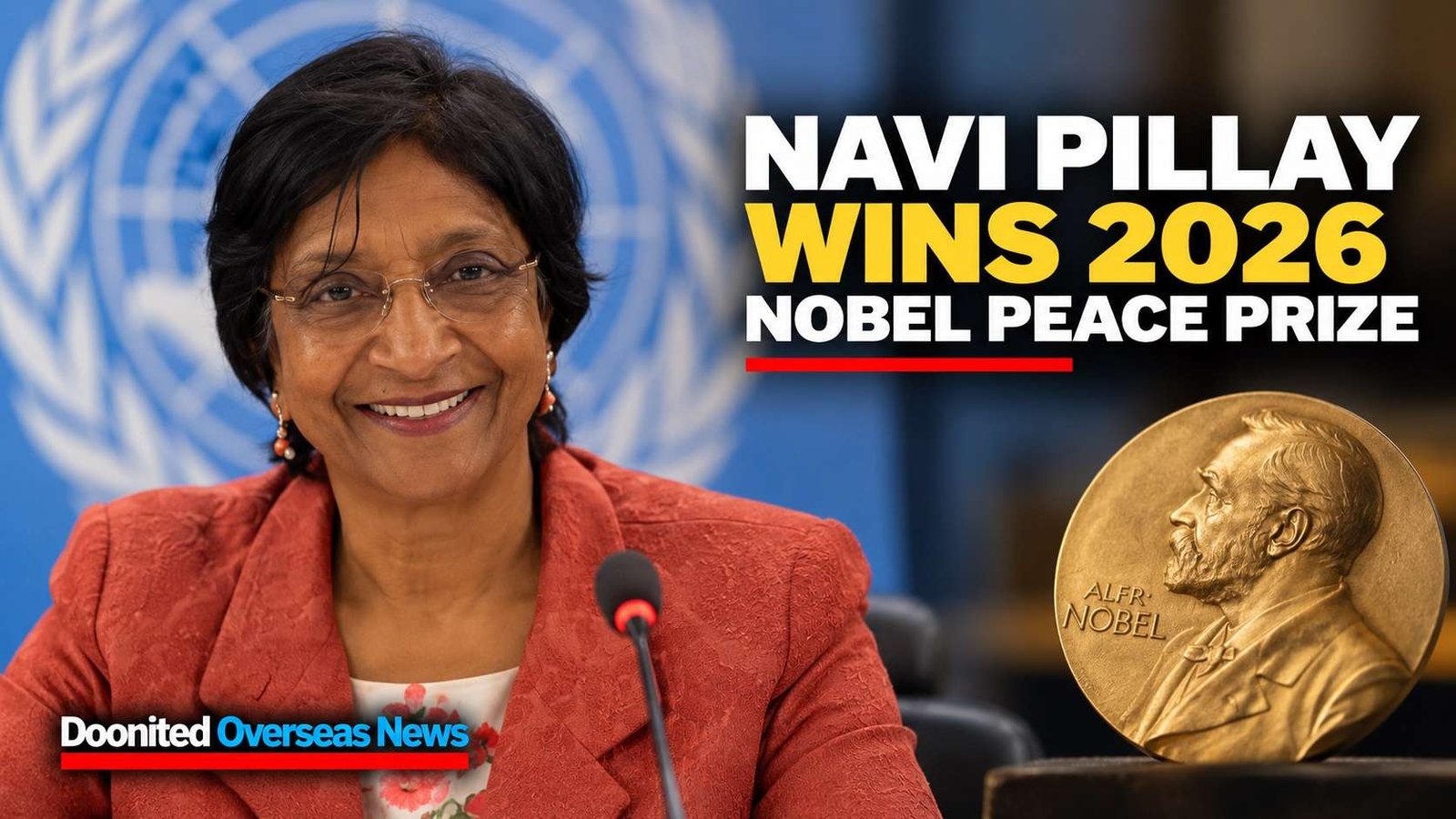
Navi Pillay Wins 2026 Nobel Peace Prize: The South African Jurist of Indian Tamil Heritage Who Took the Fight for Justice Global
Born into an Indian Tamil family under apartheid in South Africa, Navanethem “Navi” Pillay has spent decades challenging discrimination and strengthening international justice. Her Nobel Peace Prize recognises a career that connects diaspora history with one of the world’s most consequential questions: can international law hold even the powerful accountable?
From Durban to the world’s highest legal forums
For Navi Pillay, the pursuit of justice began in a society where the law itself was used to enforce racial inequality. Born in Durban, South Africa, in 1941 to a family of Indian Tamil heritage, she grew up under apartheid—a system that restricted the rights, movement and opportunities of people classified by race.
On 9 October 2026, the Norwegian Nobel Committee awarded Pillay the Nobel Peace Prize for her efforts to promote peace and international law. The recognition places a spotlight not only on her individual career, but also on the international institutions and legal principles she helped shape.
Pillay became the first woman to establish a law practice in South Africa’s Natal Province in 1967. She represented anti-apartheid activists and challenged abuses against political detainees, pursuing legal work in an environment structured to exclude people like her from positions of authority. In 1995, she became the first Black woman appointed to South Africa’s High Court.
Rwanda: a landmark in recognising sexual violence as genocide
After apartheid, Pillay’s work moved onto the international stage. In 1995, she joined the International Criminal Tribunal for Rwanda (ICTR), established to prosecute those responsible for the 1994 genocide and other serious violations of international humanitarian law.
One of the tribunal’s most consequential cases was Prosecutor v. Jean-Paul Akayesu. In its landmark 1998 judgment, the tribunal recognised that rape and sexual violence could constitute acts of genocide when committed with the requisite intent to destroy, in whole or in part, a protected group. Pillay presided over the trial chamber that delivered the judgment, which helped establish an important precedent in international criminal law.
The significance was profound. Sexual violence had often been overlooked, inadequately documented or treated as incidental to conflict. The judgment helped establish that such crimes could be central to a campaign of group destruction, rather than treated as a secondary consequence of war.
It did not mean that every act of sexual violence automatically constitutes genocide. The legal classification depends on the evidence and the specific elements of the crime. That distinction is essential to the credibility of international justice.
Pillay subsequently served as a judge at the International Criminal Court from 2003 to 2008. She became United Nations High Commissioner for Human Rights in 2008, holding the position until 2014. In that role, she advocated for the protection of vulnerable communities, equality and accountability for serious human-rights violations.
Why international law is central to the Nobel recognition
The Nobel Committee’s decision comes at a time when international legal institutions face intense political pressure and conflicts continue to raise questions about accountability for civilian suffering.
International law does not eliminate conflict, and courts cannot always enforce their decisions independently of governments and international cooperation. Investigations can take years, evidence can be difficult to obtain, and powerful states may resist scrutiny.
Yet the existence of legal standards matters. They provide a framework for documenting abuses, determining responsibility and pursuing justice through institutions rather than relying solely on political or military power.
Pillay’s career has been closely connected to this effort. Beyond her work on the Rwanda tribunal and at the UN human-rights office, she chaired the UN Independent International Commission of Inquiry on the Occupied Palestinian Territory, including East Jerusalem, and Israel from 2021 to 2025. She has also served as an ad hoc judge at the International Court of Justice in the case brought by The Gambia against Myanmar under the Genocide Convention.
That is precisely why institutional independence, transparent evidence and rigorous legal reasoning are important. Accountability is most credible when legal standards are applied consistently, regardless of the identity or political power of those accused.
What her Indian Tamil heritage means for the diaspora
Pillay’s background has particular resonance for people of Indian origin living outside India. Her family’s roots connect her story to the wider history of the Indian diaspora in South Africa, where generations of people of Indian descent built communities under systems that restricted their rights and opportunities.
Her achievement is a reminder that diaspora history is not only a story of migration, trade or cultural preservation. It also includes participation in public life, resistance to discrimination and contributions to institutions that shape societies far beyond a community’s country of origin.
For young people of Indian heritage abroad, Pillay’s career offers a concrete example of how professional expertise can intersect with public service. Legal training became a means to challenge injustice, and a career that began in South Africa contributed to international standards with implications for people across the world.
However, her Indian Tamil ancestry should not be confused with Indian citizenship or an official role representing India. Pillay is South African; her Nobel recognition is for her work promoting peace and international law, not for a national affiliation with India. Her relevance to the Indian diaspora is historical, cultural and inspirational.
A prize that recognises more than one individual
The Nobel Peace Prize is awarded to an individual, but Pillay’s work has depended on institutions, colleagues, legal professionals, investigators and the testimony of victims and survivors.
The Rwanda tribunal’s achievements, for example, rested on evidence, judicial deliberation and the broader development of international criminal law. The work of human-rights bodies likewise relies on documentation, independent investigation and cooperation across borders.
Recognising Pillay therefore also draws attention to the people who investigate abuses, preserve evidence, defend victims and work to ensure that serious crimes are not ignored. Their work can be difficult and sometimes dangerous, particularly where political authorities seek to undermine independent scrutiny.
For the international community, the challenge is to ensure that recognition translates into continued support for credible investigations, fair trials and institutions capable of applying the law without political favour.
The lasting lesson
Navi Pillay’s journey—from a Tamil family in apartheid-era Durban to the highest levels of international justice—connects personal perseverance with a larger legal transformation.
Her 2026 Nobel Peace Prize recognises decades of work to strengthen international law and accountability. It also invites a wider reflection: peace cannot rest solely on agreements between governments if serious abuses go unanswered and victims are denied a meaningful route to justice.
International courts are imperfect, their reach can be limited, and legal outcomes are rarely immediate. But the alternative—allowing power alone to determine who is held accountable—carries its own profound risks.
Pillay’s achievement lies in helping make justice an enforceable legal question rather than merely a moral appeal. For the global Indian diaspora, her story demonstrates how a person shaped by one country’s struggle for equality can contribute to principles that matter to people everywhere.

World Beyond the News
Bees Communicate Where Food Is
Honeybees use movement patterns known as waggle dances to communicate information about food locations.
Street Food Reflects Local History
Many famous street foods developed from migration, trade, local ingredients and the everyday needs of working communities.
A Day on Venus Is Extremely Long
Venus rotates so slowly that one rotation relative to distant stars takes longer than its trip around the Sun.
Human Achievement Continues to Push Limits
Athletes, engineers, scientists and explorers regularly establish new benchmarks in speed, endurance, scale and precision.