

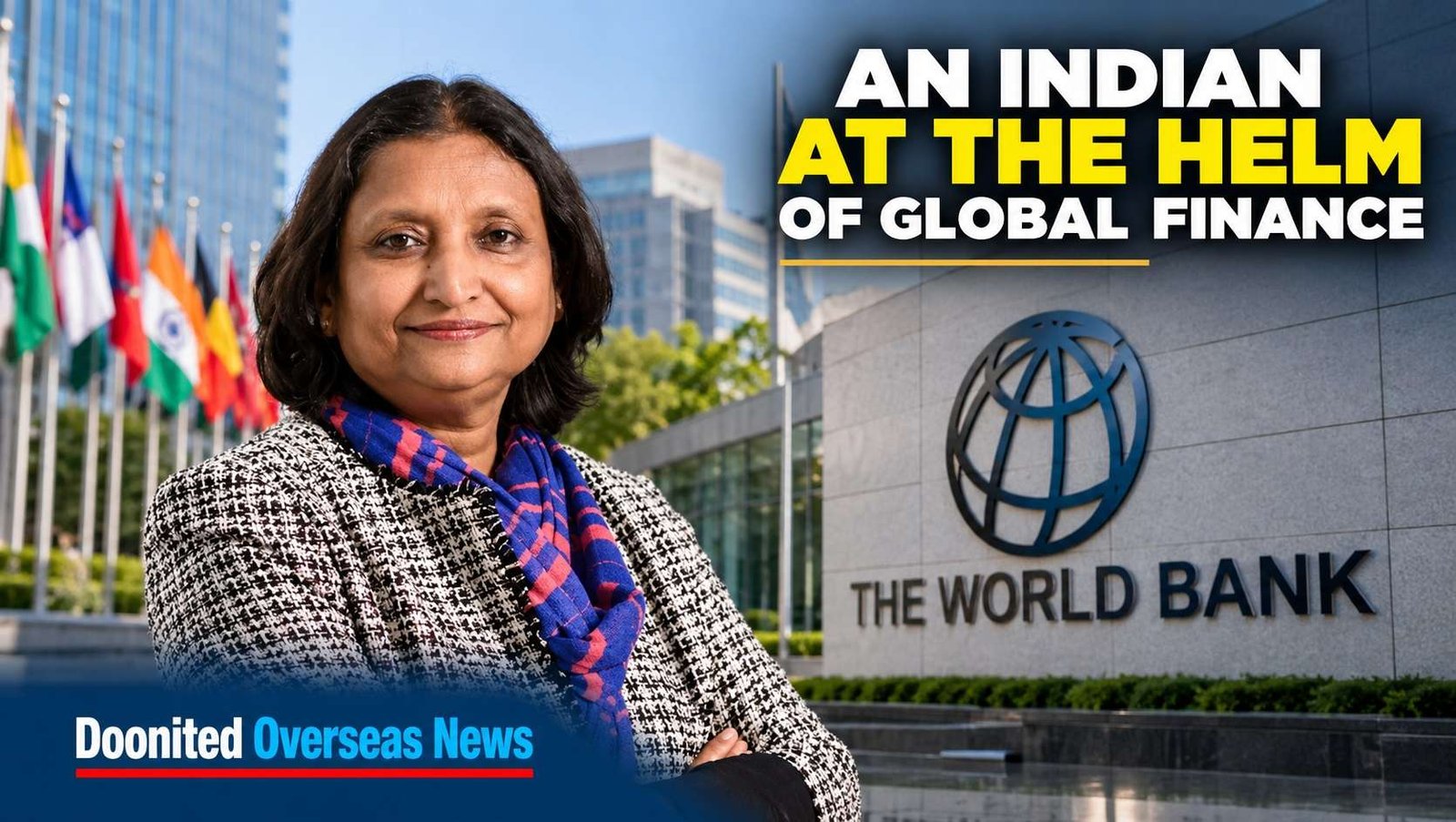
Anshula Kant: The Indian Banker Helping Shape the World Bank’s Global Financial Engine
From a career spanning more than three decades at State Bank of India to the financial leadership of the World Bank Group, Anshula Kant has moved from managing one of India’s largest banks to helping mobilise capital for development across the world.
The most interesting thing about Anshula Kant’s career is not the title attached to her name.
It is the scale of the financial systems she has been trusted to manage.
The Indian banker is Managing Director and Chief Financial Officer of the World Bank Group, a position she has held since October 2019. Her responsibilities include financial management, reporting, risk management and the mobilisation of International Development Association (IDA) and other financial resources.
That makes her career an unusually useful window into the changing role of the Indian professional on the global stage.
Kant did not move directly from India into an international institution.
She spent more than 35 years in banking, much of that career at the State Bank of India (SBI), moving through retail and corporate banking, mortgage finance, foreign exchange, treasury, risk, compliance and general management.
Her journey ultimately took her from India’s largest banking institution to one of the world’s most important development-finance organisations.
And the difference between those two jobs tells a bigger story.
From Roorkee to the global financial system
Kant is a native of India and studied economics at Lady Shri Ram College for Women in Delhi before completing a master’s degree in economics at the Delhi School of Economics.
Her professional career was built inside SBI.
Before moving to the World Bank, she had become one of the bank’s senior leaders. She served as Deputy Managing Director and Chief Financial Officer from 2015 to 2018 and later became Managing Director and a member of the SBI board.
The scale of her CFO responsibility was enormous.
According to the World Bank’s biography, she managed $38 billion in revenues and $500 billion in assets during her tenure as SBI CFO. Her later SBI board responsibilities included risk, compliance and the stressed-asset portfolio.
Those experiences matter because development finance is not simply about distributing money.
It is about deciding how capital can be raised, priced, protected and deployed without undermining the institution that provides it.
That is where Kant’s banking background becomes relevant to her current role.
What does a World Bank CFO actually do?
The title “CFO” can sound like a conventional corporate finance position.
At the World Bank Group, it is considerably broader.
The institution operates through a complex financial model involving shareholder capital, capital-market borrowing, development finance, risk management and partnerships with governments and private investors.
Kant’s official mandate includes financial and risk management and mobilisation of IDA and other resources. The World Bank says her team has worked on financial innovations intended to expand the institution’s capacity while safeguarding its triple-A credit rating.
This matters because the World Bank’s development mission ultimately depends on financial credibility.
A development project may concern roads, electricity, health, education, climate adaptation or jobs.
But before money reaches that project, someone has to structure the financing.
The institution therefore has to remain financially strong enough to borrow in global capital markets and channel that funding toward development programmes.
Kant sits at the centre of that machinery.
The balance sheet behind development
This is perhaps the least visible part of the World Bank’s work.
People tend to see the institution through the projects it finances.
They see infrastructure, schools, health systems, climate programmes and poverty-reduction initiatives.
Behind those projects is a financial architecture.
The World Bank’s International Bank for Reconstruction and Development (IBRD), for example, uses its strong credit standing to borrow from capital markets and provide financing to eligible middle-income countries.
IDA operates differently, providing highly concessional financing and grants to the world’s poorest countries. IDA has increasingly supplemented donor resources with capital-market borrowing.
This means that financial engineering is not an abstract exercise.
The price and structure of capital can influence whether a developing country can build infrastructure, expand healthcare, improve resilience or finance long-term investments.
Kant’s role therefore sits at a point where finance meets development policy.
Stretching the institution’s balance sheet
One of the most important themes in Kant’s World Bank work has been the effort to expand development-financing capacity without simply asking shareholders for unlimited additional capital.
The World Bank says Kant’s team has worked on new financial instruments and reforms that have expanded the institution’s financial capacity by tens of billions of dollars while maintaining its triple-A rating.
That is significant in a world where development needs are enormous.
Developing economies face overlapping pressures from climate change, infrastructure gaps, public-health needs, debt burdens, energy transitions and economic shocks.
Public resources alone are insufficient.
The World Bank has consequently been trying to mobilise more private capital alongside its own financing.
Kant has repeatedly argued that development finance needs deeper and more effective capital markets rather than dependence on a single source of funding.
At a G20 meeting in 2020, she described well-functioning domestic capital markets as a stable source of funding and an important buffer during crises.
That idea has particular relevance for emerging economies.
A country that can develop credible domestic bond and equity markets has more options when international capital becomes volatile.
Climate finance is also a financial problem
Climate change is often discussed as an environmental issue.
For a World Bank CFO, it is also a financing challenge.
The transition to cleaner energy requires enormous amounts of capital, while poorer countries often have fewer resources and higher financing constraints.
Kant has been involved in the World Bank’s efforts to use capital markets and sustainable bonds to mobilise funding for development.
In a World Bank publication, she highlighted the institution’s experience with climate finance and the importance of using capital markets, private-sector partnerships and donor resources to expand financing.
The World Bank subsequently launched a sustainable-development-bond initiative intended to raise as much as $10 billion, linking its borrowing programme with the wider effort to mainstream climate considerations across development finance.
The underlying principle is straightforward:
If climate investment is left entirely to governments, the financing gap is likely to remain enormous.
The private capital markets therefore have to become part of the solution.
Technology is changing the financial machinery too
Kant’s responsibilities are not limited to conventional banking.
She has also been involved in the World Bank’s exploration of digitalisation in capital markets.
In 2023, she wrote about the potential of distributed-ledger technology and central-bank digital currencies to make bond issuance, settlement and servicing more efficient.
The World Bank had already experimented with blockchain-backed bonds and subsequently issued a €100 million fixed-rate digital bond through Euroclear’s Digital Financial Market Infrastructure.
The significance is larger than one digital bond.
Development institutions have traditionally depended on financial infrastructure that can be slow, expensive and fragmented across jurisdictions.
Digitalisation could eventually make certain parts of the capital-markets process faster and more transparent.
But Kant’s own writings also emphasise an important caveat: technological solutions still have to operate within domestic and cross-border legal and regulatory frameworks.
In other words, financial innovation is not simply about adopting new technology.
It is about making the technology usable within the real-world rules governing money.
What her journey means for the Indian diaspora
For DOONITEDNEWS.IN, Kant’s story matters because it represents a different dimension of Indian diaspora achievement.
The usual diaspora success story focuses on entrepreneurs, technology executives or doctors.
Kant’s career belongs to another category:
institutional power.
She is not simply running a company.
She is helping manage the financial capacity of a multilateral institution whose activities affect economies across the developing world.
That makes her career particularly relevant to Indian professionals working in banking, finance, economics, development policy and international institutions.
Her path also demonstrates the value of expertise accumulated over decades.
There was no overnight transition from Indian banker to international financial leader.
The World Bank appointed her after more than 35 years of banking experience.
Her SBI career gave her exposure to the practical problems of finance: credit, risk, capital, foreign exchange, regulation and stressed assets.
The World Bank gave those skills a different scale.
India’s connection goes beyond representation
There is also a subtle lesson for India.
The country is no longer merely a recipient of international development thinking.
Indian financial professionals increasingly occupy positions where they help shape how global development institutions themselves operate.
That is significant.
India has one of the world’s largest banking systems, rapidly expanding capital markets and a growing international financial footprint.
Professionals trained within those institutions can carry knowledge from India’s development experience into global organisations—and bring global financial practices back into India’s own institutional ecosystem.
The relationship is therefore two-way.
The diaspora is not simply exporting Indian talent.
It can also become a conduit through which expertise, networks and institutional knowledge circulate back toward India.
The harder question: can finance solve development?
There is a natural temptation to celebrate financial innovation as if more sophisticated financing automatically produces better development.
It does not.
A larger balance sheet does not guarantee that money reaches the right projects.
A bond can raise capital, but a country still needs sound institutions to use it effectively.
Private investors can be mobilised, but commercial returns and development priorities do not always coincide.
And borrowing can become a problem if debt is not sustainable.
That is why Kant’s emphasis on risk management is as important as her emphasis on mobilisation.
The World Bank’s financial model has to achieve two objectives simultaneously: stretch available capital and protect the institution’s financial strength.
That is a difficult balancing act.
From SBI’s balance sheet to the world’s development balance sheet
Anshula Kant’s career can therefore be read as more than an impressive professional biography.
It is a story about the movement of Indian expertise into the institutions that shape global economic policy.
She began with economics in Delhi.
She built a 35-year career inside India’s banking system.
She became an SBI board-level executive.
And since October 2019, she has been helping oversee the financial architecture through which the World Bank Group mobilises resources for development.
The progression is striking.
But perhaps the most important lesson is not where Kant works.
It is what her career says about the Indian professional abroad.
Global influence increasingly comes not only from owning companies or creating technology.
Sometimes it comes from understanding how the world’s money moves.
And at the World Bank, that is precisely the system Anshula Kant has been helping to manage.

World Beyond the News
Dolphins Use Individual Signature Whistles
Bottlenose dolphins develop distinctive whistles that function somewhat like individual acoustic identifiers.
The Pacific Is Earth’s Largest Ocean
The Pacific Ocean covers more area than any other ocean basin and stretches between Asia, Australia and the Americas.
Artificial Intelligence Learns Statistical Patterns
Modern machine-learning systems identify patterns in large datasets and use those patterns to generate predictions or outputs.
Why Some Stories Spread So Quickly
Emotion, novelty, visual appeal and easy sharing can make a story travel rapidly across social platforms.