
Why America’s Crackdown Matters to Indian Professionals
For thousands of Indian technology professionals, the American dream has traditionally arrived in a familiar format: a job offer, an H-1B petition, a move across the Atlantic and a career built around specialised skills.
But there is another side to the employment-visa system that is now receiving much greater attention in Washington.
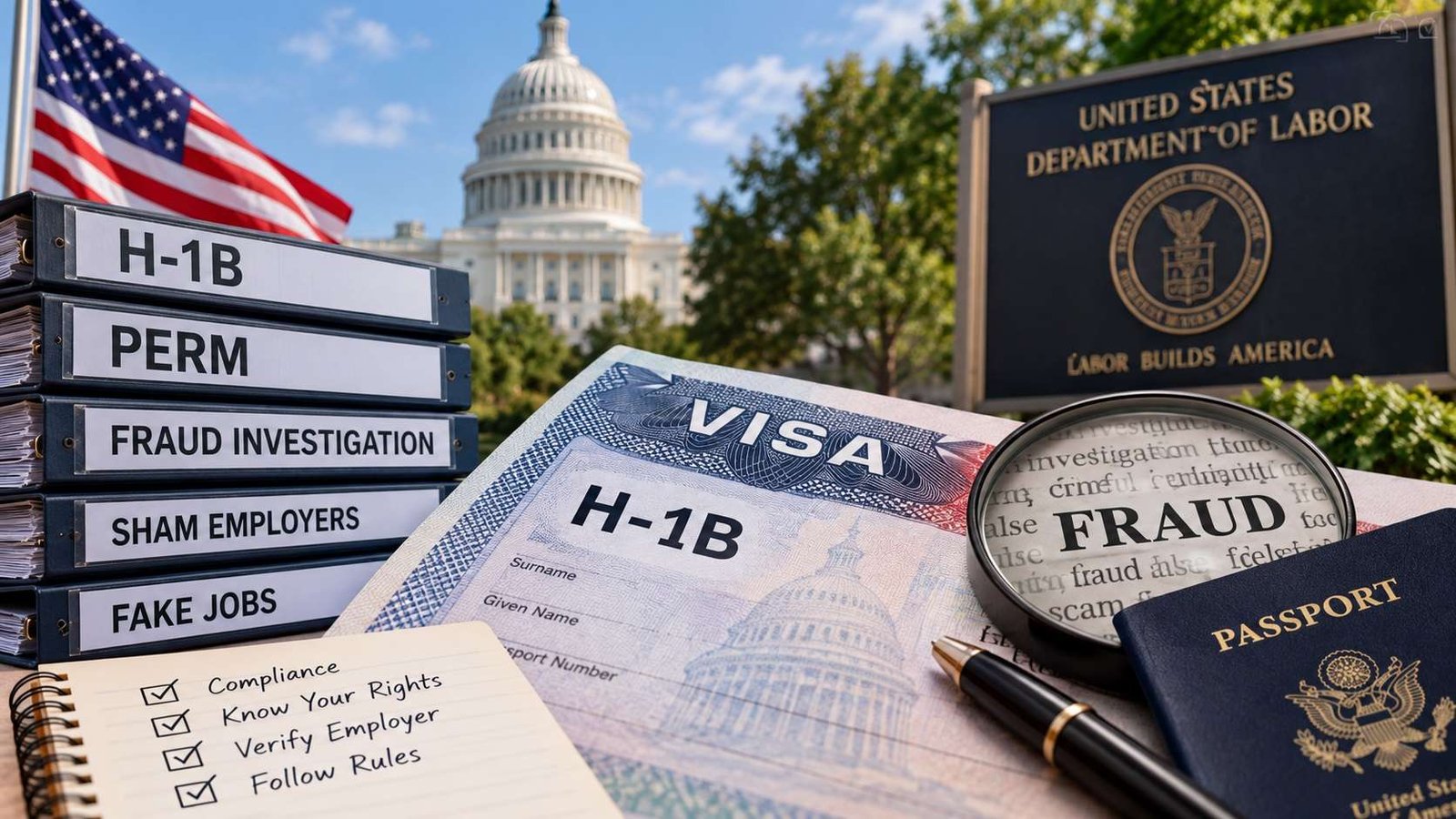
Fake jobs. Sham employers. False applications. Wage kickbacks. Worker exploitation.
The U.S. Department of Labor’s Office of Inspector General has launched a nationwide investigation into suspected fraud and abuse involving the H-1B and PERM employment-visa systems. The agency says its investigations are targeting employers, labor brokers and other actors suspected of submitting fraudulent applications or exploiting foreign workers.
For Indian professionals, the development deserves attention because Indians occupy an unusually large share of the H-1B system.
But there is an important distinction.
The crackdown is about alleged abuse of the visa system — not about Indian workers as a nationality.
Why India is at the centre of the conversation
USCIS reported 399,395 approved H-1B petitions in fiscal year 2024. Computer-related occupations accounted for about 63.9% of beneficiaries in the report.
Beneficiaries born in India accounted for approximately 71% of approved H-1B petitions, with China a distant second.
That concentration means any major change in H-1B enforcement naturally has a disproportionate impact on the Indian professional community.
It also explains why stories about H-1B investigations can create anxiety in India even when the investigation itself is not directed at Indian nationals.
A genuine Indian software engineer working for a legitimate American employer is in a very different situation from a fraudulent company creating a job that does not actually exist.
That distinction needs to remain clear.
What exactly is the U.S. investigating?
The DOL OIG announced its nationwide H-1B and PERM investigation in July 2026.
According to the agency, investigators are examining schemes involving fraudulent employment applications, exploitation of foreign workers, wage kickbacks, benching and fraudulent recruitment practices. The investigation also involves cooperation with federal law-enforcement partners.
The OIG’s broader Foreign Labor Certification investigations cover H-1B, H-2A, H-2B and PERM programmes.
Its stated concern is that fraudulent applications can undermine the integrity of the system and potentially harm both American workers and legitimate immigrants.
The agency has also specifically encouraged foreign workers who believe they have experienced exploitation, coercion, fraudulent recruitment or other abuse to report concerns.
That is an important message.
The enforcement operation is not simply a search for visa violations by workers.
Foreign workers themselves can be victims of fraudulent employers and recruiters.
The “sham employer” problem
A legitimate H-1B petition should correspond to a genuine employer and a genuine qualifying job.
That sounds obvious.
Unfortunately, the existence of paperwork does not automatically make an underlying business or job genuine.
In August, DOL OIG investigators carried out field checks in Dallas at several locations connected to companies that had received hundreds of approved H-1B petitions.
The OIG said one multi-storey building housed numerous businesses linked to more than 500 approved H-1B applications. Investigators found several offices apparently inactive, including locked doors, lights being off and little visible evidence of normal business operations.
But there is a critical journalistic caveat:
An inactive-looking office is not, by itself, proof of H-1B fraud.
Businesses can operate remotely, move locations, share offices or have other legitimate explanations for an apparently quiet workplace.
The investigation exists to determine what actually happened.
That distinction is particularly important when individual companies or professionals are named publicly.
What are wage kickbacks?
The issue becomes even more serious when money moves in the wrong direction.
Under H-1B rules, employers must pay the required wage — generally the higher of the applicable prevailing wage or the employer’s actual wage for similarly qualified workers.
The Department of Labor also states that H-1B workers cannot be required to pay certain employer business expenses or petition-related costs in ways prohibited by the regulations.
That matters because an employee who appears to receive a particular salary on paper may face a very different financial reality if an employer or intermediary illegally takes money back.
This is where visa fraud and worker exploitation can overlap.
The worker may have the visa.
The job may appear legitimate.
The paperwork may look complete.
But the economic relationship underneath it may be abusive.
“Benching” is another warning sign
The OIG has specifically identified benching among the practices it is examining.
In simple terms, this can involve an H-1B worker being left without productive work while the employment relationship continues.
For a worker whose immigration status is tied to employment, that can be particularly stressful.
The professional is not simply asking:
“When will my next project begin?”
They may also be asking:
“What happens to my immigration status if my employer has no real work for me?”
That imbalance of power is one reason employment-visa compliance matters to workers as much as it matters to regulators.
What Indian professionals should learn from this
The latest crackdown does not mean that Indian professionals should assume every H-1B employer is suspicious.
Nor does it mean that a legitimate H-1B career in America has suddenly become a fraudulent activity.
The more practical lesson is that documentation and employer due diligence matter more than ever.
Professionals should understand who the actual petitioner is, where the job is located, what position has been described in the petition and who is responsible for employment.
They should also retain copies of relevant employment and immigration documents.
The Department of Labor advises H-1B workers to keep records of hours worked, wages and employer information. Workers are also entitled to receive a copy of the Labor Condition Application associated with their employment.
Most importantly, workers should be extremely cautious about arrangements involving unexplained payments, salary kickbacks, fabricated employment histories or requests to sign documents they do not understand.
The glamorous part of an overseas job is the offer letter.
The boring paperwork may be what protects the career.
The crackdown goes beyond H-1B
The current investigation is also significant because the scrutiny is not confined to one occupation or one industry.
The DOL OIG describes its foreign-labor investigations as covering several employment-based visa programmes and says its investigators pursue employers, immigration attorneys and labor brokers involved in suspected fraudulent applications.
That suggests a broader enforcement philosophy:
the government is increasingly interested in the ecosystem around employment visas, not merely the worker who receives the visa.
That matters for India’s overseas professional community because many workers encounter recruiters, consultants, staffing companies, subcontractors and immigration-service providers before they ever reach their final workplace.
Every additional intermediary creates another point where misinformation or abuse can occur.
Enforcement can protect legitimate immigrants too
There is a constructive side to stronger enforcement.
If fraudulent employers use fake positions or manipulate wages, legitimate companies can face an uneven competitive environment.
And legitimate foreign professionals can suffer too.
A worker who follows the rules should not have to compete against an employer willing to fabricate documents or exploit visa dependency.
That is why enforcement, when supported by evidence and due process, can potentially strengthen confidence in the legitimate employment-visa system.
The challenge is ensuring that enforcement distinguishes fraud from ordinary immigration compliance issues, and that investigations do not turn allegations into conclusions before the evidence has been tested.
Doonited Editorial Perspective
America’s H-1B debate often becomes a simple argument between two slogans:
“Protect American jobs.”
versus
“America needs global talent.”
The reality is considerably more complicated.
The United States has legitimate interests in protecting workers and maintaining the integrity of its immigration system. At the same time, American companies rely heavily on highly skilled international professionals, including a very large Indian-origin talent pool.
The sensible middle ground is not to treat foreign professionals as the problem.
It is to pursue genuine employers, genuine jobs, lawful wages and transparent recruitment.
A stronger enforcement system should make it harder for fraudulent businesses to exploit workers while preserving legitimate pathways for professionals who meet the rules.
That would benefit both sides of the employment relationship.
The Doonited Insight
For Indian professionals, the most important lesson from America’s latest H-1B crackdown is surprisingly simple:
A visa is not a substitute for due diligence.
Before accepting an overseas job, understand the employer, the role, the wage arrangements and the immigration paperwork.
And if someone says, “Don’t worry, everyone does it this way,” that may be precisely the moment to start worrying.
In an increasingly scrutinised global job market, a genuine job with transparent paperwork is worth far more than a shortcut dressed up as an opportunity.

World Beyond the News
Bees Communicate Where Food Is
Honeybees use movement patterns known as waggle dances to communicate information about food locations.
Street Food Reflects Local History
Many famous street foods developed from migration, trade, local ingredients and the everyday needs of working communities.
A Day on Venus Is Extremely Long
Venus rotates so slowly that one rotation relative to distant stars takes longer than its trip around the Sun.
Human Achievement Continues to Push Limits
Athletes, engineers, scientists and explorers regularly establish new benchmarks in speed, endurance, scale and precision.