
Sethuraman Panchanathan Makes History With NAE’s Bueche Award
A child standing in a queue outside the American Center in Chennai in 1969 could hardly have known that the small grey rocks behind a glass display would eventually influence the direction of his life.
Those were pieces of the Moon brought back by the Apollo 11 mission.
For Sethuraman “Panch” Panchanathan, the fascination was not simply with the rocks. It was with the extraordinary engineering, science and human collaboration that had made their journey possible.
More than five decades later, that curiosity has become a career spanning computer science, engineering, university research, technology policy and the highest levels of American scientific administration.
Now, Panchanathan has reached another landmark.
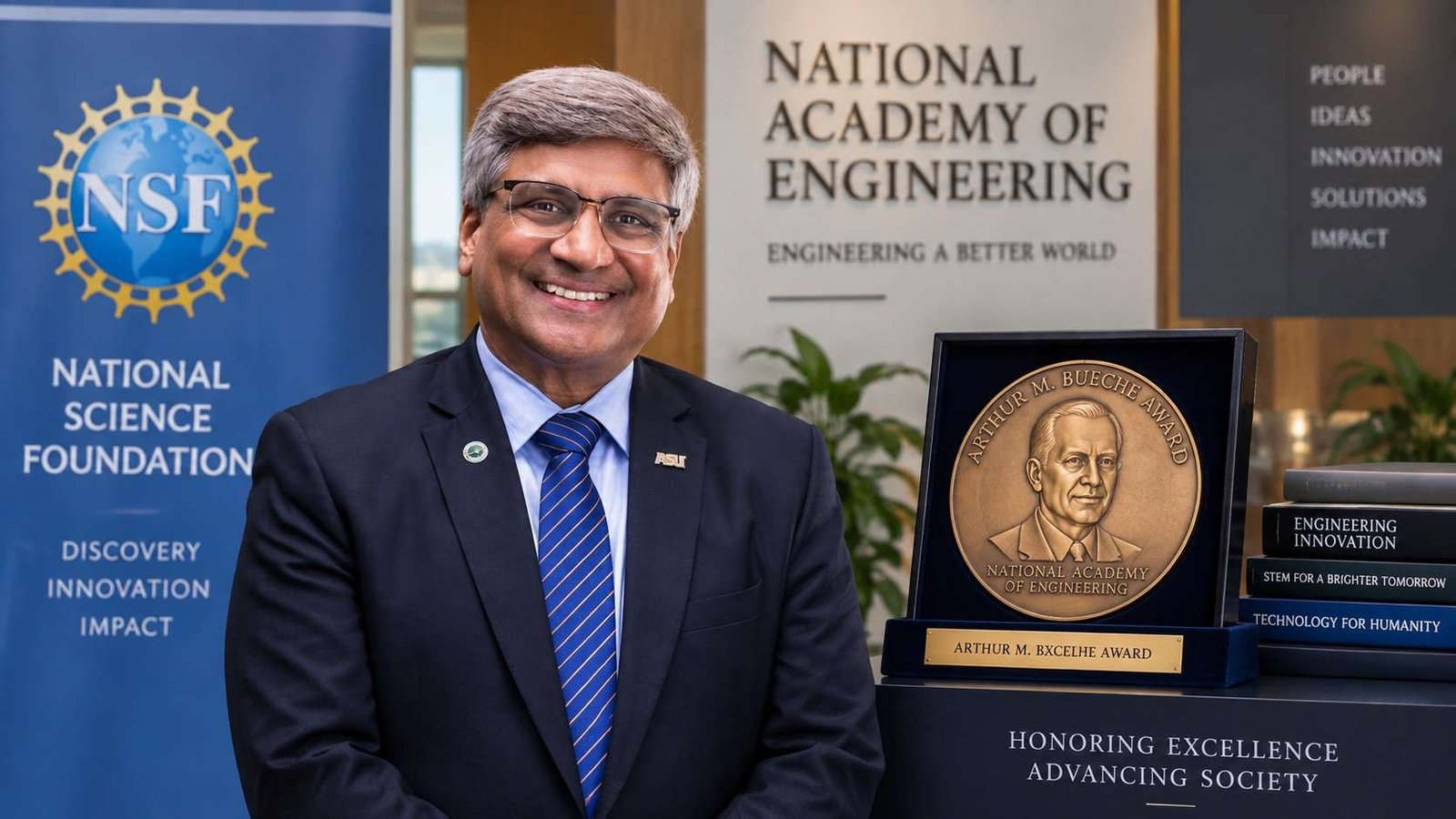
The National Academy of Engineering (NAE) has named him the recipient of the 2026 Arthur M. Bueche Award, making him the first Indian American to receive the honour in its more than four-decade history.
The award is scheduled to be presented at the NAE Annual Meeting in Washington, D.C., in October.
For the Indian-origin community, it is an achievement worth noticing.
But the deeper story is not simply that an engineer born in Chennai has won another American award.
It is about how scientific careers can evolve from laboratory research into institution-building and national technology policy.
An Award About More Than Engineering
The Arthur M. Bueche Award has a distinctive character.
It recognises engineers who have played an active role in U.S. science and technology policy, technological development and relationships between industry, government and universities.
That description fits Panchanathan’s career unusually well.
He is a computer scientist and engineer who spent more than two decades at Arizona State University, eventually becoming executive vice president of its Knowledge Enterprise and chief research and innovation officer.
He later moved from university leadership into Washington, becoming the 15th director of the U.S. National Science Foundation, serving from 2020 to 2025.
In 2026, he returned to ASU as University Professor of Technology and Innovation and Foundation Chair in Computing and Augmented Intelligence.
The Bueche Award therefore recognises something broader than an individual scientific discovery.
It recognises the work of building the machinery through which discoveries can move toward society.
The NSF Years
Panchanathan’s five years at the National Science Foundation placed him at the centre of America’s federal science and innovation system.
During his tenure, he established the Directorate for Technology, Innovation and Partnerships (TIP)—the first new NSF directorate in 31 years, according to ASU.
The purpose was to strengthen the connection between fundamental research, technological development and economic or societal application.
That is an important distinction.
Scientific discovery can happen in a laboratory.
Turning discovery into something useful often requires a much larger ecosystem involving universities, entrepreneurs, companies, investors, government agencies and skilled workers.
Panchanathan’s career has increasingly focused on that ecosystem.
ASU describes his work as spanning research innovation, strategic partnerships, entrepreneurship, global development and economic growth.
From Researcher to Institution Builder
Before Washington, Panchanathan had already spent years building research capacity at ASU.
His academic work has included artificial intelligence, machine learning, human-centred computing and assistive and rehabilitative technologies.
He founded the Center for Cognitive Ubiquitous Computing (CUbiC), which developed technologies intended to improve quality of life for people with and without disabilities. ASU says he has accumulated several patents and copyrights and nearly 500 publications.
But his influence at ASU extended beyond his own research.
ASU reports that during his leadership of the university’s research enterprise, research volume increased substantially, while new structures were established around computing, biomedical informatics and innovation.
This is where the Bueche Award becomes particularly relevant.
The award’s underlying philosophy is not simply about producing knowledge.
It is about connecting knowledge to the institutions capable of using it.
Now Quantum Technology Is on the Agenda
Panchanathan’s return to Arizona has not meant a return to the past.
In April 2026, Phoenix Mayor Kate Gallego appointed him to lead the city’s quantum strategy. The initiative is intended to help develop the region’s position in quantum technology and related economic opportunities.
Quantum technology remains an emerging field with potential applications in computing, sensing, communications, healthcare and national security.
That does not mean every current quantum promise will become a commercial reality.
The technology is still developing, and translating research into practical systems can take years.
But the fact that Panchanathan is again working at the intersection of research, education, industry and public strategy is consistent with the career path that has now earned the Bueche Award.
The India Connection Is More Than Heritage
Panchanathan’s Indian connection is particularly significant because his relationship with India has remained active throughout his career.
Born in Chennai, he built his professional life in North America while continuing to engage with Indian science and education.
In 2025, the Government of India honoured him with the Padma Shri, recognising his contributions to science. President Droupadi Murmu presented the award at an investiture ceremony in New Delhi on May 27, 2025.
The honour also reflected his interest in strengthening India–U.S. science and technology relationships.
ASU notes that Panchanathan has supported educational and research partnerships between the two countries, including through ASU’s large Indian student and alumni community.
That makes his story particularly relevant to today’s Indian students and researchers.
His career demonstrates that an Indian connection does not have to remain a cultural footnote.
It can become part of a genuinely international scientific network.
A Career Built Across Three Worlds
Panchanathan’s professional journey can broadly be viewed through three overlapping worlds.
The University
Here, the emphasis is on research, students, publications, laboratories and new ideas.
Government
At the NSF, the emphasis moved toward national research priorities, funding structures, innovation policy and the broader American scientific ecosystem.
Industry and Innovation
His work has increasingly addressed the difficult middle ground between scientific discovery and practical application.
That middle ground is where many promising technologies either become useful—or remain promising for a very long time.
The Bueche Award specifically recognises this intersection.
Why the Indian-American Achievement Matters
Calling Panchanathan the first Indian American recipient of the Bueche Award is a notable milestone, but the significance should not be reduced to representation alone.
The more interesting point is what kind of achievement is being recognised.
This is not simply an award for academic publication.
It recognises leadership in science and technology policy and the relationships connecting government, universities and industry.
For Indian-origin scientists and engineers, particularly younger researchers, that offers an important lesson.
A career in science does not have to follow a single straight line.
A researcher can become a university leader.
A university leader can shape national policy.
A policy leader can return to academia and work on the next generation of technologies.
The laboratory can lead to the boardroom, the ministry or the policy table—and sometimes back to the laboratory.
There Is a Lesson for India Too
Panchanathan’s career also raises a useful question for India.
India produces enormous numbers of engineers, computer scientists and technology professionals.
The challenge is not simply producing talent.
It is creating institutions capable of allowing that talent to move from education → research → innovation → commercialisation → societal impact.
That chain requires universities with strong research cultures, industry partnerships, patient capital, technology-transfer mechanisms and public policy capable of supporting experimentation.
Talent is the raw material.
Institutions determine how much of that talent becomes visible in the world.
The Moon Rocks Were Only the Beginning
There is something fitting about the story beginning with Apollo 11.
The young Panchanathan did not apparently become fascinated merely because the Moon was distant or exotic.
He became fascinated by the human system that made the impossible appear possible.
Decades later, his career has focused on precisely that kind of system-building.
Different technology.
Different scale.
Different institutions.
But the same basic question:
How do we turn human ingenuity into something that changes what is possible?
That is perhaps the most interesting thread running through his career.
DOONITED EDITORIAL PERSPECTIVE
Awards often compress decades of work into a single sentence.
Panchanathan’s Bueche Award citation does something similar, but his career deserves a wider reading.
His most important contribution may not be any individual paper, technology or government programme.
It may be his sustained work in connecting people and institutions that do different parts of the innovation process.
Scientists discover.
Engineers build.
Universities educate.
Companies commercialise.
Governments create policy and funding environments.
None of these works particularly well in isolation.
The modern innovation economy depends on the connections between them.
That is why this award is interesting beyond the Indian-American community.
It is recognition of a career spent working on the bridges between ideas and impact.
The Learning Point
For young Indians considering careers in science and technology, Panchanathan’s journey offers a useful lesson: technical expertise can be the beginning of a career, not its ceiling.
Research can lead to leadership.
Leadership can influence policy.
Policy can shape entire scientific ecosystems.
And international experience does not have to weaken one’s connection to India.
In the best cases, it can create a bridge through which knowledge, people and opportunity move in both directions.
From Chennai’s Apollo 11 queue to America’s national science establishment, Panchanathan’s story is ultimately less about geography than about curiosity—and what happens when curiosity is given decades to grow.

World Beyond the News
Dolphins Use Individual Signature Whistles
Bottlenose dolphins develop distinctive whistles that function somewhat like individual acoustic identifiers.
The Pacific Is Earth’s Largest Ocean
The Pacific Ocean covers more area than any other ocean basin and stretches between Asia, Australia and the Americas.
Artificial Intelligence Learns Statistical Patterns
Modern machine-learning systems identify patterns in large datasets and use those patterns to generate predictions or outputs.
Why Some Stories Spread So Quickly
Emotion, novelty, visual appeal and easy sharing can make a story travel rapidly across social platforms.