
GenomeIndia and BIRSA 101: How India Is Building a Homegrown Precision-Medicine Pipeline
India’s genomic ambitions are moving from mapping genetic diversity to developing therapies. With more than 10,000 whole genomes now assembled under GenomeIndia and BIRSA 101 advancing an indigenous CRISPR-based treatment for sickle-cell disease, the country is building capabilities that could eventually matter to patients and researchers far beyond India.
For years, one of the biggest limitations in genomic medicine has been surprisingly simple: the world’s genetic databases do not represent the world’s population equally.
Much of the genomic research that underpins modern medicine has historically drawn heavily on populations of European ancestry. That can make it harder to identify genetic variation that is more common in South Asian populations and, consequently, harder to develop truly population-aware diagnostics and treatments.
India is now trying to change that equation.
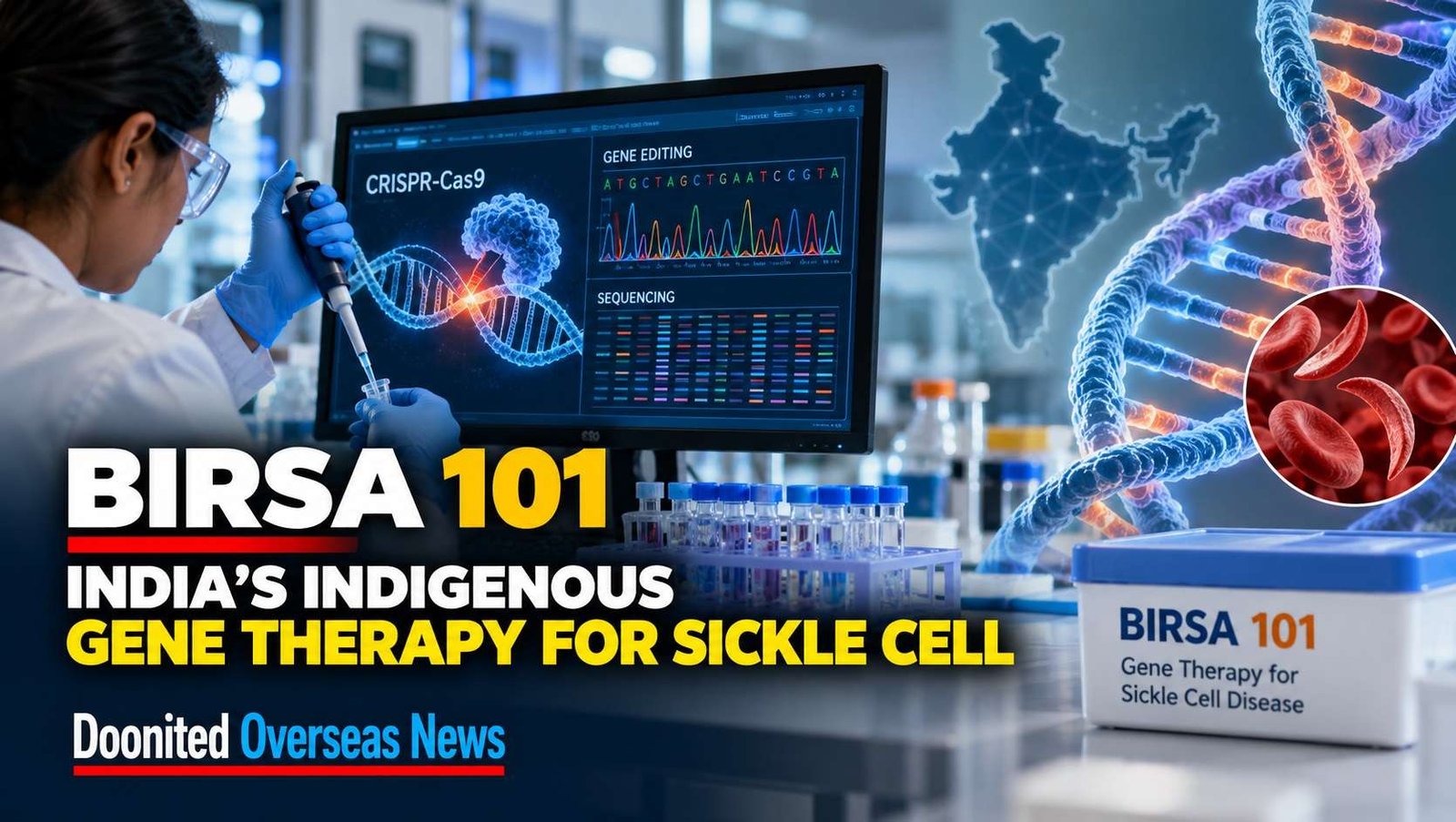
Two developments illustrate the country’s ambition. The GenomeIndia Project has assembled whole-genome data from more than 10,000 individuals representing major population groups, while BIRSA 101, developed by CSIR’s Institute of Genomics and Integrative Biology (CSIR-IGIB), has emerged as India’s first indigenous CRISPR-based gene therapy for sickle-cell disease.
Together, they point toward something more consequential than two separate scientific projects: an Indian precision-medicine pipeline that aims to connect population-scale genomic knowledge with locally developed therapies.
For the Indian diaspora, that development has a particularly important dimension. Genetic diversity does not stop at national borders. Indian-origin communities in the United States, Britain, Canada, the Gulf, Africa and elsewhere carry many of the same population histories and genetic variations represented in India’s genomic research.
GenomeIndia: building an Indian genetic reference
The GenomeIndia Project was designed to create a genomic reference representing India’s extraordinary population diversity.
Government data says the project has generated whole-genome sequencing data from 10,074 healthy individuals representing 83 population groups across 99 sites. The resulting resource is archived at the Indian Biological Data Centre (IBDC), India’s national repository for biological data.
In January 2025, the government announced that 10,000 whole-genome samples had been made accessible to researchers through the Indian Genomic Data Set and IBDC portals under defined data-access protocols.
The importance of this dataset is not simply its size.
India contains hundreds of population groups with different genetic histories. A reference that better captures that variation can help researchers distinguish common genetic variation from variants that may be associated with disease.
That could support research into conditions including diabetes, cardiovascular disease, cancer and rare genetic disorders.
But an important distinction is necessary: GenomeIndia is a research resource, not a nationwide diagnostic system. Having a population-specific reference genome does not automatically mean doctors can predict an individual’s future illness or prescribe a personalised treatment.
The scientific value lies in giving researchers a better baseline from which to investigate those possibilities.
From genomic maps to genetic medicine
This is where BIRSA 101 becomes particularly interesting.
On November 19, 2025, the Indian government announced the launch of BIRSA 101, an indigenous CRISPR-based gene therapy developed at CSIR-IGIB for sickle-cell disease (SCD). The government subsequently described the programme as an effort to develop an affordable gene-editing therapeutic pathway for a disease that disproportionately affects India’s tribal communities.
The project has also moved toward industrial translation.
CSIR-IGIB and the Serum Institute of India signed a technology-transfer agreement intended to support development, manufacturing and future scale-up. Government documents describe clinical-trial infrastructure, regulatory processes and manufacturing development as part of the programme’s progression. CSIR
This is an important stage in the journey from laboratory science to medicine.
A gene-editing concept is not the same thing as an approved, routinely available treatment. Safety, efficacy, manufacturing quality, clinical evidence and regulatory approval all have to be established.
That distinction is especially important with gene therapy because the intervention can be highly complex and may involve extracting a patient’s stem cells, modifying them and returning them to the body.
Why sickle-cell disease is an important test case
Sickle-cell disease is an inherited blood disorder caused by genetic mutations affecting haemoglobin. It can produce anaemia, pain crises and progressive organ damage.
In India, the disease has a particularly significant impact on several tribal populations.
That makes BIRSA 101 more than a technology demonstration.
It is an attempt to solve a genuine public-health problem affecting communities that have historically faced barriers to specialised healthcare.
The government has linked the programme to its ambition of achieving a sickle-cell-free India by 2047, while the May 2026 workshop on BIRSA 101 reviewed progress in clinical development, regulatory processes and manufacturing.
The potential affordability argument is also significant.
The government has contrasted BIRSA 101 with overseas gene therapies that can cost tens of millions of rupees. In its November 2025 announcement, it said comparable treatments abroad could cost ₹20–25 crore. That figure should be understood as a government comparison rather than evidence of BIRSA 101’s eventual patient price.
The eventual cost will depend on clinical development, manufacturing, regulatory requirements, hospital infrastructure and reimbursement.
The diaspora connection is bigger than it first appears
Genomics is often discussed as a national project.
Biology does not recognise national boundaries.
Indian-origin communities around the world have diverse genetic histories that overlap with populations represented in Indian genomic research. This makes the development of South Asian genomic resources potentially relevant to researchers studying disease in diaspora populations.
For example, a better understanding of genetic variation among Indian populations could eventually improve research involving people of Indian ancestry living in Britain, North America, the Gulf, East Africa and elsewhere.
But it would be wrong to assume that a genetic finding in an Indian population automatically applies to every person of Indian origin abroad.
Diaspora communities themselves are genetically diverse, shaped by migration, intermarriage, founder effects and different population histories. Precision medicine requires precisely this kind of nuance.
That is one reason representative genomic datasets matter.
India’s emerging advantage: linking data with manufacturing
GenomeIndia and BIRSA 101 become particularly interesting when viewed together.
GenomeIndia provides a population-scale research foundation.
BIRSA 101 demonstrates an attempt to translate Indian biotechnology research into a therapeutic platform.
The Serum Institute connection adds another ingredient: manufacturing capability.
India has already established a global reputation for producing vaccines at large scale and relatively low cost. The more difficult question is whether that experience can be transferred to advanced therapies such as gene editing.
Gene therapy is considerably more complicated than conventional vaccine manufacturing. It requires specialised facilities, highly controlled processes, rigorous quality systems and long-term patient monitoring.
India therefore still has to demonstrate that its scientific capabilities can be converted into safe, scalable and internationally credible advanced therapies.
What could this mean globally?
If India succeeds, the implications could extend beyond Indian patients.
Many developing countries face the same problem: advanced gene therapies exist, but their prices and manufacturing requirements make them difficult to access.
A successful Indian model could eventually provide a pathway for other countries to develop or manufacture therapies for diseases that are disproportionately concentrated in particular populations.
That is potentially where India’s pharmaceutical and biotechnology experience becomes strategically important.
Instead of simply importing high-cost therapies developed elsewhere, countries could eventually participate in regional research, manufacturing and technology-transfer networks.
But this remains an opportunity, not an established outcome.
BIRSA 101 still needs rigorous clinical validation and regulatory progression before it can be judged as a globally scalable therapy.
The ethical challenge: genomic data belongs to people, not just databases
There is another side to India’s genomic ambitions that deserves equal attention.
Large genetic databases are extraordinarily valuable — but genomic information is also deeply personal.
A person’s genetic data can reveal information about disease risk, ancestry and familial relationships. Poor governance could therefore create risks involving privacy, discrimination or unauthorised use.
India’s government has established data-access frameworks and the IBDC to manage genomic resources, while the Indian Council of Medical Research has developed ethical guidance around genomics, biobanking, sample analysis and gene-therapy research. Press Information Bureau
As India’s genomic ecosystem grows, trust will be as important as sequencing capacity.
Researchers need access to useful datasets, but participants also need confidence that their information will be handled responsibly.
The real significance of GenomeIndia and BIRSA 101 is not that India has suddenly solved precision medicine.
It has not.
The more important development is that India is beginning to connect three capabilities that are rarely available together at scale: population-specific genomic data, advanced biomedical research and domestic manufacturing capacity.
That combination could become strategically valuable.
For overseas Indians, it offers another reason to watch India’s biotechnology sector closely. The global Indian story is no longer limited to software engineers and pharmaceutical exports. Indian researchers are increasingly working on the underlying biological data and therapeutic technologies that could influence healthcare across borders.
The ultimate test will be whether India can turn genomic knowledge into treatments that are safe, scientifically validated, affordable and accessible.
If it can, GenomeIndia will have been more than a map of Indian genetic diversity.
It could become part of the foundation for a new generation of precision medicine — built in India, informed by India’s population and potentially relevant to Indians wherever they live.

World Beyond the News
Dolphins Use Individual Signature Whistles
Bottlenose dolphins develop distinctive whistles that function somewhat like individual acoustic identifiers.
The Pacific Is Earth’s Largest Ocean
The Pacific Ocean covers more area than any other ocean basin and stretches between Asia, Australia and the Americas.
Artificial Intelligence Learns Statistical Patterns
Modern machine-learning systems identify patterns in large datasets and use those patterns to generate predictions or outputs.
Why Some Stories Spread So Quickly
Emotion, novelty, visual appeal and easy sharing can make a story travel rapidly across social platforms.