
From Hyderabad to the Heart of the AI Race: Uday Ruddarraju Takes Charge of OpenAI’s Computing Infrastructure
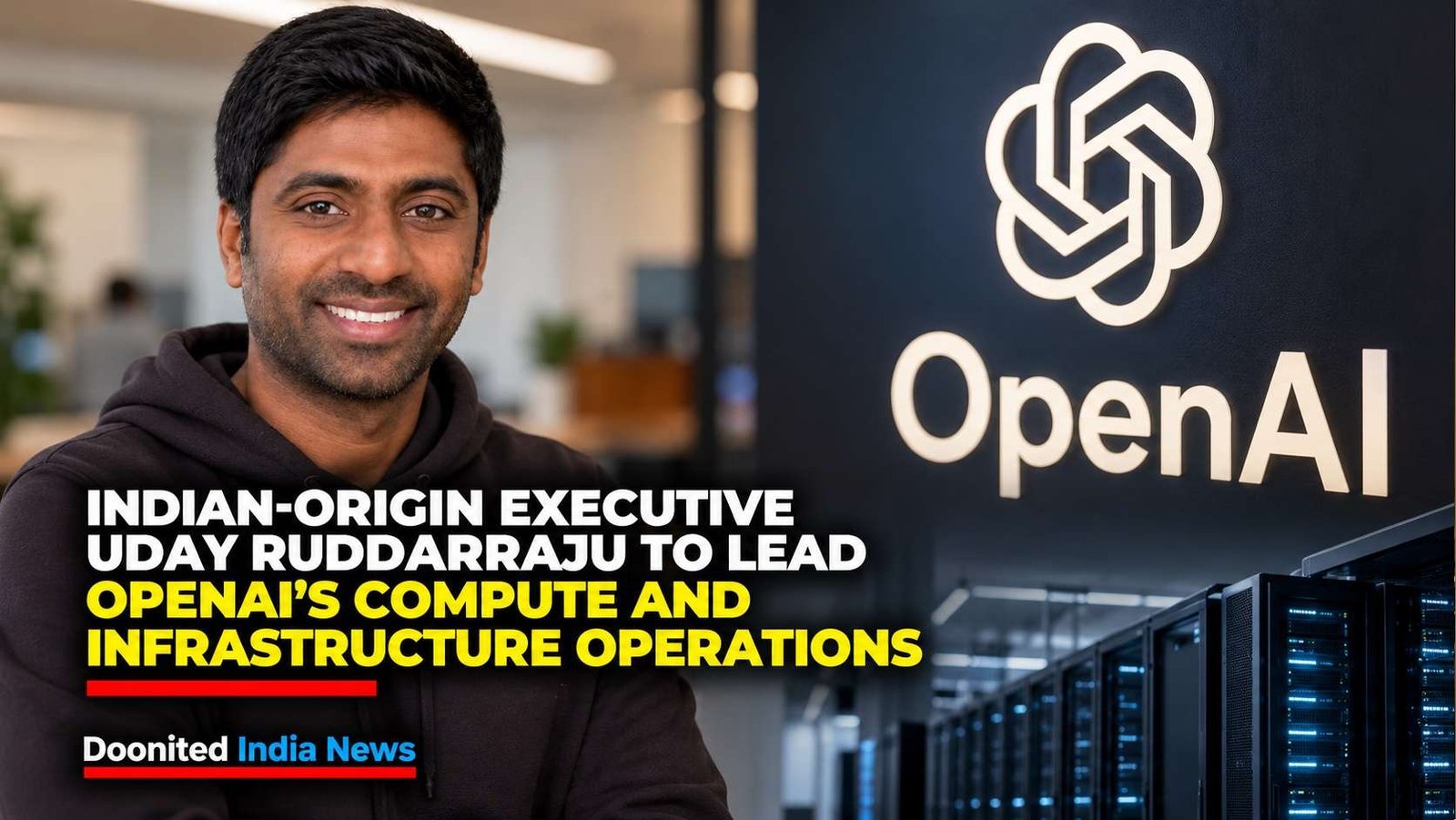
Indian-origin technology executive Uday Ruddarraju is set to lead OpenAI’s broader computing and infrastructure organisation, placing him at the centre of the systems that power the company’s artificial intelligence ambitions. His rise from engineering education in Hyderabad to Silicon Valley leadership highlights the global reach of Indian technical talent—and the growing importance of data centres, chips, networking and energy in the AI economy.
The next phase of the artificial intelligence race will be fought not only through algorithms and software, but also through the physical infrastructure needed to train and operate increasingly capable systems. That challenge is now central to the work of Uday Ruddarraju, an Indian-origin technology executive who has been selected to lead OpenAI’s broader computing and infrastructure operations.
The appointment places Ruddarraju in a pivotal position at one of the world’s most closely watched AI companies. OpenAI must expand the computing capacity behind its products while managing complex relationships with chipmakers, cloud providers, energy companies and data-centre developers.
Ruddarraju joined OpenAI in July 2025 as head of compute and infrastructure. The company promoted him to chief technology officer for compute in July 2026. On 14 October, reports citing company information said he would assume responsibility for the wider compute organisation as Sachin Katti prepares to leave the role on 15 November and continue as an adviser.
The transition reflects a broader shift in the AI industry. Securing computing capacity is only one part of the challenge; converting commitments into operational facilities that have reliable power, cooling, networking and working hardware is another.
For the Indian diaspora, Ruddarraju’s rise is a notable professional achievement. For the technology industry, it is also a reminder that the future of AI depends on a vast engineering and infrastructure effort extending far beyond the software interface most users see.
From Hyderabad’s engineering classrooms to Silicon Valley
Ruddarraju’s educational journey began in Hyderabad, where he studied computer science at Chaitanya Bharathi Institute of Technology (CBIT). He subsequently moved to the United States to pursue a master’s degree in computer science at the University of Minnesota, Twin Cities.
His professional career developed through roles at major technology companies, including eBay and Robinhood, before he joined Elon Musk’s artificial intelligence company, xAI.
At eBay, he worked on cloud and platform infrastructure. He later spent several years at Robinhood, rising into senior engineering leadership and overseeing infrastructure for a financial platform where system reliability and the ability to handle sudden increases in demand are critical.
These roles provided experience in operating complex systems under pressure. For a financial technology platform, a surge in activity can place extraordinary demands on computing infrastructure. For an AI company, the challenges are different in scale and configuration, but the underlying requirement is similar: systems must remain reliable while workloads grow.
Ruddarraju joined xAI in 2024 as head of infrastructure engineering. He later moved to OpenAI, bringing experience from a company attempting to build computing capacity at an unusually rapid pace.
His career illustrates a route taken by many internationally mobile engineers: technical education in India, postgraduate study in the United States and professional experience across several technology companies. It also demonstrates that the global technology industry needs people who can build and operate the systems behind digital services, not only develop applications.
The Colossus experience
One of the most significant chapters in Ruddarraju’s career was his work at xAI, where he helped lead infrastructure engineering for Colossus, the company’s large-scale AI computing cluster in Memphis, Tennessee.
The facility became a prominent example of the race to assemble enormous collections of graphics processing units, or GPUs, for AI training. Published reports have described Colossus as scaling beyond 200,000 GPUs, although the precise capacity depends on the reporting date and how the system is counted.
Building a cluster of this size is not simply a matter of installing servers. Thousands of computing components must operate together, supported by high-speed networking, storage systems, power distribution and cooling. The overall system must also be engineered to keep expensive hardware productive despite component failures and demanding workloads.
Ruddarraju’s experience in this environment is relevant to OpenAI’s ambitions. Training advanced AI models requires large amounts of computing power, while serving those models to users creates an additional and ongoing demand for inference capacity.
As AI products become more widely used, companies must balance the cost of training new models with the cost of running existing ones. Hardware availability, electricity prices, facility construction, networking performance and system utilisation can all affect how much computing capacity a company can deploy and what it costs to operate.
Ruddarraju’s appointment therefore places an infrastructure specialist at the centre of a business challenge that has become inseparable from AI strategy.
Why OpenAI’s infrastructure leadership matters
OpenAI’s computing requirements extend across hardware procurement, data-centre development, cloud partnerships and the engineering needed to connect these resources into reliable systems.
The company has been associated with large-scale infrastructure initiatives, including Stargate, and has pursued agreements with multiple suppliers and infrastructure partners. Such arrangements can help secure future capacity, but a signed agreement is not the same as a completed, operational data centre.
Facilities must be constructed, connected to electricity networks, equipped with computing hardware and brought into service. Delays in any of these areas can affect the availability and cost of computing resources.
That distinction is central to the leadership transition. Sachin Katti, who has overseen OpenAI’s compute strategy, helped develop commercial partnerships and secure capacity. Ruddarraju’s engineering background is particularly relevant to the operational side of bringing infrastructure online, although his expanded responsibilities also include commercial coordination.
Reporting on the transition indicates that Katti’s strategy and business teams are expected to remain in place, providing continuity as responsibilities change. Katti is also expected to advise the company after leaving his leadership role.
The transition should not be read as evidence that OpenAI’s infrastructure problems have been solved—or that its data-centre expansion will proceed without obstacles. Instead, it highlights the increasing importance of coordinating commercial commitments with the practical work required to make computing capacity available.
AI’s hidden constraints: electricity, cooling and networks
The public experience of AI is often a text box, a voice interface or an image-generation tool. Behind those products sits a resource-intensive industrial system.
AI data centres require dependable electricity, specialised cooling, high-speed networks and hardware that can be maintained and upgraded. Their development can depend on local planning decisions, construction capacity, grid connections and the availability of suitable sites.
Electricity is particularly important. Even when a company can obtain advanced chips, it cannot operate them at scale without sufficient power and the infrastructure needed to distribute it. Cooling systems must remove the heat generated by densely packed computing equipment, while networking must move data efficiently between thousands of processors.
These constraints mean that the AI race is increasingly linked to energy policy, industrial supply chains and infrastructure investment. They also create operational risks: a delayed power connection or construction schedule can postpone the availability of computing capacity even when equipment and financing are secured.
For OpenAI, the central test is whether its expanding infrastructure can support model development and commercial demand in a financially and operationally sustainable way.
Ruddarraju’s responsibilities will sit directly within that challenge. His background offers relevant experience, but the outcome will depend on execution across many teams, suppliers and physical locations.
What his rise means for the Indian diaspora
Ruddarraju’s appointment is significant for Indian-origin professionals because it demonstrates how expertise developed across countries and companies can lead to senior responsibility in a strategically important global industry.
His education in Hyderabad and subsequent career in the United States connect Indian technical education with the international technology economy. Yet the broader lesson is not simply that Indian engineers can reach leadership positions abroad. It is that the range of high-value technical work has expanded.
AI companies need researchers and software engineers, but they also need specialists in distributed computing, networking, electrical and mechanical engineering, hardware manufacturing, data-centre construction and infrastructure operations.
These roles are central to the industry’s future, even if they receive less public attention than the people leading AI research or launching new products.
Ruddarraju’s trajectory may also interest students and early-career professionals in India who are considering international study or technology careers. His path demonstrates the value of developing deep technical expertise and building experience across systems that operate at scale. It does not, however, establish a guaranteed route to success; individual outcomes depend on skills, opportunities, experience and circumstances.
His achievement should also be viewed without assuming that one executive’s success automatically translates into benefits for India. The connection is meaningful through education, professional mobility and the global contribution of Indian-origin talent, but wider economic benefits depend on investment, research partnerships, skills development and knowledge transfer.
The next measure of success
Ruddarraju takes on his expanded role at a moment when AI infrastructure is becoming one of the industry’s defining competitive factors. OpenAI’s ability to build and operate computing capacity will influence how quickly it can train models, serve customers and manage the cost of its products.
The most meaningful measures of success will therefore be operational: how reliably new capacity comes online, whether infrastructure performs as intended, how effectively the company uses its hardware and whether expansion can keep pace with demand without creating unsustainable costs.
For Ruddarraju, the challenge is considerably larger than managing a collection of servers. It involves coordinating engineering, physical construction, commercial partnerships and the supply chains that make large-scale AI possible.
For the Indian diaspora, his rise is a noteworthy example of technical leadership on the global stage. For the AI industry, it underscores a deeper reality: the future of artificial intelligence will depend as much on the ability to build and operate its physical foundations as on the intelligence of the models themselves.

World Beyond the News
Birds Can Navigate Using Earth’s Magnetic Field
Several bird species can sense Earth’s magnetic field, helping them navigate during long-distance migration.
Fermentation Is a Global Food Tradition
People across continents have used fermentation for centuries to preserve food and create distinctive flavours.
Modern Batteries Store Energy Chemically
Rechargeable batteries repeatedly move ions between electrodes, allowing electrical energy to be stored and released.
Why Songs Become Global Hits
Streaming platforms, short-form video, playlists and international collaborations can rapidly carry music across borders.