
Ashwini Asokan: The Indian AI Entrepreneur Taking Enterprise Artificial Intelligence to the World
From Silicon Valley and Chennai to global enterprises, Ashwini Asokan has spent more than a decade trying to solve a problem that is becoming increasingly important in the AI era: how businesses can make artificial intelligence actually work at scale.
Ashwini Asokan’s story is not the usual Indian technology success story.
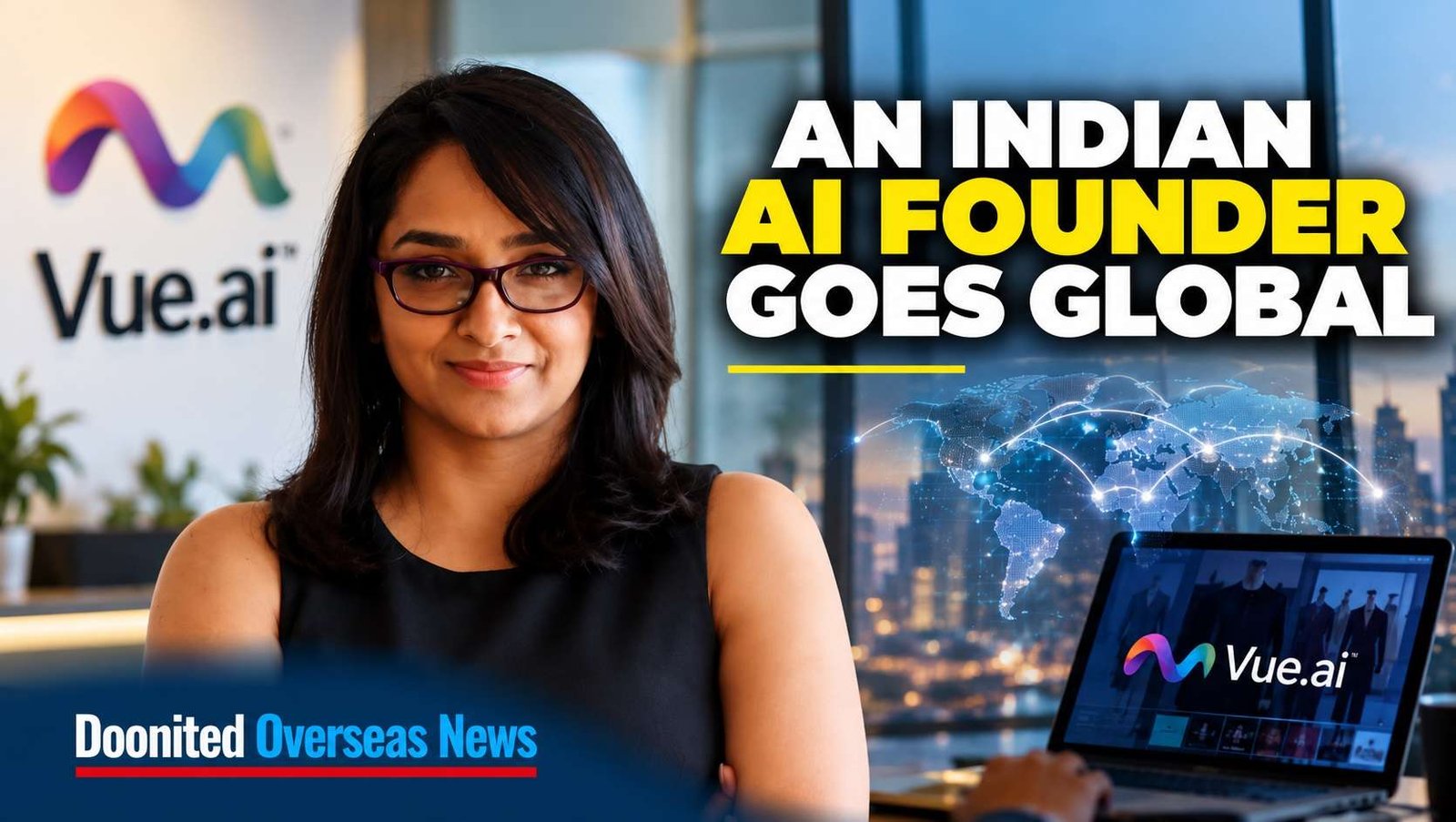
There is no simple journey from engineering college to software company. Her background is rooted in interaction design, cultural research and product thinking, followed by more than a decade of experience in Silicon Valley and at Intel. She eventually returned to India and co-founded Mad Street Den, building what became Vue.ai—an enterprise artificial-intelligence business whose technology has been used by companies across multiple international markets.
Today, Asokan is CEO of Vue.ai, whose parent company describes the platform as an AI orchestration system designed to connect enterprise data, applications, workflows, models and AI agents. The company says its platform is being used by major enterprises and lists customers or case studies involving companies including FedEx, Victoria’s Secret, Tesco and Mercado Libre. Vue.ai
Her journey offers a useful window into a bigger transformation: Indian technology companies are increasingly trying to export intellectual property and AI capabilities to the world, rather than simply providing software services.
From design to artificial intelligence
Asokan’s path into technology began from an unusual direction.
She studied visual communication in Chennai and later completed a master’s degree in interaction design at Carnegie Mellon University. She subsequently spent years working in Silicon Valley, including at Intel, where she worked around product design, user experience and technology development.
That background matters because Asokan did not approach AI solely as a computational problem.
Her interest was also in the relationship between technology, people and behaviour.
Before starting Mad Street Den, she had already worked at the intersection of product design and technology. Her experience convinced her that artificial intelligence needed to move beyond research laboratories and become useful in everyday businesses and consumer experiences.
In 2013, she and her husband, neuroscientist Anand Chandrasekaran, returned to India and launched Mad Street Den. The company’s early objective was ambitious: build AI systems capable of being applied at large scale rather than treating AI merely as an academic or experimental technology.
That decision placed Asokan in a relatively unusual position.
She was returning from Silicon Valley to India to build deep technology, rather than leaving India to pursue a technology career overseas.
The retail problem became the first global laboratory
Mad Street Den’s first major commercial direction was retail.
In 2016, the company launched Vue.ai, initially focusing on computer vision and intelligent retail automation. The idea was straightforward but technologically demanding: teach machines to understand products, images, customer behaviour and retail data well enough to automate parts of the online shopping experience.
Early applications included visual search, product tagging, recommendations, catalogue enrichment and other forms of retail automation.
The company gradually moved beyond the Indian market.
Vue.ai’s own historical material lists deployments involving companies and marketplaces across North America, Europe, Latin America, Southeast Asia, the Middle East and Japan. Its press archive has cited international users including Mercado Libre in Latin America and retailers such as Farfetch, Depop, Off-White, Diesel, Rent the Runway and ThredUp. Vue.ai
That international footprint is significant for another reason.
It demonstrated that an AI product developed by an Indian-founded company could address problems that were not specifically Indian.
Retailers in Mexico, the United States, Europe or Southeast Asia may have very different customers, regulations and business models, but they can face similar challenges involving product data, customer journeys, inventory and digital commerce.
That is the foundation of a technology export business.
From computer vision to AI orchestration
Vue.ai’s ambitions have since expanded considerably.
The company now describes itself not simply as a computer-vision platform but as an enterprise AI orchestration platform.
The distinction is important.
The first generation of enterprise AI often involved individual tools: one system for document processing, another for customer recommendations, another for data cleaning and another for automation.
As companies deploy more AI, however, the problem becomes increasingly complicated. Different models, databases, applications and workflows have to work together.
Vue.ai’s current proposition is to provide a layer that orchestrates these different components. The company describes its system as bringing together data, models, workflows and AI agents while connecting with existing enterprise applications. Vue.ai
Asokan and her fellow founders have described this evolution as a move from isolated AI applications toward composable and orchestrated systems.
In other words, the challenge is no longer simply:
Can AI perform this task?
The bigger question is:
How can an organisation make dozens or hundreds of AI-enabled tasks work together reliably?
That is a much larger enterprise problem.
Why global customers matter
Vue.ai says it works across sectors including retail, finance, insurance, logistics and healthcare, and its current website highlights customer stories involving businesses such as FedEx, Victoria’s Secret, Tesco and Mercado Libre. Vue.ai
The company has also developed partnerships around enterprise cloud and AI deployment. Its Google Cloud partnership, for example, made its Intelligent Document Processing capability available through Google Cloud Marketplace. Vue.ai
Microsoft’s AI First Movers programme separately reports results associated with Vue.ai’s Azure integration, including a reported 30% increase in data accuracy, 40% reduction in processing costs and up to five-times faster time-to-go-live for AI projects. These are company/customer-reported performance figures and should therefore be understood in that context rather than treated as independently audited industry benchmarks. Microsoft
This distinction is important in an AI industry increasingly filled with impressive claims.
For Asokan, one of the recurring themes has been that enterprises need measurable business outcomes rather than AI for its own sake.
That may ultimately prove to be one of the more important lessons from her journey.
An Indian technology story with a global address
There is an interesting geographical dimension to Vue.ai.
The company identifies a presence in Redwood City, California, Chennai and Dubai, while its technology development and business history are deeply connected with India. Vue.ai
This is increasingly characteristic of India’s new technology generation.
The old model was often:
India develops talent → overseas company hires talent → technology is exported through services.
The newer model increasingly looks like:
Indian founders → Indian engineering and product talent → proprietary technology → global customers.
That difference is substantial.
It means value can come not only from providing engineering hours but from owning the product, intellectual property, customer relationship and technology platform.
Asokan’s career sits squarely within this transition.
The significance for Indians working abroad
For the Indian diaspora, her story also carries a different lesson.
Asokan’s career demonstrates that an international technology career does not necessarily have to end with permanent relocation to the world’s established technology centres.
She built professional experience in the United States, developed expertise in Silicon Valley and then chose to return to India to build a global technology company. Hindustan Times
That makes her story relevant to Indian professionals considering a similar question:
Should global experience be the destination—or can it become an asset brought back to India?
There is no universal answer.
Building deep technology from India still involves challenges: access to global enterprise customers, international competition, capital, specialised talent and the difficulty of converting sophisticated research into repeatable commercial products.
But Asokan’s career shows that the route is possible.
The bigger story is India’s AI export ambition
The most interesting aspect of Ashwini Asokan’s story is therefore not simply that an Indian woman became an AI entrepreneur.
It is that her career illustrates a broader change in India’s position in global technology.
India has long been one of the world’s largest providers of technology services. The next opportunity is more ambitious: building AI products that foreign companies depend upon.
That requires something different from traditional outsourcing.
It requires product design, proprietary technology, intellectual property, international sales, enterprise integration and long-term customer relationships.
Vue.ai’s evolution—from computer vision and intelligent retail applications to broader enterprise AI orchestration—illustrates that transition.
The company’s own description of its mission is to make businesses and the people inside them more AI-native. Vue.ai
Whether AI orchestration ultimately becomes a major standalone technology category remains an open market question. Competition is intense, and the enterprise AI market is changing rapidly.
But the significance of Asokan’s journey does not depend on one company’s eventual market position.
It demonstrates something more fundamental: an Indian-founded technology company can originate in India, operate across continents and compete by selling intellectual property and AI capability to the world.
For the next generation of Indian entrepreneurs, that may be the more important achievement.


World Beyond the News
Birds Can Navigate Using Earth’s Magnetic Field
Several bird species can sense Earth’s magnetic field, helping them navigate during long-distance migration.
Fermentation Is a Global Food Tradition
People across continents have used fermentation for centuries to preserve food and create distinctive flavours.
Modern Batteries Store Energy Chemically
Rechargeable batteries repeatedly move ions between electrodes, allowing electrical energy to be stored and released.
Why Songs Become Global Hits
Streaming platforms, short-form video, playlists and international collaborations can rapidly carry music across borders.