
India’s 6G Breakthrough: JNCASR Develops Silicon Chip That Carries Data at 100 Gbps
From Bengaluru’s research laboratories comes a promising advance in next-generation communication technology. Indian scientists have demonstrated a silicon photonic chip that guides terahertz waves across engineered barriers with remarkably low signal loss, opening new possibilities for compact, high-capacity 6G communication circuits.
What if a communication signal could travel through a complicated electronic pathway, cross an artificial barrier and negotiate sharp turns without losing much of its strength?
That possibility has moved closer to reality through research conducted by scientists at the Jawaharlal Nehru Centre for Advanced Scientific Research (JNCASR), Bengaluru.
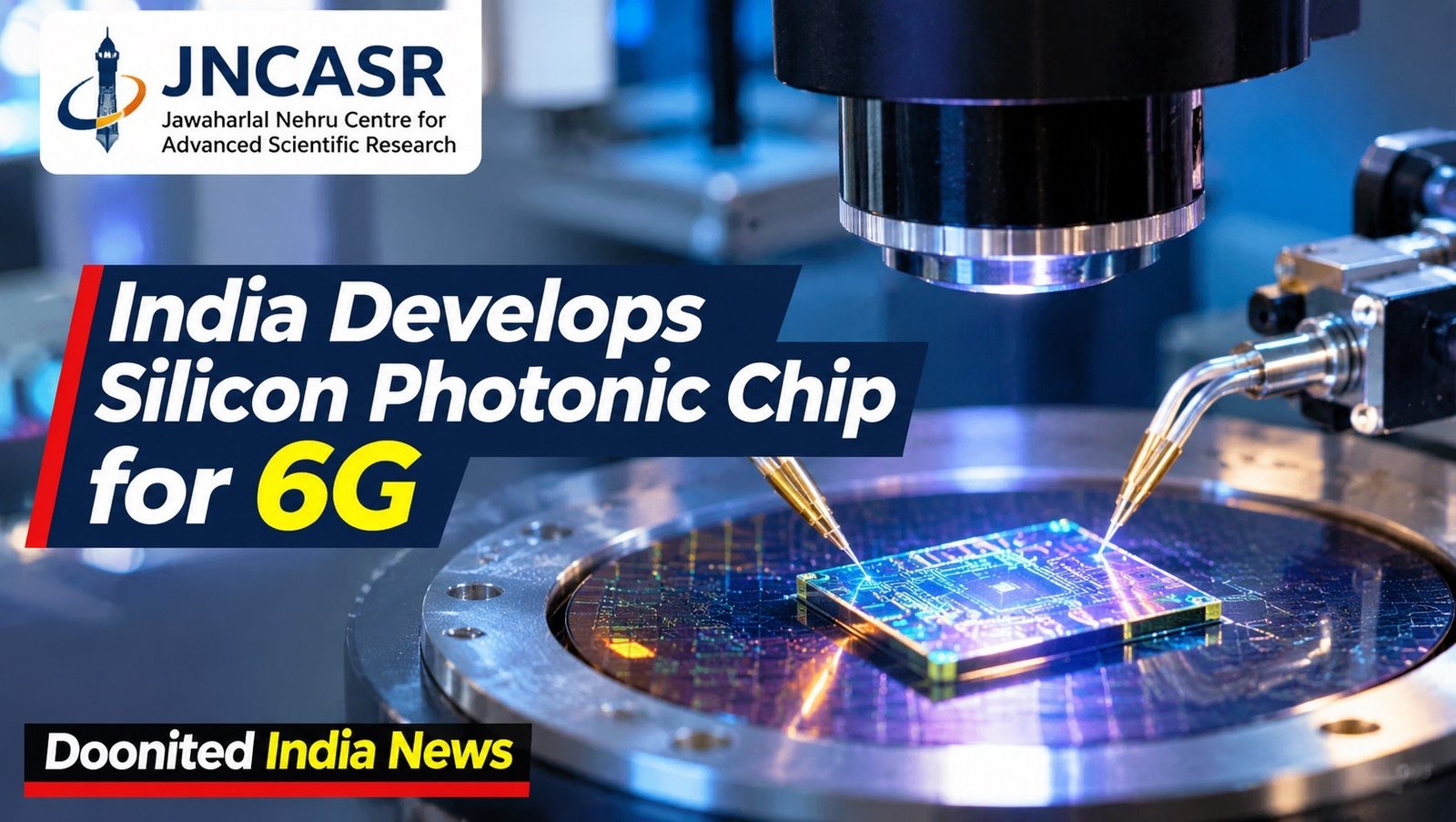
The researchers have developed a specially engineered silicon photonic chip that allows terahertz waves to cross designed barriers with very little signal loss. In laboratory demonstrations, one of the devices supported data transmission at speeds of up to 100 gigabits per second (Gbps).
The research, published in the scientific journal Advanced Materials on October 11, 2026, could contribute to the development of compact terahertz circuits for future sixth-generation (6G) communication networks.
The achievement is significant because increasing data speeds is only one part of the 6G challenge. Scientists must also find ways to guide extremely high-frequency signals through increasingly complex circuits without losing valuable information.
JNCASR’s research addresses precisely this problem.
The Science: Making Waves Cross Barriers
The technology uses an approach known as topological photonics.
To understand its importance, consider what happens when a signal encounters an obstacle inside a conventional waveguide. Some of its energy may scatter or reflect backwards, weakening the signal.
The JNCASR team developed a different approach using a silicon photonic crystal.
The researchers arranged tiny triangular holes in a silicon slab in a pattern resembling the honeycomb structure of graphene. By changing the dimensions of selected holes, they created an engineered barrier along the pathway followed by terahertz waves.
The remarkable feature is that the waves can cross this barrier while maintaining most of their transmission strength.
The phenomenon is known as photonic Klein tunnelling.
Inspired by a concept from quantum physics, it describes how waves can cross certain barriers with unexpectedly little reflection. The researchers have demonstrated this effect experimentally in a silicon-based photonic structure.
In practical terms, the design offers a way to guide high-frequency signals through compact circuits without requiring every pathway to remain perfectly straight.
Signal Loss Reduced to Just 1–3%
One of the most interesting findings concerns how little signal strength is lost when the terahertz waves cross the engineered barriers.
The experiments showed:
Single barrier: approximately 1–2% additional signal loss.
Two consecutive barriers: approximately 2–3% additional loss.
The measurements were conducted across the 310–360 GHz frequency range.
These results are important because signal loss becomes a major engineering challenge when communication systems operate at increasingly high frequencies.
The researchers demonstrated that carefully controlling the geometry of the silicon photonic crystal can help preserve signal transmission even when obstacles are deliberately introduced.
Three Prototypes Demonstrate the Technology
Rather than testing the concept in only one configuration, the research team fabricated and evaluated three different silicon-chip devices.
100 Gbps
QAM-32 modulation
This configuration divided the signal into two output pathways while maintaining nearly identical transmission performance.
60 Gbps
The device demonstrated signal transmission through an omega-shaped route containing four sharp bends and a central barrier.
48 Gbps
This configuration demonstrated high-speed transmission across two engineered barriers placed in sequence.
The results demonstrate that the concept is not limited to a single straight transmission pathway. It can also be applied to signal splitting and more complicated circuit geometries.
The 100 Gbps result belongs specifically to the power-splitter configuration; it should not be interpreted as a demonstrated 100 Gbps commercial 6G connection.
Why This Matters for Future 6G Networks
The world is already moving beyond 5G towards sixth-generation wireless communication.
Future 6G systems are expected to explore much higher frequency bands, including the terahertz spectrum, to support greater capacity and new communication applications.
Potential applications include:
Extremely high-speed wireless communication.
Advanced data centres and interconnects.
High-capacity wireless backhaul.
Next-generation imaging and sensing.
Compact integrated photonic circuits.
Future communication systems requiring high data throughput.
Terahertz frequencies offer substantial bandwidth, but they also present technical difficulties. Signal propagation, atmospheric absorption, device fabrication and efficient signal generation and detection remain significant challenges.
This is why the JNCASR development matters: it addresses one important component of the larger 6G technology challenge—the ability to route high-frequency signals efficiently within compact circuits.
Bengaluru’s Contribution to India’s Semiconductor Research
The research was led by Dr Abhishek Kumar, Assistant Professor at JNCASR and head of its Meta Optics Laboratory (MetoLab).
Samina Mulla and Sangram Kumar Sadhu were joint first authors.
The research also involved collaborators from IIT Bombay, IISER Kolkata, Singapore’s Institute of Microelectronics at A*STAR, and French research institutions associated with the University of Lille and CNRS.
An important advantage is the use of high-resistivity silicon, which is compatible with established semiconductor manufacturing processes.
This offers a potential pathway towards integrating the technology into future semiconductor-based photonic circuits.
The work also demonstrates the importance of international scientific collaboration in developing advanced technologies within India.
What Happens Next?
The research team is now looking towards making the technology more flexible.
The next stage involves introducing mechanisms that can change the barriers electrically, thermally or mechanically.
Such active tuning could allow a chip to redirect signals between different pathways when required, rather than relying on a fixed circuit configuration.
This could be particularly useful in future communication hardware where signal routing needs to adapt dynamically.
However, it is important to distinguish a successful laboratory demonstration from a commercially deployable 6G product.
The researchers have demonstrated promising signal-routing performance, but further development, integration and testing will be required before the technology can become part of operational communication networks.
An Editor’s Perspective: India’s 6G Ambition Needs Indigenous Research
India’s digital ambitions will depend increasingly on its ability to develop advanced technologies rather than simply import them.
The JNCASR experiment is an encouraging example of what Indian scientific institutions can contribute to that objective.
Its importance is not merely the headline figure of 100 Gbps. It is the underlying engineering principle: finding ways to move high-frequency signals through complicated pathways without substantial transmission losses.
There is still considerable work ahead before such technology reaches commercial applications. But breakthroughs of this kind strengthen India’s research capabilities in photonics, semiconductor materials and next-generation communication systems.
The country needs more such collaborations between universities, research laboratories, semiconductor manufacturers and the telecommunications industry.
India’s journey towards 6G will not be decided by download speeds alone. It will depend on who develops the technologies, materials and intellectual capabilities that make those speeds possible.
JNCASR’s silicon chip represents one meaningful step in that direction.
Originally published on Doonited India: Read the original article

World Beyond the News
Birds Can Navigate Using Earth’s Magnetic Field
Several bird species can sense Earth’s magnetic field, helping them navigate during long-distance migration.
Fermentation Is a Global Food Tradition
People across continents have used fermentation for centuries to preserve food and create distinctive flavours.
Modern Batteries Store Energy Chemically
Rechargeable batteries repeatedly move ions between electrodes, allowing electrical energy to be stored and released.
Why Songs Become Global Hits
Streaming platforms, short-form video, playlists and international collaborations can rapidly carry music across borders.