

Raji Doshi: How a 13-Year-Old Indian-American Scientist Is Taking on Ocean Acidification
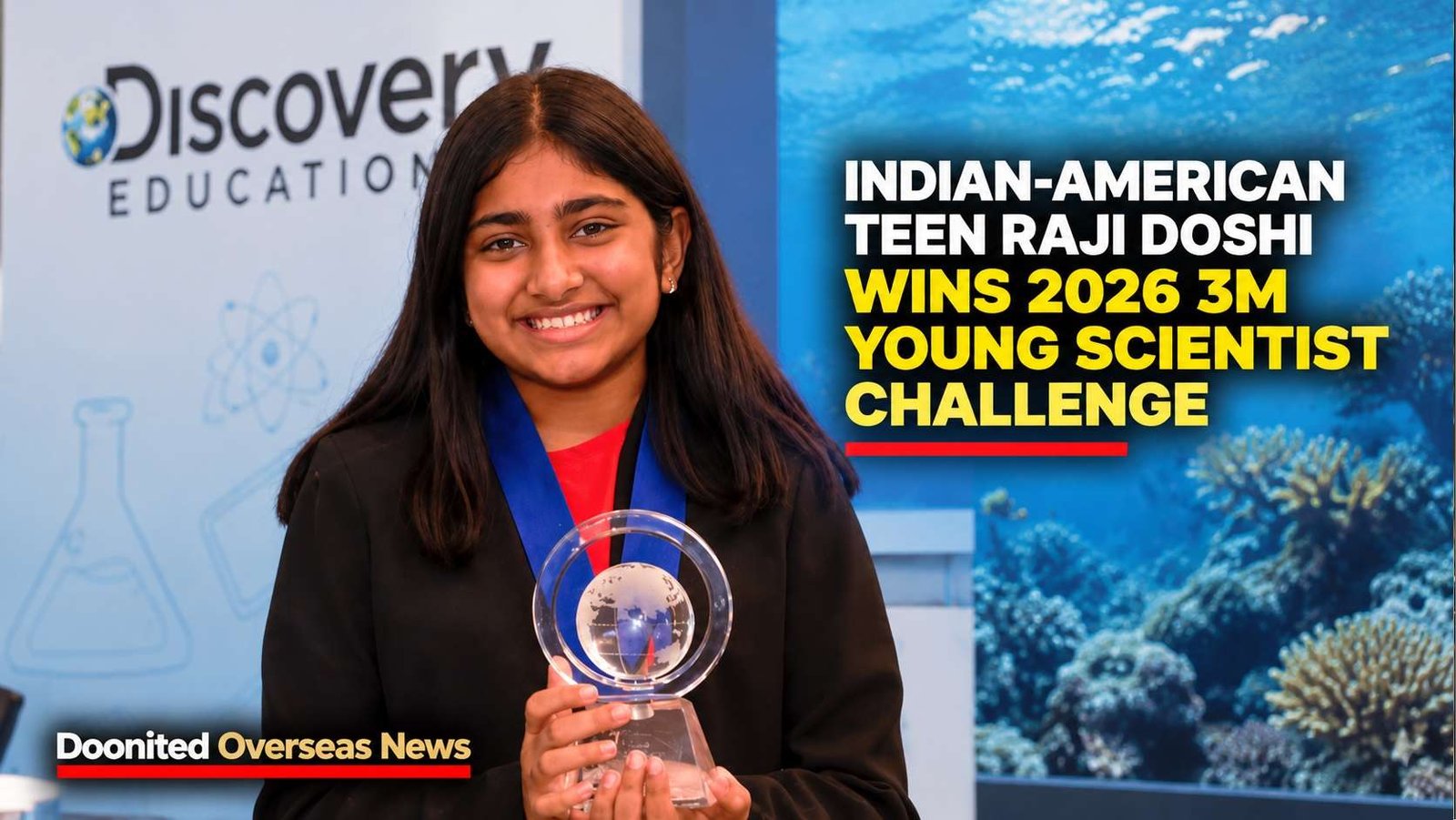
Raji Doshi, a 13-year-old student from Farmington, Connecticut, has won the 2026 3M Young Scientist Challenge and its US$25,000 grand prize. Her ALKACORE project combines macroalgae and a naturally occurring mineral to explore ways of reducing ocean acidification, demonstrating how youthful curiosity, scientific mentorship and environmental awareness can come together to address a global challenge.
A fascination with seashells has helped put 13-year-old Raji Doshi on the American scientific stage.
The Indian-American eighth grader from Farmington, Connecticut, was named “America’s Top Young Scientist” after winning the 2026 3M Young Scientist Challenge, a national competition for middle-school students organised by 3M and Discovery Education.
Her winning project, titled Engineering a Novel Durable Algae-Aragonite Alkalinity System to Reduce CO₂-Driven Ocean Acidification, proposes a natural approach to a problem affecting marine ecosystems around the world. Called ALKACORE, the system combines macroalgae cultivation with aragonite, a mineral form of calcium carbonate, to investigate whether coastal water chemistry can be made more resilient to increasing acidity.
Doshi received the competition’s US$25,000 grand prize after presenting her work at the final event held at 3M’s global headquarters in St. Paul, Minnesota, on 12 and 13 October 2026. She competed against nine other finalists, each of whom had developed a science-based response to a real-world problem.
Her achievement is notable not simply because of her age, but because her project addresses a challenge that scientists, coastal communities and marine industries are already confronting: how to protect ocean ecosystems as human activities increase the amount of carbon dioxide entering the atmosphere and seawater.
From collecting seashells to asking scientific questions
For Doshi, the project began with a personal interest in seashells. According to 3M’s announcement, she was troubled by the damage that increasing ocean acidity can cause to shells and the organisms that depend on them.
That observation became the starting point for a more technical question: could naturally occurring biological and mineral processes be combined to improve the chemical conditions in coastal water?
The transition from curiosity to experimentation is an important part of science education. A student may notice a problem in the natural world, but developing a meaningful response requires more than an imaginative idea. It involves understanding the underlying science, testing assumptions, analysing results and recognising the limits of what an experiment can establish.
Doshi’s project brought these elements together. She investigated the relationship between macroalgae, aragonite and seawater chemistry, using computational modelling to explore how much of the mineral might be needed for the system to work under the conditions being studied.
She also received one-to-one summer mentorship from Deborah Isabelle, a product engineering specialist at 3M. The competition’s mentoring programme is designed to help finalists refine their concepts and develop their presentations and prototypes.
Why ocean acidification matters
The environmental problem behind ALKACORE is well established.
The ocean absorbs a substantial share of the carbon dioxide released into the atmosphere. When that gas dissolves in seawater, it triggers chemical reactions that increase hydrogen-ion concentrations, lower pH and reduce the availability of carbonate ions.
This process is known as ocean acidification. Despite the name, seawater does not have to become chemically acidic in the everyday sense: ocean water generally remains above pH 7. The term describes a sustained shift towards greater acidity relative to previous conditions.
The change matters because many marine organisms use calcium carbonate to construct shells and skeletons. Reduced carbonate availability can make it more difficult for corals, shellfish and other organisms to build and maintain these structures.
The consequences can extend beyond individual species. Coral reefs provide habitats for marine life, while shellfish support coastal economies and food systems. Changes to organisms at the base of marine food webs can also affect other species and the communities that depend on them.
The US National Oceanic and Atmospheric Administration explains that ocean acidification is driven primarily by the ocean’s uptake of atmospheric carbon dioxide. It also notes that the effects can reach coastal waters and estuaries, with implications for marine organisms and fisheries.
The issue is global, but its effects are not identical everywhere. Local water chemistry, temperature, circulation, biological activity and other environmental conditions influence how ocean acidification affects a particular ecosystem.
That complexity is one reason researchers continue to investigate approaches that might improve the resilience of vulnerable coastal environments.
How ALKACORE is designed to work
ALKACORE combines two components that serve different functions.
First, macroalgae. These large seaweeds use photosynthesis to grow, taking up carbon dioxide or related dissolved inorganic carbon during the process. The extent to which this changes surrounding water chemistry depends on factors including species, growth conditions, light, nutrient availability and water movement.
Second, aragonite. This naturally occurring crystalline form of calcium carbonate is involved in the carbonate chemistry that determines seawater alkalinity and the availability of carbonate minerals. Under suitable conditions, adding calcium carbonate material can influence water chemistry, although its dissolution and effectiveness depend on environmental conditions.
The project explores whether combining these components could improve alkalinity while supporting algal growth and reducing dissolved carbon dioxide under the conditions tested.
Doshi also developed a computational model based on Michaelis–Menten kinetics to investigate the relationship between mineral dosage and the system’s response. Michaelis–Menten equations are widely used to describe how the rate of certain biological processes changes with the availability of a substrate.
In this context, modelling can help identify promising experimental conditions and avoid relying entirely on trial and error. However, a model’s predictions depend on its assumptions, input data and the range of conditions for which it has been validated.
The distinction is important: the competition announcement reports that Doshi used chemical analysis and computational modelling to evaluate her approach. It does not establish that ALKACORE has already been deployed at commercial scale or demonstrated long-term benefits across natural coastal ecosystems.
A promising idea, with questions still to answer
The appeal of ALKACORE lies in its attempt to combine natural processes with a measurable chemical intervention. But an approach that works under controlled conditions must pass several further tests before it can be considered a practical environmental solution.
Researchers would need to establish how reliably the system changes water chemistry, how long any improvement lasts and whether it produces unintended effects. These questions become more complicated outside a laboratory, where tides, currents, temperature changes, nutrient levels and existing marine communities interact.
The role of macroalgae also requires careful evaluation. Although algae can absorb carbon during growth, the long-term climate benefit depends on what happens to that carbon afterwards. If the biomass decomposes, much of the carbon may return to the surrounding environment. A system intended to deliver lasting carbon removal would therefore need to account for the carbon’s fate, not simply measure its uptake during growth.
Aragonite presents its own considerations. Its behaviour depends on the surrounding water chemistry, and adding mineral material does not automatically guarantee a durable or environmentally beneficial result. Any deployment would need to consider sourcing, transport, dosage, ecological effects and monitoring.
These are not reasons to dismiss a student project. They are the questions that separate a promising scientific concept from a validated intervention.
ALKACORE’s significance at this stage is that it offers a testable approach to a real problem and demonstrates how a young researcher can use chemistry, biology and computational thinking to investigate it.
Why the achievement matters to Indian-American families
Doshi’s win also belongs to a broader story about the contribution of young people from immigrant and diaspora communities to science and technology.
Indian-American families often place strong emphasis on education, but a competition of this kind highlights a lesson that goes beyond academic performance. Scientific innovation requires curiosity, experimentation, communication and the willingness to revise an idea when the evidence demands it.
The 3M Young Scientist Challenge is designed to recognise those abilities. The 2026 competition brought together ten finalists aged 11 to 14, each of whom received mentorship from a 3M scientist or specialist. Participants were assessed on criteria that included creativity, scientific understanding, communication, ingenuity and the application of STEM principles.
For students following Doshi’s example, the practical takeaway is not that every environmental concern must lead to a prize-winning invention. It is that an everyday observation can become a meaningful research question when it is followed by careful investigation.
Her story may also encourage educators and families to make room for independent projects that connect classroom learning to real-world problems. Such work can help students discover how scientific disciplines overlap: environmental questions may require chemistry, biology, mathematics, engineering and an understanding of local ecosystems.
The larger lesson: curiosity needs evidence
Doshi’s recognition arrives at a time when climate and ocean science require both ambitious ideas and careful scrutiny. Ocean acidification is not a problem that can be solved by a single student project, a new material or a local intervention alone. The underlying driver—rising atmospheric carbon dioxide—requires sustained reductions in greenhouse-gas emissions.
Potential local approaches may still have a role in protecting vulnerable environments, but their benefits must be measured against their costs, ecological consequences and durability.
For now, ALKACORE should be viewed as an award-winning research concept rather than a proven large-scale remedy. Its promise lies in the question it asks, the scientific methods it applies and the opportunity for further testing.
For Doshi, the US$25,000 prize and the title of America’s Top Young Scientist mark a significant achievement. For other young researchers, her journey offers a useful example of how curiosity can become a structured scientific investigation.
And for the wider public, it is a reminder that meaningful innovation often begins with noticing something familiar—a shell on a beach, a change in a local environment or a problem that others have learned to overlook—and asking what the evidence might reveal.

World Beyond the News
Birds Can Navigate Using Earth’s Magnetic Field
Several bird species can sense Earth’s magnetic field, helping them navigate during long-distance migration.
Fermentation Is a Global Food Tradition
People across continents have used fermentation for centuries to preserve food and create distinctive flavours.
Modern Batteries Store Energy Chemically
Rechargeable batteries repeatedly move ions between electrodes, allowing electrical energy to be stored and released.
Why Songs Become Global Hits
Streaming platforms, short-form video, playlists and international collaborations can rapidly carry music across borders.