
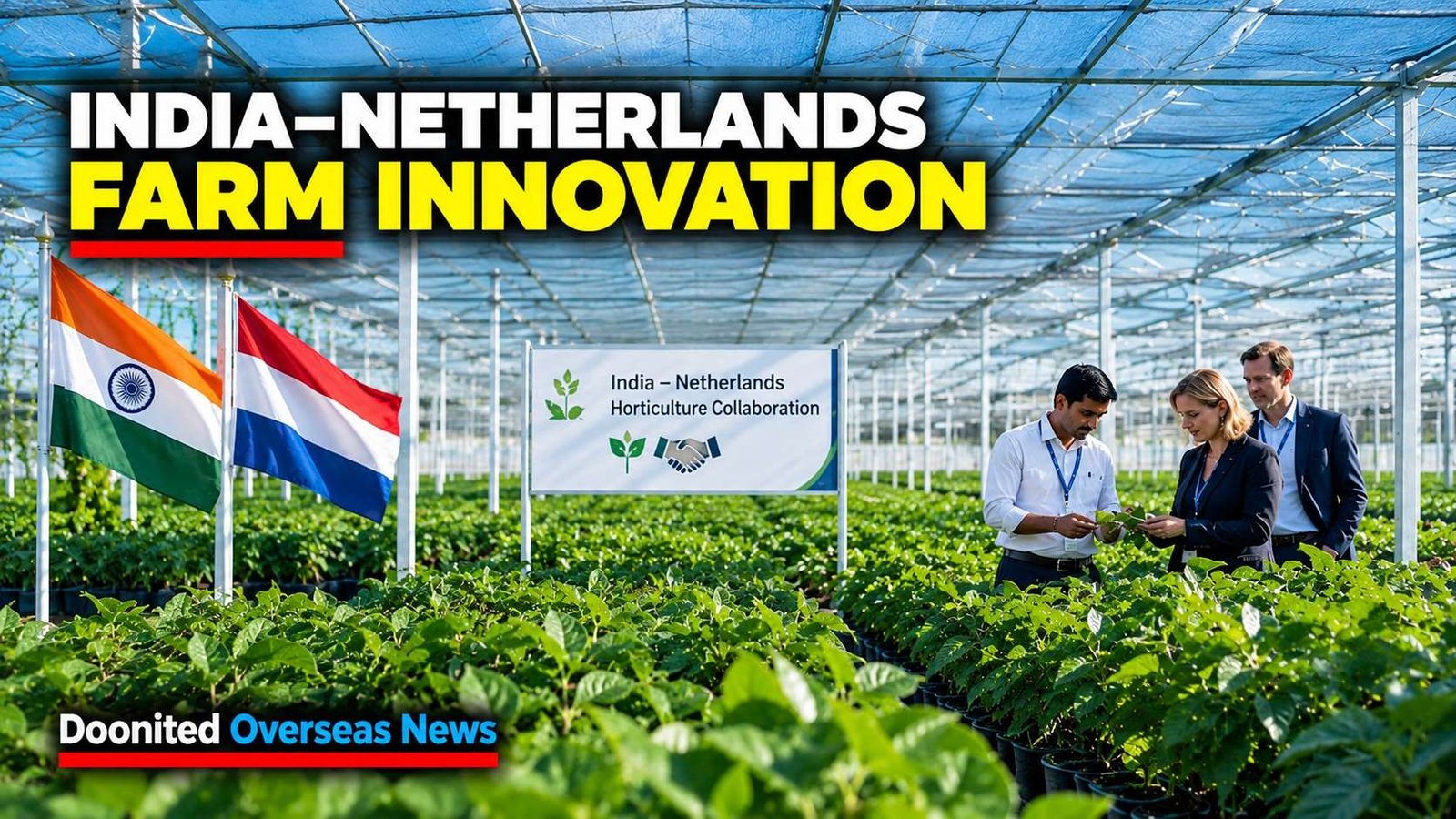
India–Netherlands Farm Partnership: Can Dutch Innovation Help Indian Farmers Grow More with Less?
India and the Netherlands are deepening agricultural cooperation through horticulture centres, seed-sector collaboration and advanced farming technology. The opportunity is significant, but the real test is whether these innovations can become affordable, locally adapted tools for Indian farmers—and create lasting opportunities for agri-tech businesses and international partnerships.
From diplomatic discussions to the farm
A greenhouse technology that works in the Netherlands cannot simply be copied into a farm in Maharashtra, Karnataka or West Bengal and expected to deliver the same results. Climate, water availability, landholding size, labour costs and access to markets can be very different. That is why the most important part of international agricultural cooperation is not importing equipment; it is adapting knowledge to local conditions.
India and the Netherlands are pursuing that challenge through a renewed focus on horticulture, improved planting material, seed-sector cooperation and agricultural innovation.
On 28 September 2026, Union Agriculture Minister Shivraj Singh Chouhan met Dutch Minister Silvio Erkens in New Delhi to review agricultural cooperation. The discussions included progress on establishing 25 Centres of Excellence (CoEs), a proposed framework for cooperation in the seed sector and opportunities to exchange agricultural technology and expertise. The Indian government reported the meeting on 2 October.
The initiative builds on a longer partnership. The two countries’ 2026–2030 strategic roadmap identifies agriculture, food systems, agri-tech, climate-resilient farming and the development of disease-free planting material as areas for continued collaboration. It also recognises the role of Dutch companies in India’s protected cultivation, food processing and related agricultural sectors.
The question now is how to translate bilateral commitments into practical improvements in farm productivity, income and resilience.
What the Centres of Excellence are intended to do
The Indo-Dutch Centres of Excellence are designed to demonstrate improved horticultural practices and technologies, including protected cultivation, high-quality planting material and farmer training.
Rather than asking every farmer to invest immediately in an advanced greenhouse, a centre can provide a place to observe techniques, learn how to manage crops and assess whether an approach suits local conditions.
Protected cultivation, for example, uses structures such as greenhouses or polyhouses to manage aspects of the growing environment. Depending on the design and crop, these systems can help growers manage temperature, moisture, pests and production schedules.
But they are not a universal solution. Structures that work well in one climate may need different ventilation, shading or cooling arrangements elsewhere. Construction, maintenance, energy and replacement costs can also be substantial.
The policy challenge is therefore to make demonstrations relevant to different farming systems. A small grower needs to understand not only how a technology works but also its total cost, likely returns, water requirements, maintenance needs and sensitivity to market prices.
The official announcement confirms that both governments reviewed progress on the 25 centres. It does not establish that every centre is fully operational or that all are delivering identical results.
Clean planting material: an important starting point
Crop performance can be affected before a seedling reaches the field. Poor-quality or infected planting material can introduce disease, reduce plant vigour and undermine the returns from fertiliser, irrigation and labour.
India’s Clean Plant Programme is intended to improve access to disease-free, quality planting material for horticultural crops. The India–Netherlands strategic roadmap specifically identifies cooperation on Clean Plant Centres and capacity building as part of the wider agricultural partnership.
For growers, the potential benefit is straightforward: healthy planting material gives crops a better starting point and can reduce certain disease-related risks. The final outcome still depends on crop variety, soil, weather, crop management and local disease pressure.
The distinction matters because disease-free planting material is not the same as a guarantee of a disease-free harvest. Farmers still need suitable agronomy, field hygiene, monitoring and appropriate pest-management practices.
Nor should headline yield improvements be treated as automatic. The percentage gains quoted in the supplied brief—including claims of 20–40% higher yields—cannot be applied universally without evidence specifying the crop, region, baseline yield, trial conditions and period measured.
Reliable field comparisons are essential if farmers are to make investment decisions with confidence.
Precision farming must make economic sense
Dutch horticultural expertise is associated with protected cultivation, precise irrigation, climate management and controlled delivery of nutrients to crops. These techniques can help farmers manage resources more carefully when the equipment and practices are appropriate for the site.
Drip irrigation, for example, delivers water close to plant roots rather than flooding an entire field. Fertigation introduces nutrients through the irrigation system, allowing applications to be tailored to crop requirements.
Such systems can reduce water use under suitable conditions, but savings vary with the existing irrigation method, soil, crop, system design and farmer practices. Sensors and automated controls also require maintenance and sometimes dependable power and connectivity.
The same principle applies to greenhouse production. A high-technology installation may deliver consistent produce, but its commercial success depends on the cost of construction, crop choice, operating expenses and access to buyers willing to pay for the output.
For smaller farmers, simpler adaptations—such as suitable shade nets, improved irrigation scheduling and better nursery management—may sometimes be more practical than capital-intensive facilities. The goal should be to identify the least expensive system that reliably solves a particular farming problem, not to equate sophistication with success.
Better production is only half the challenge
Growing more or producing higher-quality crops does not necessarily guarantee higher farm income. Farmers also need reliable buyers, efficient transport, appropriate storage, transparent grading and payment terms that reflect the quality of their produce.
This is especially important for high-value horticulture. A grower who invests in a polyhouse or premium seeds may face higher fixed costs and greater exposure if market prices fall during harvest.
Cold-chain infrastructure, packing standards and post-harvest handling can help reduce waste and improve market access, but the results depend on the crop and the supply chain. Claims that losses will fall from 25–30% to below 10% should not be treated as established outcomes of the bilateral discussions without specific supporting studies.
India and the Netherlands have also placed food systems, responsible value chains and market access within their broader cooperation. Those areas are important because agricultural innovation must work from the farm through to the final customer, rather than ending at the greenhouse door.
What the partnership could mean for overseas Indians
The agreement is not an immigration or citizenship initiative, and it does not announce a new visa route or a dedicated employment scheme for overseas Indians. Its diaspora relevance is primarily commercial and professional.
Indian-origin entrepreneurs, investors and specialists working in agriculture, horticulture, food processing, logistics and agricultural technology may be well placed to follow the partnership’s development. Potential areas of engagement include equipment supply, research collaboration, technology adaptation, seed innovation, food processing and market development.
These are opportunities to explore, not confirmed contracts or guaranteed returns. Any prospective investor or business partner should verify the technology’s performance, ownership and licensing arrangements, applicable seed and plant-health rules, import requirements, financing terms and access to customers.
Researchers and agricultural professionals may also find value in following the two countries’ plans for knowledge exchange and skills development. The strategic roadmap explicitly supports continued cooperation in agri-tech, biotechnology, vocational education and agricultural capacity building.
The test is measurable benefit, not the announcement
The India–Netherlands partnership offers a platform for technology transfer, joint learning and agricultural business development. Its long-term value will depend on whether farmers can access suitable technologies, understand their costs and achieve results that hold up outside demonstration plots.
Three measures deserve particular attention: whether the Centres of Excellence provide practical training and accessible demonstrations; whether clean planting material and improved techniques reach farmers at affordable prices; and whether productivity gains translate into better net income after all costs are counted.
Policymakers should also ensure that small and marginal farmers—who may have limited access to finance and face greater risks from failed investments—are not left behind in a transition towards more technology-intensive agriculture.
The wider lesson is that international cooperation works best when expertise travels in both directions. Dutch knowledge can contribute to Indian agricultural innovation, while India’s diverse climates, crops and smallholder farming conditions can offer important lessons about adapting technology at scale.
The success of this partnership will not be measured by how advanced a greenhouse looks. It will be measured by whether farmers can produce better crops, manage resources responsibly and earn more reliably.

World Beyond the News
Dolphins Use Individual Signature Whistles
Bottlenose dolphins develop distinctive whistles that function somewhat like individual acoustic identifiers.
The Pacific Is Earth’s Largest Ocean
The Pacific Ocean covers more area than any other ocean basin and stretches between Asia, Australia and the Americas.
Artificial Intelligence Learns Statistical Patterns
Modern machine-learning systems identify patterns in large datasets and use those patterns to generate predictions or outputs.
Why Some Stories Spread So Quickly
Emotion, novelty, visual appeal and easy sharing can make a story travel rapidly across social platforms.