
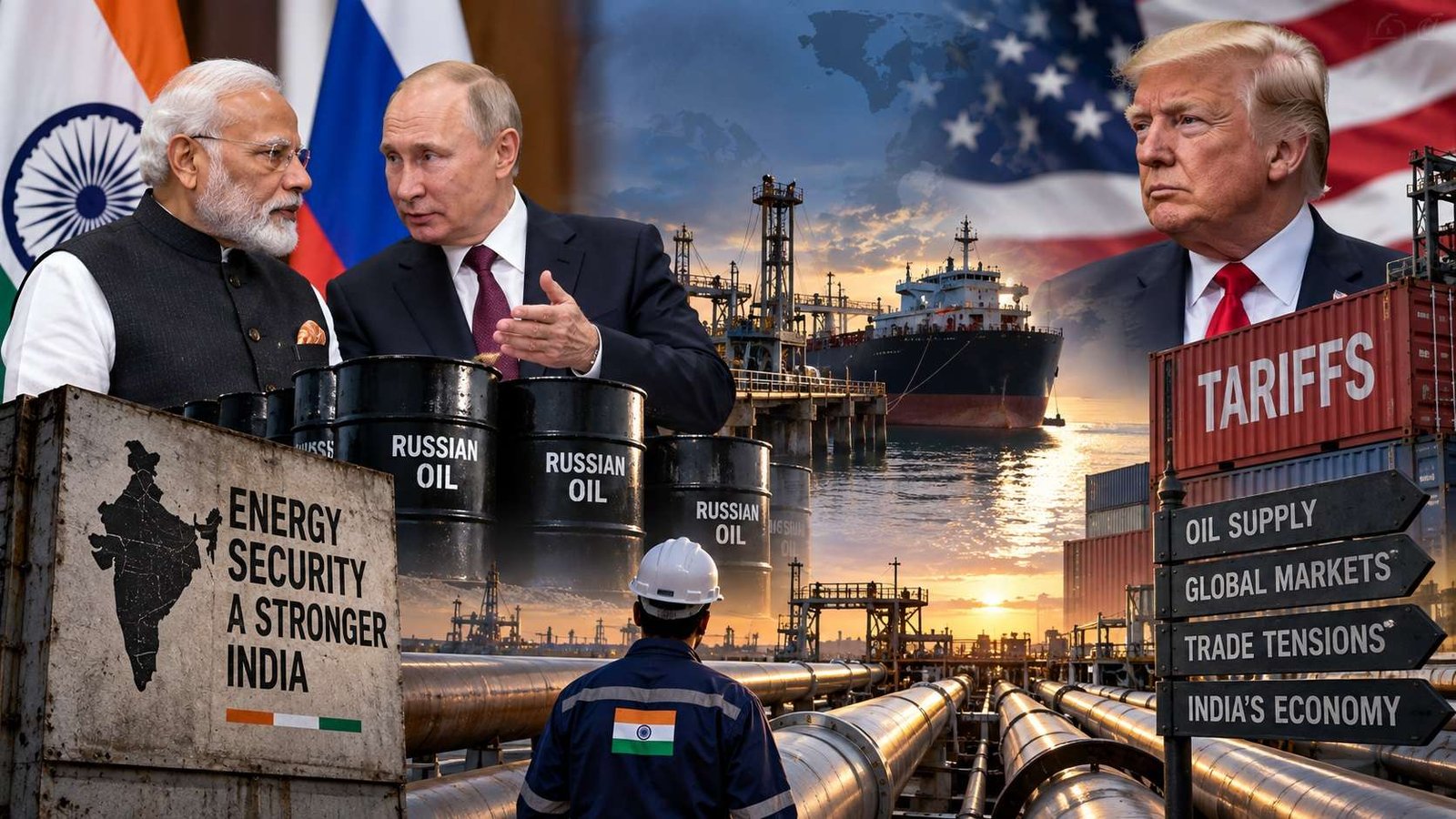
Russian Oil, US Tariffs and India: Why Energy Security Is Becoming a Foreign-Policy Test
For India, crude oil is never just a commodity.
It is transportation, manufacturing, electricity, logistics, inflation and household economics — all rolled into one barrel.
That is why the latest U.S. legislation targeting countries that continue buying Russian oil has created an unusually complicated problem for New Delhi.
The U.S. Congress has approved legislation that would give the American president authority to impose additional tariffs of up to 100% on countries meeting specified conditions related to Russian oil and gas purchases. The House passed the measure on September 16, following Senate approval, and the legislation has been sent to President Donald Trump.
That does not mean India has already been hit with a new 100% tariff.
It means a potentially powerful tariff instrument now exists.
And India is one of the countries most exposed to it.
Why Russian oil matters so much to India
India is the world’s third-largest crude oil importer and has substantially increased its purchases of Russian crude since the disruption of Russia’s traditional European markets following the 2022 invasion of Ukraine.
Reuters reported that Russian crude represented 50.83% of India’s total crude imports in July 2026, equivalent to approximately 2.47 million barrels per day.
That number explains the strategic dilemma.
Russian crude has offered Indian refiners access to a large supply source and, at various points, significant price advantages.
Replacing such a large volume overnight would be difficult.
It would mean turning to alternative suppliers and competing with other major Asian buyers for available barrels.
And this is happening at precisely the wrong time.
The global oil market is already dealing with serious Middle Eastern supply and shipping disruptions.
The timing could hardly be more complicated
Oil markets are currently dealing with disruption around several major energy routes.
The Strait of Hormuz remains under severe pressure, while Saudi Arabia’s East-West Pipeline has also been disrupted.
Saudi Arabia is responding by arranging additional crude movements through Oman’s Sohar port, helping maintain supplies to Asian customers. Reuters reported on September 18 that Saudi Aramco plans substantial Gulf crude exports through ship-to-ship transfers in Oman during September and October, with India among the buyers.
At the same time, tanker traffic through Hormuz remains far below normal levels.
Reuters reported that only four commodity vessels transited the strait on Thursday, compared with a 10-day average of 16.
The result is a global oil market where supply is available — but moving that supply safely and economically has become increasingly difficult.
Now add another variable:
the possibility of U.S. tariffs affecting countries buying Russian oil.
A 100% tariff is a threat, not an automatic bill
This distinction deserves particular attention because headlines can make the situation sound more immediate than it legally is.
The legislation authorizes the U.S. president to impose tariffs of up to 100% on goods from countries that satisfy the conditions specified in the law.
It does not automatically impose a 100% tariff on all Indian exports simply because India buys Russian crude.
That leaves considerable room for diplomacy.
India and the United States can negotiate.
Possible exemptions, quotas, implementation decisions and other policy choices could affect the eventual economic impact.
For businesses, however, even the possibility of such a tariff can create uncertainty.
Companies do not like planning factories, contracts and export strategies around a giant question mark.
Why India is pushing back
Reuters reported that Indian officials have warned Washington that the potential tariffs could strain bilateral relations.
Indian refiners are also urging the government to seek exemptions or quotas, arguing that restrictions could increase crude costs and reduce refinery margins at a time when global supply is already tight.
India’s argument is fundamentally about energy security.
The country has a population of more than 1.4 billion and a rapidly expanding economy. Crude oil demand cannot simply be switched off because a supplier becomes geopolitically inconvenient.
But Washington’s objective is different.
The U.S. legislation is intended to increase economic pressure on Russia over its war in Ukraine by targeting countries that continue buying Russian energy.
That creates a genuine clash of policy priorities.
Washington is looking at the geopolitical consequences of Russian energy revenue.
New Delhi is looking at the physical and economic consequences of keeping India’s economy supplied with fuel.
Both calculations are real.
India’s answer: diversify, don’t panic
India has repeatedly emphasized diversification of energy supplies.
The government said earlier this year that India had been expanding procurement from multiple sources and maintaining inventories to manage disruptions. It has also used alternative procurement routes for LPG and other energy supplies as Middle Eastern disruptions have developed.
That strategy now becomes even more important.
If Russian crude becomes commercially or politically more difficult to access, Indian refiners have alternatives.
But alternatives have a price.
Saudi Arabia, Iraq, the UAE, the United States and other producers can supply India — but global competition for their barrels also matters.
And the current oil market is hardly offering discounts at the checkout counter.
Russian oil isn’t cheap in the same way anymore
One of the most interesting developments is that even the Russian-oil advantage is changing.
Reuters reported on September 18 that Russia’s ESPO Blend had climbed above $120 per barrel, its highest level since April, while Urals crude had risen to around $110. Strong Chinese demand and disruptions to Middle Eastern supply have contributed to the increase.
That creates an unusual situation.
India is facing pressure over buying Russian oil at precisely the moment when Russian crude is itself becoming more expensive.
So the debate is no longer simply:
Russian oil versus expensive Western oil.
The calculation is becoming:
Which combination of suppliers, prices, routes, insurance costs and geopolitical risks gives India the most reliable energy supply?
That is a much harder equation.
The trade relationship adds another layer
Energy is only one side of India’s relationship with the United States.
The United States is also one of India’s most important export markets.
Reuters says the potential tariff threat could complicate already-delayed India-U.S. trade negotiations. Indian Trade Minister Piyush Goyal is expected to meet U.S. Trade Representative Jamieson Greer at the upcoming G20 trade ministers’ meeting.
This creates a two-way dependency.
India needs affordable and reliable energy.
Indian businesses also need access to major overseas markets.
The United States wants stronger pressure on Russia.
And both countries have broader strategic interests in technology, defence, investment and supply-chain cooperation.
None of those interests disappears because of the Russian-oil dispute.
Could India simply stop buying Russian oil?
In theory, India could reduce Russian purchases.
In practice, doing so rapidly would have consequences.
If millions of barrels of Indian demand suddenly moved into the international market, Indian refiners would have to compete with other buyers for replacement crude.
That could push prices higher.
Reuters has previously noted that India’s purchases of Russian crude have helped balance the global market during the Middle East supply disruption.
There is therefore an unusual paradox.
A policy designed to reduce Russian oil revenues could, depending on how it is implemented, also remove barrels from the market and increase prices.
Higher global prices could then increase Russia’s revenue per barrel even as volumes decline.
Energy markets have a habit of making straightforward geopolitical strategies look rather complicated.
What this means for ordinary Indians
The immediate effect for most Indian households is unlikely to be a sudden disappearance of fuel.
India has substantial refining capacity, diversified crude procurement and petroleum-product inventories.
The more important risk is cost.
Higher crude prices can raise the cost of transportation and industrial production. They can also put pressure on the country’s import bill and the rupee.
The rupee was around ₹95.875 per U.S. dollar on September 18, according to Reuters, while oil prices remained above $100 despite some recent easing.
When an oil-importing country pays for more expensive crude in dollars while its currency is under pressure, the arithmetic becomes uncomfortable.
And eventually, arithmetic finds its way into the real economy.
Doonited Editorial Perspective
India’s current predicament illustrates why energy security and foreign policy can no longer be treated as separate subjects.
The country has every reason to diversify its oil sources. It also has a practical interest in maintaining access to competitively priced Russian crude while that remains legally and commercially possible.
At the same time, India’s relationship with the United States is too economically significant to be treated casually.
The sensible policy challenge is therefore not choosing one permanent camp.
It is maintaining maximum supply flexibility while keeping diplomatic channels open.
India’s energy strategy over the coming months may involve more purchases from the Gulf, the United States, Africa and other suppliers, while Russian crude remains part of the mix where permitted.
That is not necessarily indecision.
For a country importing most of its crude, diversification is itself a form of strategic autonomy.
The Doonited Insight
The biggest lesson from the latest U.S.-India-Russia oil dispute is that the cheapest barrel is not always the most important barrel — and the most politically convenient barrel is not necessarily the easiest barrel to replace.
India’s real energy strength will come from having enough suppliers, routes, refining flexibility and diplomatic relationships that no single external decision can determine the country’s energy future.
The coming months will test exactly how resilient that strategy has become.
And for Indian consumers, one thing remains certain:
When geopolitics starts fighting over oil, the first thing everyone watches is the price at the pump.

World Beyond the News
Bees Communicate Where Food Is
Honeybees use movement patterns known as waggle dances to communicate information about food locations.
Street Food Reflects Local History
Many famous street foods developed from migration, trade, local ingredients and the everyday needs of working communities.
A Day on Venus Is Extremely Long
Venus rotates so slowly that one rotation relative to distant stars takes longer than its trip around the Sun.
Human Achievement Continues to Push Limits
Athletes, engineers, scientists and explorers regularly establish new benchmarks in speed, endurance, scale and precision.