
What the Latest Action Means for Indians
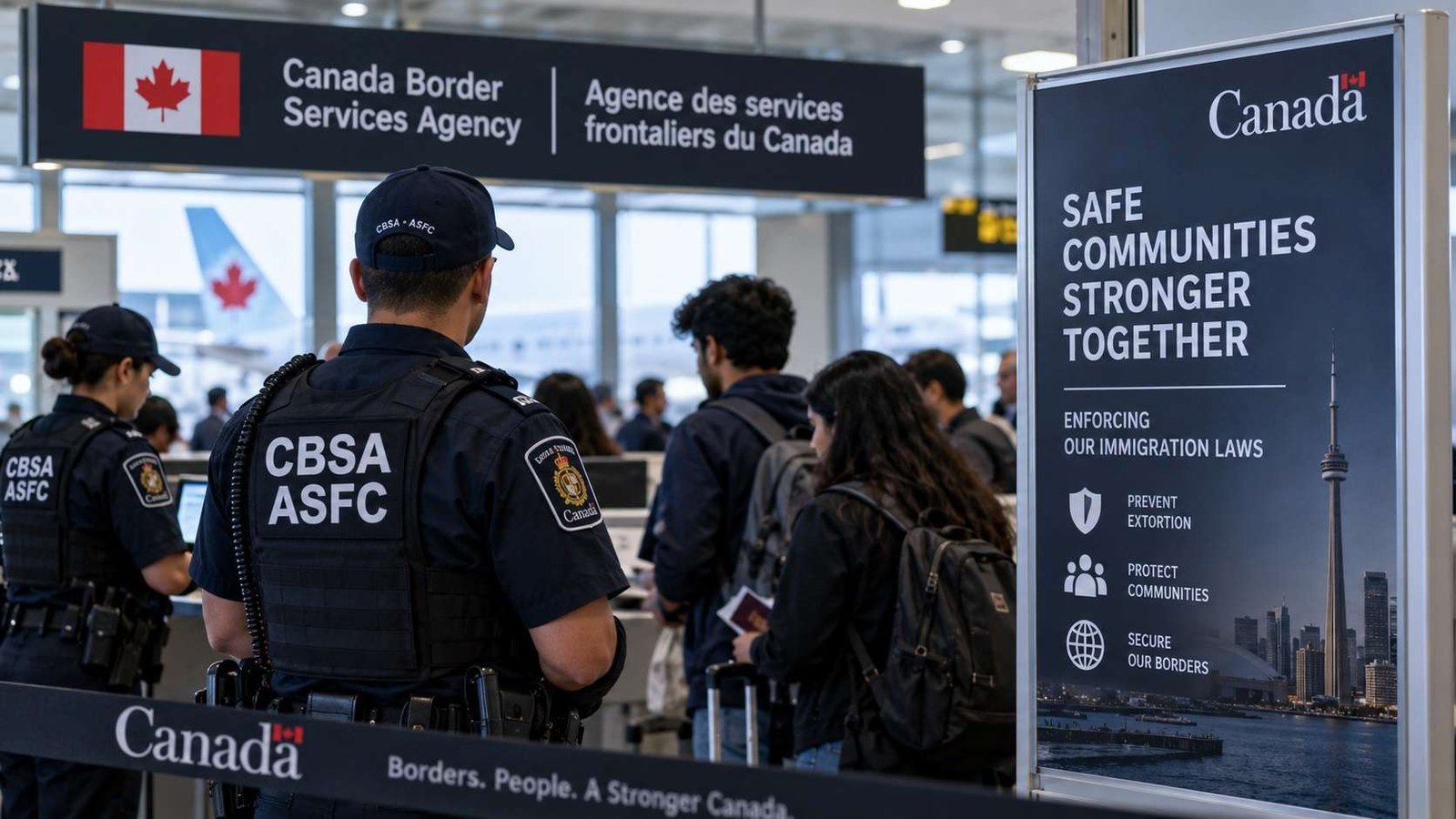
Canada’s campaign against organized crime and extortion has entered a significant new phase, with the Canada Border Services Agency (CBSA) confirming that 111 individuals have been removed from the country as part of an enforcement effort targeting foreign nationals linked to extortion and organized criminal activity.
As of September 3, the agency had issued 188 removal orders under the initiative. The latest update, released September 14, also detailed four recent cases involving foreign nationals of Indian origin: Palwinder Singh, Jasmer Singh, Amitoz Bajwa and Sahibjot Singh.
The figures are significant not simply because they involve Indian nationals.
They reveal something larger about Canada’s approach to a growing public-safety problem: immigration enforcement is increasingly being used alongside police investigations to disrupt criminal networks.
And for India’s large community in Canada, there is another important message.
A person’s nationality should not become confused with the behaviour of a criminal network.
That distinction matters.
111 removals—and 188 orders
According to the CBSA, as of September 3, 188 removal orders had been issued on various inadmissibility grounds and 111 people had actually been removed.
The regional breakdown is revealing:
- Pacific Region: 91 removal orders, 58 removals
- Prairie Region: 47 removal orders, 30 removals
- Greater Toronto Area: 50 removal orders, 23 removals
The numbers show that the issue is not confined to one Canadian city.
British Columbia and the Lower Mainland have received particular attention because of extortion-related violence, while enforcement has also expanded into the Prairies and the Greater Toronto Area.
The CBSA began enhanced tracking of immigration cases potentially connected with extortion in the Pacific and Prairie regions in August 2025. The initiative was subsequently expanded to the GTA in November 2025.
So this is not a sudden September exercise.
It is the latest stage of a campaign that has been developing for more than a year.

Who were the four latest deportees?
The CBSA’s own account provides important details.
Palwinder Singh was linked to an extortion-related shooting in autumn 2025. The Immigration and Refugee Board found him inadmissible under Canada’s Immigration and Refugee Protection Act (IRPA) for membership in a criminal organisation linked to extortion-related violence. He was subsequently removed.
Jasmer Singh had been convicted in Canada of forcible confinement. He was found inadmissible for serious criminality, received a deportation order and was removed.
Amitoz Bajwa was found inadmissible for membership in an organisation engaged in a pattern of criminal activity. The CBSA also linked him to firearms-related activity and an extortion-related shooting.
Sahibjot Singh was found inadmissible after being linked to an organisation engaged in a pattern of criminal activity. According to the CBSA, he acknowledged committing offences forming part of that organisation’s pattern of criminal activity. He was subsequently removed.
These are therefore not cases in which nationality itself was the stated reason for removal.
The legal grounds were connected to criminality and inadmissibility under Canadian immigration law.
That distinction should remain at the centre of responsible reporting.
Why extortion has become such a serious issue
Extortion is particularly damaging because it attacks people where they are most economically vulnerable.
A business owner receives a threat.
A family becomes frightened.
A community begins wondering whether reporting the crime will make matters worse.
Criminal networks can exploit fear without needing to control an entire neighbourhood.
Canadian authorities have increasingly connected extortion investigations with organised criminal networks and violence, including shootings and other intimidation tactics. The CBSA says it works with police and other agencies to identify foreign nationals who may be inadmissible because of criminal or organised-crime activity.
That cooperation is important.
Police investigate crime.
Immigration authorities determine immigration consequences.
Courts and tribunals apply the relevant legal processes.
No single agency can solve the entire problem by itself.
 The Indian connection needs careful handling
Canada has a very large Indian-origin population, and Indians are also a major group among Canada’s international students and temporary residents.
That makes stories involving Indian nationals particularly sensitive.
The wrong headline can quickly turn an organised-crime story into a story about an entire community.
That would be both unfair and factually inaccurate.
The CBSA’s September 14 announcement concerns foreign nationals found inadmissible under Canadian law in cases associated with an enforcement initiative targeting extortion and organised criminal activity. It does not establish that Indian immigrants generally are responsible for Canada’s extortion problem.
That distinction is not political correctness.
It is basic journalism.
The student angle deserves attention
There is another reason Indian families should pay attention.
The CBSA has previously identified cases in which people entered Canada on temporary status, including study permits, and subsequently became subjects of organised-crime investigations.
In one case detailed by CBSA earlier this year, Arshdeep Singh entered Canada on a study permit in 2022. The agency said he was later found inadmissible for membership in a criminal organisation linked to extortion, arson, drug trafficking and firearms offences, and he was removed in January 2026 following the relevant proceedings.
The lesson for students and families is straightforward:
A Canadian study permit is permission to study—not protection from criminal law.
Choosing Canada for education, employment or immigration is a legitimate pathway for millions of people.
But immigration status comes with responsibilities.
Associating with criminal organisations, participating in violence, facilitating extortion or committing serious offences can have consequences that extend well beyond a criminal investigation.

A crackdown that is about more than deportation
It would be easy to look at the number 111 and conclude that the story is simply about deportations.
It isn’t.
The Canadian government says the CBSA has been working with police partners to identify people potentially involved in extortion networks, investigate their immigration status and remove those found legally inadmissible.
That approach attempts to close a loophole that organised criminals might otherwise exploit.
If someone is convicted or found legally inadmissible, serving a sentence—or completing a criminal proceeding—does not necessarily mean they automatically retain the right to remain in Canada.
Immigration consequences can follow.
The government says the CBSA removed 23,160 inadmissible people in 2025, including 1,010 cases involving serious inadmissibility for categories including serious criminality and organised crime.
It is therefore important to put the 111 figure in context.
This is a targeted enforcement initiative, not a measure of all Indian deportations from Canada.
The DOONITED Editorial View
There is a legitimate public-safety argument for Canada’s tougher approach.
A country has both the right and responsibility to investigate organised crime and remove foreign nationals who are legally determined to be inadmissible.
At the same time, enforcement must remain evidence-based, individualised and subject to due process.
That is the standard that protects everyone—including innocent members of the same ethnic community.
The bigger concern is not that Canada is deporting people found to be involved in serious criminal activity.
The bigger concern would be if the public conversation allowed “Indian,” “Punjabi,” “student” or “immigrant” to become shorthand for “criminal.”
That would give criminal networks an extraordinary victory: they would damage not only their victims but also the reputation of an entire community.
There is also a slightly uncomfortable irony here.
Many young Indians travel thousands of kilometres to Canada with a university admission letter, a suitcase and an ambitious plan for a better career.
Criminal networks offer a very different kind of “career path.”
The first requires tuition, exams and patience.
The second eventually tends to involve police, lawyers and deportation orders.
The choice should not be difficult.
What Indian students and families should learn
For Indians planning to study or work in Canada, the latest crackdown offers several practical lessons:
First: verify immigration and education arrangements through legitimate institutions.
Second: understand the conditions attached to your immigration status.
Third: stay away from criminal networks, illegal financial activity and people offering apparently easy money through intimidation, drugs, weapons or fraud.
Fourth: do not assume that temporary status protects someone from Canadian criminal or immigration enforcement.
And finally: do not judge Canada’s Indian community through the actions of individuals involved in criminal cases.
The overwhelming majority of Indian students, professionals, families and entrepreneurs in Canada are there for education, employment, business and family life.
Their story should not be rewritten by the behaviour of criminal networks.
The larger lesson
Canada’s latest enforcement figures demonstrate that organised crime increasingly crosses borders—and so must law enforcement.
The 111 removals, 188 removal orders and four latest cases are part of a broader Canadian effort to disrupt extortion networks through cooperation between police, immigration authorities and other agencies.
For India, the lesson is equally relevant.
Transnational crime does not stop at the airport departure gate.
Neither should cooperation between countries.
But effective enforcement must remain precise: identify the individual, establish the evidence, follow due process and act under the law.
That is how a crackdown protects communities without unfairly turning an entire community into a suspect.
And that may be the most important message behind Canada’s latest 111-removal milestone.

World Beyond the News
Birds Can Navigate Using Earth’s Magnetic Field
Several bird species can sense Earth’s magnetic field, helping them navigate during long-distance migration.
Fermentation Is a Global Food Tradition
People across continents have used fermentation for centuries to preserve food and create distinctive flavours.
Modern Batteries Store Energy Chemically
Rechargeable batteries repeatedly move ions between electrodes, allowing electrical energy to be stored and released.
Why Songs Become Global Hits
Streaming platforms, short-form video, playlists and international collaborations can rapidly carry music across borders.