
When Ganga Aarti Reached the Thames: London Witnesses a Historic Indian Cultural Moment
For centuries, the evening glow of oil lamps on the banks of the Ganga has been one of India’s most recognisable expressions of faith, gratitude and reverence for nature. On Sunday, September 13, that tradition acquired a distinctly London setting.
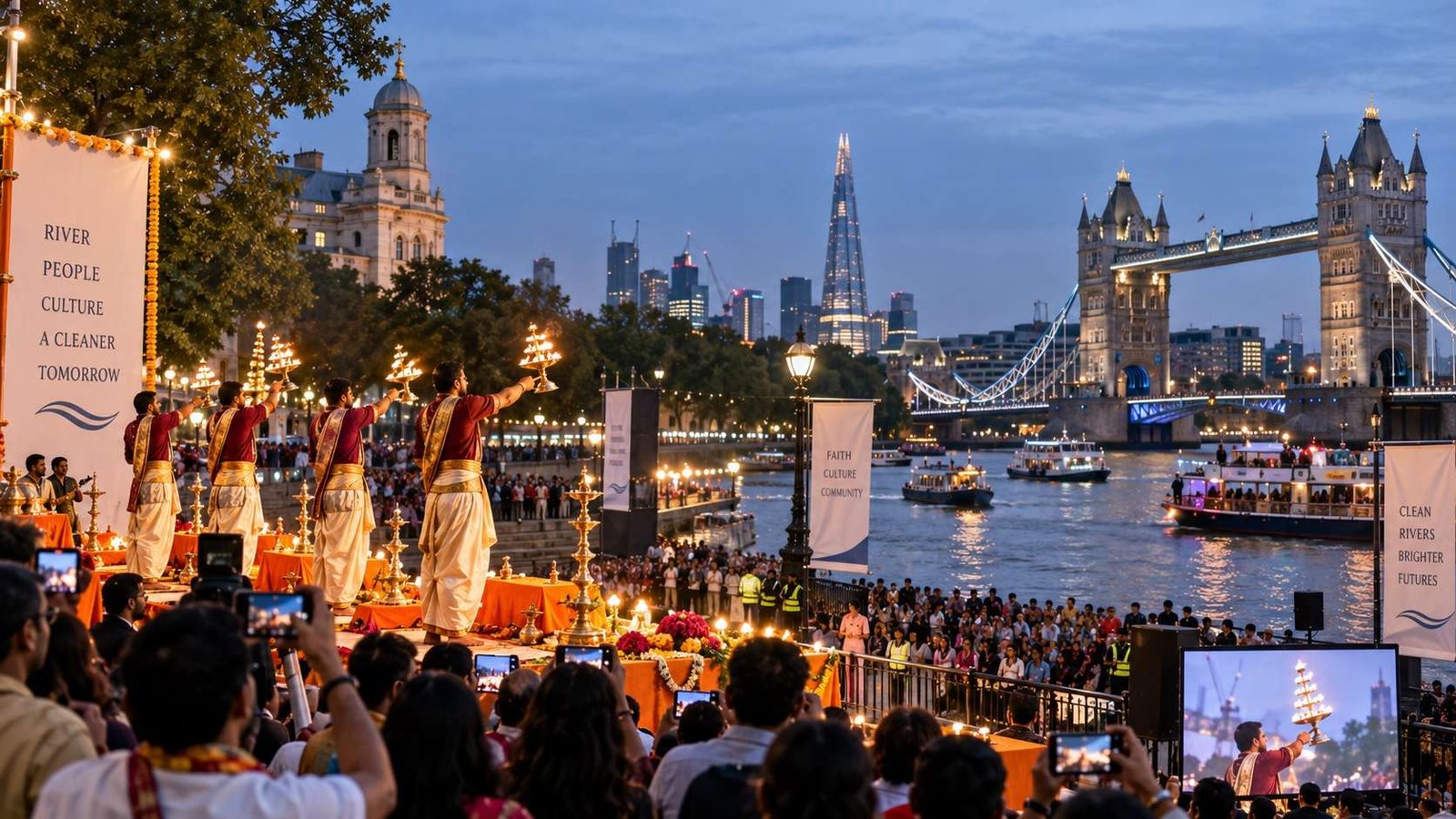
Thousands of people gathered beside the River Thames at Greenwich for what organisers described as the first-ever Ganga Aarti on the Thames. Held at the historic Old Royal Naval College, the event brought an ancient Indian ritual of light to one of Britain’s most important riverside landmarks.
The event was organised by Chinmaya Mission UK in collaboration with the Totally Thames Festival, as part of celebrations marking 75 years of the Chinmaya Mission.
And there was an interesting twist to the story: while the ceremony celebrated a tradition associated with India’s sacred Ganga, the organisers were careful not to treat the Thames as a ceremonial dumping ground.
That may ultimately be the most important part of the story.
From the Ganga to Greenwich
The programme began at around 4 pm with an afternoon of Indian culture, including food, community stalls, music, dance, family activities and exhibitions. The main spiritual programme followed later, with an explanation of the significance of the Ganga Aarti before the ceremony itself at approximately 7:15 pm.
The setting was particularly striking.
The Old Royal Naval College stands directly beside the Thames in Greenwich, within the Maritime Greenwich UNESCO World Heritage Site. Its grand architecture provided a very different backdrop from the ghats of Varanasi or Haridwar.
Yet the basic visual language of the ritual remained familiar: lamps, chanting, music and an evening gathering beside a river.
According to the organisers, the ceremony was intended not simply as a religious performance but as an expression of gratitude towards nature, life, knowledge and consciousness. People from different backgrounds were invited to attend.
That distinction matters.
This was not an attempt to reproduce Varanasi in London brick by brick. It was an attempt to carry the meaning of a tradition into a different cultural and geographical environment.
A 75-year milestone with an Indian connection
The event formed part of the Chinmaya Mission’s global celebrations marking its 75th anniversary.
Founded in 1951 under the inspiration of Swami Chinmayananda, the Chinmaya Mission has developed into an international organisation centred on Vedanta, education, culture and service. India Today reports that it now has more than 350 locations worldwide.
The London event therefore had two dimensions.
One was spiritual.
The other was cultural.
For Britain’s Indian and South Asian communities, events like this offer a way of maintaining connections with traditions that originated thousands of kilometres away. For younger generations born or raised outside India, such occasions can also become a living classroom—one where culture is experienced rather than simply explained in a textbook.
And there was no shortage of atmosphere.
Imagine the Thames at dusk, historic British architecture in the background, Indian music and chanting in the air, and ceremonial lamps illuminating the riverbank.
London has seen some unusual evenings.
This was certainly one of them.
The Thames was worshipped—but not polluted
Perhaps the most constructive element of the ceremony was its environmental approach.
The organisers conducted the Aarti entirely on land. Nothing was placed, poured or released into the Thames. The ceremonial lamps remained on the riverbank rather than being floated on the water, while the event also incorporated measures intended to reduce waste and single-use plastics.
That decision deserves attention beyond the event itself.
Religious traditions often contain practices developed in very different environmental circumstances from those of modern cities. When traditions travel internationally, communities sometimes face a practical question: How do you preserve the spirit of a ritual while adapting its physical form responsibly?
London’s Ganga Aarti offered one possible answer.
The ritual did not need to involve putting flowers, lamps or other offerings into the river for its spiritual message to remain meaningful.
In fact, the opposite argument can be made: if the underlying message is gratitude towards nature, protecting the river becomes part of the ritual’s meaning.
That is a useful lesson not only for Indian communities overseas but also for religious and cultural festivals in India.
Two rivers, but not the same river
There is also an important distinction worth making.
The Thames is not the Ganga, and Greenwich is not Varanasi.
The ceremony did not transform the Thames into a sacred Indian river, nor does performing Ganga Aarti beside another river erase the geographical and religious significance of the Ganga in India.
What travelled to London was the tradition and its symbolism.
That is precisely what makes the event interesting.
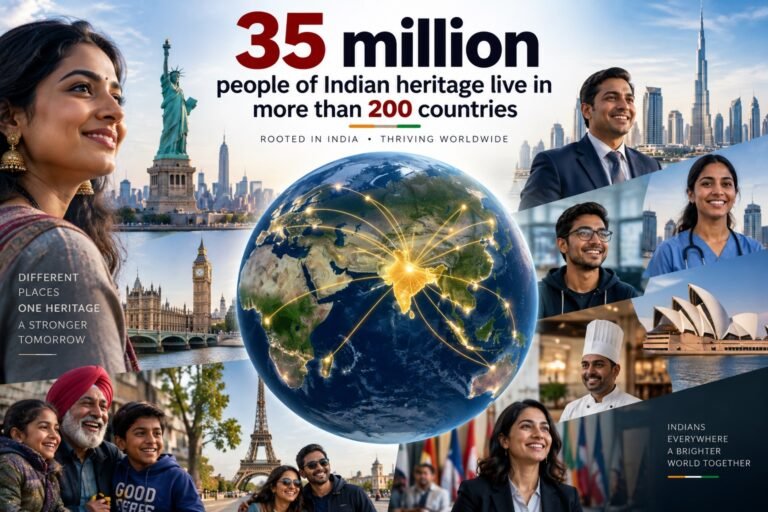
Indian culture has never remained confined to India’s borders. Food, music, yoga, festivals, language and religious traditions have travelled with generations of Indians who built lives abroad.
The London ceremony is another example of that continuing cultural journey.
And perhaps there is a little humour in the geography of it all: India has been exporting chai, Bollywood and yoga to the world for decades. Now even the Thames has received an evening invitation from the Ganga.
The DOONITED Editorial View: Tradition must travel intelligently
The most interesting lesson from the Thames ceremony is not that an Indian ritual was performed in London.
That, by itself, is hardly surprising in a multicultural city.
The more significant question is how the tradition travelled.
The organisers retained the essential spiritual character of the Aarti while modifying its environmental footprint. That is a sensible model for cultural preservation in the 21st century.
Tradition does not necessarily become weaker when its external form changes.
Sometimes it becomes stronger—because the community demonstrates that it understands the principle behind the ritual rather than merely repeating the physical procedure.
The decision not to put offerings into the Thames is therefore more than an environmental precaution. It creates a useful bridge between faith and responsibility.
A river can be honoured with prayer.
It can also be honoured by keeping it clean.
Ideally, the two should never be separated.
Why this matters to India
For India, the London Ganga Aarti is a small but meaningful example of the country’s cultural influence overseas.
It shows how Indian traditions can become part of international cultural life without losing their Indian identity.
It also highlights the role played by diaspora communities in keeping heritage alive.
But there is an important responsibility attached to that role.
When Indian culture is presented abroad, it should not become merely decorative—saffron clothing, lamps, music and photographs for social media. The deeper values behind the traditions deserve equal attention.
In Greenwich, the organisers attempted to connect the ceremony with gratitude, unity and environmental responsibility.
That gives the event a relevance extending beyond one evening in London.
The larger takeaway
The first Ganga Aarti on the Thames will probably be remembered for its striking imagery: Indian lamps glowing beside one of Britain’s great rivers, with the Old Royal Naval College providing an extraordinary backdrop.
But the lasting value of the event may lie elsewhere.
It demonstrated that cultural traditions can cross borders without becoming fossilised—and that preserving tradition does not mean ignoring the world in which that tradition is being practised.
The Ganga remains the Ganga.
The Thames remains the Thames.
But on one September evening in London, the two became part of the same cultural conversation: how humanity relates to rivers, memory, faith and nature.
And that is a story considerably bigger than the ceremony itself.

World Beyond the News
Birds Can Navigate Using Earth’s Magnetic Field
Several bird species can sense Earth’s magnetic field, helping them navigate during long-distance migration.
Fermentation Is a Global Food Tradition
People across continents have used fermentation for centuries to preserve food and create distinctive flavours.
Modern Batteries Store Energy Chemically
Rechargeable batteries repeatedly move ions between electrodes, allowing electrical energy to be stored and released.
Why Songs Become Global Hits
Streaming platforms, short-form video, playlists and international collaborations can rapidly carry music across borders.