
Ram M. Pendyala: Indian-Origin Transportation Expert Honoured for Three Decades of Service in the United States
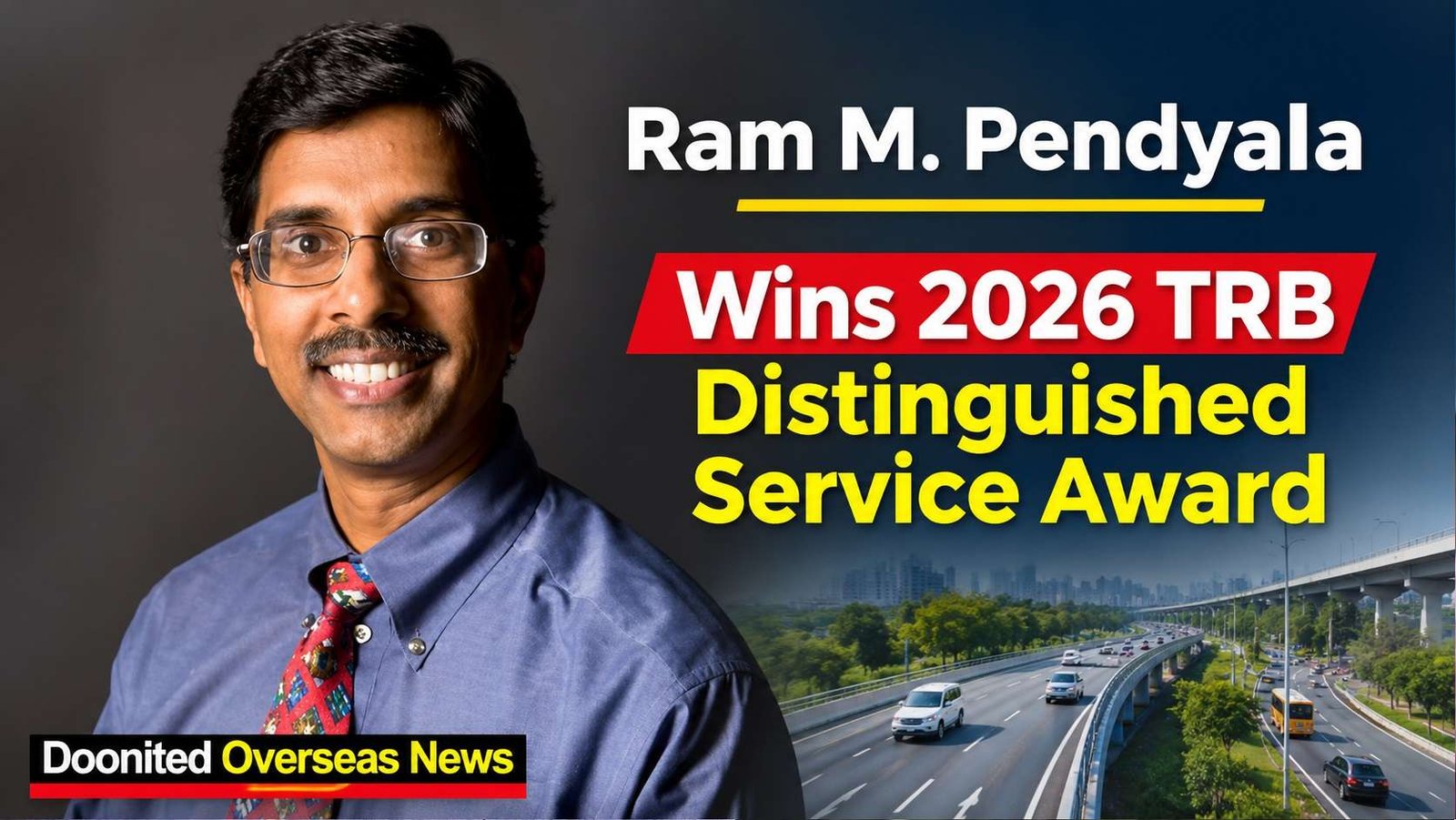
An Indian-born engineering graduate who went on to become a prominent figure in American transportation research is receiving one of the Transportation Research Board’s (TRB) distinguished honours. Ram M. Pendyala, professor and director at Arizona State University (ASU), has been named the 2026 recipient of the W.N. Carey, Jr., Transportation Research Board Distinguished Service Award.
The recognition reflects more than three decades of contributions to the Transportation Research Board, including leadership across its technical committees and research groups. The award is scheduled to be presented on January 13, 2027, during the TRB Annual Meeting in Washington, D.C.
For the Indian diaspora, Pendyala’s career is another example of an Indian engineering education serving as a foundation for international academic and professional leadership. But his significance extends beyond his personal achievement: his research addresses a fundamental challenge shared by cities and countries worldwide—how to plan transport systems around the way people actually live and travel.
From IIT Madras to American research leadership
Pendyala completed his Bachelor of Technology in Civil Engineering at the Indian Institute of Technology Madras in 1988. He subsequently earned a master’s degree in 1990 and a PhD in 1992 in Civil and Environmental Engineering, specialising in transportation systems, from the University of California, Davis.
His academic career began in the United States, with faculty positions at the University of Louisiana at Lafayette and the University of South Florida. He joined Arizona State University in 2006, later serving as the Frederick R. Dickerson Chair Professor of Transportation at the Georgia Institute of Technology between 2014 and 2016.
At ASU, he is a professor and director of the School of Sustainable Engineering and the Built Environment. He also directs TOMNET, a University Transportation Center focused on improving the understanding and forecasting of mobility choices through data analytics and behavioural science.
His professional journey illustrates a route taken by many internationally mobile Indian academics: education in India, advanced research training overseas, and a long-term contribution to institutions and professional networks in the country where they build their careers.
Why transportation research needs to understand people
Transport planning is often associated with roads, bridges, railways, airports and public transport infrastructure. But building more infrastructure does not automatically produce a more efficient mobility system. Planners also need to understand why people travel, when they travel, which modes they choose and how those choices change with employment patterns, technology, household circumstances and urban development.
This is central to Pendyala’s research.
His work covers activity-travel behaviour modelling, transportation demand forecasting, travel surveys, multimodal transport planning and the analysis of mobility choices. Activity-based approaches look beyond individual journeys to examine how travel is connected to people’s daily activities, time use and lifestyles.
For example, a person’s decision to use public transport, drive, cycle or work remotely may depend on several connected factors: the location of employment, household responsibilities, access to services, travel costs and the availability of alternatives. Understanding these relationships can help authorities assess the likely consequences of transport policies and infrastructure investments.
Pendyala’s research also examines emerging areas such as ride-hailing, shared mobility, autonomous vehicles, e-commerce and information technologies. These developments are changing both passenger travel and the movement of goods, creating new demands on transport planning.
Three decades of service to the Transportation Research Board
The TRB Distinguished Service Award recognises exemplary leadership and sustained contributions to the organisation. Pendyala has served in several significant positions, including chair of the Standing Technical Committee on Traveler Behavior and Values, the Travel Analysis Methods Section and the Planning and Environment Group.
He has also contributed to research panels and programmes associated with the National Cooperative Highway Research Program, the Transit Cooperative Research Program and the Second Strategic Highway Research Program.
The official award citation highlights his role in translating scientific advances into practical methods, tools and guidance used by transportation professionals in the United States and internationally.
His contribution to research dissemination has also been substantial. The TRB announcement records 80 papers published in Transportation Research Record. Across his wider academic career, it lists 175 refereed journal publications, 103 refereed conference papers, 32 book chapters and articles, and 117 technical reports.
These figures demonstrate the scale of his research activity, but the award is particularly about sustained service: helping professional communities share knowledge, establish research priorities and connect academic findings with the needs of transport agencies.
Building the next generation of researchers
Pendyala’s influence also includes mentoring and institution-building. The TRB announcement says he has advised 24 doctoral students, mentored 49 master’s students and served on more than 100 graduate committees.
He has also directed TOMNET, an $8.4 million University Transportation Center consortium that completed more than 60 research projects, delivered over 50 practitioner webinars and produced analytical tools and dashboards.
Such work matters because transportation systems are changing rapidly. Researchers and practitioners need to understand new technologies, assess their limitations and evaluate whether proposed solutions improve accessibility, safety, efficiency and affordability.
The development of young researchers is therefore not a peripheral academic activity. It helps determine whether the next generation of transport professionals will have the technical and analytical skills needed to address increasingly complex mobility challenges.
Why his achievement matters beyond the United States
Pendyala’s award is primarily recognition of his service to an American research institution. It should not be interpreted as an award for a specific transport project in India, nor does it establish that his research has directly changed transport policy in any particular country.
Nevertheless, the issues he studies have international relevance. Cities across the world are dealing with congestion, changing commuting patterns, public transport access, urban expansion, freight demand and the consequences of new mobility technologies.
For overseas Indians, his achievement also offers a wider professional story. Indian-trained specialists continue to contribute to research, universities and professional institutions in different parts of the world. Their work can strengthen international knowledge networks and create opportunities for academic exchange and collaboration.
The next challenge for transportation research is to ensure that sophisticated forecasting and modelling lead to practical improvements for ordinary travellers. Better data and technology are useful only when they help authorities make informed decisions and deliver transport systems that are accessible, reliable and affordable.
Ram M. Pendyala’s 2026 recognition celebrates a career devoted to that connection between research, professional service and practical application. His journey—from IIT Madras to a leadership position at Arizona State University—also underlines the growing international reach of Indian engineering talent.

World Beyond the News
Bees Communicate Where Food Is
Honeybees use movement patterns known as waggle dances to communicate information about food locations.
Street Food Reflects Local History
Many famous street foods developed from migration, trade, local ingredients and the everyday needs of working communities.
A Day on Venus Is Extremely Long
Venus rotates so slowly that one rotation relative to distant stars takes longer than its trip around the Sun.
Human Achievement Continues to Push Limits
Athletes, engineers, scientists and explorers regularly establish new benchmarks in speed, endurance, scale and precision.