

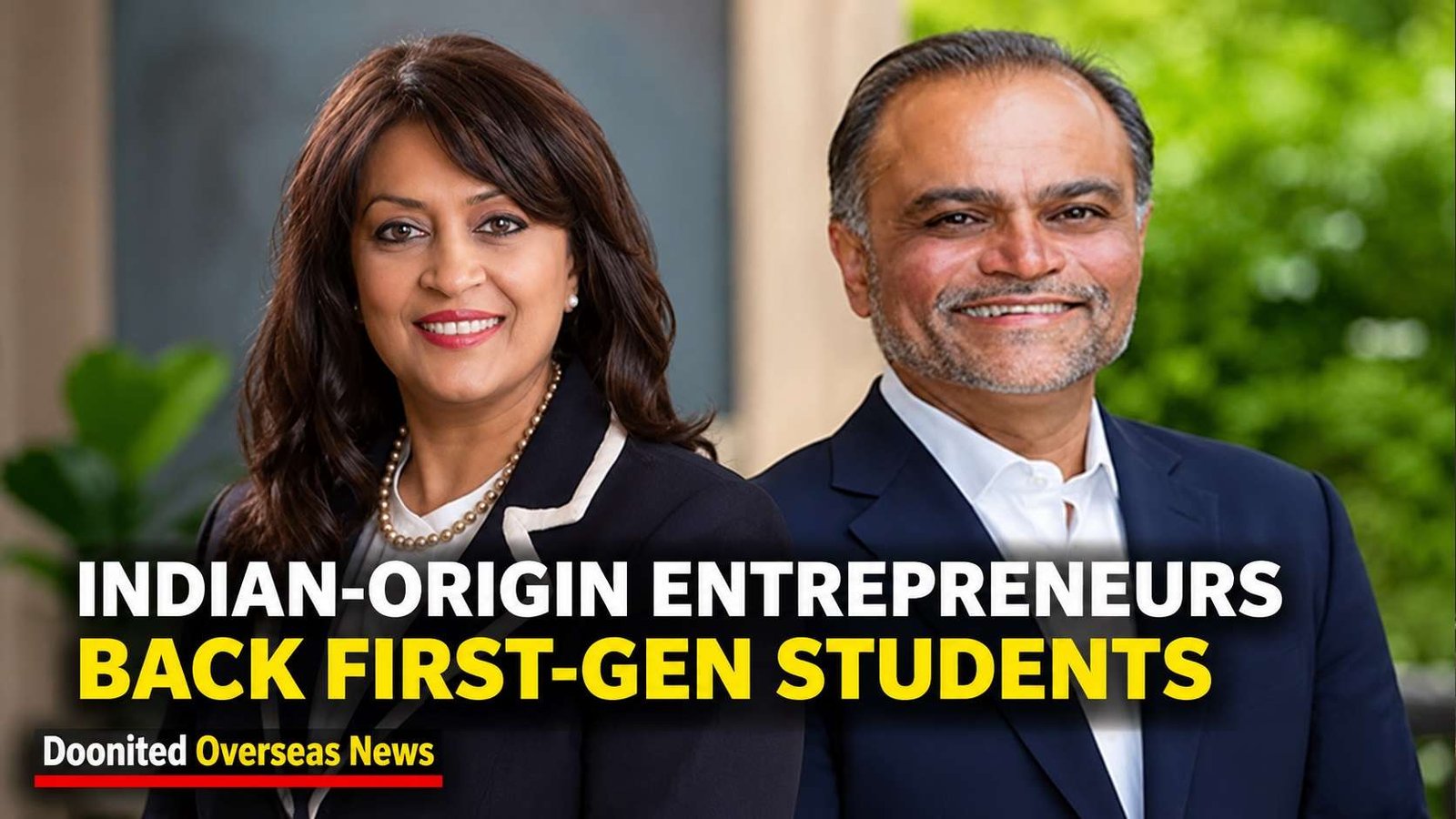
Lata Krishnan and Ajay Shah: The Indian-Origin Silicon Valley Couple Turning Business Success into Educational Opportunity
Their journey from technology entrepreneurship to philanthropy offers a wider lesson about diaspora success: wealth can create opportunities not only for the next generation of business leaders, but also for students who might otherwise struggle to enter college.
Success in Silicon Valley is often measured through company valuations, public listings and investment returns. For Indian-origin entrepreneurs Lata Krishnan and Ajay Shah, however, another measure has become increasingly important: the number of young people who receive an opportunity to pursue higher education because financial circumstances do not stand in their way.
The couple, who built their business careers in the United States, established the Krishnan-Shah Family Scholarship in partnership with the Silicon Valley Community Foundation (SVCF). The programme provides selected students with up to $10,000 annually for four years — a potential total of $40,000 towards an undergraduate education.
According to SVCF’s published donor account, the programme had supported more than 45 students from disadvantaged backgrounds by the time of its 2023–24 annual review. The initiative is not simply a one-time financial award: its stated purpose is to provide sustained support that helps students complete their degrees.
Their story is relevant to the Indian diaspora not only because of their Indian heritage, but also because it illustrates how entrepreneurial experience, family philanthropy and community institutions can be combined to address educational inequality.
From entrepreneurial beginnings to Silicon Valley
Krishnan and Shah’s professional journey reflects the international character of the Indian-origin business community. Both have Indian heritage, but their early lives were shaped by different countries: Shah was born in Uganda, while Krishnan grew up in Kenya.
Their careers eventually brought them into the American technology and finance ecosystem. In 1989, they co-founded Smart Modular Technologies, a company that became a significant player in the technology hardware sector. Shah Capital Partners’ account describes the business as having grown to more than $1 billion in revenue.
Their experience was not limited to building a company. The couple later became involved in investment and private equity, including the development of a technology-focused investment business associated with Silver Lake Sumeru.
Krishnan developed a parallel career in finance, technology investment and corporate governance. She has served in leadership roles in philanthropic and civic organisations, including the American India Foundation (AIF). Shah has also held senior business and board positions, while maintaining involvement in educational and nonprofit initiatives.
Their professional success gave them financial resources, but their philanthropy appears to have been shaped by a broader understanding of education as a source of independence and opportunity.
A scholarship designed to remove financial barriers
The Krishnan-Shah Family Scholarship is administered through the Silicon Valley Community Foundation, which works with donors to manage charitable funds and scholarship programmes.
The official programme page states that selected recipients can receive up to $40,000 over four years, at a rate of up to $10,000 annually. The support is intended for students who demonstrate academic promise, community involvement and financial need.
Its eligibility rules are specific.
Applicants must be graduating high-school seniors living in the greater Silicon Valley region — Santa Clara, San Mateo, San Francisco, Alameda or Santa Cruz counties — or current community-college students who graduated from a high school in one of those counties.
They must also be first-generation college students, meaning neither parent has earned a four-year college degree. Applicants must be pursuing their first undergraduate degree, plan to attend a four-year college or university full-time, have a cumulative GPA no higher than 3.75 on a 4.0 scale, demonstrate involvement in activities and establish financial need or hardship.
This is an important distinction. The scholarship is not a general award for all Indian-origin students, nor is it available to applicants simply because they are members of the diaspora. Its geographical and educational criteria are designed to reach a defined group of students facing barriers to higher education.
SVCF’s 2023–24 donor account also describes the couple’s personal involvement in candidate interviews. That engagement suggests a philanthropic approach that goes beyond transferring funds: the donors take an interest in the students and the decisions that shape their educational futures.
The wider vision: education, healthcare and economic mobility
The scholarship is one part of a much broader philanthropic portfolio.
Lata Krishnan is the founder, former president and current co-chair of the American India Foundation, an organisation focused on improving the lives of underserved communities in India, particularly women, children and young people.
The couple’s support for AIF includes a reported $5 million commitment to its Fellowship programme announced in 2021. Their work therefore connects two different philanthropic priorities: supporting educational opportunity in the United States and contributing to development initiatives in India.
They have also supported Eastside Prep and Downtown College Prep, organisations that help disadvantaged students prepare for four-year college programmes. In higher education and medical research, they have backed advanced scientific work, including support for a professorship in cancer therapeutics at Stanford.
Economic mobility is another important theme. Krishnan serves on the board of Accion Opportunity Fund, which works to support small-business owners, including women and people from low-income communities, through financial services, knowledge, networks and policy initiatives.
The breadth of these activities shows that their philanthropy is not confined to scholarships. It spans education, healthcare, entrepreneurship and the capacity of individuals and communities to become economically independent.
What their example means for the Indian diaspora
Indian-origin professionals and entrepreneurs have become prominent across technology, finance, healthcare and academia in the United States. Their influence is often discussed through corporate leadership, investment and innovation. Philanthropy provides another way to understand the diaspora’s contribution.
The Krishnan-Shah example demonstrates how success in one country can support opportunities in another — and how community-focused giving can also address inequality within the country where a family has built its business.
It also raises an important question for diaspora philanthropy: should charitable giving focus on the number of people reached, or on the depth and continuity of support?
A scholarship that helps a student remain in college for four years may have a different impact from a one-time grant. Sustained financial assistance can help reduce the risk that a promising student leaves higher education because of an unexpected financial difficulty. That is the logic behind the programme’s multi-year structure.
However, scholarships alone cannot solve the larger affordability challenge. Students may still face living costs, transport, books, healthcare expenses and other financial pressures. The effectiveness of any award depends partly on whether it works alongside other forms of institutional and community support.
For families considering charitable giving, the broader lesson is to build programmes around clearly defined needs, transparent eligibility and long-term outcomes — rather than relying only on headline donation figures.
A legacy measured in opportunities
Lata Krishnan and Ajay Shah’s journey connects entrepreneurship with a sustained commitment to education and economic empowerment. Their scholarship programme has created a route into higher education for students who demonstrate ability but face financial constraints.
Their work also reflects a wider dimension of the Indian diaspora: the ability to build professional and financial success across borders while remaining engaged with communities and causes beyond one’s immediate surroundings.
For the students receiving support, the significance of the scholarship is practical. It can help make a four-year college education more attainable. For the diaspora, the larger message is that achievement need not end with business success. It can also be measured by the opportunities created for people who have not yet had the same starting point.

World Beyond the News
Why Elephants Stay Close to Their Herd
Elephants live in highly social family groups and use calls, touch and body movements to maintain strong bonds.
Most of the Deep Ocean Remains Difficult to Explore
Extreme pressure, darkness and distance make deep-ocean exploration one of Earth’s greatest scientific challenges.
Spacecraft Can Travel Without Traditional Roads
Spacecraft use carefully calculated trajectories and gravity assists to travel enormous distances through space.
Why Movie Trailers Are Released in Stages
Major films often use teaser trailers, full trailers and final promotional spots to build awareness over time.