
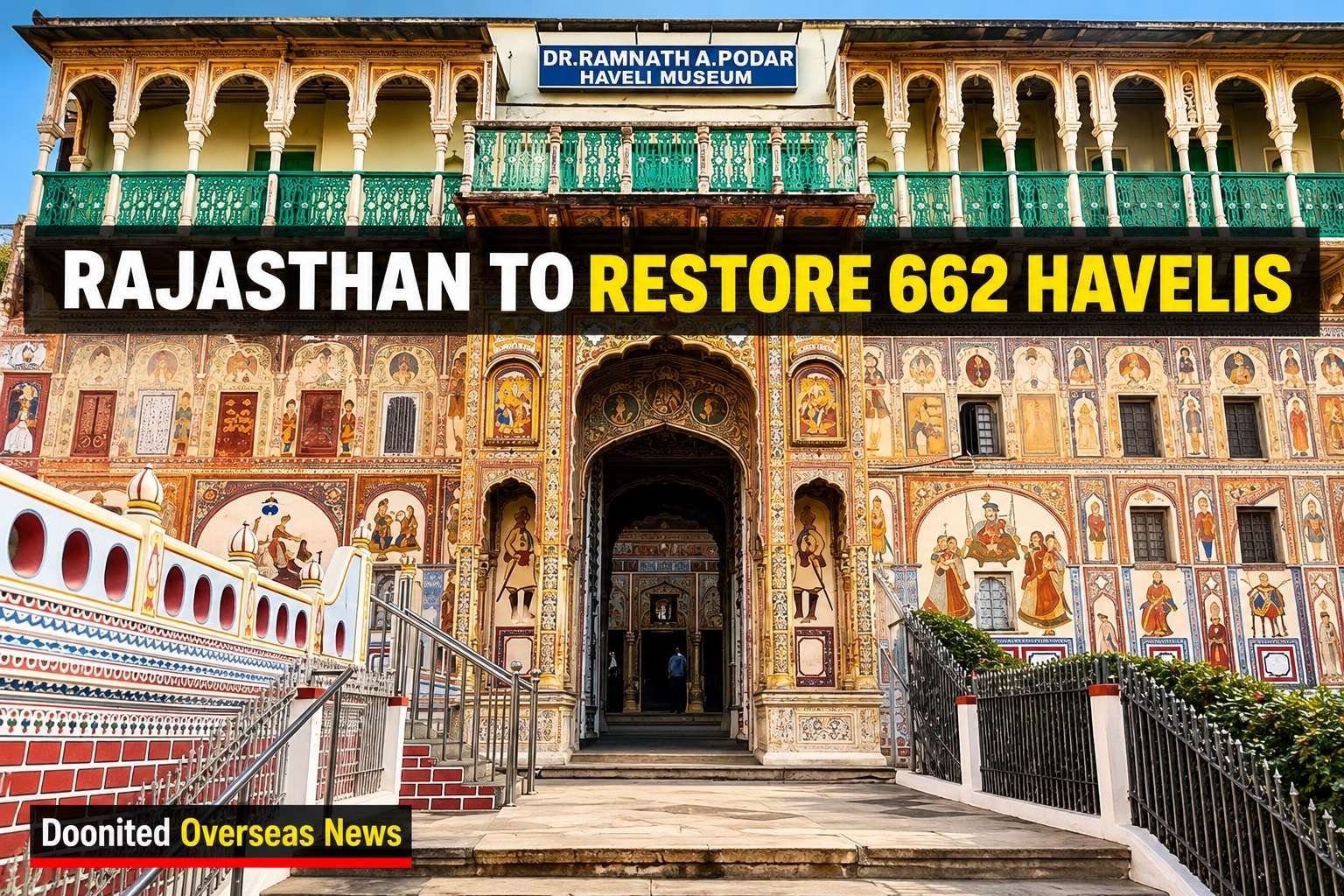
Shekhawati Havelis: How Rajasthan’s Global Diaspora Could Help Save Its Painted Heritage
Rajasthan is planning to conserve 662 historic havelis and develop a heritage tourism circuit across Shekhawati. With the region’s painted towns now on UNESCO’s Tentative List, a dedicated December meeting offers overseas Rajasthanis an opportunity to reconnect with ancestral properties, support traditional crafts and help build a sustainable heritage economy.
The grand merchant mansions of Rajasthan’s Shekhawati region were built to display prosperity. Their painted walls recorded religious stories, everyday life, changing fashions and the ambitions of families whose commercial networks extended far beyond their hometowns.
Today, many of these historic buildings face a different challenge: preserving their architectural character while finding the money, skills and practical purpose needed to keep them standing.
Rajasthan is seeking to bring the global Rajasthani diaspora into that effort. On October 24, 2026, Chief Minister Bhajanlal Sharma announced that the state was working to conserve 662 historic havelis across Sikar, Jhunjhunu and Churu districts, alongside plans for a heritage tourism circuit. He also announced a dedicated Shekhawati Heritage Meet on December 8 to encourage people from the region living elsewhere in India and abroad to contribute to conservation, tourism and investment.
The initiative arrives after an important international development: UNESCO added The Painted Haveli Towns of Shekhawati to India’s Tentative List on June 1, 2026. The recognition raises the region’s international profile, although it does not mean the havelis have already received UNESCO World Heritage status.
For overseas Rajasthanis, the opportunity is to turn cultural attachment into a practical contribution to the preservation of a distinctive architectural landscape.
An architectural legacy built by merchants
Shekhawati, in northeastern Rajasthan, encompasses towns including Mandawa, Nawalgarh, Fatehpur, Churu and Jhunjhunu. The region is renowned for its merchant-built havelis, elaborate facades and frescoes that transform residential buildings into repositories of art and social history.
The mansions reflect the commercial success of merchant communities whose businesses expanded across India and, in some cases, internationally. The Rajasthan Foundation describes Shekhawati as an open-air art gallery and connects the region’s mercantile history with the origins of prominent Indian business families.
These buildings are valuable for more than their decorative appearance. Their paintings and architectural details document the period in which they were created, combining traditional religious imagery with representations of social customs and contemporary life.
Yet a building’s historical importance does not automatically secure its future. Large properties can be expensive to maintain, particularly when ownership is dispersed among heirs or when family members live far away. Without regular maintenance, water ingress, deteriorating plaster and structural damage can threaten both the building and its artwork.
The conservation challenge is therefore twofold: repairing physical damage and finding a viable long-term use that supports continued care.
What UNESCO’s Tentative List recognition means
UNESCO’s listing gives Shekhawati a more prominent place in international heritage discussions. The submission, titled The Painted Haveli Towns of Shekhawati, covers heritage properties across 14 towns in Sikar, Jhunjhunu and Churu districts.
However, the distinction between a Tentative List entry and inscription on the World Heritage List is essential. Tentative listing is a preliminary stage in the process of seeking World Heritage recognition. It is not a guarantee of eventual inscription, nor does it mean that every historic building in the region is automatically protected or eligible for restoration grants.
For the Rajasthan government, the listing provides an opportunity to strengthen documentation, conservation planning and heritage tourism. For the diaspora, it offers a reason to look again at ancestral properties and consider whether family resources, professional expertise or business networks could contribute to their preservation.
International visibility may also help attract visitors interested in architecture, painting, history and the evolution of Indian commerce. But increased tourism will only benefit the region over time if conservation standards, local participation and maintenance funding keep pace with visitor interest.
How overseas Rajasthanis could contribute
The state’s December 8 Heritage Meet is intended to connect people from Shekhawati living elsewhere in India and abroad with conservation and investment opportunities. It forms part of the wider Pravasi Rajasthani Divas programme scheduled in Jaipur for December 10, 2026.
Diaspora involvement need not be limited to wealthy investors. Families with ancestral properties could begin by documenting their buildings, checking ownership records, commissioning structural assessments and obtaining specialist advice on the condition of frescoes and traditional plasterwork.
Where a property is suitable, owners might explore adaptive reuse as a heritage guesthouse, cultural venue, small museum or other locally appropriate enterprise. Such proposals require careful feasibility assessments: a historic mansion is not automatically suitable for hotel conversion, and commercial use must not compromise its architectural features.
Other diaspora members could support conservation through philanthropy, professional networks, tourism partnerships or training initiatives. Architects, engineers, heritage researchers, hospitality professionals and entrepreneurs may be able to contribute expertise even if they do not own a haveli.
Before committing money, prospective contributors should establish who legally owns a property, whether all necessary co-owners have agreed to the proposed work, what permissions are required and who will be responsible for ongoing maintenance. Any government incentive or funding opportunity should be checked against its published eligibility conditions rather than assumed to apply to all buildings.
Why traditional skills matter
The Rajasthan government has said the conservation initiative will seek to preserve original architecture and traditional paintings while providing training for local artists and craftspeople. The aim is to link heritage preservation with employment and tourism-related economic activity.
That emphasis is important. Frescoes and traditional plasterwork cannot always be repaired successfully using generic modern construction methods. Inappropriate materials or techniques may damage historic surfaces and accelerate deterioration.
A credible conservation programme therefore needs qualified heritage professionals, experienced craftspeople, proper documentation and a commitment to retaining original materials wherever feasible. Training younger workers can help sustain specialist skills while creating local livelihoods.
The region’s residents should also be central to decisions about tourism development. Heritage projects are more likely to remain viable when nearby communities can access jobs, business opportunities and training, rather than bearing the costs of tourism without sharing its benefits.
Turning ancestral pride into lasting preservation
The Shekhawati initiative presents the diaspora with a meaningful choice: regard ancestral havelis as reminders of family history, or help develop practical ways to preserve them for future generations.
The government’s plan to conserve 662 buildings is an important announcement, but its long-term success will depend on implementation. The number of properties assessed, the availability of funding, the quality of restoration and the arrangements for maintenance will matter more than the headline figure alone.
The December Heritage Meet could help move the discussion from broad appeals for investment towards specific projects with clear ownership, conservation plans, budgets and accountability.
For overseas Rajasthanis, the most effective contribution may not always be a large financial commitment. It could begin with identifying an endangered family property, supporting a local craftsperson, financing a professional assessment or helping a credible conservation project reach international partners.
Shekhawati’s painted mansions were created by families whose commercial horizons extended beyond their home towns. Preserving them now will require a similarly wide network—one that combines the resources of the diaspora with the knowledge of conservation experts and the skills of the communities who live among these buildings.
The real measure of success will be whether these havelis remain living parts of the region’s cultural and economic life, rather than becoming beautiful structures remembered only in photographs.

World Beyond the News
Dolphins Use Individual Signature Whistles
Bottlenose dolphins develop distinctive whistles that function somewhat like individual acoustic identifiers.
The Pacific Is Earth’s Largest Ocean
The Pacific Ocean covers more area than any other ocean basin and stretches between Asia, Australia and the Americas.
Artificial Intelligence Learns Statistical Patterns
Modern machine-learning systems identify patterns in large datasets and use those patterns to generate predictions or outputs.
Why Some Stories Spread So Quickly
Emotion, novelty, visual appeal and easy sharing can make a story travel rapidly across social platforms.